Ayurvedic Diet vs Modern Nutrition Science: 7 Evidence-Backed Truths
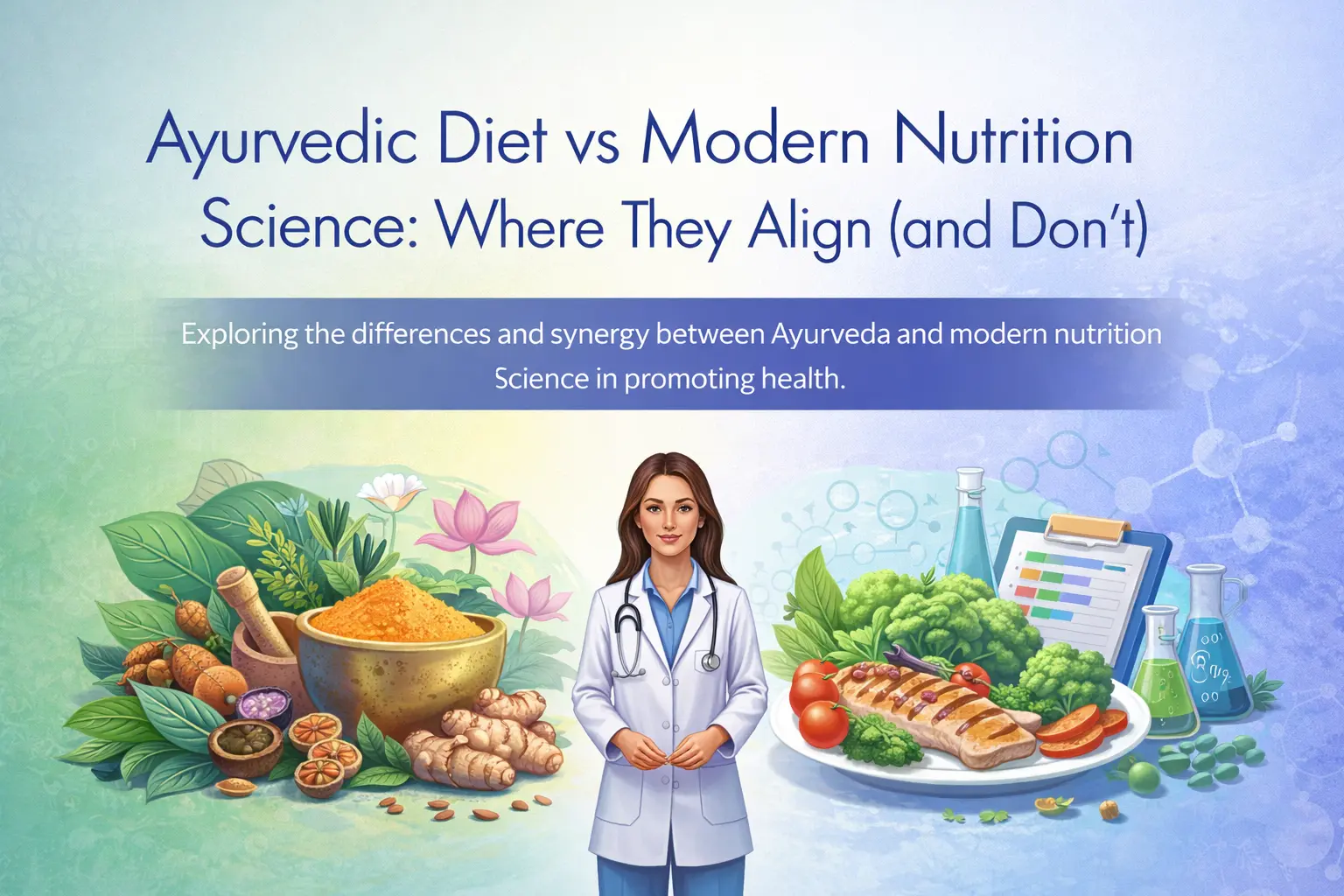
Ayurvedic Diet vs Modern Nutrition Science: Where They Align (and Don’t)
The Ayurvedic Diet vs Modern Nutrition Science debate is not about superiority but perspective. Ayurveda prioritizes digestion, metabolism, and individuality, while modern nutrition focuses on nutrients, calories, and population data. When integrated correctly, both systems complement each other and offer a more complete, sustainable approach to health.
One Question, Two Systems
Across cultures and centuries, humans have asked the same fundamental question: What should we eat to stay healthy?
Ayurveda answered this question through observation—watching digestion, energy, appetite, seasons, and long-term outcomes across generations. Modern nutrition science answered it through reduction and measurement—isolating nutrients, counting calories, and correlating intake with biomarkers and disease risk.
The debate around Ayurvedic Diet vs Modern Nutrition Science often becomes emotionally charged, as if one system must invalidate the other. In reality, both are attempting to describe the same biological truth from different vantage points.
Understanding where these systems align, where they diverge, and how to integrate them intelligently is the real opportunity—especially in a 2025 world dealing with metabolic disease, digestive disorders, and dietary confusion.
What Is the Ayurvedic Diet?
The Ayurvedic diet is a personalized nutritional framework derived from Ayurveda, India’s traditional medical system.
Rather than focusing on food in isolation, Ayurveda evaluates:
- Doshas (Vata, Pitta, Kapha): constitutional tendencies
- Agni: digestive and metabolic capacity
- Ama: metabolic waste from incomplete digestion
- Ojas: vitality, immunity, and long-term resilience
In this system, food is not judged as universally “good” or “bad.” The same meal may nourish one person and burden another, depending on digestion, season, age, and lifestyle.
What Is Modern Nutrition Science?
Modern nutrition science studies food primarily through:
- Macronutrients (proteins, fats, carbohydrates)
- Micronutrients (vitamins, minerals)
- Calories and energy balance
- Biomarkers such as blood glucose, cholesterol, and inflammation
Its strength lies in quantification, reproducibility, and scalability. It is particularly effective for identifying population-level risk factors, deficiencies, and disease correlations.
However, it has historically struggled with individual variability—though this gap is now narrowing through precision and personalized nutrition research.
Ayurvedic Diet vs Modern Nutrition Science: Core Philosophical Differences
These philosophical differences explain why dietary advice can feel contradictory, even when both systems are well-intentioned.
| Dimension | Ayurveda | Modern Nutrition |
|---|---|---|
| Primary lens | Digestion & metabolism | Nutrient composition |
| Individualization | Foundational | Emerging |
| Measurement | Appetite, energy, stool, comfort | Calories, labs, biomarkers |
| Time horizon | Seasonal & lifelong | Study-based |
| Goal | Balance & resilience | Risk reduction |
Primary lens
Ayurveda: Digestion & metabolism
Modern Nutrition: Nutrient composition
Individualization
Ayurveda: Foundational
Modern Nutrition: Emerging
Measurement
Ayurveda: Appetite, energy, stool, comfort
Modern Nutrition: Calories, labs, biomarkers
Time horizon
Ayurveda: Seasonal & lifelong
Modern Nutrition: Study-based
Goal
Ayurveda: Balance & resilience
Modern Nutrition: Risk reduction
Where the Ayurvedic Diet and Modern Nutrition Science Align
Despite their different languages and frameworks, the Ayurvedic Diet and modern nutrition science converge on several critical principles—many of which are now being validated by emerging research.
1. Digestion Determines Nutritional Value
Ayurveda has always emphasized that food only nourishes the body if it is properly digested. Modern science now echoes this through research on gut health, enzyme activity, microbiome diversity, and nutrient bioavailability.
Two people can eat identical meals and experience vastly different outcomes depending on digestion, stress levels, sleep quality, and gut function—an idea Ayurveda recognized thousands of years ago.
2. Individual Variability Matters
Ayurveda’s constitutional approach acknowledges that age, environment, stress, and physiology shape dietary needs. Modern nutrition is increasingly moving in the same direction through personalized nutrition, genetic testing, and metabolic typing.
The shift away from universal dietary rules toward individualized recommendations represents one of the strongest points of alignment between the two systems.
3. Metabolic Health Is Central
Ayurveda frames metabolism through the concept of Agni, while modern science evaluates insulin sensitivity, mitochondrial function, and metabolic flexibility.
Both agree that poor metabolic health—not calories alone—is at the root of modern disorders such as obesity, type 2 diabetes, chronic fatigue, and inflammation.
4. Meal Timing Influences Health
Ayurveda emphasizes eating in alignment with natural daily rhythms, favoring larger meals earlier in the day when digestion is strongest.
This aligns closely with modern circadian biology research, which shows that late-night eating disrupts glucose control, hormonal balance, and metabolic efficiency.
Where the Two Systems Diverge
The differences between Ayurveda and modern nutrition science are not contradictions—they reflect different priorities and methods of understanding the body.
Nutrient Focus vs Digestive Context
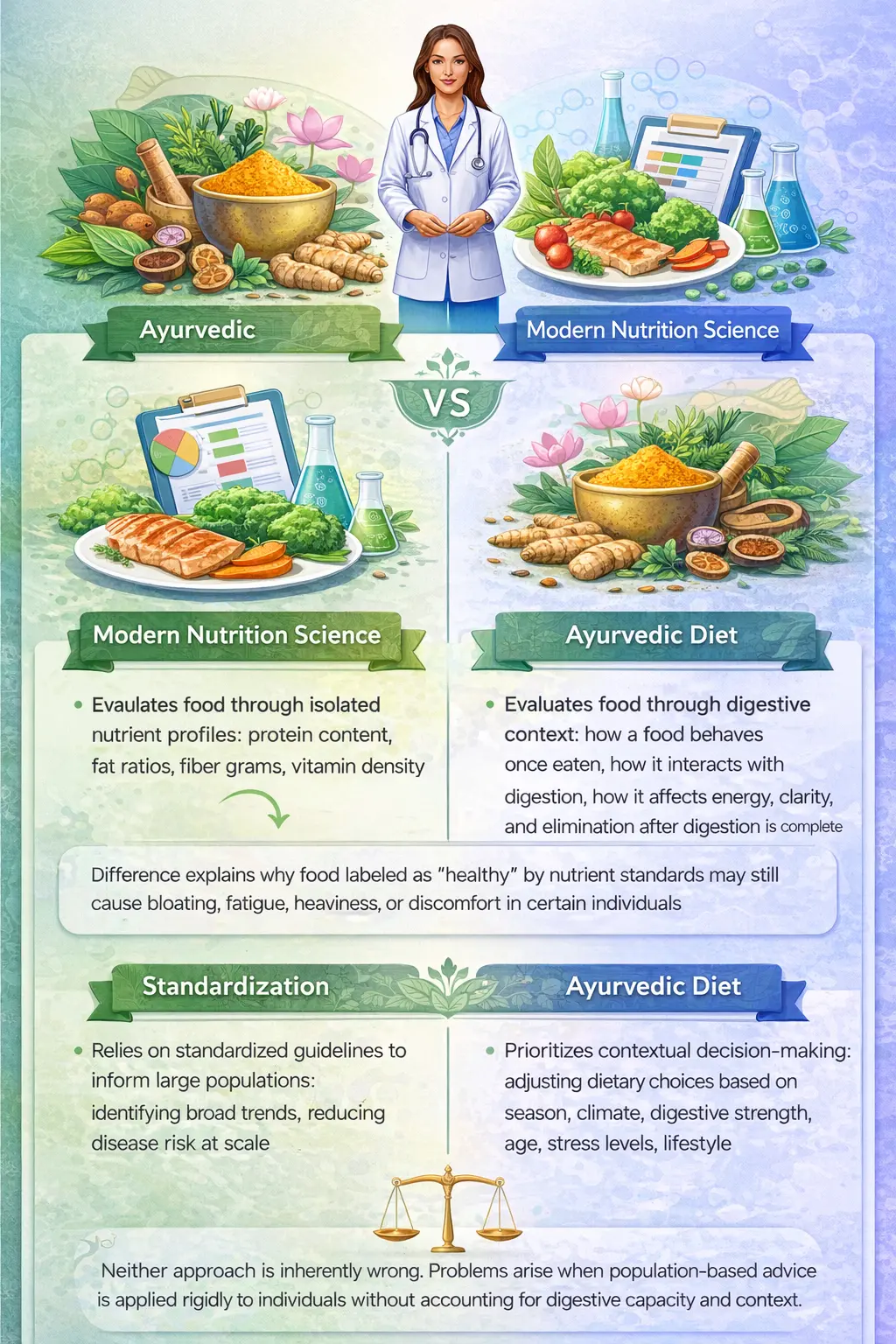
Modern nutrition often evaluates foods based on isolated nutrient profiles, while Ayurveda evaluates foods based on their digestive impact, energetic qualities, and post-digestive effect.
This explains why a food labeled as “healthy” by nutrient standards may still cause bloating, fatigue, or discomfort in certain individuals.
Standardization vs Contextualization
Modern nutrition relies on standardized recommendations to guide populations, whereas Ayurveda prioritizes contextual decision-making based on season, climate, digestion, and lifestyle.
Neither approach is inherently wrong—but applying population-based advice to individuals without adjustment can create confusion and poor outcomes.
Does the Ayurvedic Diet Ignore Calories, Protein, or Macronutrients?
A common misconception is that the Ayurvedic Diet dismisses calories, protein, or macronutrients. In reality, Ayurveda does not reject nutritional science—it reframes it through the lens of digestion and metabolic capacity.
From an Ayurvedic perspective, nutrients only nourish the body when they are properly digested. Protein, fats, and carbohydrates consumed in excess or in incompatible combinations can overwhelm digestion and contribute to metabolic stress rather than strength.
Modern nutrition identifies what nutrients food contains. Ayurveda focuses on whether the body can actually process those nutrients efficiently. These perspectives are not opposing—they address different stages of nourishment.
Why Eating “Healthy” Food Still Causes Bloating or Fatigue
Many people experience bloating, heaviness, gas, or fatigue despite eating diets considered healthy by modern standards. Ayurveda explains this through the concept of weakened Agni—digestive and metabolic capacity.
Factors such as excessive raw food intake, late-night meals, stress while eating, overeating, or incompatible food combinations can impair digestion. When digestion is incomplete, metabolic waste (Ama) accumulates.
This results in symptoms like abdominal discomfort, brain fog, sluggishness, and low energy—even when food quality is high. Ayurveda prioritizes restoring digestive strength before increasing dietary complexity.
Are Raw Foods Discouraged in the Ayurvedic Diet?
The Ayurvedic Diet does not universally discourage raw foods. Instead, it evaluates whether raw foods are appropriate for an individual’s digestion, climate, season, and stress level.
Raw foods are generally better tolerated by people with strong digestion and in warm climates or seasons. For individuals with weakened digestion, high stress, or exposure to colder environments, lightly cooked foods are often easier to digest and assimilate.
This conditional approach explains why raw food diets may feel energizing for some people and deeply depleting for others.
Is the Ayurvedic Diet Only Applicable in India or to Indian Food?
The Ayurvedic Diet is not limited to India or Indian cuisine. Ayurveda is a principle-based system that adapts to geography, climate, culture, and locally available foods.
Its primary concern is not where a food originates, but how it affects digestion, metabolism, and balance within the body. Seasonal produce, regional grains, and traditional local foods can all be used effectively when Ayurvedic principles are applied.
This adaptability is why Ayurveda has remained relevant across centuries and continents—it evolves with environment rather than prescribing a fixed dietary template.
How the Ayurvedic Diet Addresses Modern Metabolic Disorders
Modern metabolic disorders such as insulin resistance, chronic inflammation, fatigue, and weight imbalance are often addressed through calorie restriction or macronutrient manipulation alone.
The Ayurvedic Diet takes a root-cause approach by strengthening digestion (Agni), reducing metabolic waste (Ama), aligning meals with circadian rhythms, and minimizing metabolic stress.
By restoring digestive efficiency and lifestyle balance, Ayurveda supports improved insulin sensitivity, reduced inflammation, stable energy levels, and long-term metabolic resilience rather than short-term dietary compliance.
This systems-based approach complements modern nutrition science by addressing factors that extend beyond food composition, including timing, routine, stress, and environmental context.
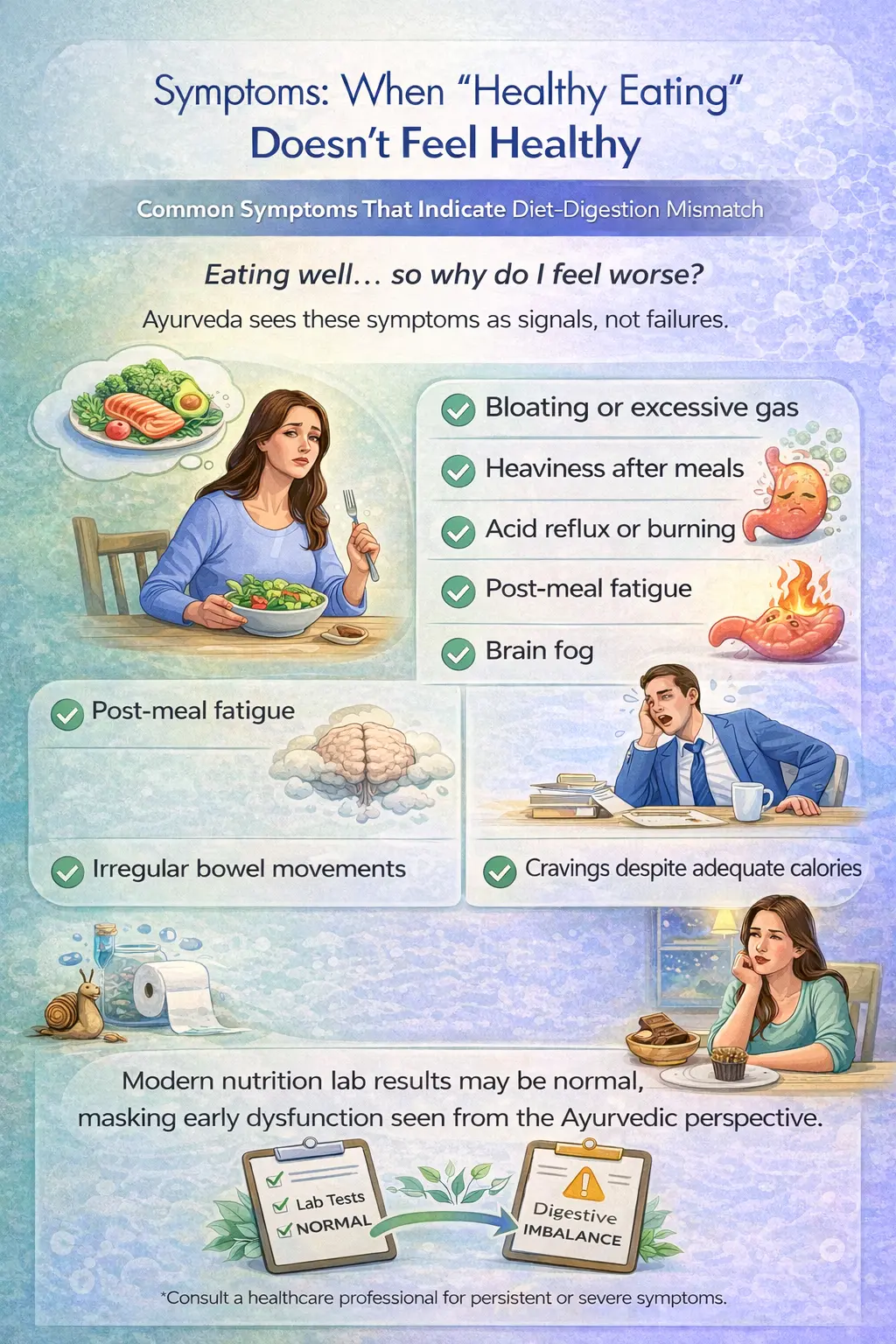
Symptoms: When “Healthy Eating” Doesn’t Feel Healthy
One of the most confusing experiences today is this:
“I’m eating well… so why do I feel worse?”
From the Ayurvedic perspective, symptoms are signals, not failures.
Common Symptoms That Indicate Diet–Digestion Mismatch
- Bloating or excessive gas
- Heaviness after meals
- Acid reflux or burning
- Post-meal fatigue
- Brain fog
- Irregular bowel movements
- Cravings despite adequate calories
Modern nutrition may see normal lab results here. The Ayurvedic diet sees early dysfunction — long before disease develops.
Causes: The Ayurvedic Explanation
According to Ayurveda, these symptoms arise not from lack of nutrition, but from functional imbalance.
Primary Causes Identified in the Ayurvedic Diet
- Weak or irregular Agni
- Eating cold or raw foods excessively
- Poor food combinations
- Eating late at night
- High stress while eating
- Ignoring hunger and satiety cues
When digestion is strained, even the most nutritious food creates Ama instead of nourishment.
This explains why “superfoods” and supplements often fail when digestion is compromised.
Where the Ayurvedic Diet and Modern Nutrition Align Strongly
1. Whole Foods Over Processed Foods
Both systems strongly discourage:
- Ultra-processed foods
- Refined sugars
- Artificial additives
Home-cooked meals made from grains, lentils, vegetables, healthy fats, herbs, and spices form the backbone of both approaches.
This alignment is one of the strongest bridges between the Ayurvedic diet and modern science.
2. Digestion Determines Outcomes
Modern research now emphasizes:
- Gut microbiome diversity
- Enzyme efficiency
- Insulin sensitivity
Ayurveda has always taught that digestion determines whether food becomes nourishment or burden. Nutrients only matter if they are absorbed.
Different language. Same biology.
3. Meal Timing Matters
The Ayurvedic diet recommends the largest meal at midday, when digestive fire is strongest.
Modern chronobiology confirms:
- Better glucose tolerance earlier in the day
- Improved insulin sensitivity
- Reduced metabolic stress with early dinners
This is ancient observation validated by modern data.
4. Food Shapes the Mind
Ayurveda classifies food effects as:
- Sattvic: clarity and calm
- Rajasic: stimulation and restlessness
- Tamasic: heaviness and dullness
Modern nutrition links diet to mood disorders, cognition, and neuroinflammation. Both systems recognize that food affects mental health deeply.
5. Lifestyle Is Part of Nutrition
Ayurveda never separated food from lifestyle. Sleep, routine, emotional state, and movement are all part of digestion.
Modern science is now catching up — recognizing that stress, sleep debt, and circadian disruption alter metabolism regardless of diet quality.
Where the Ayurvedic Diet and Modern Nutrition Clearly Diverge
Despite many points of alignment, the Ayurvedic Diet and modern nutrition science part ways in important areas. These differences explain why people often feel conflicted when following dietary advice.
Understanding these divergences prevents blind adoption of either system.
Calories vs Digestive Capacity
Modern nutrition asks a precise, numerical question:
How many calories are you consuming and burning?
The Ayurvedic diet asks a qualitative, functional question:
Can your body digest and assimilate this meal today?
From an Ayurvedic perspective, calories do not nourish the body — digestion does. Two people eating identical calories can experience opposite outcomes depending on:
- Digestive strength (Agni)
- Stress levels
- Sleep quality
- Meal timing
- Emotional state while eating
This is why calorie-perfect diets often fail in real life. The body is not a calculator — it is a biological system responding to context.
Uniform Guidelines vs Individual Reality
Modern nutrition historically relied on population averages. These guidelines are useful for public health, but limited for individuals.
The Ayurvedic diet rejects uniformity entirely. It assumes from the start that:
- People digest differently
- Seasons matter
- Age changes food tolerance
- Lifestyle alters metabolism
Interestingly, modern science is now circling back to this truth through:
- Continuous glucose monitoring (CGMs)
- Nutrigenomics
- Microbiome research
What Ayurveda stated philosophically, modern science is beginning to validate technologically.
The Raw Food Debate
Many modern diets promote raw foods as inherently superior. Smoothies, salads, and cold breakfasts are often equated with “clean eating.”
The Ayurvedic diet takes a more nuanced stance.
Raw foods are not rejected — but they are conditional. Their suitability depends on:
- Digestive strength
- Season
- Climate
- Individual constitution
For many adults dealing with stress, irregular routines, and weakened digestion, excessive raw food increases bloating, gas, and fatigue. Light cooking often improves nutrient absorption and metabolic ease.
How the Ayurvedic Diet Evaluates Food (A Simple Framework)
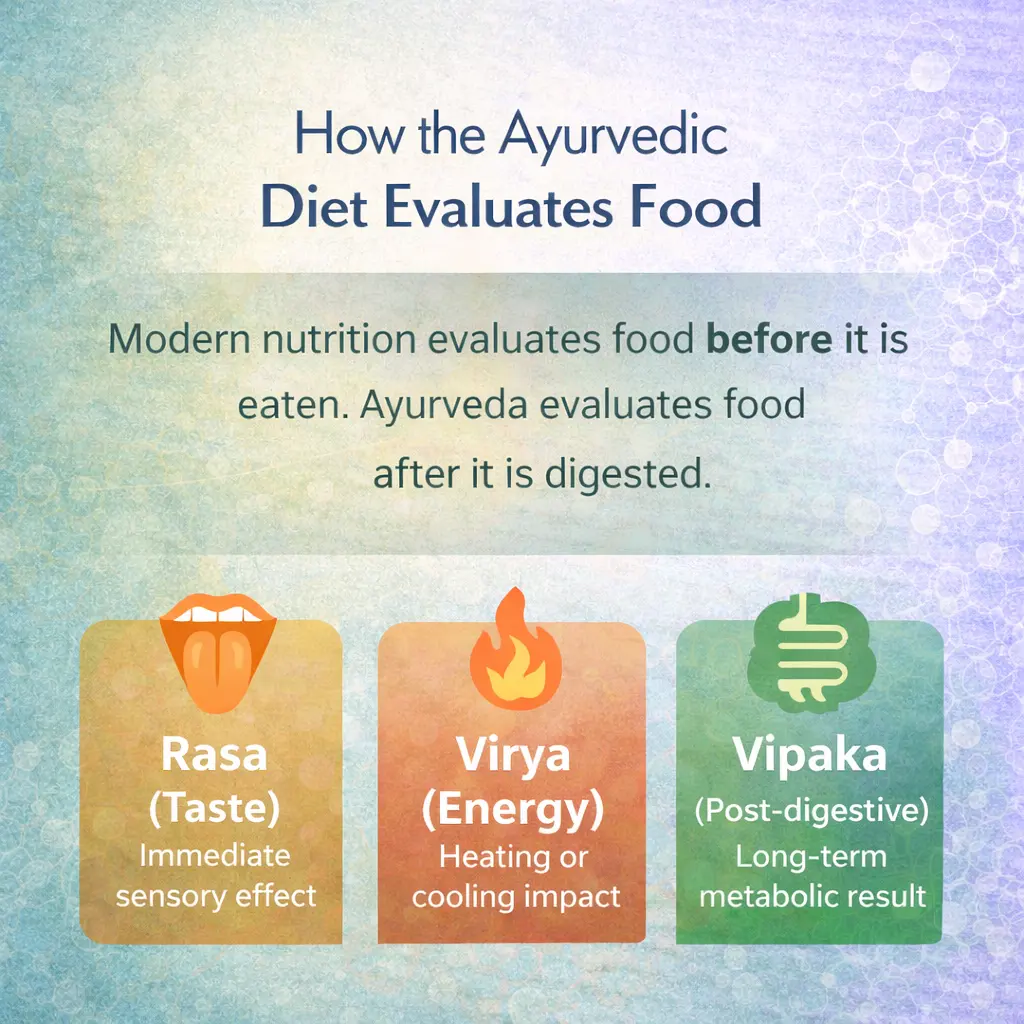
One of the most important differences between the Ayurvedic diet and modern nutrition is when food is evaluated.
Modern nutrition evaluates food before it is eaten.
Ayurveda evaluates food after it is digested.
The Three Ayurvedic Filters
- Rasa (Taste): Immediate sensory effect
- Virya (Energy): Heating or cooling impact
- Vipaka (Post-digestive effect): Long-term metabolic result
This explains why foods with similar nutrients can produce very different effects in different people.
Modern gut-health research is now rediscovering this principle through postprandial glucose response, inflammation markers, and microbiome shifts.
Step-by-Step Integrated Diet Protocol
Rather than choosing Ayurveda or modern nutrition, the most effective approach is integration.
Step 1: Assess Digestive Strength (Before Counting Anything)
Key indicators used in the Ayurvedic diet:
- Regular appetite
- Comfortable digestion
- Clear energy after meals
- Well-formed stools
- Minimal bloating or heaviness
If these are missing, digestion must be supported before optimizing macros.
Step 2: Align Meals With Circadian Rhythm
Both systems now agree on this structure:
- Morning: Warm, light foods
- Midday: Largest, most complex meal
- Evening: Simple, early dinner
This supports insulin sensitivity, digestive efficiency, and metabolic recovery.
Step 3: Use Modern Metrics as Feedback, Not Commands
Blood glucose, lipid panels, and inflammation markers are valuable tools — but they should inform, not override, bodily signals.
When numbers and digestion disagree, the Ayurvedic diet teaches us to correct digestion first.
Herbs That Bridge the Ayurvedic Diet and Modern Science
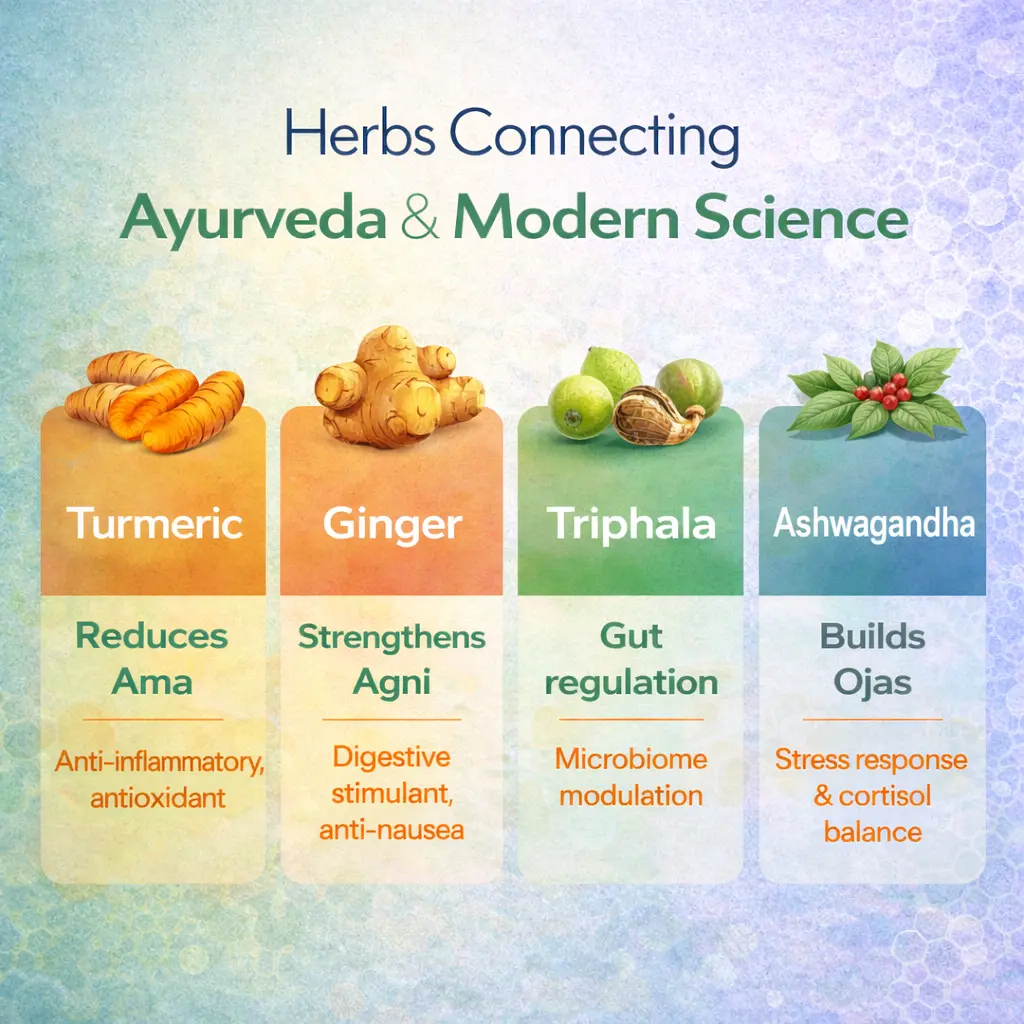
Certain herbs illustrate how the Ayurvedic diet and modern science often converge in function, even when the explanatory language differs.
| Herb | Role in Ayurvedic Diet | Modern Scientific Insight |
|---|---|---|
| Turmeric | Reduces Ama | Anti-inflammatory, antioxidant |
| Ginger | Strengthens Agni | Digestive stimulant, anti-nausea |
| Triphala | Gut regulation | Microbiome modulation |
| Ashwagandha | Builds Ojas | Stress response & cortisol balance |
| Cumin & Fennel | Improves digestion | Carminative, enzyme support |
Turmeric
Ayurvedic role: Reduces Ama
Modern insight: Anti-inflammatory, antioxidant
Ginger
Ayurvedic role: Strengthens Agni
Modern insight: Digestive stimulant, anti-nausea
Triphala
Ayurvedic role: Gut regulation
Modern insight: Microbiome modulation
Ashwagandha
Ayurvedic role: Builds Ojas
Modern insight: Stress response & cortisol balance
Cumin & Fennel
Ayurvedic role: Improves digestion
Modern insight: Carminative, enzyme support
These herbs work not by force, but by supporting function — a principle increasingly appreciated in integrative medicine.
Dietary Guidelines According to the Ayurvedic Diet
Foods to Emphasize
- Warm, freshly cooked meals
- Seasonal vegetables
- Properly prepared grains and legumes
- Healthy fats in moderation
- Digestive spices
Foods to Limit
- Excess cold foods
- Ultra-processed snacks
- Late-night meals
- Reheated or stale food
- Overly complex meals
The Ayurvedic diet is not restrictive — it is selective.
Related Ayurvedic Nutrition Resources
Continue exploring Ayurvedic nutrition through these closely related guides and learning pathways.
-
Ayurvedic Nutrition: A Holistic Guide to Eating for Wellness
Foundational overview of Ayurvedic nutrition principles -
Online Ayurvedic Nutrition Course Certification
Structured training for deeper clinical and practical understanding -
Ayurvedic Diet for Digestion: Top Agni-Boosting Foods for Better Gut Health
Keyword focus: Ayurvedic Diet for Digestion
Lifestyle Factors Modern Nutrition Often Overlooks
Ayurveda treats lifestyle as part of nutrition, not a separate category.
Important factors include:
- Eating without screens
- Emotional state during meals
- Short post-meal walks
- Consistent sleep timing
- Regular daily routines
Modern research now confirms these factors influence insulin response, digestion, and inflammation — validating what Ayurveda assumed from the beginning.
Expanded Case Study: Integrating Both Systems in Real Life
Profile
Name: Rohit, 38, Bengaluru
Profession: IT project manager
Lifestyle: Regular gym workouts, calorie tracking, high-protein diet
Primary Complaint
Persistent bloating, fatigue, and poor recovery despite “perfect” macros.
Modern Nutrition Assessment
- Calories: appropriate
- Protein intake: high
- Blood markers: within range
Ayurvedic Diet Assessment
- Weak morning appetite
- Heavy dinners
- High stress
- Protein overload relative to digestion
- Poor meal timing
Intervention
- Warm, simple breakfast
- Reduced protein density per meal
- Ginger tea before lunch
- Largest meal at midday
- Dinner before 7 pm
Outcome
Within weeks:
- Bloating resolved
- Energy stabilized
- Better sleep
- Improved workout recovery
Calories remained unchanged. Digestion changed everything.
Daily Routine That Supports the Ayurvedic Diet
A simple routine that supports both Ayurveda and modern science:
- Wake early
- Warm water on rising
- Light breakfast
- Largest meal at lunch
- Short walk after meals
- Early, light dinner
- Consistent sleep time
Small shifts. Large returns.
Common Mistakes to Avoid
- Blindly following food trends
- Ignoring digestive discomfort
- Over-supplementing
- Eating late at night
- Treating diet as punishment
- Applying rigid rules without context
The Ayurvedic diet emphasizes intelligence over discipline.
Conclusion: Why the Ayurvedic Diet Matters in 2025
The Ayurvedic Diet is not anti-science.
It is pre-science observation refined by time.
Modern nutrition explains what food contains.
The Ayurvedic diet explains how the body responds.
When these perspectives are integrated, eating becomes:
- Personalized
- Sustainable
- Humane
- Effective long-term
In a world overwhelmed by contradictory advice, the future of nutrition lies not in extremes — but in synthesis.
FAQ: Ayurvedic Diet
Is the Ayurvedic Diet scientifically relevant today?
The Ayurvedic Diet is scientifically relevant today because it prioritizes digestion, metabolic efficiency, and individual variability, aligning closely with modern research on gut microbiome health, circadian rhythm, insulin sensitivity, and inflammation.
Concepts such as Agni (digestive capacity) and Ama (metabolic waste) parallel modern understandings of poor digestion, inflammation, and metabolic dysfunction.
Can the Ayurvedic Diet and modern nutrition science be followed together?
Yes. Modern nutrition explains what nutrients food contains, while the Ayurvedic Diet explains how the body digests, absorbs, and responds to those nutrients.
Integrating both allows personalized eating based on digestion, biomarkers, lifestyle, and metabolic response.
Does the Ayurvedic Diet ignore calories or macronutrients?
No. Ayurveda does not reject calories, protein, or macronutrients—it emphasizes that nutrients benefit the body only when digestion is strong.
Why does healthy food still cause bloating or fatigue?
Ayurveda explains this as weak digestion (Agni). Raw foods, late meals, stress while eating, and incompatible food combinations can lead to Ama accumulation.
Listen to Your Body — Not Just Numbers
If you’ve followed diets, tracked calories, and still felt unheard by your own body — that’s not failure. That’s missing context.
The Ayurvedic diet doesn’t reject science. It teaches you how to listen — to digestion, rhythm, and response — while using modern tools wisely.
If you want to go deeper:
- 🌿 Online Ayurveda Courses — learn to read your body, not just rules
- 🧭 Holistic Health Consultations — thoughtful, human guidance beyond templates
Health improves when understanding replaces force.


You may also like