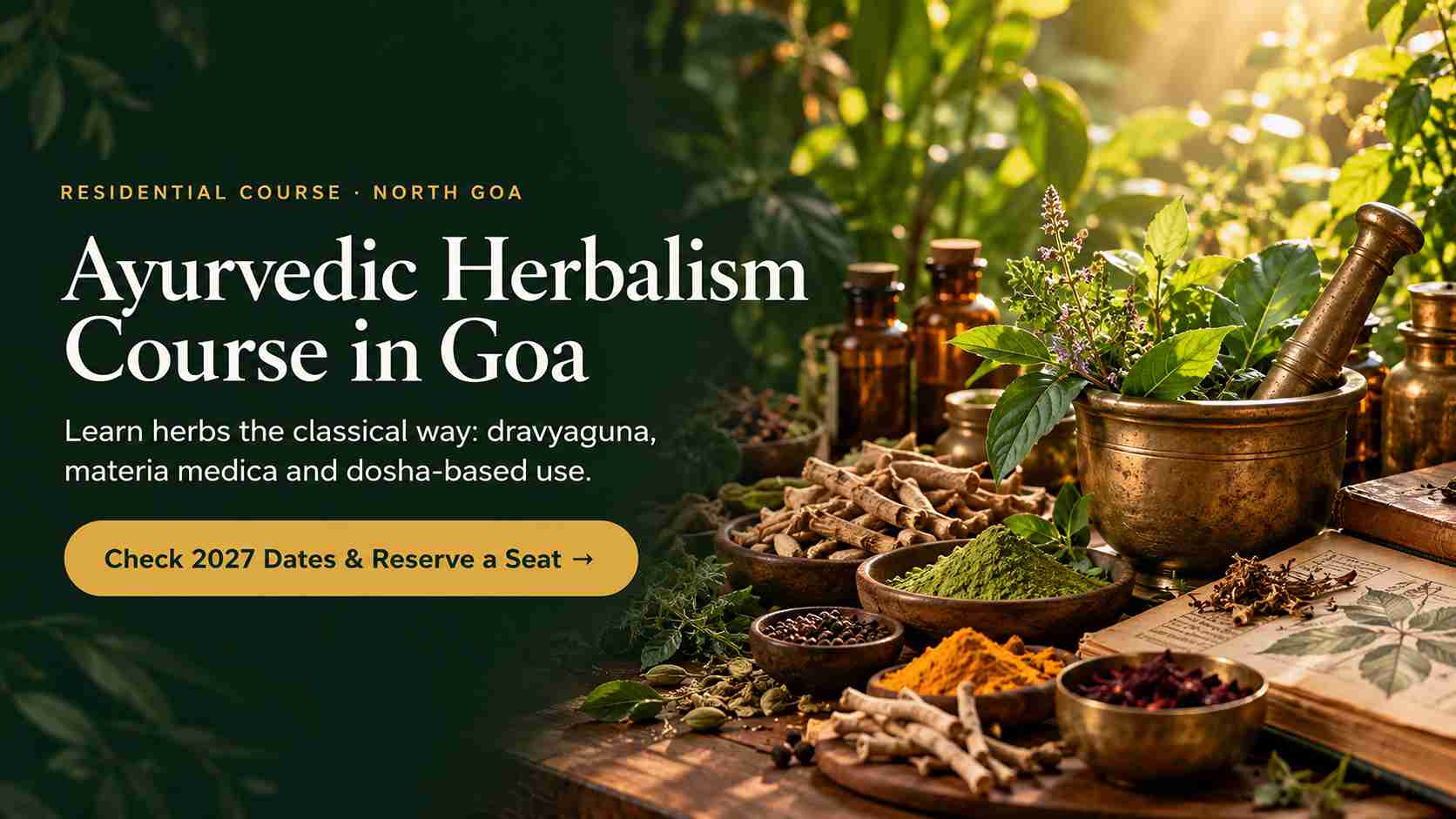
Ayurvedic Herbalism Course in Goa, India Learn herbs the classical way: dravyaguna, materia medica and dosha-based use
A certificate course in Ayurvedic herbalism. Study more than 72 prominent Ayurvedic herbs through rasa, guna, virya, vipaka and prabhava, learn to match herbs to a person’s dosha, and finish with a written exam, assignments and a viva.
- 70+ herbs studied
- Written exam + viva
- BSS-accredited certificate
- Mon–Fri classes
What is Ayurveda herbalism?
Ayurvedic herbalism is the study and use of medicinal plants through Ayurveda’s classical framework, called dravyaguna. Each herb is understood by its taste (rasa), qualities (guna), heating or cooling potency (virya), post-digestive effect (vipaka) and special action (prabhava). It is then matched to the person’s constitution (dosha) and digestion (agni), not to a single symptom.
Why “Ayurvedic herbs” lists are not an Ayurvedic herbalism course
Searching “Ayurvedic herbs” gives you benefit lists. An Ayurvedic herbalist learns why a herb suits one person and not another.
A herb list tells you
- “Ashwagandha is good for stress”
- One herb for everyone with the same label
- Supplement-style claims, little context
- No way to judge dose, timing or fit
This course teaches you
- How to read a herb by rasa, guna, virya, vipaka and prabhava
- How to match herbs to dosha, prakriti and agni
- How herbs are prepared, carried (anupana) and dosed
- Contraindications and safe dosage for each herb
How does Ayurveda classify a herb?
Ayurveda describes every herb with five lenses, known as the dravyaguna framework. Together they predict how a herb will act on digestion, dosha and tissues.
Rasa
Taste: sweet, sour, salty, pungent, bitter or astringent. It signals the herb’s first action.
Guna
Qualities such as heavy or light, oily or dry, hot or cold.
Virya
Potency: whether the herb heats or cools the body.
Vipaka
The post-digestive effect, which shapes long-term action.
Prabhava
A special action the other four cannot explain.
| Herb | Rasa (taste) | Virya | Dosha effect |
|---|---|---|---|
| Tulsi (holy basil) | Pungent, bitter | Heating | Reduces kapha and vata |
| Shatavari (Asparagus racemosus) | Sweet, bitter | Cooling | Reduces vata and pitta |
| Amalaki (Indian gooseberry) | All tastes but salty, sour dominant | Cooling | Balances all three, especially pitta |
| Shunthi (dried ginger) | Pungent | Heating | Reduces vata and kapha |
Classical descriptions as commonly taught; texts and teachers vary slightly. Educational information, not medical advice.
What will you learn in the Ayurvedic herbalism course?
Eleven modules take you from the philosophy of plants to a personal herbal and lifestyle plan.
- 01
The cosmic manifestation into plants
How Ayurveda sees plants as expressions of the five elements.
- 02
Herbal energetics
Rasa, guna, virya, vipaka and prabhava: reading a herb like a classical text does.
- 03
Managing your constitution with herbs
Matching herbs to dosha, prakriti and the imbalance in front of you.
- 04
Herbal therapeutics and classification
How classical texts group herbs by action and use.
- 05
Preparation and use of herbs
Traditional ways herbs are prepared and taken in Ayurveda.
- 06
Intake medium, administration and dosage
Carriers, timing, dose and the logic behind each.
- 07
Ayurveda materia medica
More than 70 prominent Indian herbs: actions, energetics, dosha effects, benefits and contraindications.
- 08
Non-herbal and mineral medicines
An orientation to the other classes of Ayurvedic substances.
- 09
Special Ayurvedic herbal formulas
Classical formula thinking: why herbs are combined.
- 10
Herbs and food in daily life
Bringing kitchen herbs and spices into a personal routine.
- 11
Personalising lifestyle with Ayurveda
Putting it together into a coherent, individual plan.
Study online with live guidance
Get the same classical framework through our comprehensive online program, combining video lessons with live sessions.
Ayurveda Herbalist Online Course
Watch the orientation above to see inside the course. It is designed for flexibility while maintaining the depth of our residential training.
- 19 Course Videos + Course ebook
- 7 Additional live sessions for doubt-clearing
- Earn professional certificate upon successful completion
- Get a 300-page e-book for additional reading
Who can join the Ayurvedic herbalism course?
A good fit if you are
- An Ayurveda student who has finished a basic course and wants the herbal side
- A yoga teacher, massage therapist or nutrition coach adding Ayurveda
- A wellness practitioner who wants a classical framework, not a supplement list
- Someone planning to continue to Ayurveda consultant training
Not the right course if you want
- A licence to diagnose or treat disease
- A hands-on pharmacy or clinical internship (this course is theoretical and conceptual)
- To begin with no Ayurveda background (start with our 7-day Basic course)
Ayurveda herbalism course: dates, fee and format
Why careful herbal education matters
Herbs are powerful, and quality varies. The course covers dosage, administration and contraindications for each herb, so you learn what to use, how much, and when to hold back.
We teach Ayurveda as education and wellness guidance. It does not replace medical care, and your certificate is not a medical licence. Rules for Ayurveda practice differ by country, so check your local regulations before you offer services.
Learn from Pradip Krishna
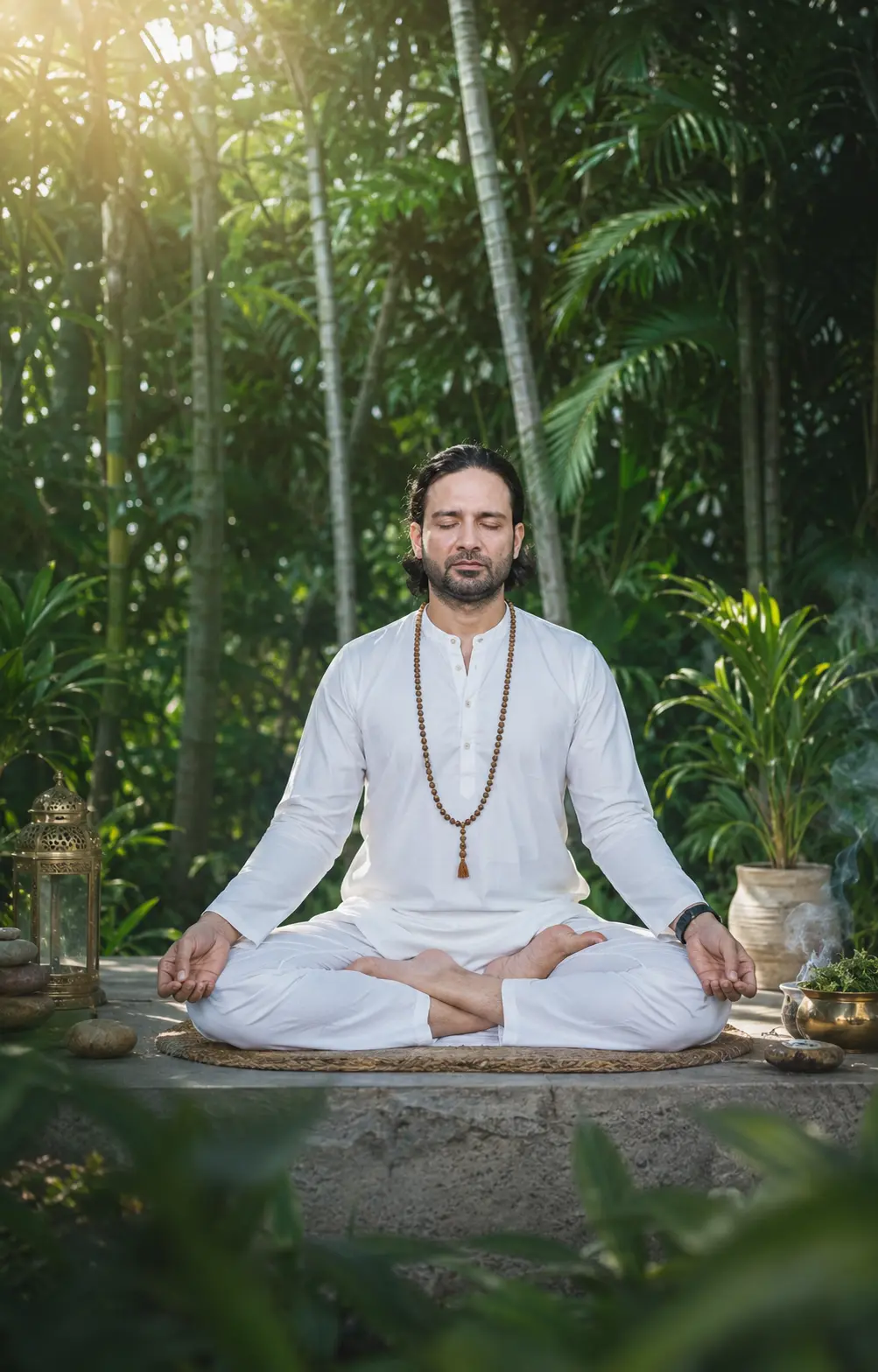
Pradip Krishna
Founder, Vishuddhi Issha Yoga & Ayurveda, Candolim, Goa. Teaches Ayurveda and Kundalini Kriya Yoga in the Sivananda–Satyananda lineage.
- Advanced Diploma in Ayurveda (Kerala)
- ERYT 500
- 15+ years teaching
- Students from Europe, USA, Canada & Australia
“I especially enjoyed learning how the different principles connect with each other.”
 Hannah Schneider, Germany
Ayurveda Course, 2025
Right on Ashwem–Mandrem Beach
Our January–March 2027 Ayurveda courses are held at Bens Inn, Ashwem — just 200 metres from Ashwem Beach and 800 metres from Mandrem Beach in North Goa.
Bens Inn · Ashwem, Mandrem
200 m from Ashwem Beach · 800 m from Mandrem BeachHouse # 205 Ashwem, Ashwem Mandrem, Beach Road, near Calisto Super Market, Pernem, Goa 403527, India.
- Single non-sharing, twin sharing, and triple sharing rooms available within serviced apartments
- Book directly with our venue partner after registration — we guide you by email
- Room availability is limited during peak January and February season, so early booking is recommended
Greenwood Meadows · Candolim
1.2 km from Candolim BeachGreenwood Meadows Candolim, Goa 403515, India.
Used for November 2026 and February–November 2027 trainings. If your intake is at Candolim, you will be notified during registration.
Accommodation is arranged directly with the venue partner after registration. We connect you with their manager to confirm your preferred room type.
A clear learning path in Ayurveda
Take herbalism on its own, or build a progressive path. Fees are as published on our schedules page.
Consultant training
15-week AACCC: consultation skills that bring it all together.
Schedules & fees →Ayurvedic herbalism course: frequently asked questions
What is Ayurvedic herbalism?
Ayurvedic herbalism is the study and use of medicinal plants through Ayurveda's classical framework, called dravyaguna. Each herb is understood by its taste (rasa), qualities (guna), heating or cooling potency (virya), post-digestive effect (vipaka) and special action (prabhava), then matched to the person's constitution (dosha) and digestion (agni) rather than to a single symptom.
What is dravyaguna?
Dravyaguna (dravya guna vijnana) is the branch of Ayurveda that studies the properties and actions of substances, mainly medicinal plants. It is Ayurveda's materia medica and pharmacology. Our herbalism course teaches its core framework: herbal energetics, therapeutic classification, preparation, dosage and the materia medica of prominent herbs.
What will I learn in the Ayurvedic herbalism course?
You will study more than 70 prominent Ayurvedic herbs along with the framework for using them: how plants are understood in Ayurveda, herbal energetics, managing dosha with herbs, herb classification and therapeutics, preparation and use, intake medium, administration and dosage, non-herbal and mineral medicines, special herbal formulas, and bringing herbs and food into daily life.
Do I need prior Ayurveda knowledge?
Yes, a working familiarity with basic Ayurveda (doshas, agni, the qualities of food and the seasons) is expected. If you are new to Ayurveda, start with our 7-day Basic Ayurveda course, then join herbalism.
How long is the course and when is the next intake?
The residential course runs 3 weeks, Monday to Friday, with weekends off. Lectures last about 2.5 hours including a 15-minute tea break. The 2027 intakes are 11 January and 8 March in North Goa. Confirm the exact dates when you enquire, as seats are limited.
How much does the Ayurvedic herbalism course cost?
Tuition for the residential course is EUR 870. Accommodation and meals are not included. An online video-series version is available for USD 96. Prices can change with promotions or seasons, so confirm on the schedules page or by email.
Will I get a certificate, and is it recognised internationally?
After the written exam, assignments and viva you receive a Certificate in Ayurveda Herbalism, which our course page states is BSS-accredited. Recognition of any Ayurveda certificate varies by country. It is an educational qualification, not a medical licence.
Can I work as an Ayurvedic herbalist after this course?
That depends on your country. In many places, including the United States, Ayurveda is not a separately licensed profession, and rules on health claims differ. The course prepares you to add herbal knowledge to a yoga, massage, nutrition or wellness practice and to guide people on wellbeing. It does not qualify you to diagnose or treat disease or to replace medical care.
Is the course hands-on, will I make herbal medicines?
The course is theoretical and conceptual. It covers how herbs are prepared, administered and dosed in Ayurveda, but it is a classroom course with exam and viva, not a pharmacy or clinical internship.
What is the difference between the herbalism and the Diet & Nutrition courses?
Herbalism studies medicinal plants and the Ayurvedic materia medica. Diet & Nutrition studies food, digestion and meal planning as the first line of Ayurvedic care. Many students take both: nutrition for the daily foundation, herbalism for targeted support.
Can I study Ayurvedic herbalism online instead?
Yes. We offer a comprehensive online program featuring 19 course videos, a 300-page ebook, and 7 additional live sessions for doubt-clearing and direct guidance. You can explore the online option and use the coupon code OAC20 for a discount.
Where is the course held and who teaches it?
The school is based in Candolim, North Goa, India, and the venue for each intake is confirmed when you enquire. The course is taught by Pradip Krishna, founder of Vishuddhi Issha Yoga & Ayurveda, who holds an Advanced Diploma in Ayurveda from Kerala and teaches in the Sivananda-Satyananda lineage.
Ready to study Ayurvedic herbs the classical way?
Seats are limited for the 11 January and 8 March 2027 intakes. Send an enquiry and we will confirm dates, venue and what to prepare.
Or email info@vishudhiyogaayurveda.com
Sources: Saper RB, Kales SN, Paquin J, et al. Heavy metal content of Ayurvedic herbal medicine products. JAMA, 2004. · National Ayurvedic Medical Association, Being an Ayurvedic Doctor in the United States.


