Kundalini Kriya Yoga Course online— Upward Spiral Program (Satyananda Lineage)
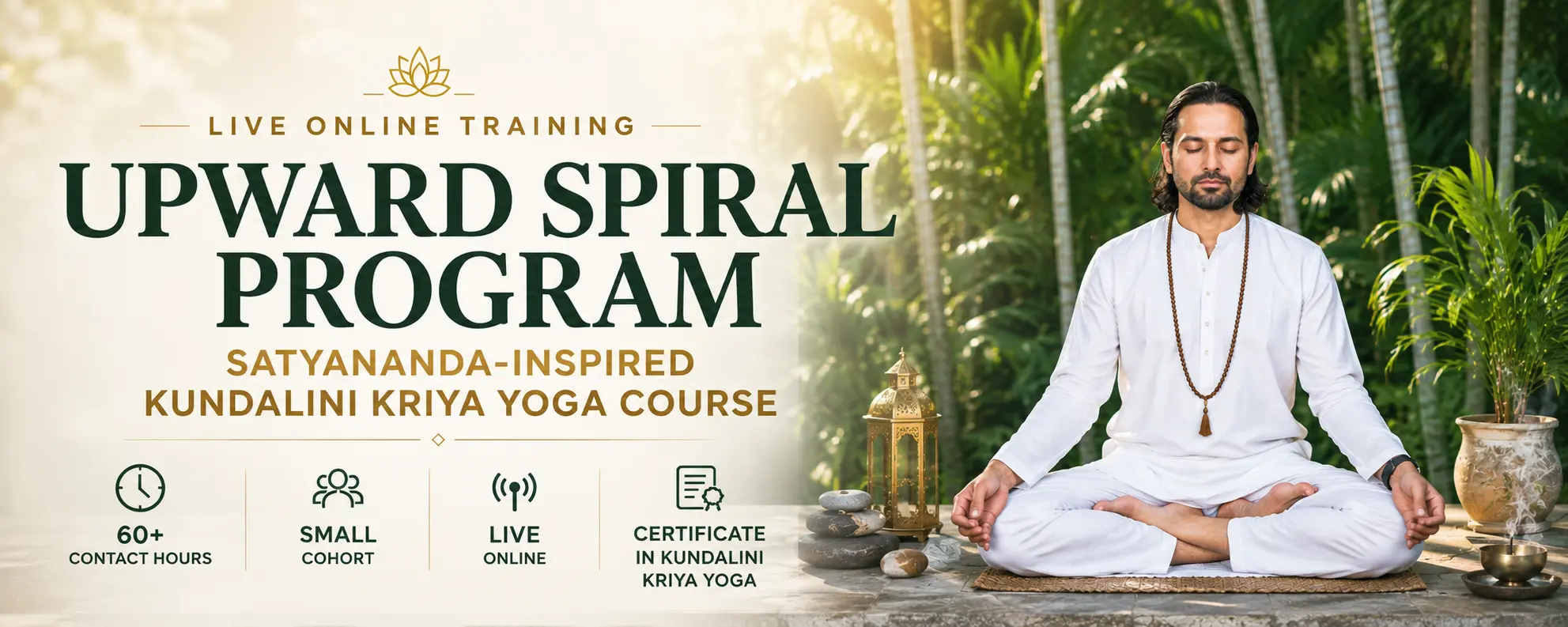
Live Online Training
Upward Spiral Program
Satyananda-Inspired Kundalini Kriya Yoga Course, Online
A structured, live, seven-weekend entry into Kundalini Kriya Yoga — the tradition as it developed within the Satyananda and Sivananda-oriented lineages, not the version most people encounter first.
~60 contact hours · Small cohort · Live online · Certificate in Kundalini Kriya Yoga
Explore our foundational Complete Kundalini Yoga Guide to understand the classical roots and philosophical bedrock upon which this training is built.
Tradition
The Lineage Distinction
Ask most people what Kundalini Yoga is, and they'll describe white turbans, mantra music in Gurmukhi, and a system created in America in 1969.
That system — Kundalini Yoga as taught by Yogi Bhajan, through 3HO — has genuinely helped many people. It is also not the tradition this training draws from, and treating the two as interchangeable does a disservice to both.
Upward Spiral is Kundalini Kriya Yoga as it developed within the Satyananda and Sivananda-oriented lineages — informed by classical Hatha Yoga, built on kriya-based preparation rather than performance sequences, and considerably quieter than what most Western students have encountered under the same name.
This is the traditional, text-rooted approach — not a modern reconstruction, and not the version most Kundalini Yoga marketing assumes you mean.
Understanding the roots of these traditions is critical. We deeply explore how these distinct paths evolved and why the practical differences matter for your nervous system in our dedicated guide on Hatha vs. Kundalini Yoga.
Clarity
What This Training Is — And Isn't
This is not:
- Kundalini Yoga as taught by Yogi Bhajan, or affiliated with 3HO
- A system requiring specific clothing, Gurmukhi mantras, or organizational affiliation
- Designed for mass accessibility — this is a small, screened cohort
- Kriya technique stripped of its philosophical foundation
This is:
- A structured entry into Kundalini Kriya through classical Hatha Yoga
- Satyananda-inspired methodology, Sivananda-oriented frameworks
- Taught by someone with 15+ years inside this practice
- Deliberately paced, internally focused, and philosophically grounded
Teacher's Note: Clarity protects the student. Understanding what a Kundalini Kriya actually encompasses—versus what it is often mislabeled as—is fundamental. We define the true structure of a Kundalini Kriya in-depth during our foundational sessions.
Pacing
Why Online Means Slower, Not Shorter
Our residential version of this training runs as a 14-day intensive in Goa. Online, we deliberately don't compress it into two consecutive weeks over video calls — partly because most students can't clear fourteen consecutive days for a screen-based format, but mostly because the spacing turns out to suit this tradition better, not worse.
This practice was never built around stimulation or speed. It was built around gradual preparation — each stage given room to actually settle before the next one begins. Delivered online across seven weekends, with real weeks in between rather than back-to-back days, that gap isn't downtime. It's where the integration the tradition insists on actually happens — in your own daily life, between sessions, rather than compressed into a single immersive week.
Same seven modules. Same ~60 hours of contact time. Delivered with the space the practice was designed to have.
Physiologically speaking: The nervous system requires time to down-regulate and encode new patterns. We explore this neurobiological reality, and how Kundalini specifically impacts the Science of Kundalini Yoga & the Nervous System, to explain precisely why spacing matters.
Applicant
Who This Is For
- Practitioners who want the practice explained honestly, including its risks and its limits — not marketed as a shortcut to awakening.
- Yoga teachers who want to understand what they're actually teaching if "Kundalini" appears anywhere in their own class descriptions. A deep look at our Demystifying Kundalini Myths article helps clarify these boundaries.
- Students who have practiced Yogi Bhajan-style Kundalini Yoga and want to understand what else exists within this name.
Who this isn't for: Anyone expecting a single dramatic "awakening" experience, a specific uniform or organizational affiliation, or a fast-paced, high-energy class format. This is a deliberately slower, more internally-focused practice — and that's true online as much as it is in Goa.
Curriculum
The Seven-Weekend Curriculum
Each weekend covers one module, built directly on the one before it — from chakras and nadis through pranayama and bandhas, mantra and kirtan, philosophy, and Antar Mouna meditation. Two live session blocks per day (Saturday and Sunday), offered at times that work across time zones.
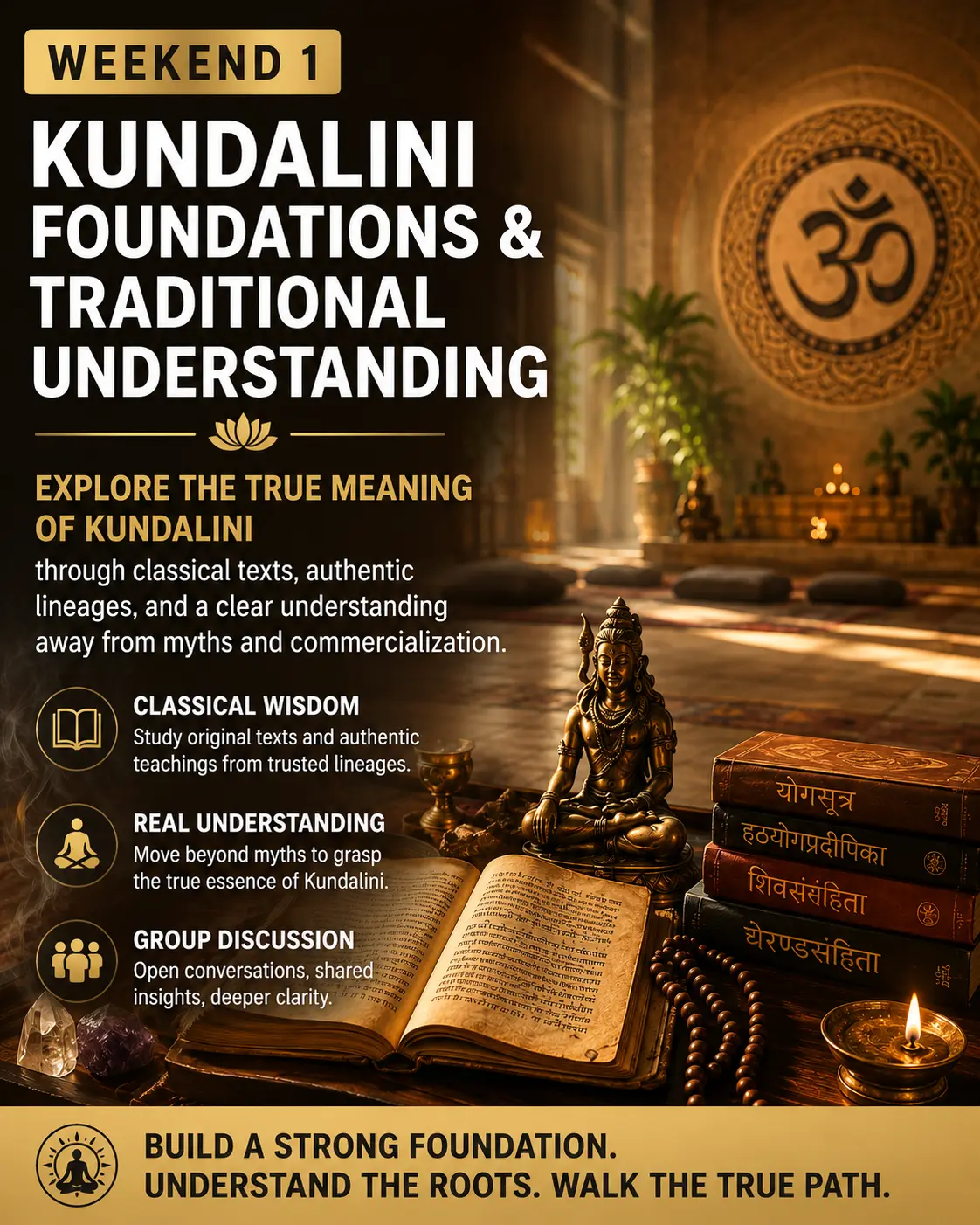
Kundalini Foundations & Traditional Understanding
Session 1: What Kundalini Actually Refers To: Kundalini in the classical texts; orientation to the lineage — Satyananda/Sivananda vs. Yogi Bhajan/3HO, addressed directly. Opening ceremony and group orientation.
Session 2: The Commercial Reshaping of a Tradition: How the concept has been reshaped for Western commercial consumption, and why the distinction matters practically, not just academically. Group discussion.
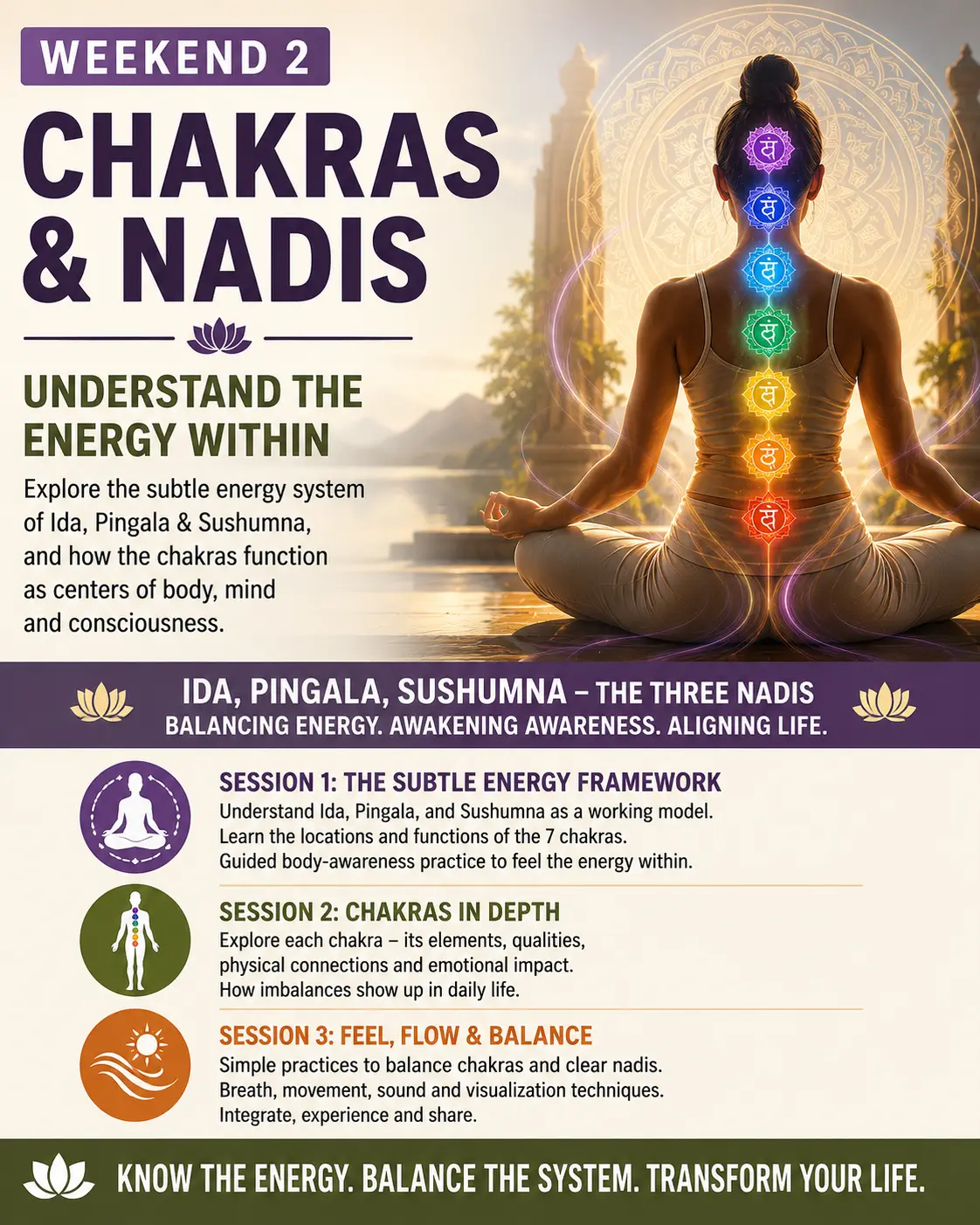
Chakras & Nadis
Session 1: Ida, Pingala, Sushumna as a Working Model: The subtle energy framework, treated as a working model rather than a decorative chart. Chakra locations and function. Guided body-awareness practice.
Session 2: From Concept to Application: Using the nadi/chakra framework to inform practice sequencing. Applied sequencing practice. We cross-reference this with the classical 7 Chakras and their role in Kundalini Energy.
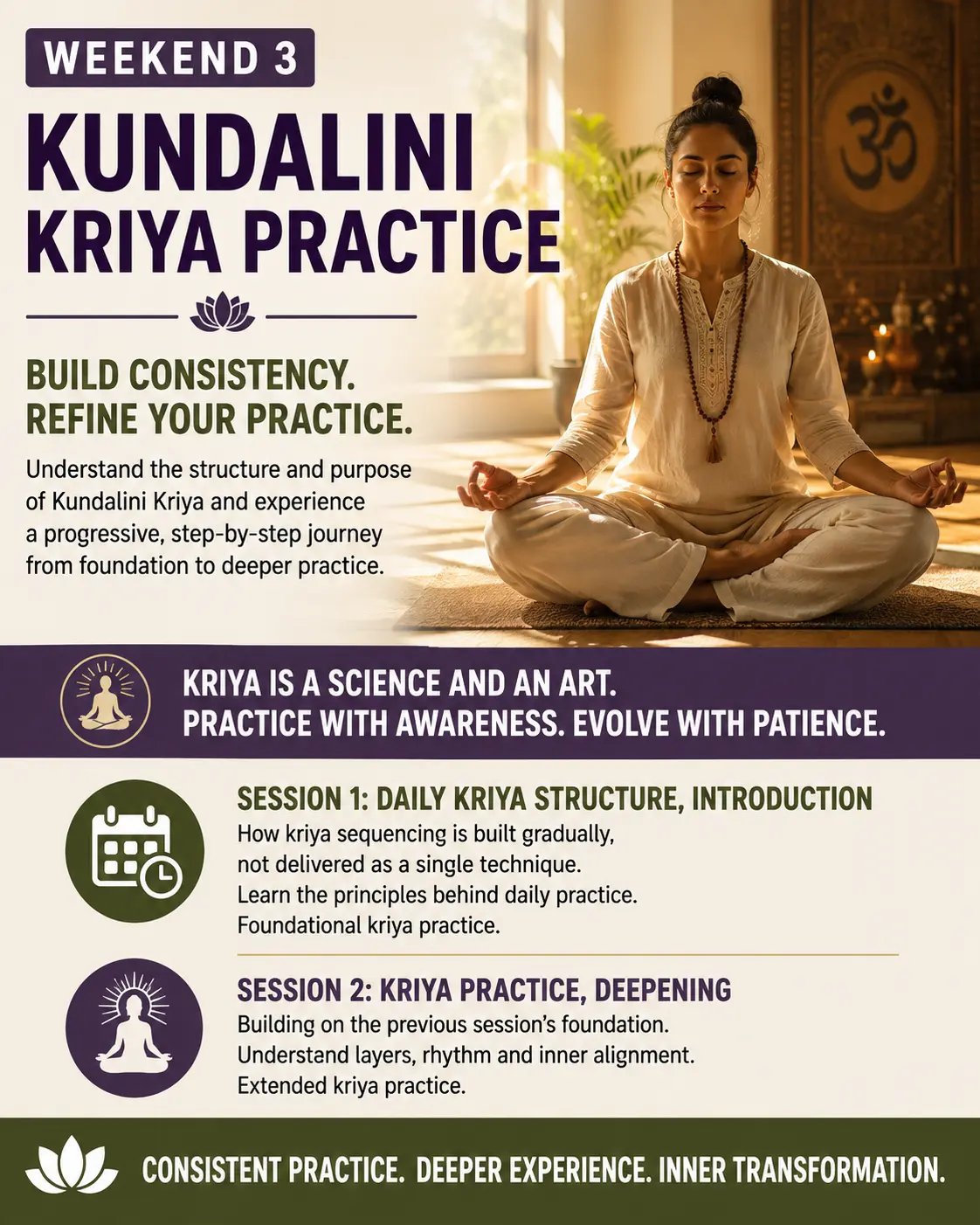
Kundalini Kriya Practice
Session 1: Daily Kriya Structure, Introduction: How kriya sequencing is built gradually, not delivered as a single technique. Foundational kriya practice.
Session 2: Kriya Practice, Deepening: Building on the previous session's foundation. Extended kriya practice.
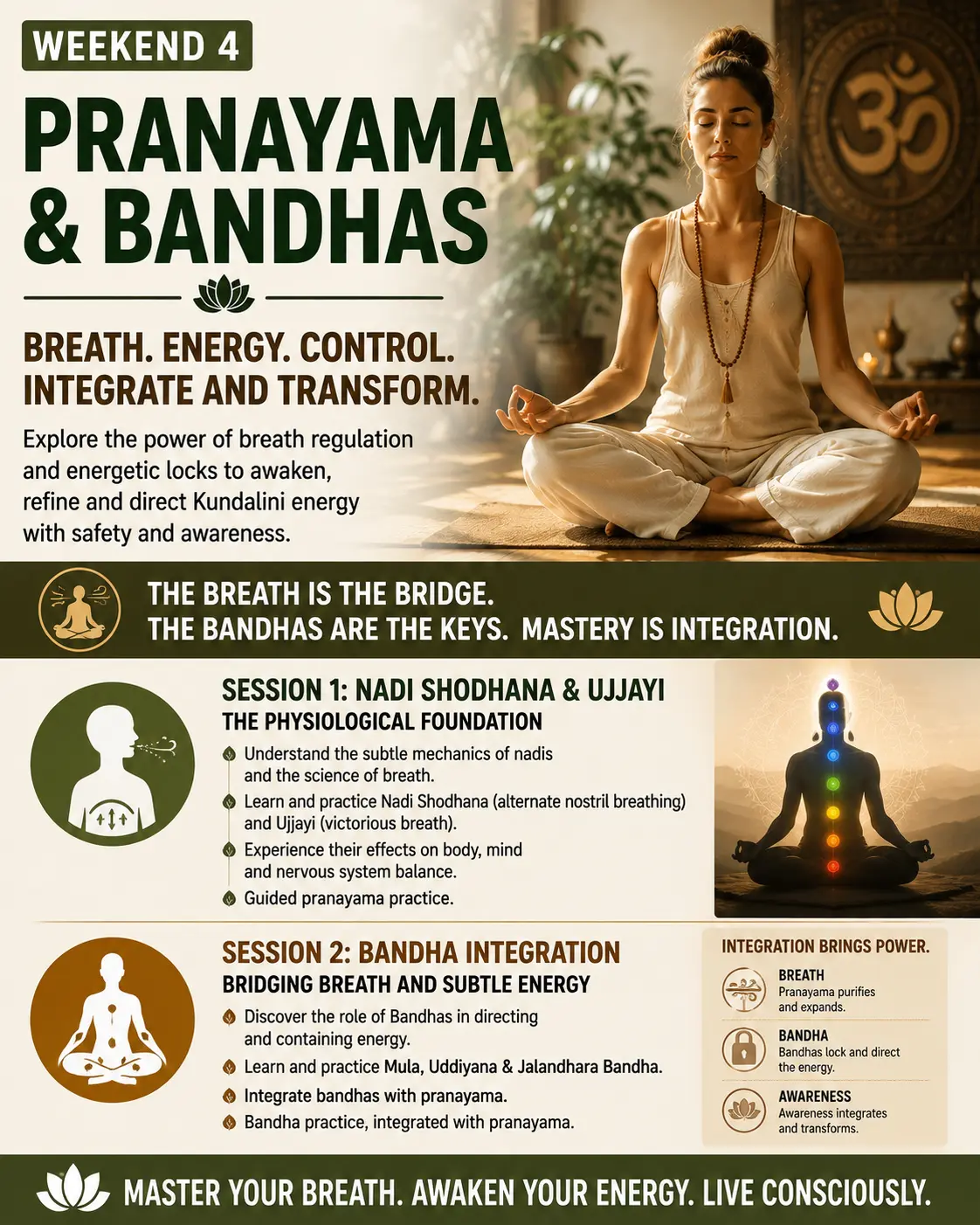
Pranayama & Bandhas
Session 1: Nadi Shodhana & Ujjayi: The physiological foundation beneath the more subtle practices that follow. Guided pranayama practice.
Session 2: Bandha Integration: Bridging breath practice and subtle energy work. Bandha practice, integrated with pranayama.
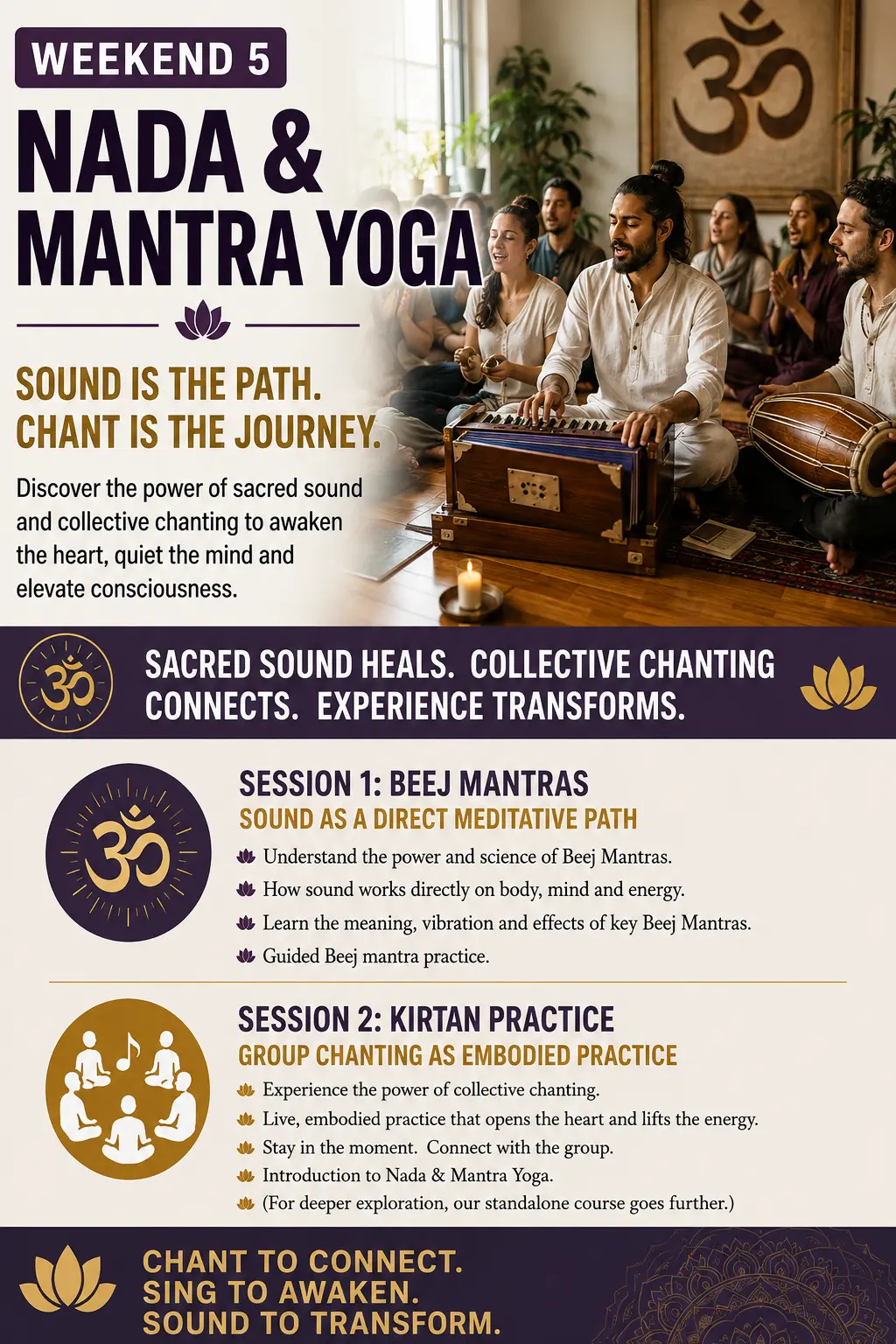
Nada & Mantra Yoga
Session 1: Beej Mantras: Sound as a direct meditative path, not background music. Guided beej mantra practice.
Session 2: Kirtan Practice: Group chanting as embodied practice, held live so it stays a group experience rather than a recording. (This module is an introduction — our standalone Nada & Mantra Yoga course covers this territory in far more depth for those who want to continue.)
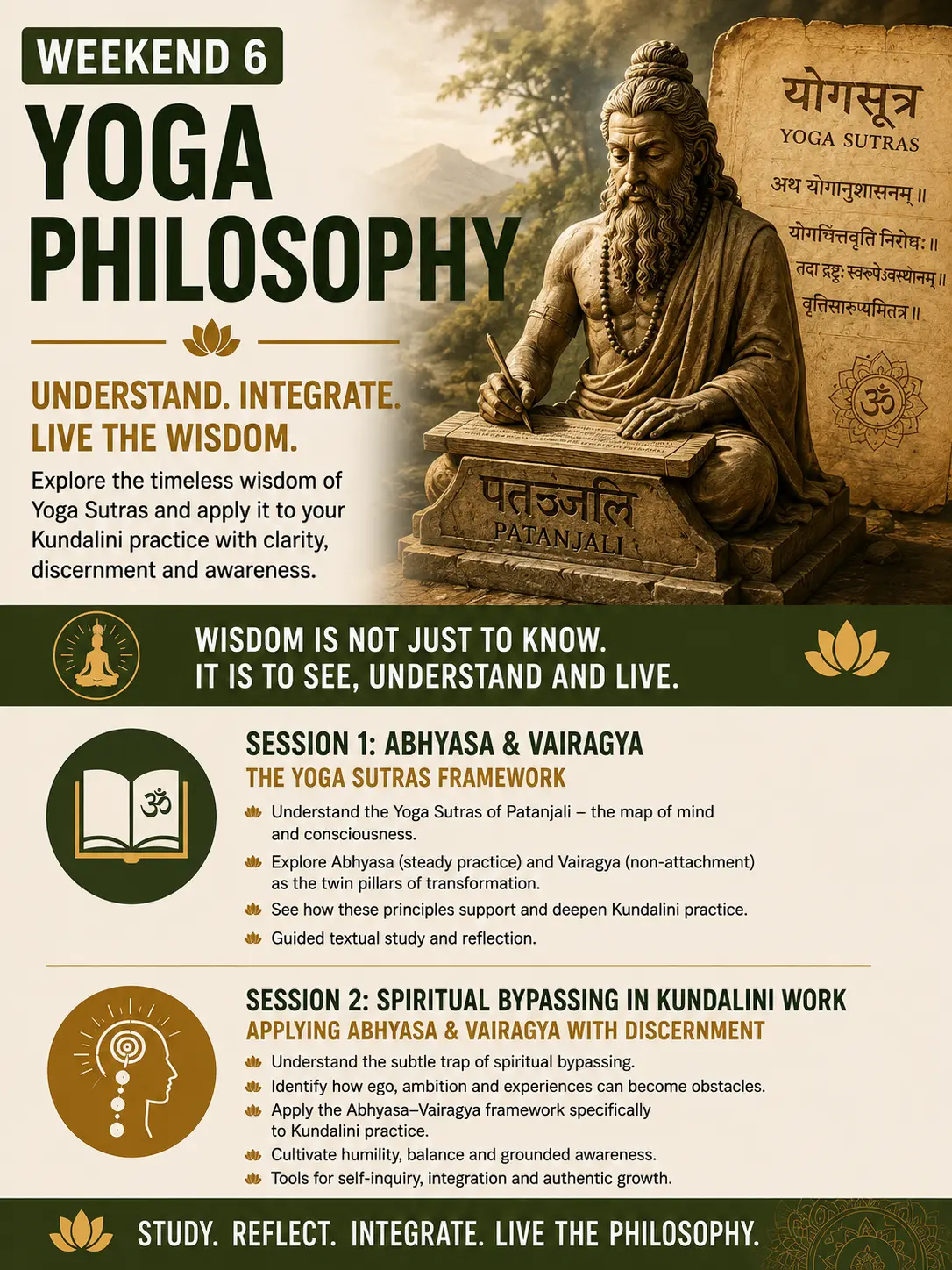
Yoga Philosophy
Session 1: Abhyasa & Vairagya: The Yoga Sutras' framework of practice and non-attachment. Guided textual study.
Session 2: Spiritual Bypassing in Kundalini Work: Applying the Abhyasa/Vairagya framework specifically to Kundalini practice, where the risk of spiritual bypassing is highest. Group discussion — direct and honest, not sanitized.
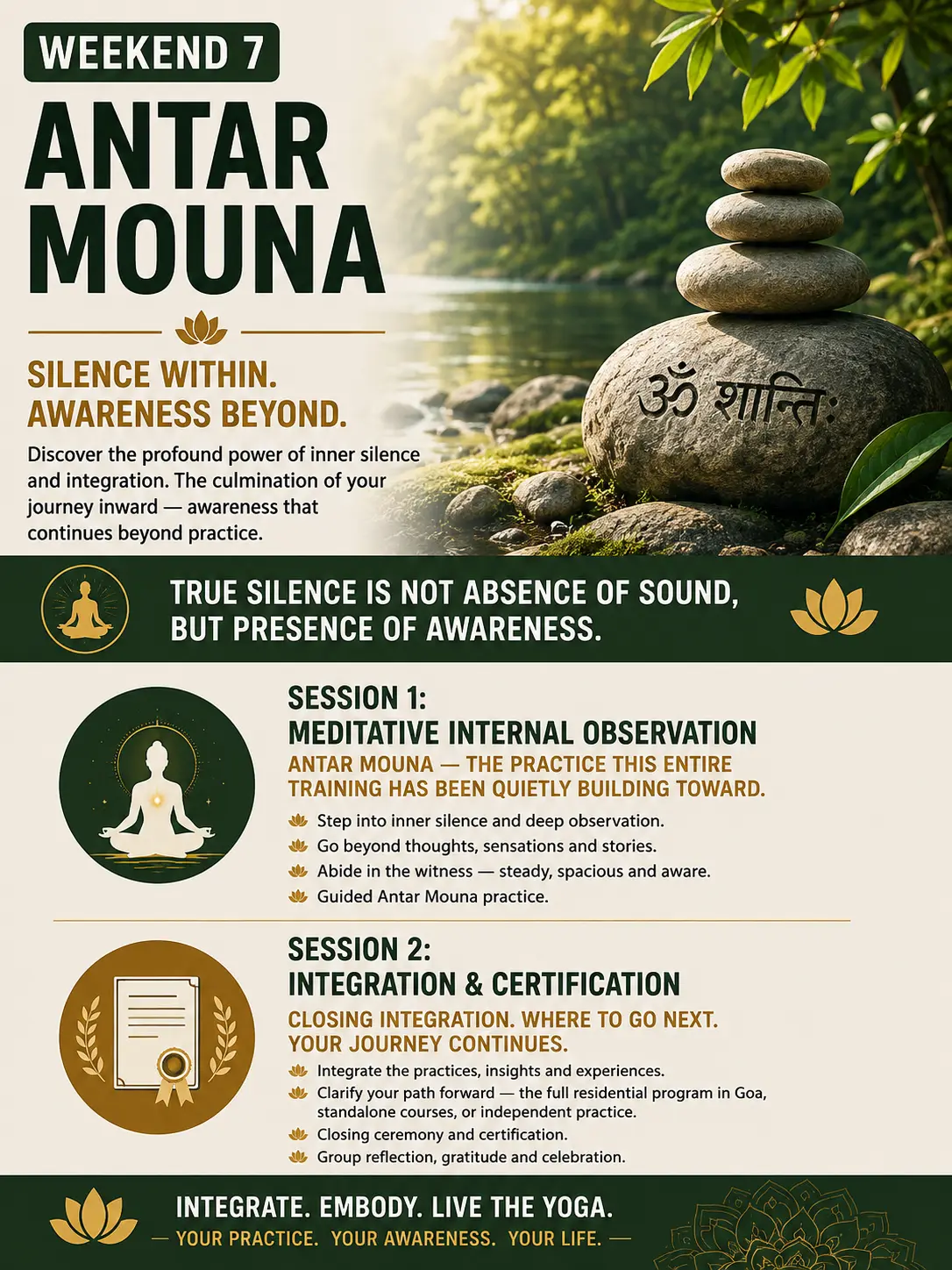
Antar Mouna
Session 1: Meditative Internal Observation: Antar Mouna — the practice this entire training has been quietly building toward. Guided Antar Mouna practice.
Session 2: Integration & Certification: Closing integration. Where to go next — the full residential program in Goa, standalone module courses, or independent practice. Closing ceremony and certification.
Faculty
Format & Faculty
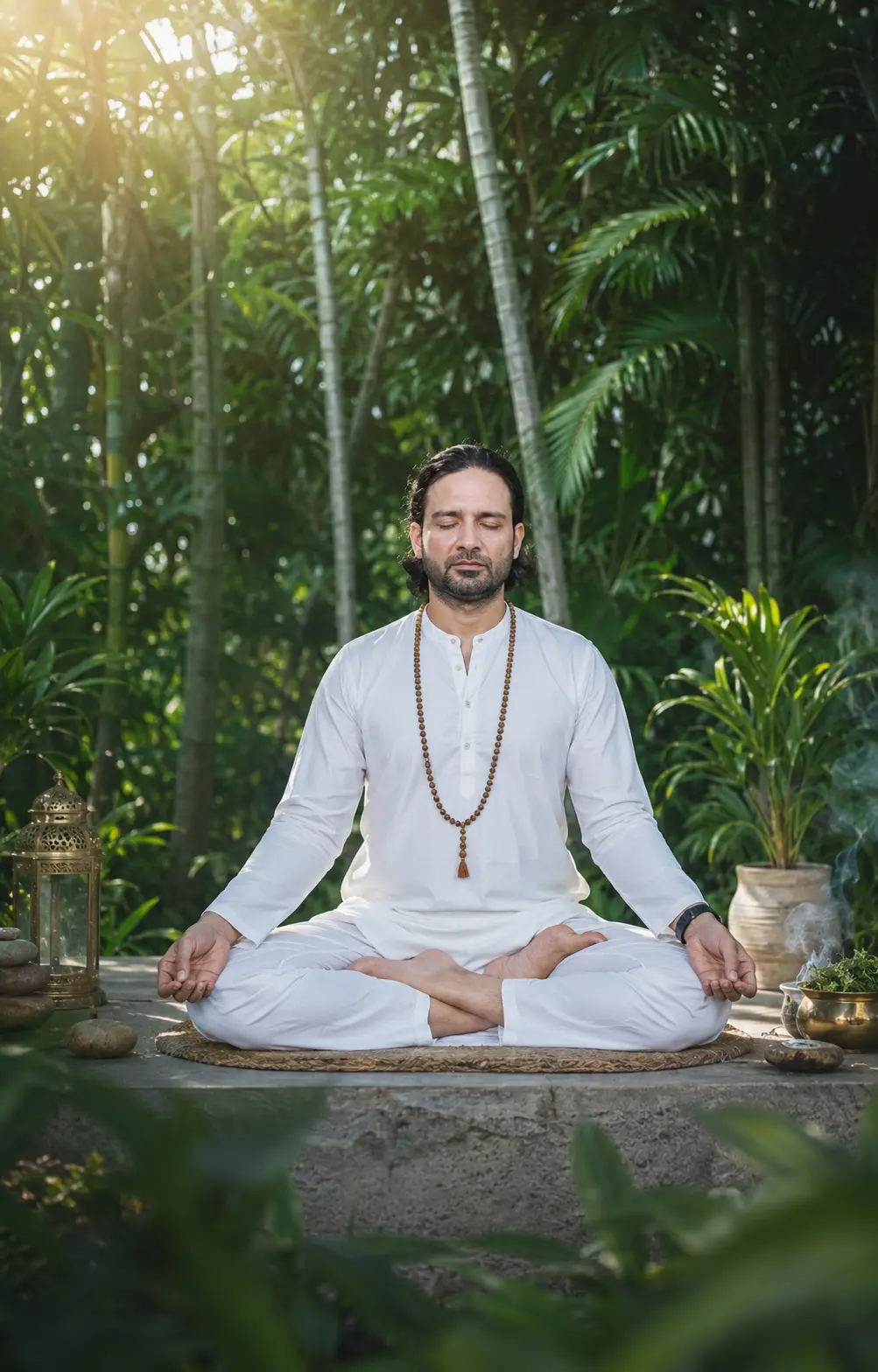
Lead Faculty: Pradip Krishna — ERYT 500, CYT 200, Holistic Health Coach & Consultant, Kundalini Yoga Mentor, Founder of Vishuddhi Isha Yoga & Ayurveda. 15+ years of personal practice and teaching experience, 1,500+ students guided across 40+ countries.
Group Size: Small cohort, typically 6–8 students, to preserve the depth this practice requires — the same reason we keep our residential groups small.
Delivery: Live online, seven weekends, spaced roughly two weeks apart. Not self-paced or pre-recorded — this is a live cohort, held to the same pacing and group format as our in-person trainings.
What's Included:
- Upward Spiral Course Manual
- Kriya Practice Sequence Guide
- Beej Mantra & Kirtan songbook
- Certificate in Kundalini Kriya Yoga — Upward Spiral
Support
Frequently Asked Questions
What's the difference between traditional Kundalini Yoga and Yogi Bhajan's Kundalini Yoga?
Traditional Kundalini Kriya Yoga — the Satyananda and Sivananda-oriented lineage this course teaches — developed within classical Hatha Yoga and Tantra, built around kriya-based preparation rather than a fixed performance sequence. Kundalini Yoga as taught by Yogi Bhajan is a distinct system created in the West in 1969, associated with 3HO, Gurmukhi mantras, and a specific uniform. Both are legitimate practices — they're simply not the same tradition, and this course teaches the former.
Is this the same as the Kundalini Yoga taught at my local studio?
Likely not, if your local studio's class descends from the Yogi Bhajan/3HO system — which is the majority of Kundalini Yoga classes currently taught in the West. This training draws from an older, separate lineage.
Is this live, or can I go through it at my own pace?
It's live. Each weekend is a scheduled cohort session with real-time teaching and group discussion, not a library of recordings you work through whenever you like. If you miss a session, recordings are available to review, but the format is built around a group moving through the material together.
Do I need prior yoga experience?
Some foundational familiarity with pranayama and basic asana is recommended, though this is assessed individually rather than gatekept by a rigid prerequisite.
Is this Yoga Alliance recognized?
Yes — delivered under the same ERYT 300/CYT 200 credentialing as our residential programs in Goa.
I've only ever practiced Yogi Bhajan-style Kundalini Yoga. Will this feel completely unfamiliar?
Some technical vocabulary will overlap, but the pacing, philosophical framing, and absence of a fixed uniform or organizational structure will likely feel quite different — that difference is the point of this training, not an accident.
How does this compare to the 200-Hour Kriya Kundalini Yoga Teacher Training in Goa?
Upward Spiral is a structured entry point, not a substitute — roughly a quarter of the contact hours of the full residential program, and without the immersive residential environment. Many students use it as preparation before committing to the full 200-hour training.
Enroll Now
Choose Your Path
Invest in a practice that will stay with you for life — not just for the seven weeks of the course.
One-time payment · Lifetime access to recordings
- ✅ 7 weekends of live, cohort-based instruction
- ✅ ~60 contact hours with direct teacher feedback
- ✅ Small group — typically 6–8 students
- ✅ Satyananda lineage Kriya Kundalini Yoga
- ✅ Certificate in Kundalini Kriya Yoga
- ✅ Course Manual & Kriya Practice Guide
- ✅ Beej Mantra & Kirtan Songbook
- ✅ Lifetime access to session recordings
Secure your spot. Limited seats available.
Begin Your Journey
Ready to Explore the Authentic Path?
If you want the practice explained honestly — including where it came from, what it can and can't do, and why the pacing matters — Upward Spiral is built to do exactly that, from wherever you are.
Begin Your Journey
Ready to Explore the Authentic Path?
If you want the practice explained honestly — including where it came from, what it can and can't do, and why the pacing matters — Upward Spiral is built to do exactly that, from wherever you are.
Enroll Now
Secure your spot in our small cohort. Enrollment is open — reserve your place before seats fill.
Enroll Now — $490 →Explore the 200-Hour Training
If you find yourself craving an immersive in-person experience in Goa, our full residential teacher training awaits.
Learn About the 200-Hour Kundalini Yoga Teacher Training →