Hatha vs Kundalini Yoga: The Real Difference and Why It Matters
Architecture of Practice
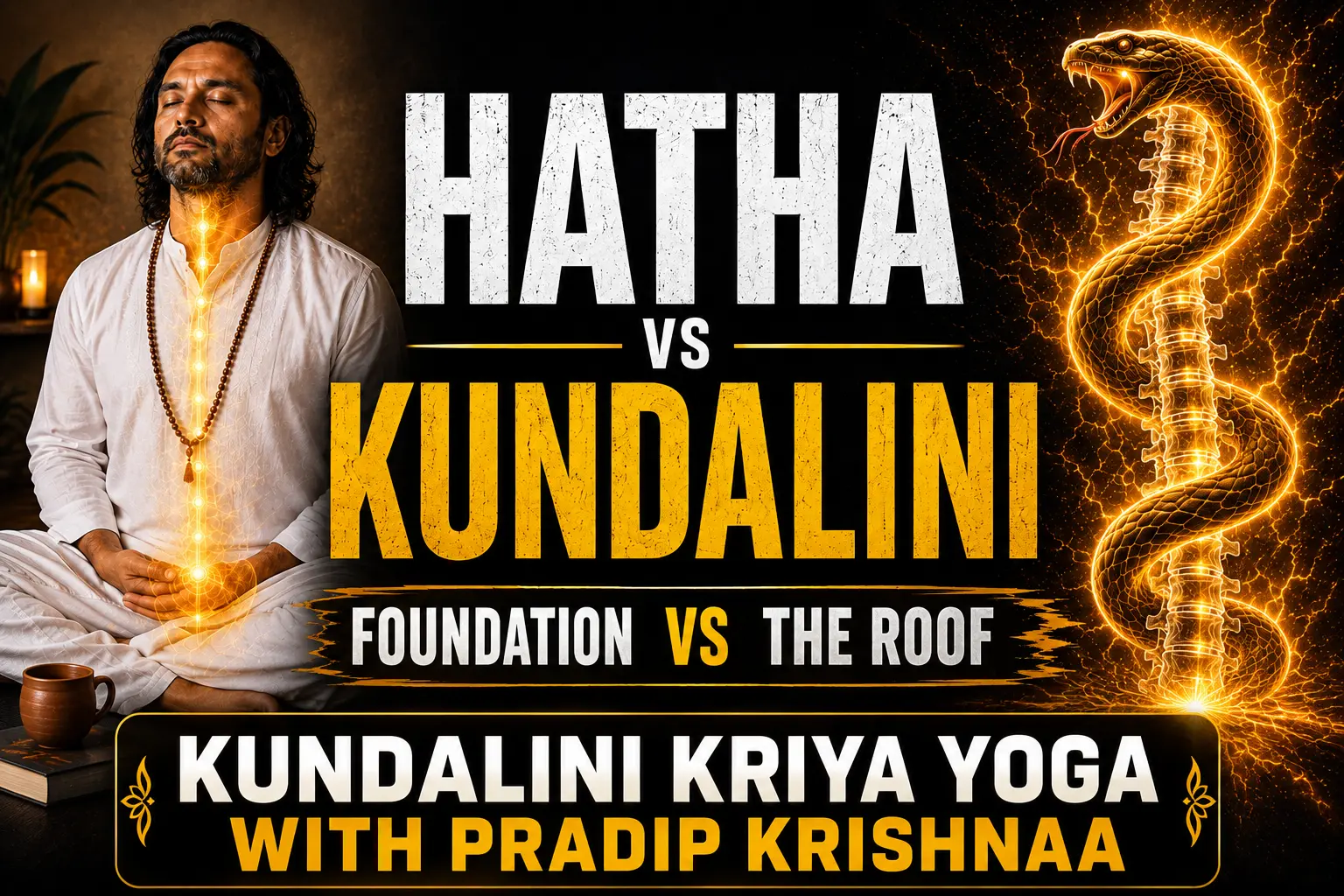
Hatha vs Kundalini Yoga: The Architectural Difference Between Posture and Awakening
For decades, modern wellness has treated Hatha Yoga as a physical workout and Kundalini Yoga as a mystical energy practice. This split is a profound misunderstanding. In the Sivananda–Satyananda lineage, these two paths are not different styles of the same thing. They are two halves of a single, integrated engineering system. One builds the power grid. The other turns the switch on.
To understand this engineering, you must first see the whole picture. Hatha is the preparation; Kundalini is the activation. If you are new to this system, we recommend beginning with our Complete Kundalini Yoga Guide. It explores the origins, the Satyananda lineage, the chakras, and the foundational kriyas in depth. This article builds on that foundation by examining the architectural relationship between the two practices.
Hatha
What Is Hatha Yoga, Really?
We must begin with the Sanskrit word itself. Ha represents the solar energy, Pingala Nadi. Tha represents the lunar energy, Ida Nadi. The word Hatha literally means "force" or "willful effort." It refers to the deliberate union of these two opposing energies. Hatha Yoga is not a fitness trend. It is the science of physiological preparation. These practices are rooted in the Tantric tradition — for a deeper look at the framework behind them, see our guide to Kundalini Tantra.
In our tradition, we treat Hatha as the foundation of a building. Its primary tools are the Asanas (postures) and the Shatkarmas (internal cleansing techniques). The goal is not to build muscle. The goal is to stabilize the nervous system so completely that the physical body ceases to be a distraction. When you hold Siddhasana for twenty minutes, you are not stretching. You are pressing the perineal trigger point for Mooladhara Chakra. You are practicing biomechanical engineering.
Kundalini
What Is Kundalini Yoga?
If Hatha Yoga is the physical building, Kundalini Yoga is the high-voltage electrical grid. It is not a "style" of yoga at all. It is a specific, biochemical activation protocol. In Kundalini Tantra, Swami Satyananda Saraswati describes Kundalini Shakti as a dormant potential coiled at the root of the spine. Unlike the physical movements of Hatha, Kundalini practices involve precise neurological exercises.
These exercises include specific Mudras (hand gestures), rhythmic Pranayama (breath regulation), and mental Drishti (fixed gaze). The active component is not the movement of the limbs, but the movement of consciousness through the psychic passageways. We call this the Arohan (ascending) and Awarohan (descending) cycles. You are not exercising your muscles. You are exercising your brain.
Explore the structure of a Kundalini Kriya in practice — observe the sequence, breath, and locks in action.
Bandhas
What is the Role of Bandhas in Kundalini Practice?
The Bandhas are the critical lock mechanisms that bridge the physical and the energetic. There are three primary locks: Jalandhara (throat lock), Uddiyana (abdominal lock), and Moola (perineal lock). In Hatha Yoga, these are often taught as advanced breathing exercises. In Kundalini Yoga, they are mandatory.
Prana naturally dissipates downwards due to gravity and the pull of worldly desires. The Bandhas force this energy to reverse direction and travel upwards through the central canal known as Sushumna Nadi. Without mastering these locks in Hatha, the energy awakened by Kundalini will have nowhere to go but sideways. This sideways flow is the primary cause of the neurotic imbalances and "spiritual emergencies" frequently warned about in modern wellness circles. This is why we dedicate a full section to safety and preparation in our Demystifying Kundalini Myths guide.
Preparation
Can I Practice Kundalini Without Doing Hatha Yoga First?
Technically, yes. You can attempt the Kriyas without a physical practice. However, the classical texts, including Kundalini Tantra, explicitly warn against this. Hatha Yoga is the prerequisite that purifies the nervous system and opens the Nadis to handle high-voltage energy.
We have seen students in our teacher training who skip the foundational Hatha practices because they seem boring or purely physical. They want the Kriyas; they want the awakening. This is a catastrophic mistake in the lineage. Because Hatha Yoga is designed to purify the Nadis—the psychic energy channels—before the electricity flows. If you attempt a Kundalini Kriya while your digestive system is filled with Ama (toxins) and your spine lacks flexibility, you are turning on a generator without properly wiring the house.
Technique
How Do the Techniques Differ in Practice?
The technical execution is immensely different. In Hatha Yoga, the active component is the physical posture. You stretch, you sweat, you breathe. The mind is focused on the alignment of the joints. The practice is external and measurable.
In Kundalini Yoga, the physical posture is often secondary. You sit perfectly still, often in Siddhasana or Padmasana, while the entire practice takes place internally. The Kriyas are choreographed movements of breath and lock that are performed mentally. The active component is not the movement of the limbs, but the movement of consciousness through the Sushumna Nadi. For a deeper dive into the mechanics of these energy pathways, you can explore the research in our Science of Kundalini Yoga and the Nervous System piece.
Safety
What Are the Safety Risks of Practicing Kundalini Without Hatha?
The primary risk is a condition we call Pranotthana without grounding. This occurs when the energy rises, but the physical channels are blocked by impurities or tension. The result is not enlightenment. It is burnout, anxiety, erratic behavior, and chronic insomnia.
Modern neuroscience validates this warning. When the nervous system is hyper-stimulated without the physical stability of Hatha practice, the sympathetic nervous system (the fight-or-flight response) goes into overdrive. The amygdala becomes hyperactive, and the prefrontal cortex—the seat of logic and calm—is bypassed. The body experiences a panic response instead of a spiritual awakening.
Function
How Do Bandhas and Mudras Function Differently?
In Hatha Yoga, Mudras and Bandhas are often used as isolated techniques to improve health. For example, Uddiyana Bandha is practiced to massage the internal organs. It is therapeutic.
In Kundalini Yoga, these same locks are used as switches. They redirect the flow of Prana from the lower centers to the higher centers of the brain. The Mudras act as physical circuits that prevent the energy from dissipating out of the hands and feet. This is the precise science of energy conservation. One is physical therapy; the other is neurological redirection.
Myth
Is Hatha Yoga Just Physical Exercise?
This is one of the most damaging myths of modern wellness. Hatha Yoga is not just physical exercise. It is an exhaustive system of internal purification. The Shatkarmas—Neti, Dhauti, Nauli, Basti, Kapalabhati, and Trataka—are not designed to burn calories. They are designed to release accumulated toxins from the body’s deepest tissues.
From a neurological perspective, Hatha Yoga stimulates the vagus nerve, which is the primary highway of the parasympathetic nervous system. When this nerve is tonified, the heart rate slows, inflammation markers decrease, and the brain shifts into a state of coherence. This is the biological basis for the "yogic calm." It is measurable. It is real. It is the prerequisite for the higher states of consciousness.
Goal
Why Are the Goals of These Two Paths Different?
The ultimate goal of these two paths differs in its expression. The goal of Hatha Yoga is a steady, healthy, purified body. It is the foundation. The goal of Kundalini Yoga is Samadhi—the dissolution of the ego into the ocean of pure consciousness.
Hatha Yoga ensures you live a long, healthy life. Kundalini Yoga ensures you understand why you are alive. The first is a building; the second is the light that illuminates the building. You cannot have the light without the structure to hold it. To understand this structure better, understanding the Chakras and Kundalini Energy is the essential map of the terrain.
Science
How Does the Brain Respond to Each Practice?
We must look at the neurobiology. Hatha Yoga, through its emphasis on slow, diaphragmatic breathing and physical relaxation, increases parasympathetic activity. It lowers cortisol. It stabilizes the amygdala. It acts as a sedative for the overactive mind.
Kundalini Yoga does not aim for relaxation in the same way. It aims for ignition. The goal is to fuse the Ida and Pingala energies at the Ajna Chakra—the point between the eyebrows. When this fusion occurs, the dormant 90% of the brain is activated through the Sushumna Nadi in the central nervous system. This aligns with modern EEG studies, which demonstrate that when the left and right brain hemispheres synchronize, the brain enters a state of 'hyper-coherence'—a measurable electrical event that mirrors the traditional description of Sushumna activation.
Transmission
The Need for a Guru in Kundalini
There is another architectural difference. Hatha Yoga can be learned safely from a book or a generic video. It is difficult to injure yourself doing Mountain Pose. Kundalini Yoga, conversely, is a transmission science. In our tradition, a Kriya is never taught to a room of strangers. It is taught mouth-to-ear, Guru-Parampara.
Why? Because the subtle manipulation of the Bandhas and Mudras requires real-time observation. A Guru observes the color of your skin, the sound of your breath, and the flickering of your eyes to know if the energy is moving safely. You cannot get this feedback from a screen.
Mind
The Psychological Impact of Each Practice
The psychological impact of these practices is also distinct. Hatha Yoga strengthens the ego. It gives you pride in your physical capability. It is a practice of Ahimsa (non-violence) but also a practice of physical power. It grounds you in reality.
Kundalini Yoga, however, is a practice of Bhava (inner feeling). It does not aim to strengthen the ego; it aims to dissolve it. When the Kundalini rises to Sahasrara, the individual "I" disappears. You cannot survive a high-voltage shock if you are clinging to your identity. The Hatha student learns to stand solid. The Kundalini student learns to be empty.
Energy
The Role of Prana: Accumulation vs. Transformation
Let us look at the energy itself. Hatha Yoga seeks to accumulate Prana. It builds strength, endurance, and digestive fire. It charges the battery. It slows down the aging process.
Kundalini Yoga seeks to transform that Prana. It takes the accumulated vital force and channels it through the Brahma Nadi, the most subtle of the internal pathways. It is offered up to the consciousness at the crown. It is the difference between storing electricity in a battery and firing that electricity through a laser.
Perspective
Why the Western Mind Confuses Them
The Western mind often struggles with this distinction. We treat everything as a hierarchy of difficulty. In truth, Hatha and Kundalini are not levels of difficulty. They are parallel sciences that run on different tracks. One is physical engineering. The other is neurological activation.
In the Sivananda–Satyananda lineage, we do not see a conflict between them. We see a sequence. The Hatha student learns to master the body. The Kundalini student learns to surrender the body. The first is a warrior; the second is a lover of the divine.
Support
Frequently Asked Questions
What is the main difference between Hatha and Kundalini Yoga?
The main difference lies in the target of the practice. Hatha Yoga focuses on the physical purification of the body through postures and cleansing techniques. Kundalini Yoga focuses on the neurological activation of the dormant energy in the spine. Hatha is the preparation; Kundalini is the culmination.
Do I need to practice Hatha Yoga before Kundalini?
Yes. Hatha Yoga is the mandatory foundation. Without the physical purification and nervous system stabilization provided by Hatha, attempting Kundalini practices can lead to energetic imbalances and neurological distress. We recommend a minimum of two years of dedicated Hatha practice before approaching the advanced Kriyas.
Can Kundalini Yoga awaken the energy without Hatha preparation?
Technically, the energy can be stirred without Hatha. However, without a prepared vehicle, the energy will cause physical and mental chaos. The classical texts are explicit: skipping the preparation is the primary cause of spiritual emergency.
What are the safety risks of practicing Kundalini without Hatha?
The primary risks are anxiety, chronic insomnia, erratic moods, and a condition known as Pranotthana without grounding. When the energy rises through a blocked nervous system, it manifests as neurosis rather than peace.
How do Bandhas and Mudras function differently in these two systems?
In Hatha, they are therapeutic tools for internal massage and health. In Kundalini, they are energetic switches that redirect Prana from the lower body to the higher brain centers. They function as a cage for the electricity.
Is Hatha Yoga just physical exercise, or does it also affect the nervous system?
It is absolutely not just physical exercise. The Shatkarmas and Asanas deeply stimulate the vagus nerve and the parasympathetic nervous system. They create a physiological state of coherence that directly prepares the brain for higher states of consciousness.
Scientific References
Sources & References
- Satyananda Saraswati, Swami. Kundalini Tantra. Yoga Publications Trust, Munger, Bihar, India. https://www.biharyoga.net/
- Gothe NP, Khan I, Hayes J, et al. Yoga Effects on Brain Health: A Systematic Review of the Current Literature. Frontiers in Human Neuroscience, 2019. https://www.ncbi.nlm.nih.gov/pmc/articles/PMC6971819/
- The classical texts of the Sivananda–Satyananda lineage on Hatha Yoga Pradipika and the practical application of Bandhas.
Begin Your Journey
Ready to Explore the Authentic Path?
Don't navigate this ancient science alone. Whether you are seeking the profound depths of Kundalini Kriya or looking to integrate these teachings into a daily practice, our lineage offers the authentic guidance you need.
Kriya Kundalini Teacher Training
Immerse yourself in an intensive residential programme in Goa, India. Study Kundalini Kriya Yoga, meditation, pranayama, philosophy, teaching methodology, and yogic lifestyle through daily guided practice.
Explore Residential TrainingOnline Yoga Courses
Learn from anywhere in the world through our structured online programmes, combining live classes, guided practice, mentoring, and comprehensive study materials at your own pace.
Browse All Online CoursesExplore the Kundalini Master Resource Library
We are building one of the web's most comprehensive evidence-informed libraries on traditional Kundalini Kriya Yoga, integrating authentic yogic wisdom with modern scientific research. New in-depth guides are continuously researched, written and added to expand this growing knowledge hub for students, practitioners and yoga teachers worldwide.
Foundations
Practices & Techniques
- What is a Kundalini Kriya?
- Breath of Fire (Agni Prana)
- Kundalini Mantras Explained — how sound functions as an active component
- Understanding Bandhas — the three locks in depth
- Daily Kundalini Yoga Practice
Science & Research