
How to Prepare Body for Kundalini Awakening: A Safe, Step-by-Step Framework
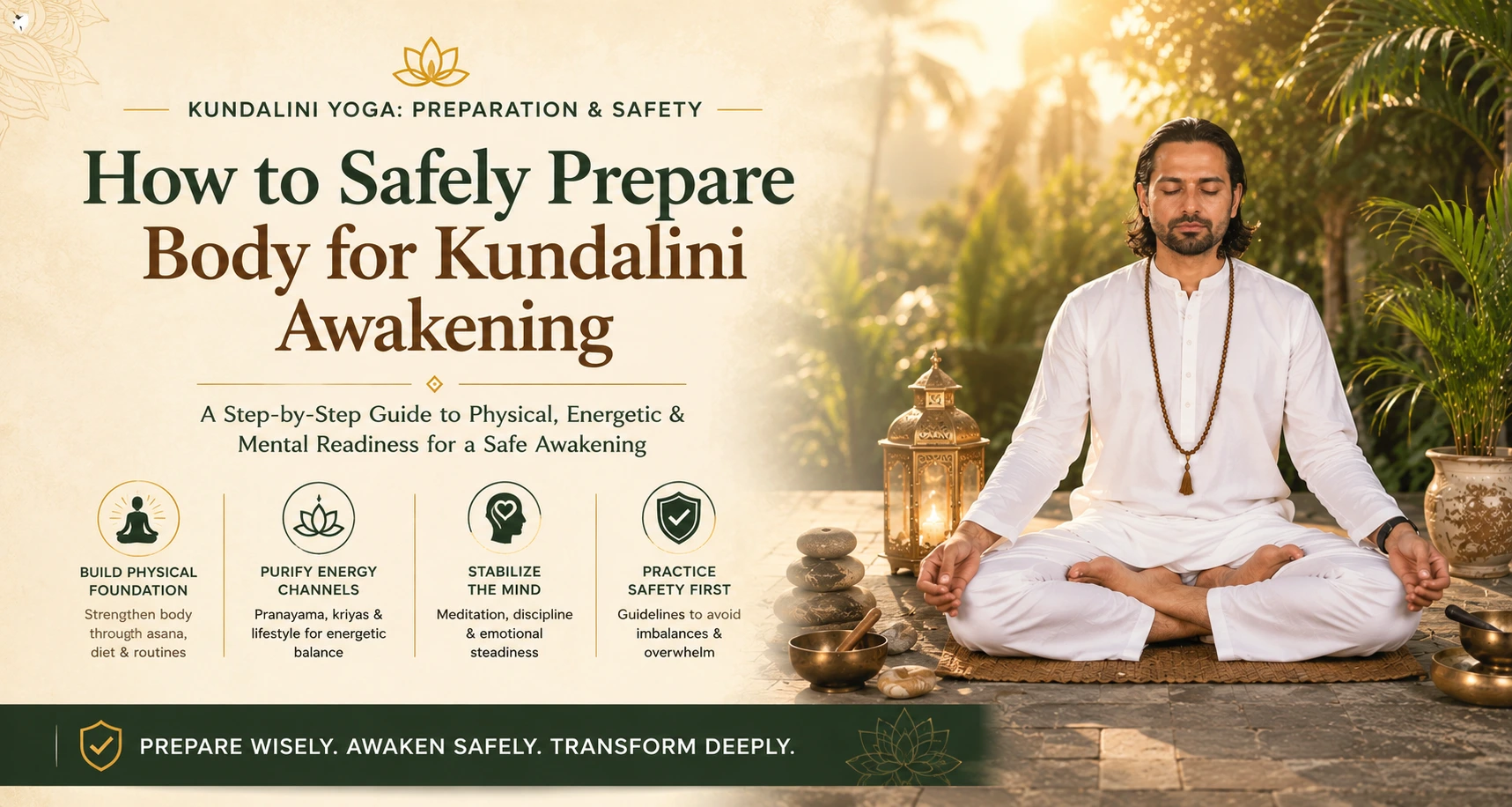
Kundalini Yoga: Preparation & Safety
How to Safely Prepare Body for Kundalini Awakening
Preparing body for a kundalini awakening means building physical steadiness through asana, purifying the energy channels (nadis) through pranayama, adopting a light and regulated diet, and stabilizing the mind through consistent meditation — carried out gradually, over months or years rather than days, and ideally under the guidance of a teacher trained in the tradition. Skipping straight to advanced breathwork or intense kriya practice without this foundation is the single most common reason kundalini experiences become overwhelming instead of transformative.
This guide lays out that preparation in the order the classical texts actually teach it — not as a checklist to rush through, but as the practice itself.
New to this topic? Start with our foundational Complete Kundalini Yoga Guide for the classical roots this article builds on.
Learn the 200-Hour Kundalini Yoga Teacher Training → Upward Spiral Kundalini Course → Jump to FAQ ↓
Reframe
Preparation Is the Practice, Not a Prelude to It
Most online guides treat “preparing for kundalini awakening” as a short warm-up phase — a few weeks of deep breathing and clean eating before the “real” event. That framing doesn’t come from the tradition; it comes from treating kundalini like a wellness trend with a start date.
In Kundalini Tantra, Swami Satyananda Saraswati’s foundational text on this subject, the material on preparation isn’t a preamble tucked before the interesting chapters — it’s structured as its own extended body of teaching: rules and preparation, posture, diet, and the risks of skipping any of it. That structure reflects something worth taking seriously: in the Satyananda-Sivananda lineage this course teaches, the preparation is the sadhana. There isn’t a separate, more advanced practice waiting on the other side of it. You are either doing the work that stabilizes the nervous system to hold this energy, or you aren’t yet ready to work with it directly.
That reframe matters for anyone searching for a shortcut. There isn’t one — and the honest version of this guide is more useful than a version that pretends otherwise.
Framework
The Four-Part Preparation Framework
Classical Kundalini Kriya Yoga prepares the body across four dimensions at once, not in strict sequence but in parallel, with each one supporting the others.
Asana
Physical Foundation: Asana Before Anything Else
Hatha yoga isn’t a separate, more basic practice you graduate out of before “real” kundalini work begins — it is the entry point. The difference between hatha and kundalini yoga is really a difference in emphasis, not in lineage: hatha stabilizes the physical vessel; kundalini kriya works with what moves through it. You need the first before the second holds.
A handful of postures appear specifically in the classical preparation texts, chosen because they steady the base of the spine and open the pelvis, where the Mooladhara chakra is located:
- Siddhasana / Siddha Yoni Asana — the primary meditation seat for kundalini practice; it applies gentle, sustained pressure at the perineum, which is considered to stimulate the root center directly.
- Padmasana (lotus pose) — a stable, symmetrical seated base that keeps the spine self-supporting for long periods without strain.
- Bhadrasana (gracious pose) — opens the hips and inner thighs, preparing the body to sit comfortably for extended pranayama and meditation.
- Uttanpadasana (raised leg pose) — strengthens the lower abdomen and lumbar region, which supports the bandhas (energy locks) used later in kriya practice.
What matters more than any single posture is consistency: the same time of day (traditionally the early morning), the same place, and a daily rhythm your nervous system can come to recognize and settle into. A scattered practice — twenty minutes here, an intensive weekend there — doesn’t build the same stability as a modest practice repeated daily.
For a fuller understanding of how hatha and kundalini relate, see Hatha vs Kundalini Yoga.
Pranayama
Pranic Purification: Pranayama and the Nadis
Before energy is asked to move through the central channel (sushumna), the two channels on either side of it — ida and pingala — need to be brought into balance. This is the specific job of Nadi Shodhana (alternate nostril breathing), which is why it appears as the first pranayama practice in nearly every serious preparation sequence, traditional or modern. When ida and pingala are balanced, energy has a clear, direct route upward. When they aren’t, energy tends to move erratically through one side or the other, which is part of why unprepared practice can feel destabilizing rather than expansive.
A workable progression looks like this:
- Nadi Shodhana — daily, as the foundation, for weeks to months before adding intensity.
- Ujjayi — introduced alongside asana, to build breath awareness and a subtle internal sound that anchors attention.
- Kapalabhati and Bhastrika — added only once Nadi Shodhana is genuinely steady, since these more forceful breathing practices generate more heat and energetic movement than a beginner’s system may be ready to hold.
This is a place where rushing does real harm. Jumping straight into vigorous breath-of-fire style practices without the Nadi Shodhana foundation is one of the more common ways people report feeling flooded or “wired” rather than clear.
For a complete guide to Breath of Fire, see Breath of Fire (Agni Prana).
Diet
Dietary Regulation: Light, Sattvic, and Seasonal
The classical guidance is consistent and fairly specific: a sattvic diet — light, freshly prepared, plant-based, and low in the heavy, fried, and overly stimulating foods that demand a lot of digestive energy. This isn’t dietary purism for its own sake. Pranayama and the bandhas are physically harder to perform well on a full stomach, and a body spending most of its energy on digestion has less capacity available for subtle practice.
Practical guidelines that follow from this:
- Favor whole grains, legumes, and cooked vegetables over raw, processed, or heavily spiced food.
- Reduce animal protein, deep-fried food, and excess caffeine, particularly in the hours before pranayama or meditation.
- Stay hydrated, and keep meal timing regular rather than erratic.
- Avoid alcohol and recreational substances, which work against the nervous system stability this whole framework is trying to build.
None of this needs to be extreme. Crash detoxes and prolonged fasting — a pattern that shows up in some popular kundalini content — tend to add physical stress at exactly the moment the body needs steadiness, and aren’t part of the classical guidance in any case.
Mind
Mental and Emotional Steadiness
This is the dimension most preparation guides gesture at and few actually explain. A regular meditation practice does more than “calm the mind” in a general sense — it builds the capacity to observe intense internal experience without being swept up in it, which is precisely the capacity kundalini practice will ask of you.
Unresolved trauma, significant untreated mental health conditions, and general emotional volatility are the factors that research on kundalini-related distress points to most consistently — not the energy itself, but the container it’s moving through. The nervous-system mechanics behind this explain why: kundalini practices work directly on autonomic regulation, and a nervous system that’s already dysregulated has less spare capacity to absorb that work.
If you want to understand what genuine awakening looks like versus a nervous system in distress, see our guide on Signs of a Genuine Kundalini Awakening.
Timeline
The Timeline: Why This Isn’t a Few-Weeks Project
A number of guides online suggest kundalini preparation can be meaningfully completed in four to eight weeks. That timeline doesn’t match the tradition this course teaches, and it’s worth saying so directly rather than softening it for the sake of a tidier answer.
Classical texts describe chakra work as sequential and slow — traditionally approached one center at a time, often starting with Ajna (the “control center” at the third eye) before moving to Mooladhara itself, with each stage given real time to stabilize before the next begins. Understanding the chakras and their role in kundalini energy is worth reading in full if this sequencing is new to you — it isn’t a straight line from root to crown so much as a gradual, guided unfolding.
Realistically, most people are looking at months to years of consistent foundational practice — hatha yoga, pranayama, meditation, and dietary regulation — before advanced kriya work is appropriate. That’s not a discouraging answer; it’s an honest one, and it’s also why the common myths about kundalini yoga so often center on the idea that this can be rushed, packaged, or achieved through a single dramatic technique.
For more on the common myths, see Demystifying Kundalini Myths.
Guidance
Why Guidance From a Trained Teacher Matters
Every serious source on this subject — classical and clinical alike — converges on the same point: this isn’t a solo practice. A teacher trained in the lineage can see things a self-directed practitioner generally can’t from the inside: whether your foundation is actually stable, whether you’re progressing too quickly, and how to adjust practice when something isn’t landing the way it should.
This is less about gatekeeping and more about the nature of the work itself. Kundalini Kriya Yoga, taught properly, is a relationship between student and teacher as much as it is a set of techniques — which is a large part of why it’s traditionally taught in person, in small groups, over an extended period rather than through a single video or article.
Learn more about our 200-Hour Kriya Kundalini Yoga Teacher Training.
Mistakes
Common Mistakes That Undermine Preparation
A few patterns show up again and again in people who report kundalini practice going sideways — and nearly all of them are preparation shortcuts rather than problems with the practice itself.
- Starting with advanced pranayama. Jumping straight to Bhastrika or long breath-retention practices without first stabilizing Nadi Shodhana is one of the most common ways people generate more energetic movement than their system is ready to integrate.
- Treating diet as optional. Heavy, stimulating food doesn’t just sit poorly during practice — it competes with the digestive and nervous system resources that pranayama and meditation draw on.
- Practicing inconsistently, then compensating with intensity. A single long, intense session after weeks of no practice isn’t equivalent to steady daily practice; it tends to produce a spike rather than a stable shift.
- Skipping the seated postures. Siddhasana and its variants aren’t included in classical texts as a formality. Sitting in a pose that applies steady pressure near the root center is part of what makes the practice work; sitting in a chair or an unstable cross-legged position changes the practice materially.
- Going without a teacher because “it’s just breathing.” Pranayama looks simple from the outside. The margin between a Nadi Shodhana practice that steadies the system and one that’s subtly straining it is often something only an experienced eye catches.
For a deeper dive, see The Science of Kundalini Yoga & the Nervous System.
Practice
A Morning Practice, in Practical Terms
The classical instruction to practice in the early morning, in the same place, isn’t arbitrary — it’s practical. The body is naturally quieter before the day’s demands begin, digestion is minimal (assuming a light evening meal), and a consistent time slot is simply easier to sustain as a habit than one that has to be renegotiated daily.
A modest, realistic version of a preparation-phase morning practice might look like this:
| Stage | Practice | Approximate Time |
|---|---|---|
| Settle | Seated posture (Siddhasana or a comfortable seated variant), a few minutes of quiet breath awareness | 5 minutes |
| Physical | Gentle hatha sequence — sun salutations, hip openers, spinal twists | 15–20 minutes |
| Pranic | Nadi Shodhana, then Ujjayi | 10–15 minutes |
| Mental | Seated meditation, attention on breath or a simple mantra | 10–20 minutes |
This isn’t a fixed prescription — a teacher will adjust it to what you’re actually ready for — but it gives a realistic sense of scale. It’s a 40–60 minute daily commitment, not a weekend intensive, and that’s very much the point.
Safety
A Brief Word on Safety
Preparation, done properly, is itself the primary safety measure — but a few situations call for real caution before beginning intensive practice at all: active psychosis or a significant untreated mental health condition, a recent major trauma that hasn’t been processed with support, or significant current instability in your life. None of these are permanent disqualifiers, but they’re reasons to build stability first, with appropriate support, rather than adding intensive energy practices on top of an already-taxed system.
For the fuller picture — how to tell the difference between a genuine, well-supported awakening and a nervous system in distress, and what to do if something feels off — see our dedicated guide on recognizing a genuine spiritual kundalini awakening.
Support
Frequently Asked Questions
How long does it take to prepare the body for kundalini awakening?
There’s no fixed number, but realistically it’s measured in months to years of consistent practice — not weeks. The classical tradition builds capacity gradually: physical steadiness through asana, nadi balance through pranayama, and mental stability through meditation, each given time to actually settle before intensity increases.
What should I eat before starting kundalini practices?
A sattvic diet — light, freshly prepared, mostly plant-based food, with reduced fried food, excess caffeine, and animal protein, especially before pranayama or meditation sessions. The goal is freeing up energy that would otherwise go toward digestion, not extreme restriction or fasting.
Do I need a teacher to prepare for kundalini awakening?
The classical tradition treats this as essential, not optional. A trained teacher can assess whether your foundation is actually stable and adjust your practice accordingly — something that’s genuinely difficult to self-assess from the inside.
What yoga poses help prepare the body for kundalini energy?
Siddhasana (or Siddha Yoni Asana for women), Padmasana, Bhadrasana, and Uttanpadasana are named specifically in the classical texts, chosen for how they stabilize the base of the spine and open the pelvis and hips ahead of pranayama and kriya work.
Can kundalini awakening happen without any preparation?
It can happen spontaneously, without any deliberate practice — but the classical view, echoed by clinical literature on kundalini-related distress, is that an unprepared nervous system is far more likely to experience this as overwhelming or destabilizing rather than as a smooth, integrated unfolding.
Is it safe to practice kundalini yoga alone at home?
Foundational hatha yoga, gentle pranayama like Nadi Shodhana, and meditation are generally safe to build on your own. More intensive kriya and pranayama practices are traditionally taught in person, under supervision, specifically because they’re harder to self-correct if something isn’t going the way it should.
How do I know if I’m ready to move from preparation into kriya practice?
Readiness generally shows up as steadiness rather than as a specific milestone: you can sit comfortably in your seated posture for the full practice without strain, Nadi Shodhana feels calming rather than agitating, and your mood and sleep stay reasonably stable through periods of more intensive practice. A teacher assessing this in person is far more reliable than self-assessment, which is exactly why this stage of the journey is traditionally supervised.
What’s the difference between preparation and the actual kriya practice?
Preparation builds the container — physical stability, nadi balance, mental steadiness. Kriya practice works with the energy that moves through that container. You need the first before the second holds. This is covered in more depth in What Is a Kundalini Kriya?
Sources
Authoritative Sources
The following sources underpin the classical and clinical claims made in this article — each one is a primary or peer-reviewed resource that supports the preparation framework described above.
Swami Satyananda Saraswati — Kundalini Tantra
The foundational text on kundalini preparation, describing the rules, posture, diet, and the risks of skipping preparation.
Read the Classical Source →Greyson et al. (2014) — Psychiatry
A study documenting cases where individuals presenting with psychotic symptoms had experiences clinically indistinguishable from descriptions of kundalini awakening.
Read the Study →Pereira et al. (2021) — Case Report
A case report describing a patient with a “kundalini-like syndrome” that resolved through a combination of psychiatric support and spiritual guidance.
Read the Case Report →Swami Sivananda — Kundalini Yoga
The classical text describing the precise signs of awakening — prana rising to Sahasrara, electric-like currents, and the heat-then-cold pattern at each chakra.
Read the Classical Source →Master Resource Library
Explore the Kundalini Master Resource Library
We are building one of the web’s most comprehensive evidence-informed libraries on traditional Kundalini Kriya Yoga, integrating authentic yogic wisdom with modern scientific research. New in-depth guides are continuously researched, written and added to expand this growing knowledge hub for students, practitioners and yoga teachers worldwide.
Foundations
- Complete Kundalini Yoga Guide
- What is Kundalini Yoga? History, Origins & Philosophy
- Kundalini Yoga vs Hatha Yoga
- Understanding the Seven Chakras
- Kundalini Yoga: Myths & Misconceptions
Practices & Techniques
- What is a Kundalini Kriya?
- Breath of Fire (Agni Prana) — full mechanics, pacing, contraindications
- Kundalini Mantras Explained — how sound functions
- Understanding Bandhas — the three locks in depth
- Daily Kundalini Yoga Practice
Science & Research
- The Science of Kundalini Yoga
- Kundalini Yoga & the Vagus Nerve
- Meditation & Brain Plasticity
- Kundalini Yoga for Anxiety & Stress
Kundalini Awakening
- How to Safely Prepare the Body for Kundalini Energy Awakening — this article
- Signs of a Genuine Kundalini Awakening
- Preparing the Body for Kundalini Practice
- Understanding Kundalini Syndrome
Learn With Guidance, Not Guesswork
Preparation Deserves a Teacher Watching How You Respond
Everything above is the “what” and the “why.” Recognizing whether your foundation is actually stable happens in relationship with a teacher — not from a written framework, however thorough.
200-Hour Kriya Kundalini Yoga Teacher Training
Our residential program in Goa, built around the gradual, prepared approach this article describes.
Learn About the 200-Hour Training →Explore Our Online Yoga Courses
Not ready for a residential commitment? Browse our full range of online offerings.
View Online Courses →Medical Disclaimer:
The information presented in this article is intended solely for educational purposes and should not be interpreted as medical advice, diagnosis, or treatment. Individual responses to kundalini practice vary considerably. Always consult a qualified healthcare professional before beginning any new practice or if you are experiencing severe distress, disorientation, or any loss of touch with ordinary reality.
Tag:how to awaken kundalini safely, how to prepare for kundalini awakening, kundalini asana preparation, kundalini awakening preparation, kundalini body preparation, kundalini practice foundation, kundalini preparation guide, kundalini safety tips, kundalini teacher guidance, kundalini yoga preparation, nadis purification, pranayama for kundalini, sattvic diet for kundalini, signs of readiness for kundalini