Kundalini Yoga Teacher Training in India: Goa & Kundalini Yoga Lineage
Teacher Training
Why Take a Kundalini Yoga Teacher Training Course in India? The Case for Goa and an Authentic Lineage
Most people who search this question already believe the answer. India is where yoga began, so training there must be more “real” than training at a studio back home — that assumption does most of the persuading before the article even starts.
It’s not wrong, but it’s incomplete. India now has well over a thousand yoga schools running 200-hour certificates, and a growing share of them teach a Westernised, performance-oriented version of the practice back to Western students, just with cheaper rent and a beach view. Training in India doesn’t automatically mean training in an authentic lineage — and for Kundalini Yoga specifically, “authentic” is a genuinely contested word, because two distinct traditions currently share the same name.
So the useful version of this question isn’t “why India?” on its own. It’s: what does India actually add that a class in your home city can’t, how do you tell a grounded, lineage-based program from a repackaged one, and — if Goa is where you’re looking — what does that specific place add or cost you compared with the alternatives. That’s what this article works through.
New to Kundalini Yoga? Start with our foundational Complete Kundalini Yoga Guide for the classical roots this article builds on.
Immersion
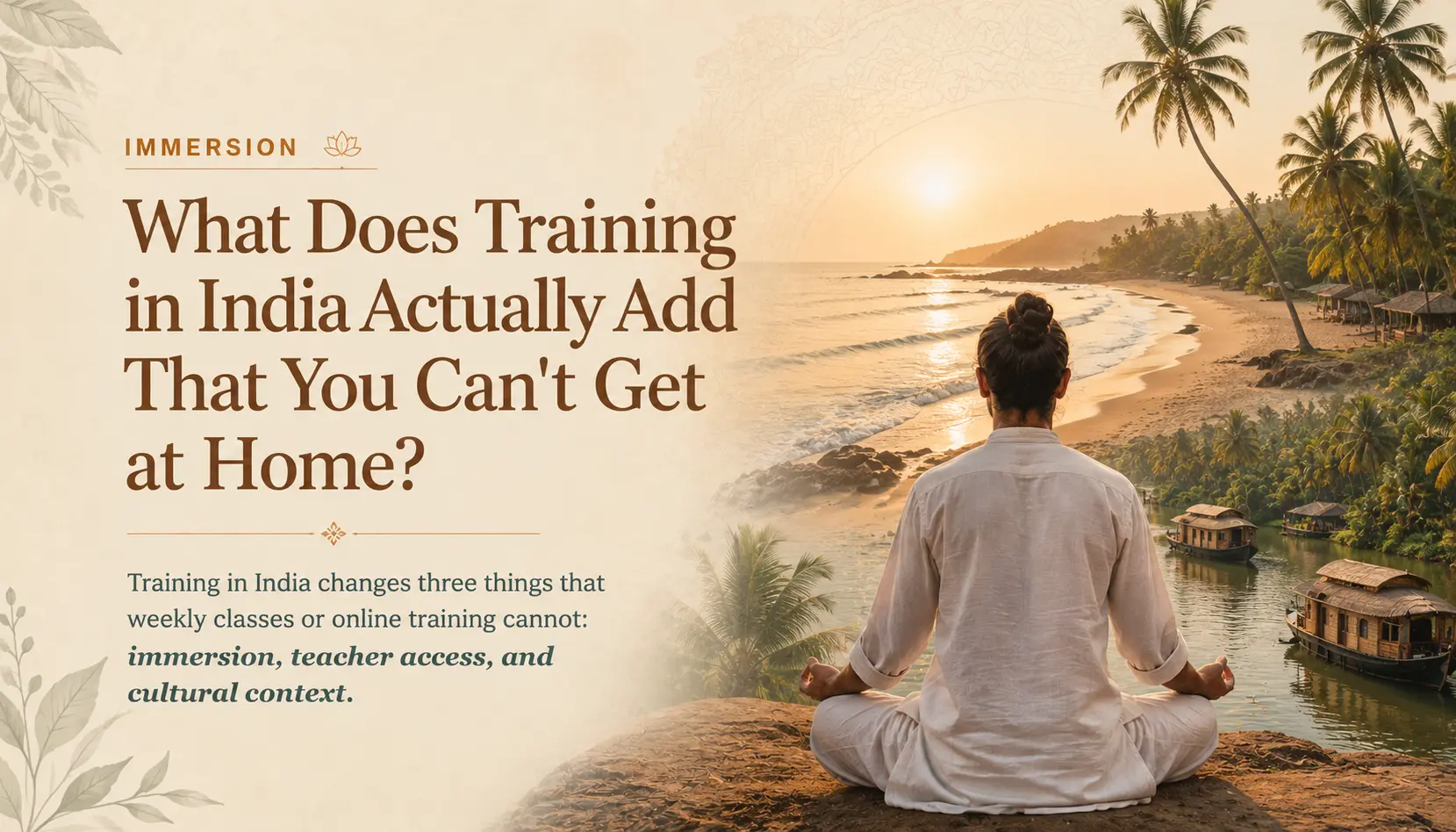
What Does Training in India Actually Add That You Can’t Get at Home?
Training in India changes three things that a weekly evening class or a weekend workshop back home structurally cannot: immersion, teacher access, and cultural context.
Immersion means the practice becomes the center of your day rather than something squeezed in after work. A 200-hour certification split across evenings and weekends over four to six months is a different experience from the same 200 hours lived daily, inside a small group, with nothing competing for your attention. Momentum builds differently when you’re not resetting your nervous system every Monday morning between sessions.
Teacher access is a function of group size and time, not geography by itself — but small, residential Indian schools tend to run smaller cohorts than studio-based trainings elsewhere, simply because the economics of a residential program favor a manageable group. That means more direct correction, more time for the teacher to actually watch you attempt a kriya rather than demonstrate it once to a room of thirty.
Cultural context is the part that’s hardest to replicate anywhere else. Kundalini Kriya Yoga didn’t emerge from a fitness studio; it developed within a broader Indian framework of Tantra, Hatha Yoga, Ayurveda, and Vedic philosophy that still shapes daily life in places like Goa — the rhythm of the morning, the food, the language people use for the body and mind. You can study the philosophy anywhere. Living inside the environment it came from changes how it lands.
None of that makes training in India inherently superior to a well-taught program elsewhere — a poorly run, overcrowded school in India is not better than a small, careful one in Europe. It means India offers a specific set of conditions that are difficult to reconstruct outside it, and whether those conditions matter to you is a genuinely personal question, not a settled fact.
Value
Is a Kundalini Yoga Teacher Training in India Actually Worth It?
For students who want depth over convenience, yes — the combination of lower cost, daily immersion, and direct access to teachers working inside a specific lineage is difficult to match elsewhere at a comparable price. It’s a poor fit for anyone who wants to keep working full-time through the training, needs constant connectivity, or is looking for a certificate more than a practice.
Kundalini Yoga in particular rewards this kind of immersion more than most physical yoga styles do, because so much of what’s being trained is nervous system regulation and subtle-energy awareness rather than posture alignment. Research into Kundalini’s measurable effects on cortisol, GABA, and autonomic nervous system function points to something that develops gradually, through repetition, not something absorbed in a single weekend intensive. A residential setting simply gives that repetition more room to happen.
The honest caveat: “worth it” depends entirely on the specific program, not the country. A rushed, overcrowded 200-hour certificate that crams advanced kriyas into the first week is not worth it whether it’s run in Rishikesh, Bali, or Los Angeles. The country gets you proximity to the source. It doesn’t get you a good teacher — that still has to be verified separately, which is what the sections below are for.
Lineage
Why Does Lineage Matter More in Kundalini Yoga Than in Other Styles?
Lineage matters more here because “Kundalini Yoga” currently refers to two genuinely distinct systems that happen to share a name, and most people searching for a teacher training have no idea a choice is even being made.
The tradition this training draws from developed within the Satyananda and Sivananda-oriented lineages — rooted in the Bihar School of Yoga, classical Hatha Yoga, and Tantric and Vedic texts including the Hatha Yoga Pradipika and the Yoga-Kundalini Upanishad. It’s built on kriya-based preparation: structured sequences of posture, breath, sound, and lock, developed and refined over generations, taught gradually and with an emphasis on nervous system regulation before intensity.
A separate system — Kundalini Yoga as taught by Yogi Bhajan, associated with the 3HO organization — was created in the West starting in 1969. It has its own sequencing, its own mantra set drawn from Gurmukhi devotional language, and its own teaching structure. It’s the version most Western students encounter first, largely because of its visibility over the past five decades, and it has genuinely helped many people. It’s also the subject of a well-documented 2020 independent investigation, commissioned by 3HO-affiliated organizations themselves, which found it “more likely than not” that Yogi Bhajan engaged in serious sexual and spiritual abuse of students over decades — a matter of public record that a growing number of practitioners now factor into where they choose to train.
Neither tradition is “more authentic” as an abstract category. But they are not interchangeable, and a program that never mentions which one it teaches — or worse, blends elements of both without acknowledging it — is a program that hasn’t done the work of knowing its own lineage. For a fuller breakdown of how the two traditions actually differ in practice, see Kundalini Yoga vs. Hatha Yoga and Demystifying Kundalini Myths.
This is why “authentic lineage” isn’t marketing language in this context — it’s a factual question you should be able to get a direct answer to before you enroll anywhere, in India or otherwise.
Destination
Why Goa? Comparing India’s Main Kundalini Yoga Teacher Training Destinations
Goa offers a slower, coastal, less commercially saturated training environment than India’s other major yoga hubs — a meaningful difference for a practice like Kundalini Kriya Yoga, where nervous system regulation is part of the curriculum, not just a side effect of it.
Rishikesh, Kerala, Mysore, and Goa each host serious training, but the atmosphere surrounding the practice differs enough to be worth comparing directly:
| Destination | Atmosphere | Best suited to |
|---|---|---|
| Goa | Slower coastal rhythm, tropical climate, spacious pacing, less spiritual-tourism density | Students prioritizing nervous system decompression, quieter immersion, and a training environment that isn’t competing for attention with dozens of other schools nearby |
| Rishikesh | Dense concentration of yoga schools, Himalayan foothill setting, high spiritual-tourism traffic, cooler winters | Students who want the historical and cultural weight of yoga’s most famous training town, and don’t mind a more crowded, faster-paced environment |
| Kerala | Strong Ayurvedic infrastructure, backwaters and coastal settings, generally quieter than Rishikesh | Students prioritizing an Ayurveda-integrated training, particularly Panchakarma-adjacent programs |
| Mysore | Historic center of Ashtanga Vinyasa specifically, more structured/academic feel | Students specifically pursuing Ashtanga lineage training rather than Kundalini or Hatha |
None of these is objectively “the best” — the right destination depends on what a student is training in and what kind of environment supports their own nervous system, not on which town has the most schools. For Kundalini Kriya Yoga specifically, where the training deliberately avoids stimulation and intensity in favor of gradual regulation, Goa’s slower pace tends to work with the curriculum rather than against it. A closer, dedicated comparison between Goa and Rishikesh specifically is covered in depth on our 200-Hour Kundalini Yoga Teacher Training page.
Goa also carries practical advantages that matter over a multi-week stay: an international airport with direct and connecting flights from Europe, the UK, and the Gulf; a well-developed expat and long-stay infrastructure that makes finding accommodation, food that suits dietary needs, and basic services straightforward for first-time visitors to India; and a genuinely different pace of life outside the training itself — evenings by the coast rather than a crowded pilgrimage town.
Investment
How Much Does a Kundalini Yoga Teacher Training in India Cost — And How Does That Compare to the West?
A residential 200-hour Kundalini Yoga Teacher Training in India typically costs between $700 and $2,000 USD in tuition, often including accommodation and meals — roughly a third to a half of what an equivalent program costs in the US or Europe, where tuition-only pricing of $2,500–$5,000+ is common.
At Vishuddhi Isha Yoga & Ayurveda, the 200-hour Kriya Kundalini Yoga TTC is priced at €1,100 (early bird) to €1,180 (full price) for the 2027 Goa cohorts, and the 100-hour foundational immersion runs €694–€784. These figures cover tuition only — accommodation and meals in Goa are arranged separately, which is worth factoring into a total budget alongside flights and visa costs. Current schedules and full pricing are listed here.
A realistic total budget for a Western student attending a residential training in India — tuition, accommodation, meals, flights, and a tourist visa — generally lands somewhere between $2,500 and $4,000 all-in, depending on flight origin and accommodation choice. That’s still meaningfully below the tuition-only cost of many Western 200-hour programs before travel is even factored in.
The lower cost is a real advantage, but it shouldn’t be the deciding factor on its own. A program’s price reflects local cost of living and school size as much as it reflects quality — the cheapest option in any destination is not automatically the best value, and the questions in the next section matter more than the number on the invoice.
Recognition
Is a Kundalini Yoga Teacher Training Certificate From India Recognized Internationally?
Yes, provided the school is registered with Yoga Alliance or an equivalent recognized body — the certificate carries the same international standing as one earned anywhere else, because Yoga Alliance registration is what confers recognition, not the country the training happens in.
A 200-hour certificate from a Yoga Alliance-registered school in India makes a graduate eligible for RYT-200 registration, which is generally what studios, gyms, and insurers look for when hiring or credentialing a teacher, regardless of where the training took place. What matters is confirming the specific school’s registration status directly on the Yoga Alliance website before enrolling — not assuming that “India” or “traditional lineage” automatically implies formal accreditation, since the two are independent facts about a program and need to be verified separately.
Due Diligence
How Do You Know If a Kundalini Yoga Teacher Training Program Is Actually Authentic?
Authenticity in a Kundalini Yoga Teacher Training comes down to five verifiable facts about the program, not a feeling the marketing gives you: named lineage, teacher credentials and tenure, group size, curriculum depth beyond technique, and Yoga Alliance registration.
Before enrolling anywhere — in India or elsewhere — it’s worth getting direct answers to:
- Which specific lineage does this program teach? A program should be able to name it precisely — Satyananda-inspired, Sivananda-oriented, Yogi Bhajan/3HO, or another named tradition — not describe itself vaguely as “traditional” or “authentic” without specifying what that means.
- How long has the lead teacher practiced and taught, and within which lineage did they train? Years of personal practice matter more here than a single certification, given how much of teaching this material well depends on judgment developed over time, not information recall.
- How small is the group, and how much direct feedback does that group size actually allow? A “small group” claim with thirty students in it isn’t small.
- Does the curriculum go beyond technique into philosophy, safety, and teaching methodology? A program that teaches kriyas without covering when a student is progressing too fast, or how to recognize the difference between normal energetic release and something that needs to be slowed down, is teaching technique without the judgment that’s supposed to accompany it.
- Is the school registered with Yoga Alliance, and can that registration be verified independently? This is a five-minute check that rules out a meaningful share of low-quality programs immediately.
A program willing to answer all five of these clearly and specifically, unprompted, is generally telling you something true about how it operates. One that answers only in mood and atmosphere — “transformative,” “life-changing,” “ancient wisdom” — without naming a lineage or a teacher’s background is a program still worth asking harder questions of.
Season
What’s the Best Time of Year to Train in Goa?
The window from November through early March is the established season for Kundalini Yoga Teacher Training in Goa — dry, warm rather than oppressively hot, with daytime temperatures generally in the mid-20s to low-30s Celsius and considerably lower humidity than the monsoon or pre-monsoon months.
April and May turn hot and humid ahead of the monsoon, and the June-to-September monsoon itself closes or restricts most outdoor and open-air training in the region entirely. January and February — the heart of the dry season, and the window our own 200-hour and 100-hour cohorts run in — tend to offer the most stable conditions for the kind of daily, sustained practice a residential Kundalini training requires: consistent weather that doesn’t interrupt outdoor sessions, and a climate that supports rather than works against the nervous system regulation the curriculum is built around.
Entry
Do You Need Prior Experience to Join a Kundalini Yoga Teacher Training in India?
No — most well-structured 200-hour Kundalini Yoga Teacher Trainings, including residential programs in India, are designed to accept sincere beginners alongside experienced practitioners, provided the curriculum introduces practices through a genuinely gradual progression rather than assuming prior knowledge.
What actually predicts whether a beginner does well isn’t prior flexibility or meditation experience — it’s willingness to practice consistently, observe honestly, and follow a structured pace rather than push ahead of it. Programs that gatekeep primarily on advanced physical ability are generally signaling a performance-oriented approach rather than a traditional one; Kundalini Kriya Yoga in particular has historically been taught as accessible to sincere beginners precisely because it emphasizes breath, awareness, and gradual energetic preparation over physical achievement.
Remote Option
What If You Can’t Travel to India Right Now?
A live, cohort-based online Kundalini Kriya Yoga training is a legitimate way to begin in the same lineage without traveling — with the honest trade-off that it delivers a fraction of the contact hours and none of the residential immersion of an in-person program in Goa.
Our Upward Spiral Program is exactly this: seven weekends, roughly 60 live contact hours, taught in the same Satyananda-inspired lineage as the residential training, in a small cohort rather than a self-paced video library. It’s not a substitute for the full 200-hour immersion — it’s closer to a quarter of the contact hours, without the environment change that a residential stay provides — but for practitioners who aren’t in a position to clear several weeks for travel, or who want to test their fit with this specific lineage before committing to a residential program, it’s a genuine entry point rather than a diluted one. Many students use it as preparation before later joining the full 200-Hour Kundalini Yoga Teacher Training in Goa.
From the Trainer
A Personal Note on What This Training Offers
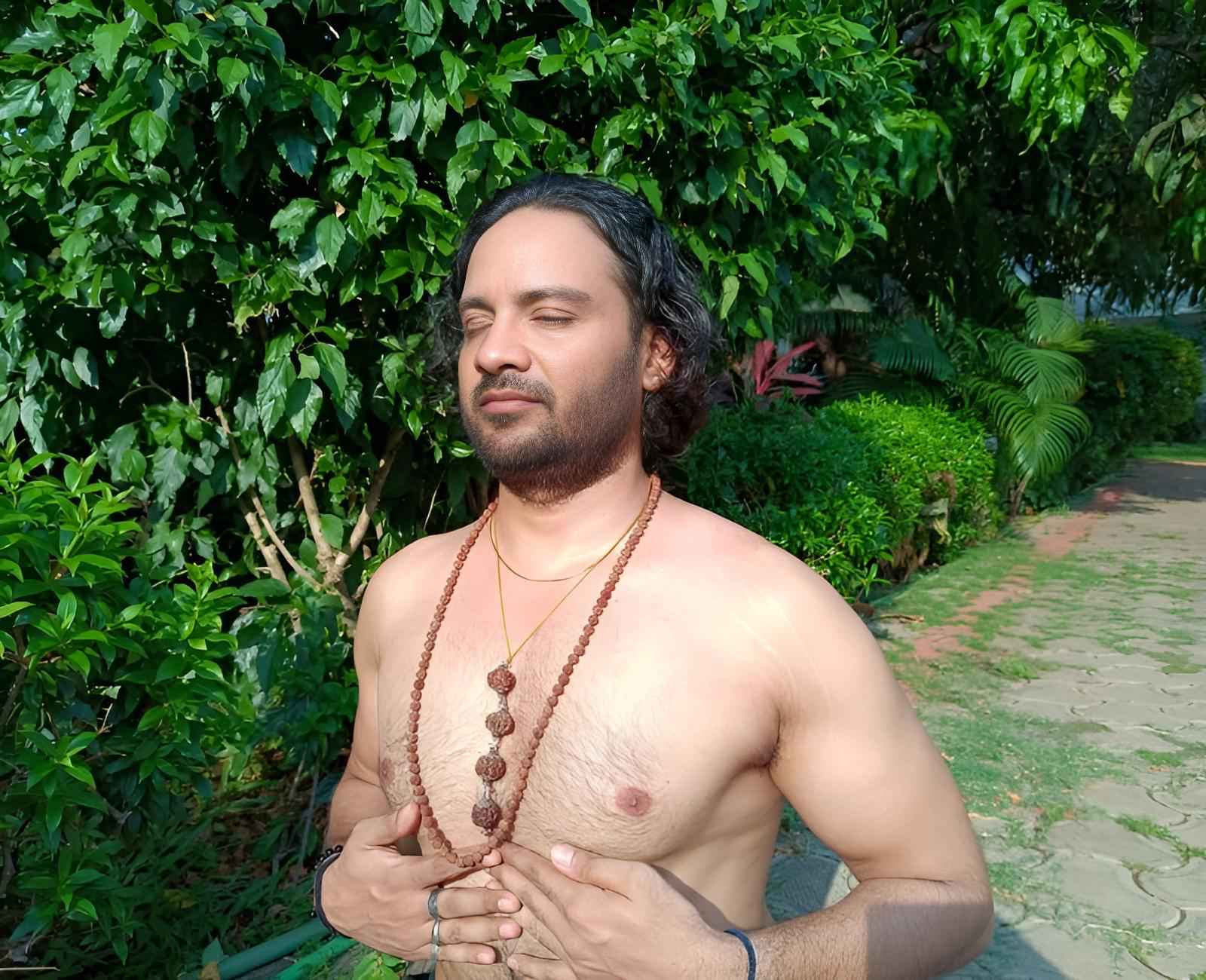
A Word from Pradip Krishna
If You’re Considering Joining the 200-Hour Training, Here’s What You Should Know Before You Arrive
This isn’t a performance-oriented program. It’s a practice-based immersion designed to build nervous system regulation and authentic teaching capacity over time. The cohort is small, the pacing is gradual, and the lineage is Satyananda-inspired — not the 3HO version most people encounter first.
We don’t promise a dramatic awakening in 28 days. We do promise a genuine foundation that will support your practice and teaching for years to come.
The training environment in Goa is deliberately quiet. No competition. No rush to “get through” material. Just daily practice, direct feedback, and enough space for the nervous system to actually settle into the work rather than just survive it.
If that sounds like what you’re looking for, the full curriculum is covered on the 200-Hour Training page.
Coming Soon: A dedicated orientation video where I walk you through the training structure, what to expect in Goa, and answer common questions.
Check back or follow our YouTube channel for updates.
Support
Frequently Asked Questions
Is Kundalini Yoga Teacher Training in India recognized by Yoga Alliance?
Yes, when the specific school is Yoga Alliance-registered — this should always be verified directly on the Yoga Alliance website rather than assumed from a program’s marketing.
Do I need to speak Hindi or have any Indian cultural background to train in India?
No. Training is conducted in English at essentially every established yoga school in India, including Goa, and the majority of students at any given training are international.
Is Goa safe for solo travelers attending a yoga teacher training?
Goa is one of India’s most internationally visited and tourism-developed states, with an established infrastructure for long-stay foreign visitors; as with travel anywhere, ordinary precautions around accommodation, transport, and personal safety apply.
How long is a Kundalini Yoga Teacher Training course?
Programs are most commonly offered at 100-hour (foundational) and 200-hour (full certification) lengths, typically delivered residentially over roughly three to four weeks in India, compared with several months when spread across evenings and weekends elsewhere.
Can I go straight from a Kundalini Yoga Teacher Training into teaching?
Technically, yes, once certified — but most traditional programs, including this one, encourage several months of continued personal practice and integration before taking on students, rather than teaching immediately after graduation.
Is Kundalini Yoga Teacher Training in India the same as Yogi Bhajan / 3HO Kundalini Yoga?
Not necessarily, and this is worth confirming for any specific school. Programs across India teach different lineages — some Satyananda or Sivananda-inspired, some Himalayan-tradition, some directly modeled on Yogi Bhajan’s 3HO system. The country doesn’t determine the lineage; the individual school does.
Final Word
The Actual Decision
India doesn’t make a Kundalini Yoga Teacher Training authentic by default, and Goa doesn’t make it calm by default. What actually determines whether a training is worth your time and money is the same short list wherever it happens: a named, verifiable lineage; a teacher with real tenure inside that lineage; a group small enough for direct feedback; a curriculum that goes beyond technique into judgment and safety; and formal recognition that travels with the certificate once the training ends.
India adds immersion, cost advantage, and proximity to where these traditions actually developed. Goa adds a training environment built for regulation rather than stimulation. Neither replaces the due diligence in the checklist above — it’s just a better setting to do that due diligence in.
If an immersive, Satyananda-lineage residential training in Goa is what you’re weighing, the 200-Hour Kriya Kundalini Yoga Teacher Training page covers the full curriculum, structure, and admissions process. If travel isn’t possible right now, the Upward Spiral online program offers a genuine entry point into the same lineage from wherever you are.
Ready to Train in India?
Authentic Lineage, Immersive Experience, Goa
Whether you choose the full 200-hour residential immersion or the online Upward Spiral program, the same Satyananda-inspired curriculum awaits — guided by teachers who live this tradition.
200-Hour Kundalini Teacher Training
Join our residential programme in Goa — small cohort, daily practice, and a curriculum built for nervous system regulation and authentic lineage transmission.
Explore Training →Upward Spiral Online Program
Can’t travel right now? Start with our live, cohort-based online course — 60 contact hours, the same lineage, from wherever you are.
Explore Online →Master Resource Library
Explore the Kundalini Master Resource Library
We are building one of the web’s most comprehensive evidence-informed libraries on traditional Kundalini Kriya Yoga, integrating authentic yogic wisdom with modern scientific research. New in-depth guides are continuously researched, written and added to expand this growing knowledge hub for students, practitioners and yoga teachers worldwide.
Foundations
- Complete Kundalini Yoga Guide
- What is Kundalini Yoga? History, Origins & Philosophy
- Kundalini Yoga vs Hatha Yoga
- Understanding the Seven Chakras
- Kundalini Yoga: Myths & Misconceptions
Practices & Techniques
- What is a Kundalini Kriya?
- Breath of Fire (Agni Prana) — full mechanics, pacing, contraindications
- Kundalini Mantras Explained — how sound functions
- Understanding Bandhas — the three locks in depth
- Daily Kundalini Yoga Practice
Science & Research
- The Science of Kundalini Yoga
- Kundalini Yoga & the Vagus Nerve
- Meditation & Brain Plasticity
- Kundalini Yoga for Anxiety & Stress
Kundalini Awakening
- Signs of a Genuine Kundalini Awakening
- Preparing the Body for Kundalini Practice
- Understanding Kundalini Syndrome
Medical Disclaimer:
The information presented in this article is intended solely for educational purposes and should not be interpreted as medical advice, diagnosis, or treatment. Individual responses to breathing, movement, and meditation practices vary. Always consult a qualified healthcare professional before beginning any new practice, particularly if you have cardiovascular disease, epilepsy, uncontrolled hypertension, psychiatric conditions, pregnancy, or any other medical concern.
Sources
Authoritative Outbound Sources
The following sources underpin the claims made in this article — each one is a primary, peer-reviewed, or otherwise authoritative resource that supports the comparisons, lineage distinctions, and practical guidance offered above.
- Yoga Alliance — RYS 200 Standards Official standards for Registered Yoga Schools offering 200-hour teacher training, including curriculum requirements and accreditation guidelines.
- Bihar School of Yoga — Kundalini Tantra The foundational text by Swami Satyananda Saraswati that defines the Satyananda lineage of Kundalini Kriya Yoga, covering chakras, kriyas, and safety guidelines.
- PMC — Neurophysiological Effects of Kundalini Peer-reviewed research from the NIH database on the neurophysiological effects of Kundalini practice, including cortisol regulation and autonomic nervous system function.
- NIH — Yoga & Nervous System Regulation Research on how yoga affects the nervous system, supporting the claims about Kundalini’s impact on the vagus nerve and parasympathetic response.
- Hatha Yoga Pradipika — Sacred Texts One of the most important classical Hatha Yoga texts, foundational to the Kundalini Kriya Yoga tradition. Direct access to the source material.
- Ministry of AYUSH — Government of India The official Indian government body regulating Ayurveda, Yoga, and traditional medicine systems. Source of official standards and guidelines.
- NCERT — Yoga Education Curriculum India’s national curriculum body, which includes yoga education in its framework, providing official educational standards.
- The Guardian — Kundalini Yoga & Spiritual Abuse Mainstream media coverage of the investigation into Yogi Bhajan and the broader conversation about accountability in spiritual communities.
- Religion News Service — Yogi Bhajan Investigation Independent investigative report commissioned by 3HO-affiliated organizations, concluding that it is “more likely than not” that Yogi Bhajan engaged in serious abuse.
Note: These sources are provided for independent verification of the claims made in this article. They represent a mix of classical texts, peer-reviewed research, official government bodies, and mainstream journalism — all selected to support your research without directing traffic to competing yoga schools.