
Signs of a Genuine Kundalini Awakening: 7 Stages & How to Tell
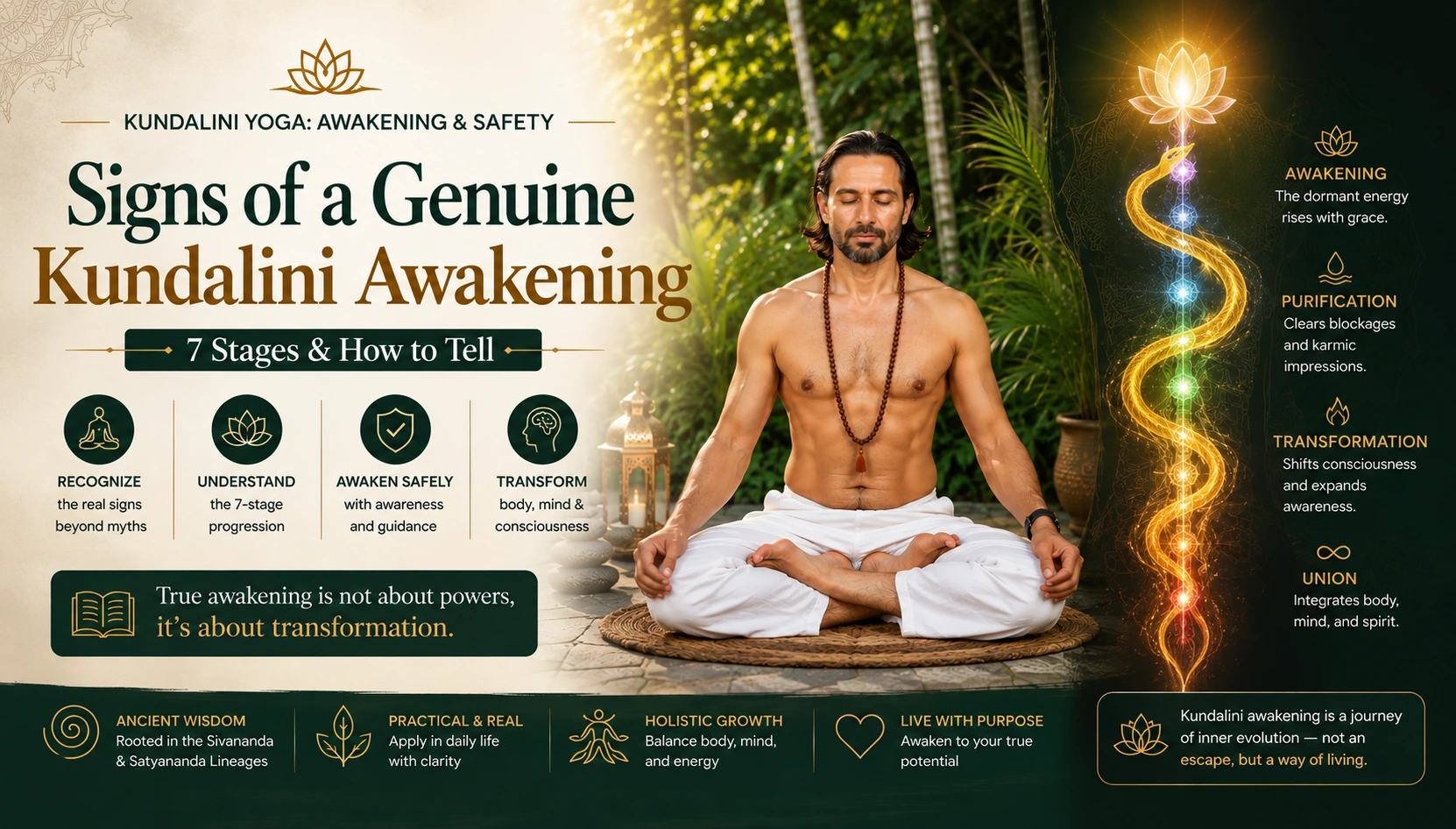
Kundalini Yoga: Awakening & Safety
Signs of a Genuine Kundalini Awakening
Search this topic and you’ll find dozens of lists claiming to tell you whether you’re “awakening.” Almost none of them tell you how to tell a genuine process apart from ordinary stress, a mental health crisis, or simple wishful thinking — and that distinction is the part that actually matters.
New to this topic? Start with our foundational Complete Kundalini Yoga Guide for the classical roots this article builds on.
Definition
What “Genuine” Actually Means Here
A genuine kundalini awakening, in the classical framework this tradition draws from, is the movement of a specific dormant energetic potential along the central channel (sushumna nadi), through the chakras, typically arising from — and following — sustained spiritual practice. That last part matters more than most content on this topic acknowledges: a genuine awakening has context. It doesn’t usually appear out of nowhere in someone with no prior practice, and it doesn’t announce itself through a single dramatic event so much as an unfolding process with real signs a practitioner can learn to recognize.
That framing rules out two things this article deliberately doesn’t do. It won’t hand you a checklist where any five of ten vague feelings mean “you’re awakening” — ordinary stress, sleep deprivation, and grief can produce several of the symptoms commonly listed elsewhere. And it won’t pretend every intense experience described in spiritual language is automatically benign. Some genuinely aren’t, and pretending otherwise does real harm.
Rooted in text, not trend: For the broader philosophical and physiological grounding this article assumes, see The Science of Kundalini Yoga & the Nervous System.
Tradition
Classical Signs, According to the Sivananda Tradition
Swami Sivananda’s own writing on this subject describes a fairly specific set of signs, considerably more precise than “you’ll just feel different.” In Kundalini Yoga (1935), he writes:
“When Kundalini awakens, the aspirant feels a current of Prana rising to Sahasrara. He feels vibrations of that energy. There is a current like that of electricity flowing up and down along the nerves. He experiences genuine bliss, spontaneous insight, and inner vision. A chakra is felt as intensely hot while Kundalini is there, and becomes cold once it moves on.”
One specific detail worth knowing, because it’s rarely mentioned outside classical sources: as kundalini is active at a given chakra, that center is often felt as distinctly hot — and once the energy has moved on to the next center, the one it left behind can feel unusually cold, almost inactive by comparison. That heat-then-cold pattern, tracking upward through the centers, is a more precise and traceable sign than the generic “energy moving through your body” language most modern content settles for.
These classical signs are also, notably, more restrained than what circulates online today. There’s no mention of psychic downloads, aura reading, or sudden fluency in ancient wisdom — additions that seem to have accumulated as the concept passed through decades of Western spiritual marketing.
Stages
The 7-Stage Progression of Awakening
The tradition treats this as a gradual unfolding with distinct stages, each preparing the ground for the next:
Stage 1 — Preliminary Signs: Increased energy, vivid dreams, spontaneous movement during meditation, a general sense that “something is shifting.” This stage often lasts months or years and is frequently dismissed as coincidence.
Stage 2 — Physical Purification: Digestive changes, altered sleep patterns, spontaneous release of physical tension through involuntary movements or sounds, a heightened sensitivity to food and environment.
Stage 3 — Emotional Release: Surfacing of old grief, fear, and stored emotion. This can feel like a rollercoaster — genuine bliss alternating with real distress, sometimes within the same day. This is where many practitioners mistake the process for something “wrong.”
Stage 4 — Mental Clarity and Intuition: Sharpened insight, spontaneous understanding of things that were confusing, enhanced intuition, a pull toward solitude and away from environments that feel draining.
Stage 5 — Chakra-by-Chakra Ascent: Heat rising through each center, specific sensations at each chakra, the heat-then-cold pattern Sivananda described. This is where the process becomes unmistakable, and where guidance becomes essential.
Stage 6 — Integration and Settling: The energy stabilizes. The intensity resolves. Ordinary life returns — but different. The person who emerges is not the same one who began the process.
Stage 7 — Sahasrara and Beyond: The culmination. The energy reaches the crown, and the practitioner experiences a lasting shift in consciousness — not a permanent “high,” but a fundamental reorientation of how they experience themselves and the world.
Teacher’s Note: I have seen students rush through these stages, eager to “get to the good part.” Forcing the later stages before the earlier ones have genuinely settled is one of the more common causes of the difficult, destabilizing experiences that give this whole topic its troubling reputation online. This is exactly why the tradition’s actual technology for this work exists in the first place.
Body
Physical Signs
- Heat or vibration along the spine and chakra points — often described as warmth or a pulsing sensation concentrated in specific areas, consistent with the classical description above.
- Spontaneous movement — involuntary shifts in posture, breath, or sound during meditation, generally understood as the body working through held tension as energy moves.
- Changes in sleep — vivid dreams, lighter sleep, or periods of reduced need for it.
- Waves of energy or tingling in the hands, feet, or along the spine, ranging from mild to intense.
None of these, on their own, confirm anything. The same sensations show up in ordinary nervous-system activation from intensive breathwork, from stress, and occasionally from unrelated physical causes worth ruling out with a doctor first.
Heart
Emotional and Psychological Signs
As energy moves through the lower centers particularly, stored emotional material tends to surface — old grief, old fear, patterns a person had stopped consciously carrying but hadn’t actually resolved. This can genuinely feel like a rollercoaster: real bliss alternating with real distress, sometimes within the same day.
Heightened sensitivity is common too — to other people’s emotional states, to noise, to environments that used to feel neutral. A pull toward solitude and honest conversation, and away from small talk or environments that feel draining, is frequently reported alongside this.
The emotional intensity itself isn’t the concerning part. What matters is whether a person retains a clear sense of their ordinary reality and identity throughout it — which brings us to the section further down that actually matters most for safety.
Mind
Mental and Perceptual Signs
Increased mental clarity, sharper intuition, and a sense of expanded awareness are commonly described as the energy reaches the upper centers. Some describe moments of spontaneous insight — a sudden, clear understanding of something they’d been confused about for years.
A genuine process, even at its most intense, tends to leave a person able to say afterward: “that was strange, but I knew it was happening to me, and I knew who I was throughout it.” That thread of ordinary self-recognition — even inside an extraordinary experience — is one of the clearest markers separating this from something that needs a different kind of help entirely.
Order
Why the Sequence Matters
The tradition treats this as a gradual unfolding, not a single event — general spiritual growth and inner readiness first, then the more specific activation of kundalini itself, then its rise through the chakras. Each stage is understood to prepare the ground for the next.
Forcing the later stages before the earlier ones have genuinely settled — through intense, unsupervised practice aimed specifically at “triggering” an awakening — is one of the more common causes of the difficult, destabilizing experiences that give this whole topic its more troubling reputation online. This is exactly why the tradition’s actual technology for this work — kriya practice built from posture, breath, sound, and lock together, taught in sequence over time — exists in the first place: not as ritual, but as the thing that makes gradual, well-prepared unfolding more likely than a forced one.
Clarity
What Isn’t a Kundalini Awakening
Because the symptom list above is broad, it’s tempting to attach the label to almost any intense experience — a hard breakup, a panic attack, ordinary burnout, a particularly moving meditation retreat. Most of the time, that’s a misattribution, not a diagnosis. Intensity alone isn’t the signal; the pattern, and its relationship to sustained practice, is.
A quick but important distinction: the tradition this article draws from — the Sivananda–Satyananda lineage of Kriya Kundalini Yoga — is not the same as the system taught by Yogi Bhajan through 3HO. The two are often conflated online. The practical differences in how awakening is understood, taught, and supported are real — and worth knowing when evaluating advice on this subject.
This gets confused further by a real trap worth naming directly: treating every uncomfortable feeling that shows up during spiritual practice as automatically meaningful or automatically transcendent, rather than sometimes just being an ordinary emotion that deserves ordinary attention. We go into this pattern in more depth in Demystifying Kundalini Myths.
Safety
When It Might Be Something Else
This is the part most content on this topic avoids, and it’s the part worth taking most seriously. There is a real, documented overlap between what’s described as kundalini awakening and what clinicians recognize as psychosis or a broader spiritual emergency — the overlap is significant enough that it appears in the psychiatric case-report literature, not just in spiritual forums.
A 2014 study by Greyson and colleagues documented cases where individuals presenting with psychotic symptoms had experiences that were clinically indistinguishable from descriptions of kundalini awakening. A 2021 case report by Pereira and colleagues described a patient with a “kundalini-like syndrome” that resolved through a combination of psychiatric support and spiritual guidance. The literature is clear: this isn’t just a niche concern.
A few distinctions the literature and experienced teachers both point to, without being definitive on their own:
- Context: a genuine process usually arises from — and during — sustained spiritual practice, rather than appearing with no relationship to any practice at all.
- Retained insight: a person going through a genuine process typically knows something unusual is happening to them and wants support integrating it. Losing that thread of self-recognition — genuine confusion about what’s real, or a conviction that isn’t open to any outside perspective — is a different and more serious situation.
- Functioning: if someone can no longer work, sleep, maintain basic relationships, or keep themselves safe, that’s a threshold for professional support regardless of how the experience is being interpreted spiritually.
None of this is a framework for self-diagnosis, and this article isn’t the place to attempt one. If you or someone practicing with you is experiencing severe distress, disorientation, or any loss of touch with ordinary reality, the right next step is a qualified mental health professional — ideally one who won’t dismiss the spiritual context out of hand, but who can also properly assess whether something clinical is happening underneath it. Spiritual framing and psychiatric care aren’t in competition here; a genuine spiritual crisis often benefits from both at once. For a deeper look at the traditional safety guidelines within the Tantric framework, see our guide to Tantric safety guidelines.
Practice
Why Guided, Gradual Practice Matters
Most of what makes this process destabilizing isn’t the energy itself — it’s an unprepared system meeting it too fast, without anyone present who can actually observe how a specific person is responding and adjust accordingly. That’s the entire argument for learning this practice from a teacher over time, rather than assembling it from isolated videos: not tradition for its own sake, but because pacing is the actual safety mechanism.
A qualified teacher does more than demonstrate technique. They observe the color of your skin, the sound of your breath, the quality of your energy, and the flickering of your eyes — subtle signs that tell them whether the process is unfolding safely or moving too fast. You cannot get this feedback from a screen, and you cannot replace it with a checklist.
Support
Frequently Asked Questions
Is kundalini awakening the same as psychosis?
No, but there is real, documented overlap between how each is described and experienced, which is why the topic appears in psychiatric case-report literature. A genuine process tends to arise from sustained practice and preserve a person’s sense of ordinary self-recognition throughout. Loss of reality-testing, severe functional impairment, or a conviction that dismisses all outside perspective points toward needing professional mental health support, regardless of how the experience is being spiritually framed.
Can kundalini awakening happen spontaneously, with no prior practice?
It’s described in the tradition as usually arising from sustained spiritual practice, though spontaneous cases following intense life events are also discussed in the literature. Spontaneous, unprepared awakening is generally considered higher-risk than one that unfolds gradually through consistent practice.
What is kundalini syndrome?
A term used for a more severe, destabilizing version of this process — typically involving persistent, overwhelming symptoms that go beyond the more integrated signs described above. It’s generally associated with energy moving too quickly through an unprepared system, most often from forced or unsupervised practice.
How long does a kundalini awakening last?
There’s no fixed timeline. The tradition treats it as an unfolding process rather than a single event, and a gradual, well-supported version tends to integrate more smoothly than a sudden, forced one.
What should I do if I think I’m experiencing a kundalini awakening?
Slow down rather than intensify your practice, seek a qualified teacher who can observe your specific experience directly rather than relying on an article or checklist, and if the experience includes severe distress or any loss of touch with ordinary reality, involve a mental health professional alongside any spiritual guidance.
What’s the difference between the Sivananda-Satyananda lineage and Yogi Bhajan’s 3HO system?
The Sivananda-Satyananda lineage teaches Kriya Kundalini Yoga rooted in classical Hatha Yoga and Tantra. The Yogi Bhajan/3HO system is a distinct tradition created in the West in 1969, with its own sequencing, Gurmukhi mantras, and organizational structure. Both are legitimate practices, but they are not the same tradition, and their approaches to awakening differ significantly.
Master Resource Library
Explore the Kundalini Master Resource Library
We are building one of the web’s most comprehensive evidence-informed libraries on traditional Kundalini Kriya Yoga, integrating authentic yogic wisdom with modern scientific research. New in-depth guides are continuously researched, written and added to expand this growing knowledge hub for students, practitioners and yoga teachers worldwide.
Foundations
- Complete Kundalini Yoga Guide
- What is Kundalini Yoga? History, Origins & Philosophy
- Kundalini Yoga vs Hatha Yoga
- Understanding the Seven Chakras
- Kundalini Yoga: Myths & Misconceptions
Practices & Techniques
- What is a Kundalini Kriya?
- Breath of Fire (Agni Prana) — full mechanics, pacing, contraindications
- Kundalini Mantras Explained — how sound functions
- Understanding Bandhas — the three locks in depth
- Daily Kundalini Yoga Practice
Science & Research
- The Science of Kundalini Yoga
- Kundalini Yoga & the Vagus Nerve
- Meditation & Brain Plasticity
- Kundalini Yoga for Anxiety & Stress
Kundalini Awakening
- Signs of a Genuine Kundalini Awakening — this article
- Preparing the Body for Kundalini Practice
- Understanding Kundalini Syndrome
Learn With Guidance, Not Guesswork
This Process Deserves a Teacher Watching How You Respond
Everything above is the “what” and the “why.” Recognizing your own experience with any real accuracy happens in relationship with a teacher — not from a symptom checklist, however thorough.
200-Hour Kriya Kundalini Yoga Teacher Training
Our residential program in Goa, built around the gradual, prepared approach this article describes.
Learn About the 200-Hour Training →Explore Our Online Yoga Courses
Not ready for a residential commitment? Browse our full range of online offerings.
View Online Courses →Sources
Authoritative Sources
The following sources underpin the classical and clinical claims made in this article — each one is a primary or peer-reviewed resource that supports the distinction between genuine kundalini awakening and its documented overlap with spiritual emergency.
Swami Sivananda — Kundalini Yoga
The classical text that describes the precise signs of awakening — prana rising to Sahasrara, electric-like currents, and the heat-then-cold pattern at each chakra.
Read the Classical Source →Sharma et al. (2022) — Indian J Psychol Med
A peer-reviewed case report of a 19-year-old whose unguided kundalini practice led to a catatonic psychotic episode — explicitly citing Sivananda’s signs and coining the term “kundalini psychosis syndrome.”
Read the Case Report →Suchandra et al. (2021) — Complement Ther Clin Pract
A clinical review examining how kundalini-like experiences can mimic mental illness, and why unguided advanced practice carries real side effects.
Read the Review →Sourial S. — Royal College of Psychiatrists
A first-person account by a psychiatric nurse whose brief psychotic episode was later reframed as a kundalini spiritual awakening — demonstrating the real-world complexity of discernment.
Read the Personal Account →Medical Disclaimer:
The information presented in this article is intended solely for educational purposes and should not be interpreted as medical advice, diagnosis, or treatment. Individual responses to kundalini practice vary considerably. Always consult a qualified healthcare professional before beginning any new practice or if you are experiencing severe distress, disorientation, or any loss of touch with ordinary reality.