What is Kundalini Jagran? Kundalini Shakti and the Tantric Path of Awakening
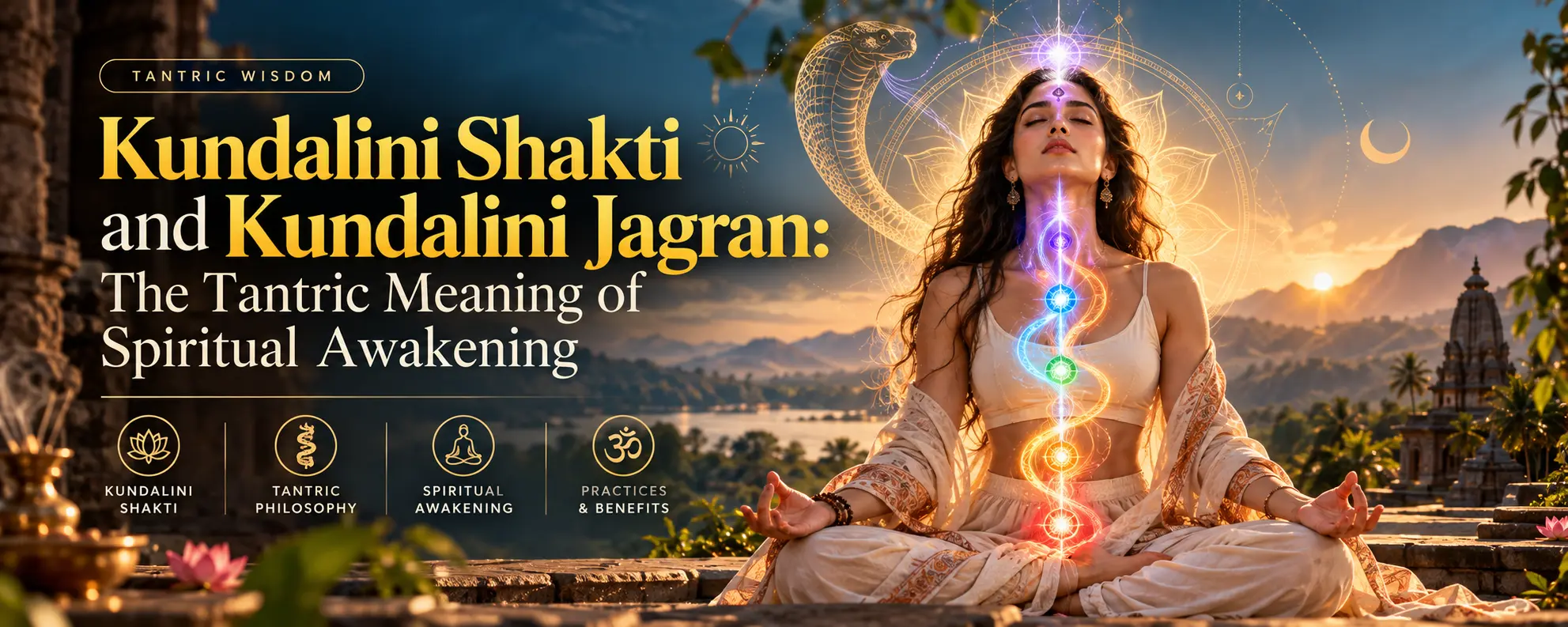
Kundalini Shakti and Kundalini Jagran: The Tantric Meaning of Spiritual Awakening
Kundalini Shakti is the Divine Feminine power that yogic and Tantric traditions say rests, coiled, at the base of the spine in every person. Kundalini Jagran is the awakening of that power.
Kundalini Shakti is the Divine Feminine power that yogic and Tantric traditions say rests, coiled, at the base of the spine in every person. Kundalini Jagran (कुंडलिनी जागरण) is the awakening of that power: its rising along the central channel (sushumna) to unite with Shiva, pure consciousness, at the crown. Tradition describes it as a gradual inner transformation, not a supernatural power-up.
Two people can type "kundalini power" into a search box and mean opposite things. One wants energy, charisma or special abilities. The other wants freedom from suffering. The tradition sits firmly in the second camp, and understanding why changes how you practise.
This article explains what Kundalini, Shakti and Jagran actually mean, where the teaching comes from, and what "awakening" looks like in the Tantric view. For the full overview of the subject, start with our complete guide to Kundalini Yoga.
- Kundalini is the individual's share of Shakti, the creative power of the universe.
- Jagran means waking or awakening. Kundalini Jagran is the awakening of that power.
- In Tantra the goal is union of Shakti and Shiva (power and consciousness), not the acquisition of abilities.
- The traditions describe a gradual, guided process, and good teachers pace it carefully.
01. What do "Kundalini," "Shakti" and "Jagran" mean?
| Term | Devanagari | Meaning | Note |
|---|---|---|---|
| Kundalini | कुण्डलिनी | From kuṇḍalī, "ring" or "coil" | The "coiled" power, pictured as a sleeping serpent |
| Shakti | शक्ति | Power, energy; the Divine Feminine | Personified as the Mother Goddess (Devi) |
| Jagran / Jagaran | जागरण | Waking, awakening | Also used for devotional night vigils (see below) |
| Kundalini Jagran | कुंडलिनी जागरण | Awakening of Kundalini | The usual Hindi and Sanskrit phrase for the process |
| Sushumna | सुषुम्णा | The central energy channel along the spine | The route Kundalini is said to travel |
| Shiva | शिव | Pure consciousness | The still, witnessing principle |
Sir John Woodroffe, who introduced the Tantric teaching on Kundalini to English readers, explained the name simply: kundala means coiled, and the power is the Goddess Kundalini, pictured as a coiled, sleeping serpent in the lowest centre at the base of the spine until she is aroused by the yoga named after her.
02. Shiva and Shakti: the idea behind Kundalini Jagran
The core of the teaching is a pairing. Shiva is pure consciousness: still, aware, without action. Shakti is the power through which consciousness appears, moves and creates. Tantra holds that neither works without the other. Shiva without Shakti is inert, and Shakti without Shiva has no ground.
Apply that to a human being and you get the Kundalini map:
- Shakti rests in the individual at the muladhara, the root centre, as Kundalini.
- Shiva is located at the sahasrara, the crown, as pure awareness.
- Kundalini Jagran is the movement from one to the other, ending in union.
Woodroffe stressed that Shakti is not blind force. In the Tantric reading she is power that is also awareness and bliss — a core tenet of Kundalini Tantra. That is why the tradition talks about Kundalini as the Divine Mother, not as a battery to be charged.
03. Where the teaching comes from
| Source | Approximate period | What it adds |
|---|---|---|
| Yoga Upanishads (including the Yoga-Kundalini Upanishad) | Classical | Name Kundalini as the Shakti and link her to posture, diet and breath |
| Śāradātilaka Tantra | About the 11th century | An early Tantric text that describes Kundalini as a serpent-like Shakti |
| Hatha Yoga Pradipika (Svatmarama) | 15th century | Systematic methods: asana, pranayama, mudra and bandha |
| Shat-Chakra-Nirupana (Purnananda) | 16th century | The map of six chakras and Kundalini's ascent |
| The Serpent Power (Sir John Woodroffe) | 1919 | English translation and commentary; the Western gateway to the subject |
| Swami Sivananda and Swami Satyananda Saraswati | 20th century | Sivananda's Kundalini Yoga; Satyananda's Kundalini Tantra from the Bihar School of Yoga |
This is a living lineage of texts, teachers and practice, not a modern wellness invention. Respecting that is part of practising it well.
04. The inner map: sushumna, chakras and granthis
On the Tantric map, two side channels (ida and pingala) carry the ordinary currents of breath and mind, and the central channel, the sushumna, is where Kundalini travels. Along the way sit the chakras, and three "knots" (granthis) named for Brahma, Vishnu and Rudra, which the tradition describes as points of attachment where the ascent meets resistance: roughly the root and sacral region, the heart region, and the brow.
For a detailed tour, read Understanding the 7 Chakras and Their Role in Kundalini Energy. For the modern physiological view, including the vagus nerve and autonomic regulation, see the science of Kundalini Yoga and the nervous system.
05. Three paths to Kundalini Jagran in the Indian traditions
| Path | Core tools | Emphasis |
|---|---|---|
| Hatha and Raja | Asana, pranayama, mudra, bandha, meditation | Preparing the body and mind; the route of the Hatha Yoga Pradipika |
| Tantric and Shakta | Mantra, yantra, devotion to Devi, ritual, shaktipat | Relationship with Shakti and the guide who transmits the lineage |
| Kriya | Defined sequences combining posture, breath, sound and awareness | Precision: each kriya works on a particular effect |
In practice these overlap. A good Kundalini Kriya practice blends all three: the discipline of Hatha, the devotion of Tantra and the precision of kriya. If you'd like to understand how a kriya actually works, read What is a Kundalini Kriya?. And if you are comparing styles, Hatha vs Kundalini Yoga lays out the differences clearly.
06. What "Kundalini power" really means (and what it doesn't)
The phrase "kundalini power" attracts the wrong expectations, so let's separate fact from fantasy.
- It is not a superpower. Traditional texts mention extraordinary abilities (siddhis) as distractions, not goals.
- It is not a force to conquer. The tradition speaks of cooperation, humility and devotion, not domination.
- It is not a quick fix. The texts frame it as the fruit of sustained practice and ethical living.
- It is not reserved for ascetics. Householders, teachers and monks all appear in the tradition. Research with a Kundalini tradition has studied all three groups (Edwards & Woollacott, 2022).
- It is not gender-specific. Shakti is the inner power of every person.
Several of these misunderstandings are covered in more depth in Demystifying Kundalini Myths.
07. How a Kundalini Jagran really unfolds
In the Tantric view, the first awakening is character, not fireworks. Before any dramatic sensation, the signs are quieter: more patience, less reactivity, a steadier mind, a deeper capacity to be with discomfort. That is why the classical paths insist on ethical living (yama and niyama) before intensive practice.
The physical and energetic experiences some people report, such as heat, tingling, spontaneous movements and vivid inner imagery, are documented in research. A 2021 study of 152 people with spontaneous spiritual or kundalini awakenings found kundalini awakenings to be more physical than other spiritual awakenings, though overall rated as more positive than negative, even when initially challenging (Corneille & Luke, Frontiers in Psychology). Clinicians have also published case reports of kundalini-type experiences that presented as psychosis, which is exactly why pacing, screening and a good teacher matter.
If you want to see what is normal and what is not, read the signs of a genuine kundalini awakening, and if you are preparing to practise seriously, start with how to prepare your body for kundalini awakening.
08. Kundalini Jagran vs a "jagran" (the vigil)
Searchers in India often meet both meanings, so here is the difference.
| Kundalini Jagran | Jagran (vigil) | |
|---|---|---|
| What it is | The inner awakening of Kundalini energy | A devotional night-long gathering of prayer and singing, such as a Mata ka Jagran |
| Where it happens | Within the practitioner | In a home, temple or community space |
| Shared idea | Both come from the same root idea of waking |
A jagran vigil can be a beautiful devotional practice. It is simply not the same thing as the yogic process of Kundalini awakening.
09. A 10-minute daily practice to honour Shakti
You don't need an intense practice to build a relationship with Kundalini Shakti. Here is a gentle daily routine suitable for most healthy adults.
- Sit tall (2 min). Feel the base of the spine and the crown of the head, and the line between them.
- Easy alternate-nostril breathing (3 min). Slow, quiet and even.
- Mantra (3 min). Repeat Om, or a mantra given to you by your teacher, in a steady rhythm. For ideas, see Top Kundalini Mantras and the Science of Sound Healing.
- Silent awareness (2 min). Rest your attention along the spine. Don't try to make anything happen.
Keep it consistent rather than intense. If you have a history of psychosis, mania, epilepsy, high blood pressure or are pregnant, get medical guidance before adding stronger breathwork.
10. Do you need a guru for Kundalini Jagran?
Classical Tantric and yogic traditions put great weight on a qualified teacher, especially for intensive practices. The reason is practical: a teacher can see what you can't, adjust the pace, and help you integrate what arises. Gentle foundations such as posture, breath and meditation can be begun with a good teacher or course, while advanced techniques and any form of shaktipat belong inside a trusted relationship and lineage.
When choosing a teacher, ask about their lineage, their training, how they screen students for health conditions, and how they support integration. Be cautious of anyone who guarantees awakening or pressures you to commit quickly.
Frequently asked questions
What is Kundalini Shakti?
Kundalini Shakti is the Divine Feminine power that Tantric and yogic traditions describe as resting, coiled, at the base of the spine. Kundalini comes from the Sanskrit for "coil," and Shakti means power or energy: together, the coiled power within every person.
What does Kundalini Jagran mean?
Kundalini Jagran (कुंडलिनी जागरण) means the awakening of Kundalini. In Hindi and Sanskrit, jagran means waking or awakening. In this context it refers to the rousing of Kundalini Shakti so that it moves up the central channel (sushumna) towards the crown.
Is Kundalini Jagran the same as a jagran vigil?
No. A jagran in popular Indian usage is usually an all-night devotional vigil of prayer and singing. Kundalini Jagran refers to the inner awakening of Kundalini energy, although both come from the same idea of waking.
What is the difference between Shakti and Kundalini?
Shakti is the universal creative power. Kundalini is that same power as it exists, in dormant form, within an individual body. Tantra treats Kundalini as the personal expression of cosmic Shakti.
Is Kundalini power dangerous?
Kundalini is not a weapon or a superpower, and the traditions describe a gradual, guided awakening. The risk lies in forcing intense techniques without preparation. Anyone with a history of psychosis, mania or severe anxiety should seek medical guidance before intensive practice.
Do I need a guru for Kundalini Jagran?
Classical traditions emphasise a qualified teacher, especially for intensive practices, because the teacher can adjust the pace and help you integrate experiences. Gentle foundations such as posture, breath and meditation can be started with a good teacher or course.
Can men and women both awaken Kundalini?
Yes. Kundalini Shakti is described as present in every human being regardless of gender. In the Tantric view, Shakti is the inner power of everyone.
Go deeper with a trained teacher
If this article stirred your curiosity, the best next step is guided practice in a lineage that respects the pacing.
Learn online: Kundalini Kriya Yoga Course Browse all courses: Online Yoga CoursesReferences
- Woodroffe, J. (Arthur Avalon). (1919). The Serpent Power: Being the Shat-Chakra-Nirupana and Paduka-Panchaka. Luzac & Co. https://archive.org/details/the-serpent-power
- Svatmarama. Hatha Yoga Pradipika (15th century). https://archive.org/details/hatha-yoga-pradipika
- Corneille, J. S., & Luke, D. (2021). Spontaneous spiritual awakenings: phenomenology, altered states, individual differences, and well-being. Frontiers in Psychology, 12, 720579. https://doi.org/10.3389/fpsyg.2021.720579
- Edwards, L., & Woollacott, M. H. (2022). Analysis of spiritual awakening in a Kundalini tradition: psychological change and spiritual growth. The Journal of Transpersonal Psychology, 54(1), 56–81.
- Awakening of Kundalini Chakras Presenting as Psychosis: A Case Report (2022). Indian Journal of Psychological Medicine, 44(5), 526–528. https://doi.org/10.1177/02537176221082936