Kundalini Tantra: Philosophy, Practice, and Awakening
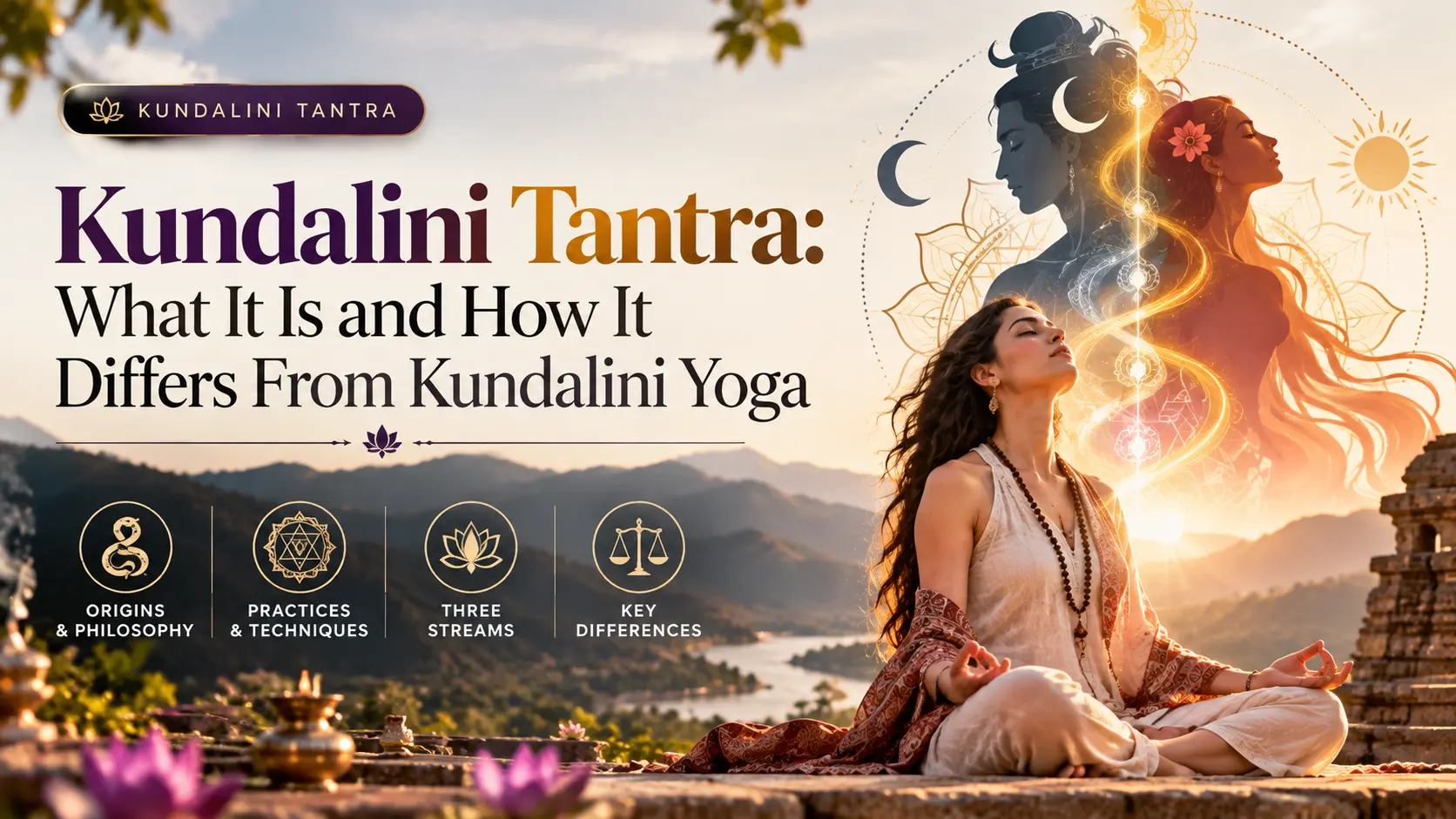
Kundalini Tantra: What It Is and How It Differs From Kundalini Yoga
Kundalini Tantra is the Tantric tradition’s philosophy and practice of Kundalini Shakti — the teaching that a dormant divine power lies coiled in every human being and can be awakened and united with pure consciousness (Shiva). Kundalini Yoga is a practice system, built mostly on posture, breath, bandha, mudra, mantra and kriya, that works with the same energy through the body. Tantra supplies the map and the meaning. Kundalini Yoga is one of the vehicles. They overlap heavily, but they are not the same thing.
Kundalini Tantra is the Tantric tradition’s philosophy and practice of Kundalini Shakti: the teaching that a dormant divine power lies coiled in every human being and can be awakened and united with pure consciousness (Shiva). Kundalini Yoga is a practice system, built mostly on posture, breath, bandha, mudra, mantra and kriya, that works with the same energy through the body. Tantra supplies the map and the meaning. Kundalini Yoga is one of the vehicles. They overlap heavily, but they are not the same thing.
- Kundalini Tantra is the wider tradition: scriptures, philosophy, mantra, ritual and initiation. Kundalini Yoga is a method for working with Kundalini, mostly through body and breath.
- In the classical view, Kundalini Yoga is a part of Tantra, not a rival to it. Swami Satyananda Saraswati said so directly in his 1984 book Kundalini Tantra.
- Early Tantric texts treat Kundalini as a cosmic, mantric power. Later Hatha texts turned it into a personal energy worked through the body (Yudiantara, 2025).
- “Kundalini Yoga” can mean three different things: the classical Sivananda–Satyananda tradition, Kundalini Yoga as taught by Yogi Bhajan, or a modern studio blend. Always ask which one is being offered.
- Tantra is not mainly about sex. The sex-focused product sold in the West is largely a modern invention called neo-tantra.
- Kundalini practice can be intense. Learn gradually, with a qualified teacher, and see a doctor for persistent physical or psychological symptoms.
What is Kundalini Tantra?
Kundalini Tantra is the branch of the Tantric tradition devoted to Kundalini, the latent power said to rest at the base of the human spine. The word kundalini comes from the Sanskrit kundala, a coil or ring, which is why she is pictured as a coiled serpent. Tantra means a loom or a weaving, and is commonly explained as coming from tan (to expand) and tra (to protect or liberate): a system that expands awareness and leads to freedom.
Tantra is not one school. It is a family of Shaiva, Shakta and Kaula traditions, with a parallel Buddhist stream, each with its own scriptures (the Tantras and Agamas), rituals and lineages. What they share is a bold premise: the world and the body are not obstacles to liberation but expressions of divine power (Shakti), so the body itself can be the field of practice.
In this view consciousness (Shiva) is still, and power (Shakti) is what moves. In a human being, Shakti rests dormant at the muladhara, the root centre. Practice awakens her. She rises through the central channel (sushumna) and the chakras, and when she reaches the crown centre (sahasrara), Shiva and Shakti are experienced as one. Traditions describe this as liberation while living. You can read it literally or as a precise map of inner experience. Either way, it is the framework Kundalini Tantra teaches. For the wider foundations, see our complete guide to Kundalini Yoga.
Where does Kundalini Tantra come from?
There is no single founding moment. The ideas developed over more than a thousand years, and dates for early texts are approximate.
- 7th to 12th centuries: the early Tantras. A 2025 review of Tantric texts from this period finds Kundalini presented mainly as a cosmic and mantric force, practised through mantra together with breath control (Yudiantara, 2025).
- Around the 10th and 11th centuries: Kashmir. Non-dual Shaiva thinkers such as Abhinavagupta organised the philosophy of consciousness and Shakti in works like the Tantraloka.
- 15th century: the Hatha Yoga Pradipika. Svatmarama describes Kundalini as a personal energy to be roused through asana, pranayama, mudra and bandha. The same review notes this shift from cosmic force to bodily energy.
- 16th century: the Sat-chakra-nirupana. Purnananda’s text describes the six chakras and the rising of Kundalini. Sir John Woodroffe, writing as Arthur Avalon, translated it as The Serpent Power in 1919, which shaped how the West understands chakras.
- 1935. Swami Sivananda published a book on Kundalini Yoga that reached a wide readership.
- 1984. His disciple Swami Satyananda Saraswati of the Bihar School of Yoga published Kundalini Tantra, a systematic modern manual on kundalini, chakras and twenty kriyas.
- Late 1960s onward. Yogi Bhajan introduced his own style, Kundalini Yoga as taught by Yogi Bhajan, to North America, joining Tantric ideas with Sikh mantras and set sequences.
The pattern is clear: the Tantric framework came first, and the body-based method grew inside it.
How is Kundalini Tantra different from Kundalini Yoga?
Kundalini Tantra is the tradition, with its philosophy, ritual and initiation. Kundalini Yoga is a method of practice within or derived from that tradition. Here is the comparison side by side.
| Kundalini Tantra | Kundalini Yoga | |
|---|---|---|
| What it is | A tradition: scriptures, philosophy, mantra, ritual, initiation | A practice system for awakening and managing Kundalini |
| Question it answers | What is Kundalini, and how do consciousness and power meet? | What do I do, and in what order? |
| Source texts | Tantras and Agamas, Kularnava Tantra, Tantraloka | Hatha Yoga Pradipika, Yoga Kundalini Upanishad, Sat-chakra-nirupana, modern manuals |
| Main tools | Mantra, yantra, nyasa, worship (puja), visualisation, initiation (diksha) | Asana, pranayama, bandha, mudra, kriya, meditation |
| View of the body | A sacred field, a miniature of the cosmos | The instrument to be purified and prepared |
| Emphasis | Devotion, surrender, recognition | Discipline, effort, technique |
| Teacher | Initiation into a lineage usually expected | Often open classes; initiation optional |
| Goal | Union of Shiva and Shakti, liberation within life | Awakened energy, steady mind, expanded awareness, often the same ultimate goal |
| Typical modern form | Courses on Tantric philosophy, mantra and ritual | Studio classes, kriya sets, teacher trainings |
Three differences that matter in practice
- Map versus vehicle. Tantra explains what Kundalini is and why it matters. Kundalini Yoga gives you the exercises. Practising without the map can turn yoga into mere exertion. Studying the map without practice stays theory.
- Cosmic versus personal. In the early Tantras, Kundalini is a power of sound and creation that also lives in you. In Hatha-based Kundalini Yoga she becomes mostly a personal energy to be raised by physical methods. Both views survive in living teaching. For a deeper comparison with Hatha, read our post on the difference between Hatha and Kundalini Yoga.
- Effort versus surrender. Hatha-based practice leans on effort and technique. Tantric practice leans on devotion, mantra and surrender. Good teachers combine both.
Where they overlap
Swami Satyananda put it plainly: Kundalini Yoga is a part of the tantric tradition. Hatha Yoga itself grew in the same Tantric environment, and nearly all classical Kundalini Yoga uses Tantric elements such as mantra and chakra meditation. So when someone asks whether to study Tantra or Kundalini Yoga, the honest answer is usually both, in a sensible order.
What does “Kundalini Tantra Yoga” mean?
People use the phrase for three different things.
- Kundalini Yoga inside its Tantric frame. This is the classical meaning, as in Satyananda’s Kundalini Tantra: asana, pranayama, bandha, mudra and kriya, taught alongside the Tantric theory of chakras, nadis and Shakti.
- A studio label for a blend. Some schools mix Kundalini Yoga with Tantric ideas in their own proportions. Check the syllabus.
- A mislabel for neo-tantra. Workshops focused on sexuality and relationships sometimes borrow the name. That is a modern Western offering and a different subject.
A simple test: if the course teaches chakras, nadis, mantra, kriyas and the Shiva–Shakti framework, it fits meaning 1. If it is mostly intimacy exercises, it is meaning 3.
“Kundalini Yoga” means three different things
I teach within the Sivananda–Satyananda lineage of Kundalini Kriya Yoga, so that is the lens here. I have tried to describe the other streams the way their own practitioners would recognise them.
- Classical Hatha–Tantric Kundalini Yoga (Sivananda, Satyananda, Bihar tradition). Graded practice: asana, pranayama, bandha and mudra first, then kriya, with a guru–student relationship. Here a kriya is a meditative practice that moves awareness along subtle pathways.
- Kundalini Yoga as taught by Yogi Bhajan. A modern system from the late 1960s, taught in open classes. It uses set kriyas, meaning fixed sequences of postures, breath and sound, and Sikh mantras. It borrows Tantric theory but is its own lineage.
- Modern studio blends. Classes that combine elements of the above with general wellness. Quality varies widely.
None is automatically better. They are different products, and the word kriya itself means different things in each. When a studio says Kundalini Yoga, ask which one.
The core ideas of Kundalini Tantra
- Shiva and Shakti. Pure consciousness and the power through which it becomes the world. Our post on the Tantric view of Kundalini Shakti and Jagran goes deeper.
- Kundalini. Shakti in her dormant form within the individual.
- Nadis. The subtle channels of prana. Ida, pingala and sushumna are the three principal ones.
- Chakras. Subtle centres along the spine: six in the classical Tantric scheme, with the seventh, sahasrara, as the crown. See chakras and Kundalini energy.
- Granthis. Three knots (Brahma, Vishnu, Rudra) said to hold Kundalini back until they are loosened.
- Mantra and bija. Sound as a living form of Shakti. Seed syllables are linked with each chakra.
- Yantra and nyasa. Sacred diagrams for focus, and the placing of mantra and awareness on parts of the body.
- Diksha. Initiation by a teacher, which transmits a practice within a lineage.
What do you actually practise in Kundalini Tantra?
Practice is layered, and the order matters.
- Preparation. Cleansing practices, asana for a steady spine and relaxed body, pranayama, and a regular lifestyle with light, nourishing food.
- Bandhas and mudras. Locks and seals that direct prana and steady the mind. Learn more about understanding bandhas in Kundalini.
- Mantra and japa. Repeating a mantra aloud, softly or mentally, including ajapa japa, the spontaneous awareness of the breath-mantra. See our guide to Kundalini mantras and sound healing.
- Chakra and kriya meditation. Moving awareness through the chakras and subtle pathways. Satyananda’s Kundalini Tantra sets out twenty kriyas with their preparatory practices. See our explainer, what is a Kundalini kriya.
- Nyasa and Yoga Nidra. Deep relaxation that uses body-awareness rotation, a method with Tantric roots.
- Ritual and devotion. Worship, yantra, and offering practice to a deity or to the Goddess.
- Integration. Steady daily sadhana, service, and a stable life. Awakening without stability is the risk the tradition warns about most.
Does Kundalini Tantra involve sex?
Not in the way the internet suggests. Classical Kundalini Tantra centres on mantra, meditation, visualisation, ritual and yoga practice. Tantra as a whole is large and varied, and some Kaula lineages include initiated rites with sexual or transgressive symbolism. These are performed only within an initiatory lineage under strict guidance, and are often carried out symbolically or through substitutes. They are very different from the sexuality workshops sold in the West as Tantra, which are modern and called neo-tantra. If a teacher offers you intimate practice as a shortcut to Kundalini, treat that as a warning sign. Our post on Kundalini myths covers more misconceptions.
Is Kundalini Tantra safe?
It is a serious inner discipline, not a wellness trend, and it deserves the care you would give any strong practice.
What can go wrong. Forceful breathing, long holds or late-night meditation can stir up sleeplessness, agitation, palpitations, emotional flooding or a sense of unreality in some people. Teachers across traditions warn against rushing. Kundalini awakening is not a recognised medical diagnosis. Clinicians who meet people in distress after intense practice generally treat the symptoms and the context, and mental-health manuals treat a spiritual or religious problem as a reason to seek help, not as a disorder in itself.
Who needs extra care. People with a history of psychosis, bipolar disorder, severe trauma, panic attacks, epilepsy, or heart and blood pressure conditions should involve their doctor or therapist before intensive breathwork or long meditation.
Ground rules
- Build foundations for several months before strong pranayama or kriya.
- Never force the breath or hold it to the point of strain.
- Keep sleep, meals and daily routine regular.
- Avoid teachers who promise fast awakening, discourage medical advice or ask for secrecy.
- Stop and seek help if you cannot sleep for several nights, feel detached from reality, have physical pain or panic that persists, or have thoughts of harming yourself. In that case, contact a doctor or local emergency services straight away.
To understand what the tradition itself describes, read our post on the signs of a genuine Kundalini awakening. This article is educational and is not medical advice.
How to begin: six steps
- Choose your stream. Decide whether you want the classical Tantric–Hatha path, Yogi Bhajan’s system, or a general class. Ask the school which it teaches.
- Build the base. Spend three to six months on gentle asana, slow breathing and relaxation such as Yoga Nidra. Learn how to prepare your body for kundalini awakening.
- Learn the map. Study the chakras, nadis and the Shiva–Shakti framework from a reliable source.
- Find a teacher you can verify. Ask: Who taught you? Which lineage? How long have you practised? What do you advise if practice becomes disturbing? Avoid vague answers.
- Practise daily. Twenty to thirty minutes at the same time each day beats an occasional long session.
- Watch yourself. Keep a short note on sleep, mood and energy. If you feel unsettled, slow down and ask your teacher.
If you want structured study in the Sivananda–Satyananda tradition, our residential Kundalini Kriya Yoga Teacher Training in Goa runs each January and February, and you can begin with our online yoga courses.
Related terms at a glance
| Term | Meaning | Relation to Kundalini Tantra |
|---|---|---|
| Tantra | Family of scriptures and traditions using ritual, mantra and meditation | The parent tradition |
| Kundalini Yoga | Practice system for awakening Kundalini | A method within or derived from Tantra |
| Kriya Yoga | Advanced meditative techniques, in Satyananda’s system twenty kundalini kriyas | Core practice of the classical stream |
| Hatha Yoga | Physical and breath-based yoga | Grew in a Tantric environment, supplies the body methods |
| Laya Yoga | Yoga of absorption, often through sound and chakras | Close cousin, often included in Kundalini teaching |
| Tantra Yoga | Yoga approached through Tantric philosophy | Often used as a synonym |
| Neo-tantra | Modern Western sexuality and intimacy workshops | A different subject |
| Kundalini awakening | The experience traditions describe when Kundalini becomes active | The aim, and the reason for caution |
Frequently asked questions
What is Kundalini Tantra in simple words?
It is the Tantric teaching about Kundalini, a latent spiritual power said to rest at the base of the spine. Kundalini Tantra explains what that power is, how it moves through the subtle body, and how mantra, meditation, ritual and yoga can awaken it so that individual awareness merges with universal consciousness.
What is the difference between Kundalini Tantra and Kundalini Yoga?
Kundalini Tantra is the wider tradition: philosophy, scriptures, mantra, ritual and initiation. Kundalini Yoga is a method of practice, mainly posture, breath, bandha, mudra and meditation, for awakening the same energy. Classical teachers treat Kundalini Yoga as a branch of Tantra, so the two overlap rather than compete.
Is Kundalini Yoga part of Tantra?
In the classical view, yes. Swami Satyananda Saraswati wrote that Kundalini Yoga belongs to the tantric tradition, and Hatha Yoga itself grew in a tantric environment. Modern variants such as Kundalini Yoga as taught by Yogi Bhajan borrow Tantric ideas but present them within their own framework.
What is Kundalini Tantra Yoga?
The phrase usually means Kundalini Yoga practised within its Tantric framework: kriyas, pranayama, bandhas, mudras and mantra alongside teachings on chakras, nadis and Shakti. It is also used loosely by studios, and sometimes for sexuality-focused workshops, so check the syllabus before enrolling.
Is Kundalini Tantra about sex?
No. Classical Kundalini Tantra centres on mantra, meditation, visualisation, ritual and yoga practice. Some Kaula lineages have initiated rites with sexual or transgressive symbolism, performed under strict guidance and often symbolically. Western workshops that market Tantra as sexual technique are a modern development called neo-tantra.
Is Kundalini Tantra dangerous?
It can be intense if approached carelessly. Forceful breathwork, long meditation and rushed practice can cause sleeplessness, anxiety or disorientation in some people. Gradual preparation and an experienced teacher lower the risk. Anyone with a history of psychosis, bipolar disorder or severe trauma should involve a clinician, and persistent symptoms need medical attention.
Do I need a guru or initiation?
Traditional Tantra expects initiation (diksha) from a teacher in a lineage, especially for mantra and ritual practice. Foundational yoga practices such as asana, pranayama and relaxation do not require it. Deeper kriya and mantra work is best done under guidance.
How is Yogi Bhajan’s Kundalini Yoga different from Kundalini Tantra?
Kundalini Yoga as taught by Yogi Bhajan is a modern system, brought to the West in the late 1960s, that uses set kriyas of postures, breath and sound, along with Sikh mantras. It borrows Tantric ideas but is not the classical Tantric tradition, which centres on Shaiva and Shakta scriptures, ritual and initiation.
Can beginners practise Kundalini Tantra?
Beginners can start with the foundations: gentle asana, slow breathing, relaxation such as Yoga Nidra, and simple mantra repetition. Intensive kriya, strong pranayama and ritual practice should come later, with a teacher, after months of steady groundwork.
How long does Kundalini awakening take?
There is no reliable timeline. Traditions describe awakening as a gradual maturing of practice, sometimes with sudden experiences, and they warn against chasing it. Steady daily practice, a stable lifestyle and a teacher matter more than any schedule or promise of fast results.
Sources and further reading
- Swami Satyananda Saraswati, Kundalini Tantra, Bihar School of Yoga (first published 1984). Publisher page →
- Putu Yudiantara, “Kundalini Yoga: From the Early Tantras to the Hatha Yoga,” Dharmasmrti, vol. 25, no. 1, 2025, doi 10.32795/5j9a7n69.
- Svatmarama, Hatha Yoga Pradipika (15th century). Read on Internet Archive →
- Purnananda, Sat-chakra-nirupana (16th century), translated by Sir John Woodroffe (Arthur Avalon) as The Serpent Power, 1919.
- Abhinavagupta, Tantraloka (around the 10th to 11th century).
- Georg Feuerstein, Tantra: The Path of Ecstasy, Shambhala, 1998. Publisher page →
- David Gordon White, The Alchemical Body, University of Chicago Press, 1996.
- Swami Sivananda, Kundalini Yoga (1935).
Dating of early Tantric texts is approximate and debated among scholars.
Go deeper with a trained teacher
If this article stirred your curiosity, the best next step is guided practice in a lineage that respects the pacing. Our teaching follows the Sivananda–Satyananda tradition of Kundalini Kriya Yoga.