The 7 Chakras and Kundalini Energy: Understanding Your Body’s Energy Centers
Kundalini Foundation
Understanding the 7 Chakras and Kundalini Energy
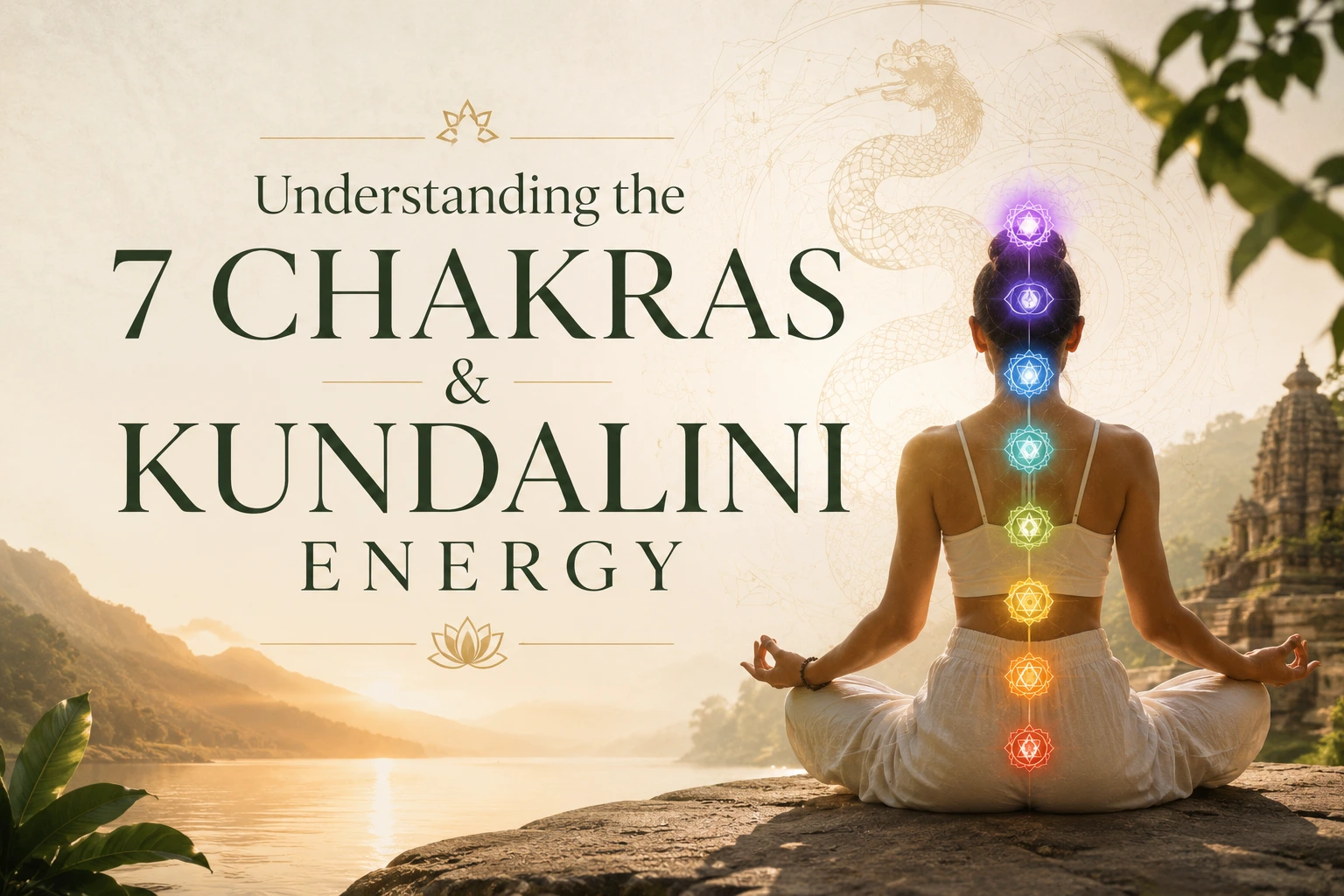
The seven chakras are psychic centers described in classical Tantric and Hatha Yoga texts as lying along the spine’s central channel, or sushumna nadi — from the base of the spine (Muladhara) to the crown of the head (Sahasrara). In the Kundalini tradition, they function as the stations through which dormant spiritual energy is said to rise and awaken as it ascends. To understand the broader framework behind the Tantric model of the chakras, see our dedicated guide to Kundalini Tantra.
Each chakra governs a distinct psychological and energetic theme, and together they form a complete map of how consciousness is described as evolving through practice.
If you’re new to the practice, we recommend beginning with our Complete Kundalini Yoga Guide, which explores the origins of Kundalini Kriya Yoga, the Satyananda lineage, chakras, kriyas, meditation techniques, benefits, safety guidelines and teacher training in depth. This article builds on that foundation by examining the seven major energy centers in detail.
Quick Reference
The 7 Chakras at a Glance
| Chakra | Sanskrit Meaning | Location | Element | Bija Mantra |
|---|---|---|---|---|
| Muladhara | Root support | Base of spine | Earth (Prithvi) | LAM |
| Svadhishthana | One’s own abode | Sacral region | Water (Apas) | VAM |
| Manipura | City of jewels | Navel / solar plexus | Fire (Agni) | RAM |
| Anahata | Unstruck sound | Heart center | Air (Vayu) | YAM |
| Vishuddhi | Especially pure | Throat | Ether (Akasha) | HAM |
| Ajna | Command | Between the eyebrows | Mind (Manas) | OM |
| Sahasrara | Thousand-petaled | Crown of the head | Beyond the elements | — |
This table is worth returning to as you read — each section below builds on it.
Foundation
What Is Kundalini Energy, and Why Do the Chakras Matter to It?
In Swami Satyananda Saraswati’s Kundalini Tantra—a foundational text published by the Bihar School of Yoga—Kundalini Shakti is described as a dormant potential coiled at Muladhara, the root chakra. Not a metaphor so much as a specific technical claim within the tradition: a latent energy, present in everyone, that ordinary life rarely calls on.
Through sustained practice — asana, pranayama, mantra, and meditation, built up systematically rather than attempted all at once — this energy is said to be roused and to travel upward through sushumna nadi, the central channel running along the spine.
As it rises, it’s described as piercing through each chakra in sequence — a process traditionally called chakra bheda. Each chakra it passes through is said to require a certain degree of purification before the energy can move further, which is part of why the classical texts treat the chakras less as fixed points to “activate” individually and more as a graduated path. For a fuller exploration of Shakti as a living force, see our article on Kundalini Jagran and Shakti.
Editorial Note: This is precisely why the chakras and Kundalini are inseparable in this tradition — the chakras are the terrain, and Kundalini is what travels through it. For a fuller walkthrough of how the whole system fits together, our Kundalini Yoga guide covers the broader framework this article sits inside.
Watch: Chakras Explained — the Kundalini awakening sequence most people get wrong, by Vishuddhi Issha Yoga & Ayurveda.
Chakra 1
Muladhara — The Root
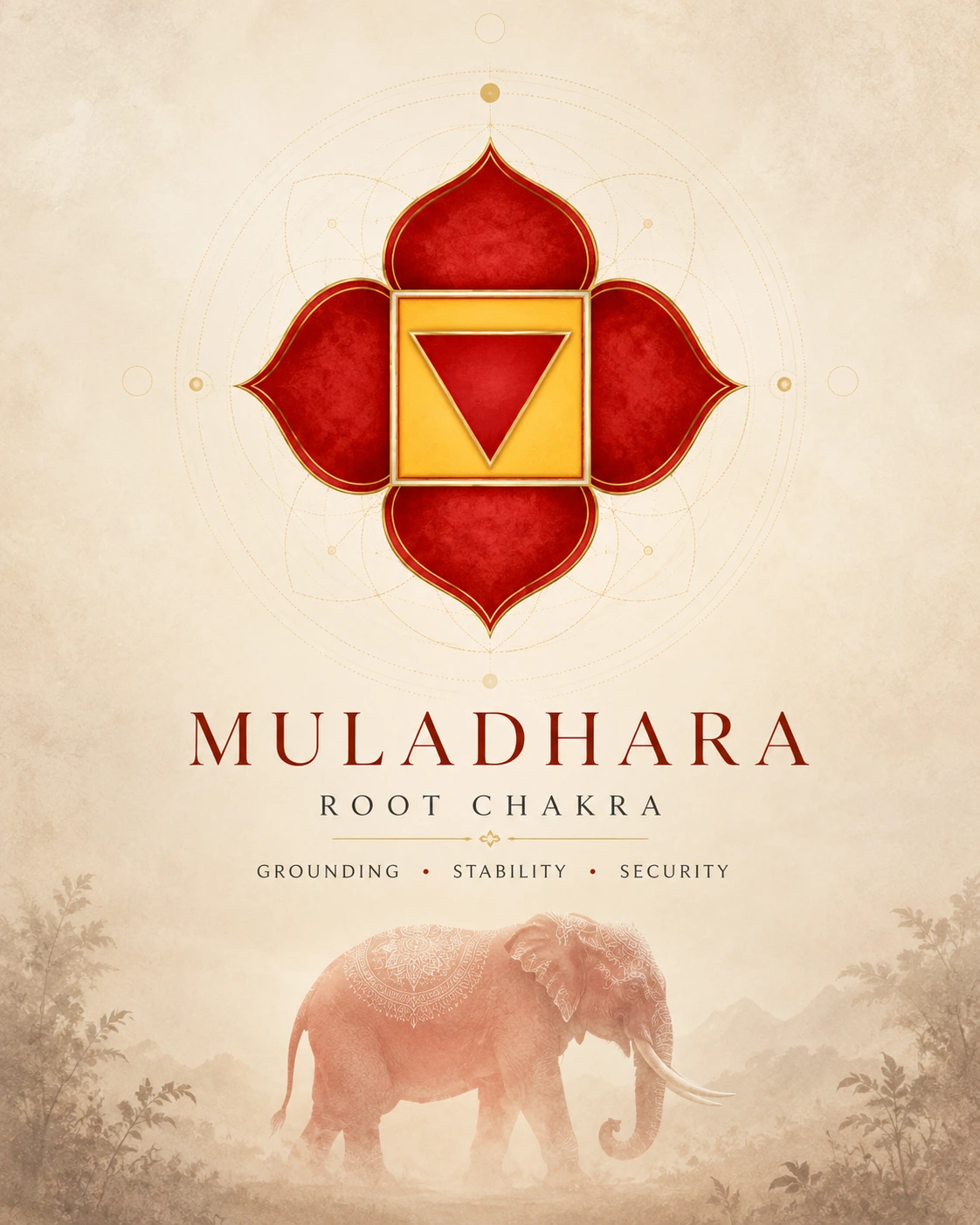
Located at the perineum, Muladhara (“root support”) is governed by the earth element and is described as the seat of Kundalini itself — coiled here, dormant, in most people most of the time.
Psychologically, this chakra is associated with survival instinct, stability, and a basic sense of groundedness. When this center is described as imbalanced in the traditional model, the themes that surface are usually fear, insecurity, or a rigid over-attachment to safety.
Traditional practice at this level tends to emphasize physical grounding and steadiness before anything more subtle is attempted — a sequencing choice, not an arbitrary one. This is exactly why we encourage serious students to prepare the body for Kundalini awakening before attempting more intensive practice.
Chakra 2
Svadhishthana — The Seat of the Unconscious

Just above Muladhara, in the sacral region, Svadhishthana (“one’s own abode”) is governed by the water element. Satyananda’s tradition places particular emphasis on this chakra as the seat of the unconscious mind — the storehouse of samskaras, or subtle impressions, that shape unconscious patterns of desire and reaction.
Its themes are creativity, pleasure, and emotional fluidity. An imbalance here is traditionally described less as a “blockage” in the popular sense and more as an unexamined pull — old patterns running without awareness.
Chakra 3
Manipura — The City of Jewels
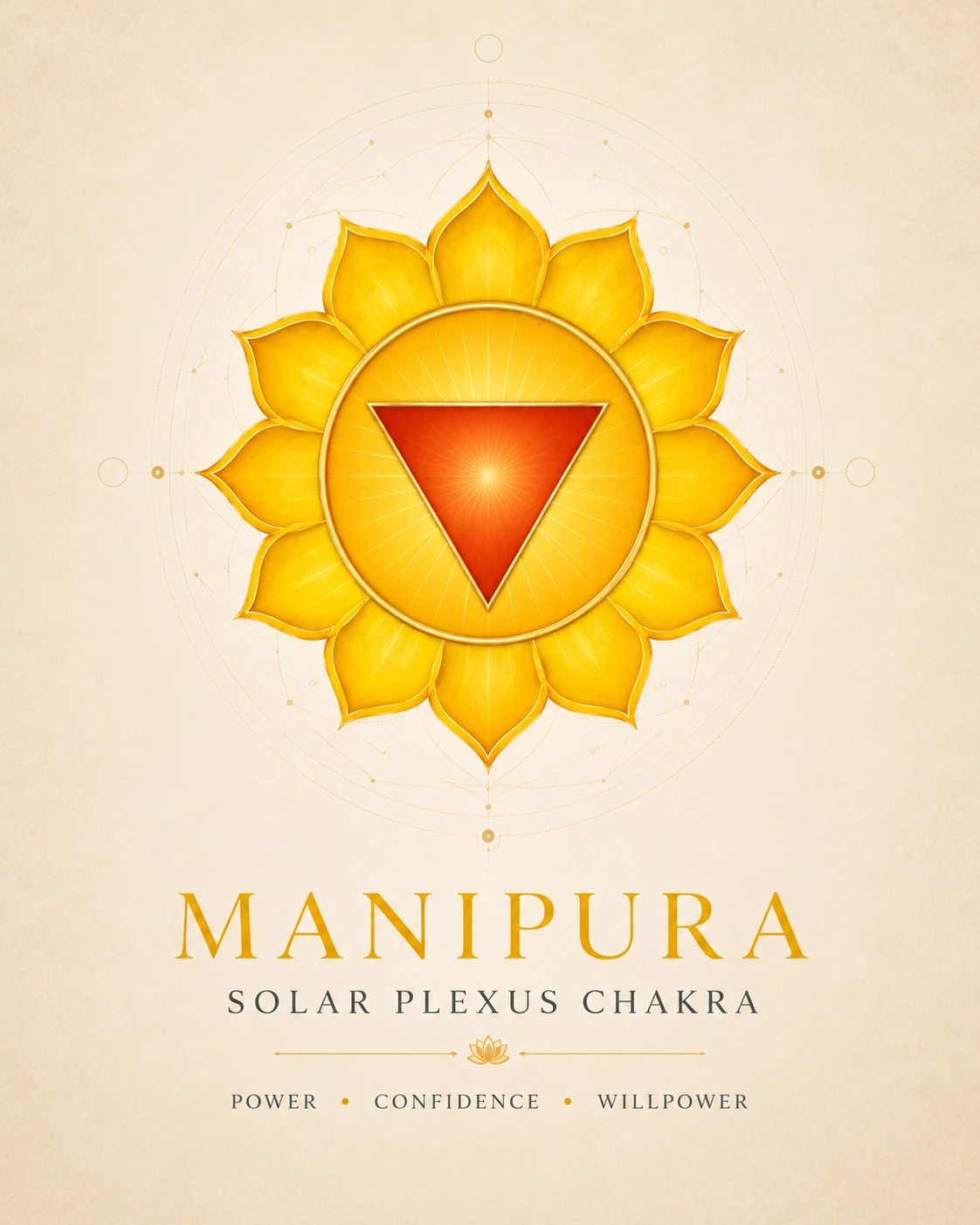
At the navel and solar plexus, Manipura (“city of jewels”) is governed by fire — the same agni that governs digestion, which is why this chakra is so often discussed alongside metabolic and digestive vitality in Ayurvedic-adjacent teaching.
Its themes are personal power, will, and transformation. This is the chakra most associated with a sense of agency: the capacity to act rather than simply react. Breathwork is one of the most direct ways to work with this center — our guide to pranayama for Kundalini awakening explores how.
Chakra 4
Anahata — The Unstruck Sound
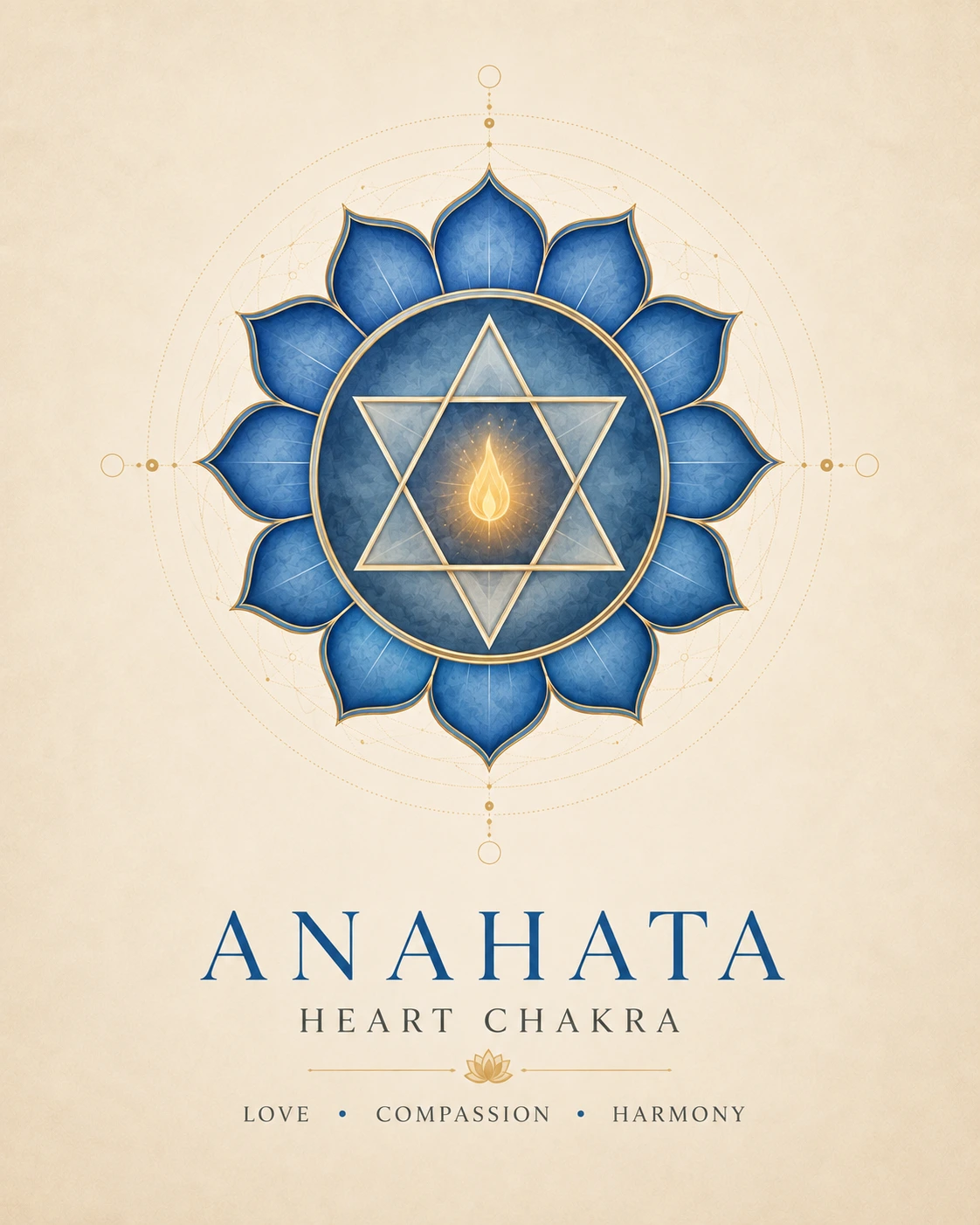
The heart center, Anahata (“unstruck sound”), is governed by air. Its name refers to a sound said to arise without any two things striking together — a reference used extensively in nada yoga, the yoga of inner sound.
Anahata sits at the literal and symbolic midpoint of the seven — three below, three above — and is associated with love, compassion, and the capacity to relate rather than simply transact. In the classical model, this is often described as the chakra where the ascent shifts from primarily physical and instinctual concerns to primarily relational and expressive ones.
Chakra 5
Vishuddha — Especially Pure
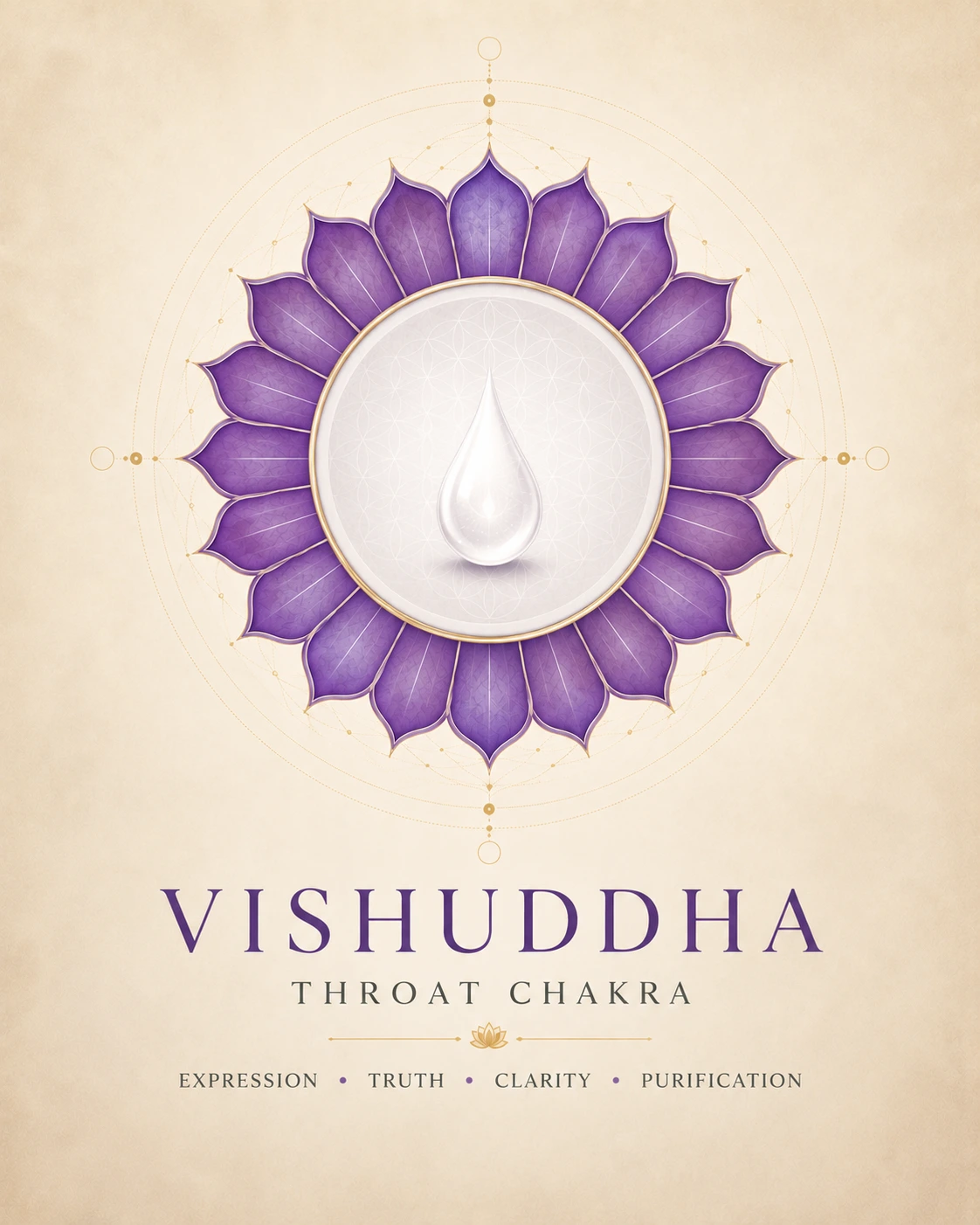
At the throat, Vishuddha (“especially pure”) is governed by ether or space — the most subtle of the five gross elements.
Its themes are purification, communication, and truthful expression (satya). Traditionally, this is the center associated with the gap between what a person feels and what they’re able to actually say — and the work here is often described as closing that gap rather than simply “speaking more.” Mantra and sound work are traditionally used to purify this center — see our guide to Kundalini mantras and sound healing for how sound functions as an active tool.
Chakra 6
Ajna — The Command Center
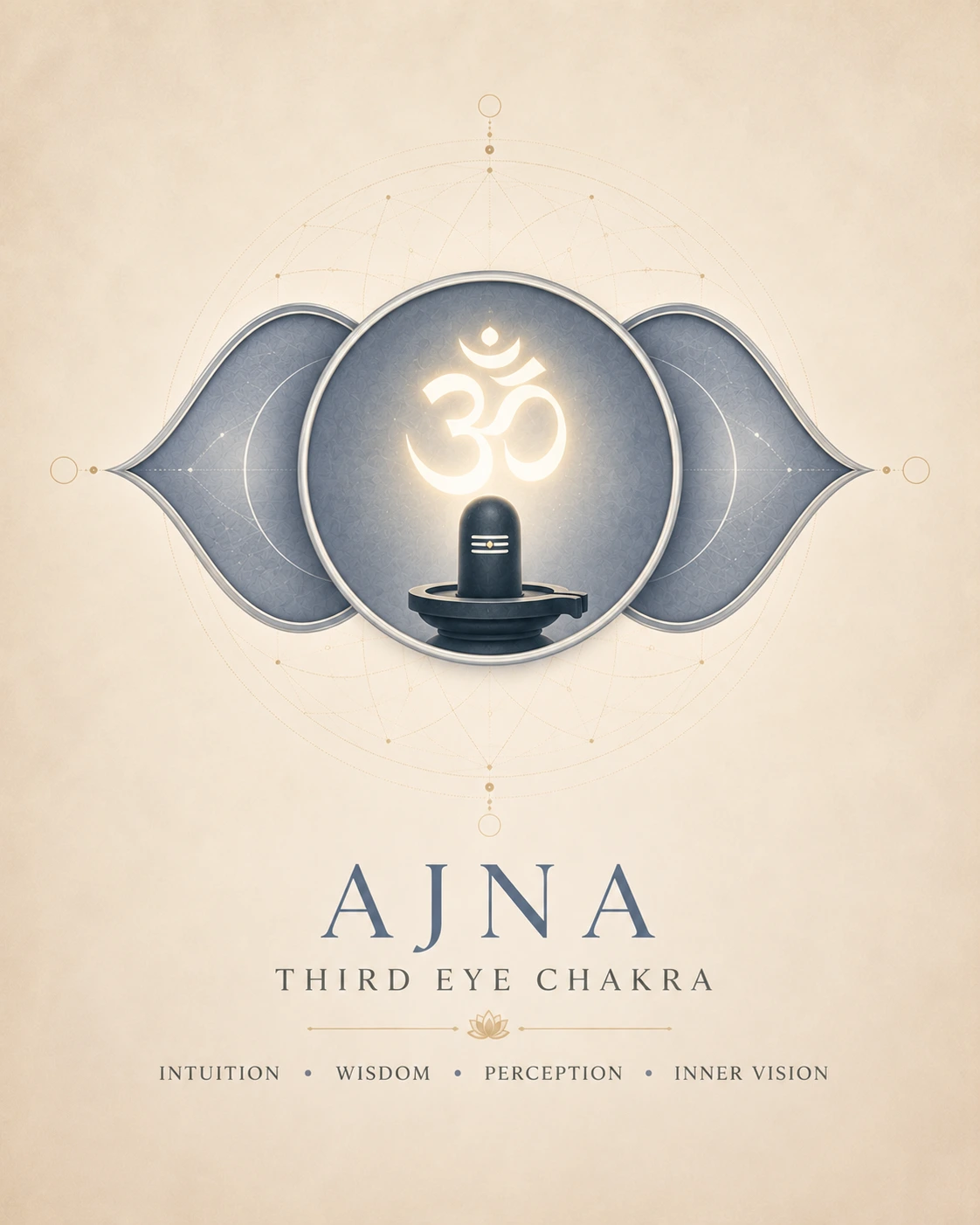
Between the eyebrows, Ajna (“command”) is where the three principal nadis — ida, pingala, and sushumna — are said to converge before sushumna continues alone to the crown.
Rather than a gross element, Ajna is associated directly with the mind, manas, and with intuition. In the Kundalini model, this chakra functions as a command point: the place from which subtler perception is said to be directed once the lower centers have been sufficiently purified. For a practical look at how meditation works with this center, see our guide to Kundalini meditation.
Chakra 7
Sahasrara — The Thousand-Petaled Crown
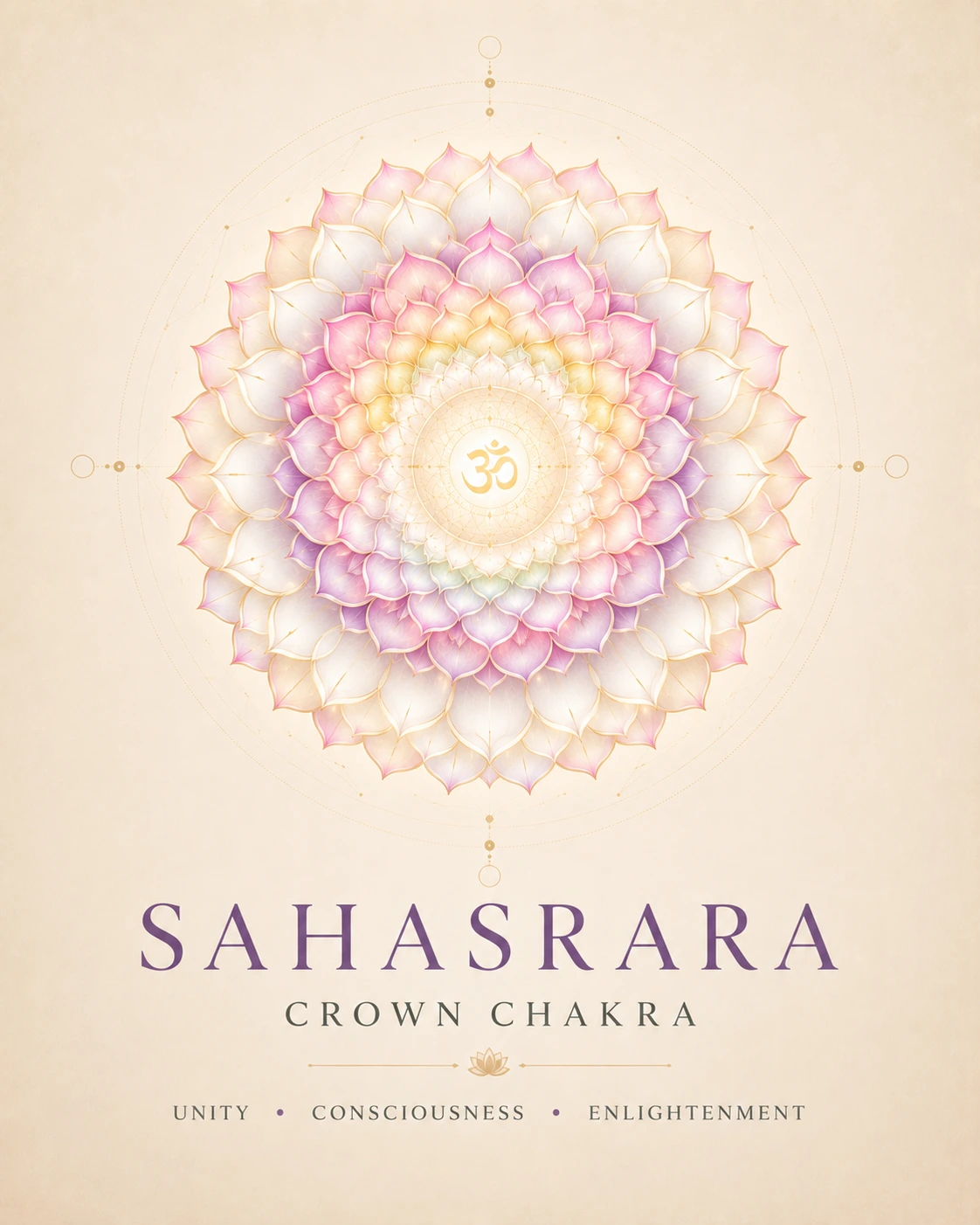
At the crown of the head, Sahasrara (“thousand-petaled”) is described in the classical texts as beyond the tattvas altogether — not governed by any element, because it represents the point of union rather than another station along the way.
This is where Kundalini Shakti is said to unite with Shiva consciousness, traditionally described as the culmination of the entire ascent. Some source texts debate whether Sahasrara is properly a “chakra” at all, since it represents totality rather than a discrete center — but it’s included as the seventh in virtually every standard presentation of the system, including this one. For a step-by-step look at the awakening process that culminates here, see Kundalini awakening yoga and meditation.
System View
How the Chakras Function as a System, Not in Isolation
It’s worth stating plainly: the classical texts don’t treat these seven as independent switches to flip one at a time. They’re described as a connected sequence, where the condition of one genuinely affects what’s accessible at the next.
This is part of why isolated “chakra healing” — treating, say, Anahata on its own, disconnected from what’s happening at Manipura or Vishuddha — sits somewhat awkwardly next to the tradition it borrows its vocabulary from. The classical model is a systems model, not a symptom-by-symptom one — which is also, incidentally, the same reason a scattered, one-center-at-a-time approach tends to underperform a properly sequenced practice built around all seven together.
Explore the Path: The kind of properly sequenced practice described here is taught progressively in a structured Kundalini Yoga teacher training.
Clarifying
Common Misconceptions About Chakras and Kundalini
A few claims circulate widely enough that they’re worth addressing directly.
- Chakras are not physical organs that can be located on an MRI, and the traditional texts never claimed they were — they’re described as psychic or subtle-energy centers, a different category of claim entirely.
- Kundalini “awakening” is not a single dramatic event that happens once and resolves everything that follows; the classical model describes it as a gradual, cumulative process, and most traditional teachers are explicit that a rushed or unsupervised approach is where the well-documented cautionary accounts actually come from.
- Having seven chakras doesn’t mean there are only seven — subtler texts describe many more secondary centers — the seven here are simply the major ones along the central axis.
We go into these and several other widely repeated claims in more depth in Demystifying Kundalini Myths.
Bridge
The Nervous System Connection
None of this is presented in isolation from the body. Several of the chakra locations correspond closely to major nerve plexuses along the spine, and a growing body of teaching — including within this tradition — draws that correspondence out directly, without collapsing the subtle model into the physical one or vice versa.
That connection deserves its own full treatment rather than a condensed paragraph here; we cover it properly in The Science of Kundalini Yoga and the Nervous System. For the specific role the vagus nerve plays in emotional release during practice, see our article on the vagus nerve, trauma release, and Kundalini.
Application
Why This Matters for Practice, Not Just Theory
Understanding the chakra system isn’t a prerequisite you clear before the “real” practice begins — it’s what makes the practice legible while you’re inside it.
Knowing that Svadhishthana governs the unconscious changes what you notice when old emotional material surfaces mid-practice. Knowing that Ajna is a convergence point changes what a moment of unusual clarity in meditation actually means, rather than leaving it unexplained.
The map doesn’t replace the territory, but walking without any map at all is exactly the pattern that leads to the confusion — and occasionally the real difficulty — that gives Kundalini practice its more sensationalized reputation. A structured, properly sequenced training addresses this directly, rather than leaving you to piece the system together from fragments. If you’re new to daily practice, our 15-minute Kundalini Yoga routine for beginners is a good place to start.
Support
Frequently Asked Questions
Are there really only 7 chakras?
The seven along the central spinal axis are the major ones covered in virtually every classical presentation, including Satyananda’s. Subtler texts describe additional secondary centers, but the seven-chakra model is the standard reference framework.
Can a chakra actually be “blocked”?
In the traditional model, yes — though “blocked” is a modern simplification of a more specific classical idea: that a given center hasn’t yet been sufficiently purified for energy to move through it cleanly. It’s described as a condition to work through systematically, not a permanent state.
Is Kundalini awakening dangerous?
Unsupervised, rushed, or improperly sequenced practice is where the documented difficult experiences tend to originate, which is exactly why the classical texts insist on gradual, guided progression rather than attempting to force the process. For what the tradition describes as a healthy unfolding, see our guide to the signs of a genuine Kundalini awakening.
Do I need to believe in the chakra system for the practices to work?
Most traditional teachers would say the practices — breath, posture, concentration — have their own direct effects regardless of belief; the chakra system is the traditional map for interpreting and organizing those effects, not a precondition for having them.
How long does it take to move through all seven?
The classical texts are consistent that this isn’t a fixed timeline — it depends on the consistency and depth of practice, and rushing the sequence is considered counterproductive rather than efficient.
What’s the difference between the chakras and the nervous system?
The chakras are a subtle/psychic model; the nervous system is a physical one. They correspond in interesting ways at several points along the spine, but one isn’t simply a rebranding of the other — see The Science of Kundalini Yoga and the Nervous System for the full comparison.
Where to Go From Here
Theory Into Practice
Understanding the seven chakras is foundational — but it’s still theory until it’s held inside an actual practice, sequenced properly and taught directly rather than pieced together from articles.
If this system resonates, the fuller picture is in our Kundalini Yoga guide, and for guided, in-person progression through it, our Kundalini Kriya Yoga Teacher Training is where the theory in this article becomes an actual practice.
Begin Your Journey
Ready to Explore the Authentic Path?
Don’t navigate this ancient science alone. Whether you are seeking the profound depths of Kundalini Kriya or looking to integrate these teachings into a daily practice, our lineage offers the authentic guidance you need.
Kriya Kundalini Teacher Training
Immerse yourself in an intensive residential programme in Goa, India. Study Kundalini Kriya Yoga, meditation, pranayama, philosophy, teaching methodology, and yogic lifestyle through daily guided practice.
Explore Residential TrainingOnline Yoga Courses
Learn from anywhere in the world through our structured online programmes, combining live classes, guided practice, mentoring, and comprehensive study materials at your own pace.
Browse All Online CoursesMedical Disclaimer
The information presented in this article is intended solely for educational purposes and should not be interpreted as medical advice, diagnosis or treatment. Although the scientific studies discussed provide valuable insights into the physiological effects of yoga and meditation, individual responses vary considerably. Always consult a qualified healthcare professional before beginning any new exercise, breathing or meditation programme, particularly if you have cardiovascular disease, epilepsy, uncontrolled hypertension, psychiatric conditions, pregnancy or any other medical concerns.
Knowledge Library
Explore the Kundalini Knowledge Library
We are building one of the web’s most comprehensive evidence-informed libraries on traditional Kundalini Kriya Yoga, integrating authentic yogic wisdom with modern scientific research. This knowledge hub is continuously expanding.
Foundations
Practices & Techniques
Science & Research
Kundalini Awakening