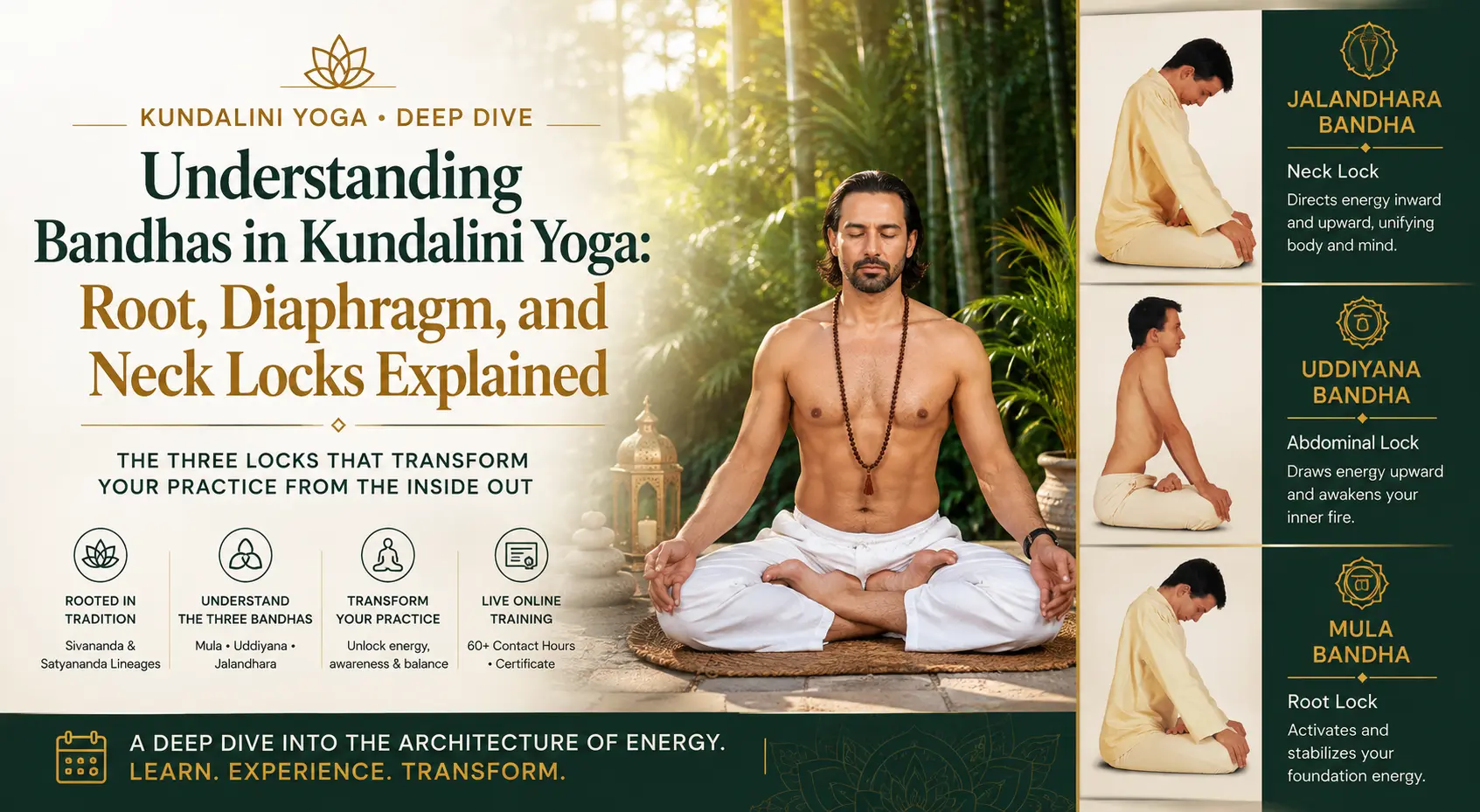
Understanding Bandhas in Kundalini Yoga: Root, Diaphragm, and Neck Locks Explained

Kundalini Yoga · Deep Dive
Understanding Bandhas in Kundalini Yoga: Root, Diaphragm, and Neck — The Three Locks That Transform Your Practice
Most people treat bandhas as just another yoga technique — something you “do” along with the postures and the breathing. That’s a misunderstanding. In the Satyananda tradition, bandhas are not techniques. They are the architecture that holds the entire practice together.
You’ve probably heard of mula bandha, uddiyana bandha, and jalandhara bandha. You might even have tried them in a class. But if you’re practicing them as isolated muscle contractions — squeezing the pelvic floor, pulling the belly in, tucking the chin — you’re missing the point entirely. Understanding kundalini yoga bandhas starts with recognizing that these body locks are not about strength. They’re about precision, timing, and understanding the subtle architecture of your own nervous system.
In this guide, you’ll learn everything about kundalini bandhas — the three body locks that transform your practice — including mula bandha, uddiyana bandha, and jalandhara bandha, plus how to practice them safely. You’ll also discover the research-backed bandha yoga benefits and how these yoga locks work inside a kriya.
This guide walks you through what the three locks actually are, how they function within a kriya, and why practicing them correctly changes everything — not just on the mat, but in how your nervous system holds itself throughout the day.
Explore our foundational Complete Kundalini Yoga Guide to understand the classical roots and philosophical bedrock upon which this training is built.
Definition
What Are Bandhas, Really?
Let’s be precise about this.
Bandhas are not just muscle contractions. They are psycho-physiological locks that seal the flow of prana within the body. The word “bandha” comes from the Sanskrit root bandh, meaning “to bind” or “to lock.” It refers to a specific action that redirects energy from its habitual pathways into the central channel — the sushumna nadi.
In the Satyananda tradition, there are three primary bandhas: mula bandha (root lock), uddiyana bandha (diaphragm lock), and jalandhara bandha (neck lock). When practiced together, they form maha bandha — the great lock. Each one sits at a different point along the spine, and each one has a distinct function.
Mula bandha seals the base. Uddiyana bandha lifts the middle. Jalandhara bandha seals the top. Working together, they create a sealed container for prana — a closed loop that prevents energy from dissipating outward and forces it to move upward through the central channel.
Think of it this way: prana naturally moves outward through the body’s habitual pathways — through the hands, the feet, the sensory organs. Bandhas redirect that flow inward. They don’t create energy. They conserve it. And in a practice built around awakening dormant energy, conservation is everything.
Architecture
How Bandhas Function in a Kriya
In a kriya, bandhas are not practiced in isolation. They are embedded in the sequence — applied at specific points, held for specific durations, and released at specific moments.
Mula bandha is typically applied during kumbhaka — breath retention after inhalation. It seals the base and prevents energy from leaking downward. Uddiyana bandha is practiced during rechaka — breath retention after exhalation. It lifts the diaphragm and draws energy upward. Jalandhara bandha is applied during kumbhaka — it seals the throat and prevents energy from escaping through the head.
The sequence matters. In the classical texts, the bandhas are described as working in a specific order: mula bandha first, then jalandhara bandha, then uddiyana bandha. Each one builds on the one before it. Each one creates the conditions for the next.
What most students don’t realize is that bandhas are also doing something physiological. Mula bandha engages the pelvic floor. Uddiyana bandha engages the diaphragm and the deep abdominal muscles. Jalandhara bandha engages the throat and the carotid sinus. Each one influences a different part of the autonomic nervous system.
That’s why the timing matters — and why learning bandhas from a written guide is never quite the same as learning them from a teacher who can see what’s actually happening in your body.
Root Lock
Mula Bandha — The Root Lock
Mula bandha is the foundation. In the classical texts, it’s described as the contraction of the perineum — the area between the anus and the genitals. In practice, it’s a subtle lifting and drawing inward of the pelvic floor. Not a clench. A lift.
The root lock is associated with muladhara chakra, the energy center at the base of the spine. It’s the seat of stability, grounding, and survival instincts. When mula bandha is engaged correctly, it does something specific: it prevents apana — the downward-moving energy — from escaping the body.
Instead of dissipating, that energy is redirected upward. It moves into the pelvic cavity, then up through the spine. That’s the mechanical action. The effect is a sense of grounding and containment — a feeling of being held from within rather than collapsing outward.
From a physiological perspective, mula bandha activates the levator ani and the deeper pelvic floor muscles. Studies have shown that regular practice of mula bandha improves pelvic floor function and may help prevent bladder dysfunction. A 2020 ultrasound study found that simultaneous application of moolabandha inhibited the impact of forceful breathing techniques on the pelvic floor.
In a kriya, mula bandha is usually the first lock introduced. It’s the anchor. Without it, the other two locks don’t have a foundation to work from. That’s why beginners are often taught to find mula bandha first — not because it’s easier, but because nothing else works properly without it.
Diaphragm Lock
Uddiyana Bandha — The Diaphragm Lock
If mula bandha is the anchor, uddiyana bandha is the engine.
Uddiyana bandha is described in the classical texts as the “abdominal lock” — the action of drawing the abdomen in and up, lifting the diaphragm into the chest cavity. The word “uddiyana” means “to fly upward”. And that’s exactly what it does: it lifts energy from the lower abdomen into the upper body.
The mechanics are precise. After a full exhalation, with the lungs empty, the abdomen is drawn inward and upward, pulling the diaphragm up and creating a cavity in the abdominal cavity. The navel moves toward the spine. The ribs lift slightly. The back curves, but the spine remains long.
This is not a “sucking in” of the belly. It’s an active, engaged lift — like pulling a drawstring upward from the inside. The sensation is one of hollowing, not squeezing.
In the classical texts, uddiyana bandha is described as “a lion to the elephant of death” — a dramatic image that points to its power. It’s the bandha that generates internal heat, stimulates the digestive organs, and moves prana forcefully upward through the central channel.
Modern research is beginning to catch up. A 2024 randomized controlled study found that regular practice of uddiyana bandha significantly improved heart rate variability in hypertensive patients. The intervention group showed enhanced parasympathetic activity and better autonomic balance. The researchers concluded that uddiyana bandha may be a viable non-pharmacological strategy for hypertension management.
In a kriya, uddiyana bandha is applied during retention after exhalation. It’s the lock that accelerates the energetic effect of the sequence. Without it, the activation is incomplete.
Neck Lock
Jalandhara Bandha — The Neck Lock
Jalandhara bandha is the top seal.
In the classical texts, it’s described as the “chin lock” — the action of pressing the chin into the notch between the collarbones. The word “jalandhara” is sometimes translated as “net-bearing” or “throat lock”. It’s the bandha that seals the throat and prevents energy from escaping upward through the head.
The mechanics are simple: sit in a comfortable posture with the spine tall. Without tensing the neck or shoulders, lower the chin toward the chest, pressing it into the hollow of the throat. The sternum lifts slightly. The back of the neck lengthens. The breath becomes softer, quieter.
When jalandhara bandha is engaged correctly, it does something remarkable: it slows the heart rate and attenuates the activity of the carotid sinus nerves. In the classical tradition, this is described as a way to bring the vijnani nadi — the channel of consciousness — under conscious control. In practical terms, it creates a state of mental stillness that is difficult to access through willpower alone.
Research supports this. A study published in 1990 found that jalandhara bandha decreases vagal reflex changes during breath retention and may act as a stabilizing component in yogic breathing exercises. It reduces the bradycardia — the slowing of the heart — that typically occurs during apnea. This suggests that jalandhara bandha modulates the autonomic nervous system in a way that makes prolonged breath retention safer and more stable.
In a kriya, jalandhara bandha is applied during kumbhaka — retention after inhalation. It’s the lock that prevents the energy generated by mula and uddiyana bandha from dissipating through the throat and head. Without it, the energetic container isn’t fully sealed.
There’s also a practical safety consideration. In the classical texts, it’s said that if jalandhara bandha is not applied during breath retention, the air can rush through the auditory tubes and disturb the inner ear. This can cause a range of disorders, from dizziness to tinnitus. The chin lock isn’t optional — it’s protective.
Great Lock
Maha Bandha — The Great Lock
When all three bandhas are practiced together, it’s called maha bandha — the great lock. This is where the real power of the practice becomes available.
Maha bandha is performed by engaging mula bandha first, then jalandhara bandha, then uddiyana bandha. The sequence matters. Each lock creates the conditions for the next. Together, they seal the entire spinal column — from the base of the pelvis to the top of the throat.
When all three locks are engaged simultaneously, prana is forced into the central channel — the sushumna nadi. The energy that would normally dissipate outward is redirected inward, moving upward through the spine. This is the mechanism that, in the classical tradition, is described as “raising kundalini.”
In practical terms, maha bandha creates a profound shift in the nervous system. Heart rate slows. Breath becomes still. Awareness moves inward. It’s the closest thing to a physiological “reset button” that exists in the yogic tradition.
But here’s the thing: maha bandha is not something to rush into. In the Satyananda tradition, students are taught each bandha individually — usually over months, not weeks. The root lock is introduced first. The diaphragm lock comes later. The neck lock comes last. And maha bandha — the full combination — is reserved for students who have demonstrated competence with each component.
Benefits
Benefits of Practicing Bandhas
The bandha yoga benefits extend far beyond the mat. Here’s what consistent, correct practice can do:
Physiological Benefits:
- Improves heart rate variability and autonomic balance
- Strengthens pelvic floor muscles
- Stimulates digestive organs
- Regulates the nervous system
- Enhances breath capacity and control
Energetic Benefits:
- Seals and redirects prana within the central channel
- Prevents energy dissipation
- Builds internal heat
- Creates a closed-loop energy system
- Supports kundalini awakening
Psychological Benefits:
- Increases mental clarity
- Develops body awareness
- Cultivates internal stability
- Reduces anxiety and nervous tension
- Creates a sense of grounded presence
Science
What the Research Says
It’s worth being precise about what the research does and doesn’t support.
A 2024 study on uddiyana bandha found that regular practice significantly improved heart rate variability in hypertensive patients. The researchers concluded that uddiyana bandha may be a viable non-pharmacological strategy for hypertension management.
A study on mula bandha found that 30 minutes of daily practice for 30 days improved cognitive functions in college students. Another study found that mula bandha may be helpful for mild pelvic organ prolapse. A 2020 ultrasound study found that simultaneous application of moolabandha inhibited the impact of forceful breathing techniques on the pelvic floor.
Research on jalandhara bandha is older but still relevant. A 1990 study found that jalandhara bandha decreases vagal reflex changes and may act as a stabilizing component in yogic breathing exercises.
The evidence is preliminary but consistent: bandhas influence the autonomic nervous system. They are not just energetic metaphors. They are measurable, physiological interventions that affect heart rate variability, pelvic floor function, and autonomic balance.
Beginner’s Guide
Bandhas for Beginners
If you’re new to bandhas, start with the root lock. Mula bandha is the foundation, and it’s the safest place to begin.
Step 1: Find the Root Lock
Sit comfortably with the spine tall. Exhale completely. Gently draw the pelvic floor upward — as if stopping the flow of urine. Hold lightly, not tightly. Breathe normally. Feel the lift at the base of the pelvis.
Step 2: Practice for Short Durations
Hold the root lock for 5-10 seconds. Release. Breathe normally. Repeat 3-5 times. Build gradually over days, not hours.
Step 3: Add Breath Awareness
Once you can hold mula bandha comfortably, begin coordinating it with your breath. Engage on the inhale. Release on the exhale. Move slowly. Listen to your body.
Step 4: Wait on the Advanced Locks
Uddiyana bandha and jalandhara bandha require empty lungs and precise alignment. Do not attempt them until you have a stable mula bandha practice and guidance from a qualified teacher.
The most important rule for beginners: less is more. A subtle, correct lock does more than a forceful, misaligned one. Practice with patience. The depth will come.
Clarifications
Common Misunderstandings
Let’s clear up some of the most common misunderstandings about bandhas.
Misunderstanding 1: Bandhas are just muscle contractions. They’re not. Bandhas are psycho-physiological locks that redirect prana. The muscle engagement is the means, not the end. If you’re just squeezing, you’re missing the point.
Misunderstanding 2: You should hold bandhas as tightly as possible. The opposite is true. In the tradition, bandhas are held with the minimum amount of effort required to create the seal. Force creates tension. Tension blocks flow. The practice is about precision, not power.
Misunderstanding 3: Bandhas are just for advanced practitioners. Not true. Mula bandha, in particular, is taught to beginners because it’s foundational. You don’t need to be advanced to benefit from it. You just need to learn it correctly.
Misunderstanding 4: You should practice bandhas with full force. The opposite is true. In the Satyananda tradition, bandhas are taught with the intention of letting them become subtle, almost imperceptible. The goal is integration, not intensity.
Misunderstanding 5: Bandhas are dangerous. They can be, if practiced incorrectly or without proper guidance. But the danger is not in the bandhas themselves. It’s in skipping the preparation, ignoring the contraindications, or assuming you can learn them from a video.
Safety
Safety & Contraindications
Bandhas are powerful practices. They require precision, patience, and respect. Here’s what you need to know before you begin.
High blood pressure: Uddiyana bandha should not be practiced by anyone with high blood pressure. A 2024 study showed that uddiyana bandha can significantly affect heart rate variability. While this is beneficial for some, it may not be appropriate for everyone.
Hiatal hernia: Uddiyana bandha creates significant intra-abdominal pressure. Anyone with a hiatal hernia should avoid it.
Ulcers or heart disorders: The abdominal and diaphragmatic engagement involved in uddiyana bandha may be inappropriate for anyone with ulcers or heart conditions.
Pregnancy: Bandhas should not be practiced during pregnancy, particularly in the later stages. The pressure and engagement are not appropriate.
Cervical spine issues: Jalandhara bandha requires careful alignment of the neck. Anyone with cervical spine issues should approach this lock with caution or under direct guidance.
Menstruation: In the Satyananda tradition, uddiyana bandha is generally not practiced during menstruation. The engagement of the abdomen and diaphragm may be inappropriate during this time.
As with any intensive practice, the guidance is always the same: learn it from a teacher. Bandhas are subtle. A teacher can see what you can’t feel, and they can correct what you can’t perceive.
Support
Frequently Asked Questions
What are the three bandhas in Kundalini Yoga?
The three primary bandhas are mula bandha (root lock, located at the pelvic floor), uddiyana bandha (diaphragm lock, located in the abdomen), and jalandhara bandha (neck lock, located at the throat). When practiced together, they form maha bandha, the great lock.
Why do bandhas matter in Kundalini practice?
Bandhas redirect and seal prana within the central energy channel (sushumna nadi), preventing it from dissipating and forcing it to move upward. They are the architecture that holds the practice together.
Do bandhas have any scientific backing?
Yes. Research shows uddiyana bandha improves heart rate variability and autonomic balance, mula bandha may improve cognitive function and pelvic floor health, and jalandhara bandha may stabilize the nervous system during breath retention.
How do I learn bandhas safely?
Learn them from a qualified teacher. Bandhas are subtle practices that require real-time feedback. You cannot learn them correctly from a video or a written guide alone.
Can I practice bandhas on my own?
Foundational mula bandha can be safely explored on your own, but uddiyana and jalandhara bandha should be learned with direct guidance. The risk of incorrect practice is real, particularly with uddiyana bandha.
What’s the difference between bandhas in Hatha and Kundalini Yoga?
In Hatha Yoga, bandhas are often practiced as standalone techniques. In Kundalini Yoga, they are embedded in kriyas — applied at specific points in a sequence to produce a specific effect. The mechanics are the same. The context is different.
What are the benefits of practicing bandhas?
Bandha yoga benefits include improved heart rate variability, stronger pelvic floor, enhanced digestive function, regulated nervous system, increased internal heat, and better energy conservation for kundalini awakening.
Are bandhas safe for beginners?
Mula bandha is safe for beginners when practiced gently. Uddiyana and jalandhara bandha should be learned with a qualified teacher.
Ready to Learn This Directly?
Learn the Bandhas in Person
Everything above describes the mechanics. Learning to actually feel the difference between a correct lock and a superficial contraction — in real time, with correction — is exactly what direct training offers.
Kriya Kundalini Teacher Training
Immerse yourself in an intensive residential programme in Goa, India. Study Kundalini Kriya Yoga, meditation, pranayama, philosophy, teaching methodology, and yogic lifestyle through daily guided practice.
Explore Residential Training →Online Yoga Courses
Learn from anywhere in the world through our structured online programmes, combining live classes, guided practice, mentoring, and comprehensive study materials at your own pace.
Browse All Online Courses →References
- Govindasamy K, Kaur D, Elayaraja M, et al. Immediate Effect of Uddiyana Bandha on Heart Rate Variability in Patients with Hypertension: A Randomised Controlled Study. Ann Neurosci. 2024. https://pubmed.ncbi.nlm.nih.gov/39678718/
- Sweta KM, Godbole A, Awasthi HH, Pandey U. Effect of Mula Bandha Yoga in Mild Grade Pelvic Organ Prolapse: A Randomized Controlled Trial. Int J Yoga. 2018. https://pubmed.ncbi.nlm.nih.gov/29755220/
- Protective Role of Moolabandha While Practicing Bhastrika and Kapalabhati by Women Vulnerable to Bladder Dysfunction: A Preliminary Ultrasound Study. Int J Yoga. 2020. https://pubmed.ncbi.nlm.nih.gov/32261185/
- Lepicovská V, Dostálek C, Kovárová M. Hathayogic exercise jalandharabandha in its effect on cardiovascular response to apnoea. Act Nerv Super (Praha). 1990. https://pubmed.ncbi.nlm.nih.gov/2399805/
- Sharma S, Nivethitha L, Mooventhan A. Effect of Moola Bandha (Perineum Contraction), A Yogic Lock on Cognitive Functions of College Students: An Exploratory Study. J Relig Health. 2020. https://pubmed.ncbi.nlm.nih.gov/31172394/
Medical Disclaimer:
The information presented in this article is intended solely for educational purposes and should not be interpreted as medical advice, diagnosis, or treatment. Individual responses to bandha practice vary considerably. Always consult a qualified healthcare professional before beginning any new breathing, movement, or meditation practice, particularly if you have high blood pressure, heart conditions, hiatal hernia, ulcers, cervical spine issues, are pregnant, or have any other medical concern.
Master Resource Library
Explore the Kundalini Master Resource Library
We are building one of the web’s most comprehensive evidence-informed libraries on traditional Kundalini Kriya Yoga, integrating authentic yogic wisdom with modern scientific research. New in-depth guides are continuously researched, written and added to expand this growing knowledge hub for students, practitioners and yoga teachers worldwide.
Foundations
- Complete Kundalini Yoga Guide
- What is Kundalini Yoga? History, Origins & Philosophy
- Kundalini Yoga vs Hatha Yoga
- Understanding the Seven Chakras
- Kundalini Yoga: Myths & Misconceptions
Practices & Techniques
- What is a Kundalini Kriya?
- Breath of Fire (Agni Prana) — full mechanics, pacing, contraindications
- Kundalini Mantras Explained — how sound functions
- Understanding Bandhas — the three locks in depth
- Daily Kundalini Yoga Practice
Science & Research
- The Science of Kundalini Yoga
- Kundalini Yoga & the Vagus Nerve
- Meditation & Brain Plasticity
- Kundalini Yoga for Anxiety & Stress
Kundalini Awakening
- Signs of a Genuine Kundalini Awakening
- Preparing the Body for Kundalini Practice
- Understanding Kundalini Syndrome