
Science of Kundalini Yoga: Research on Cortisol, GABA, EEG Brainwaves & the Nervous System
Research & Neuroscience
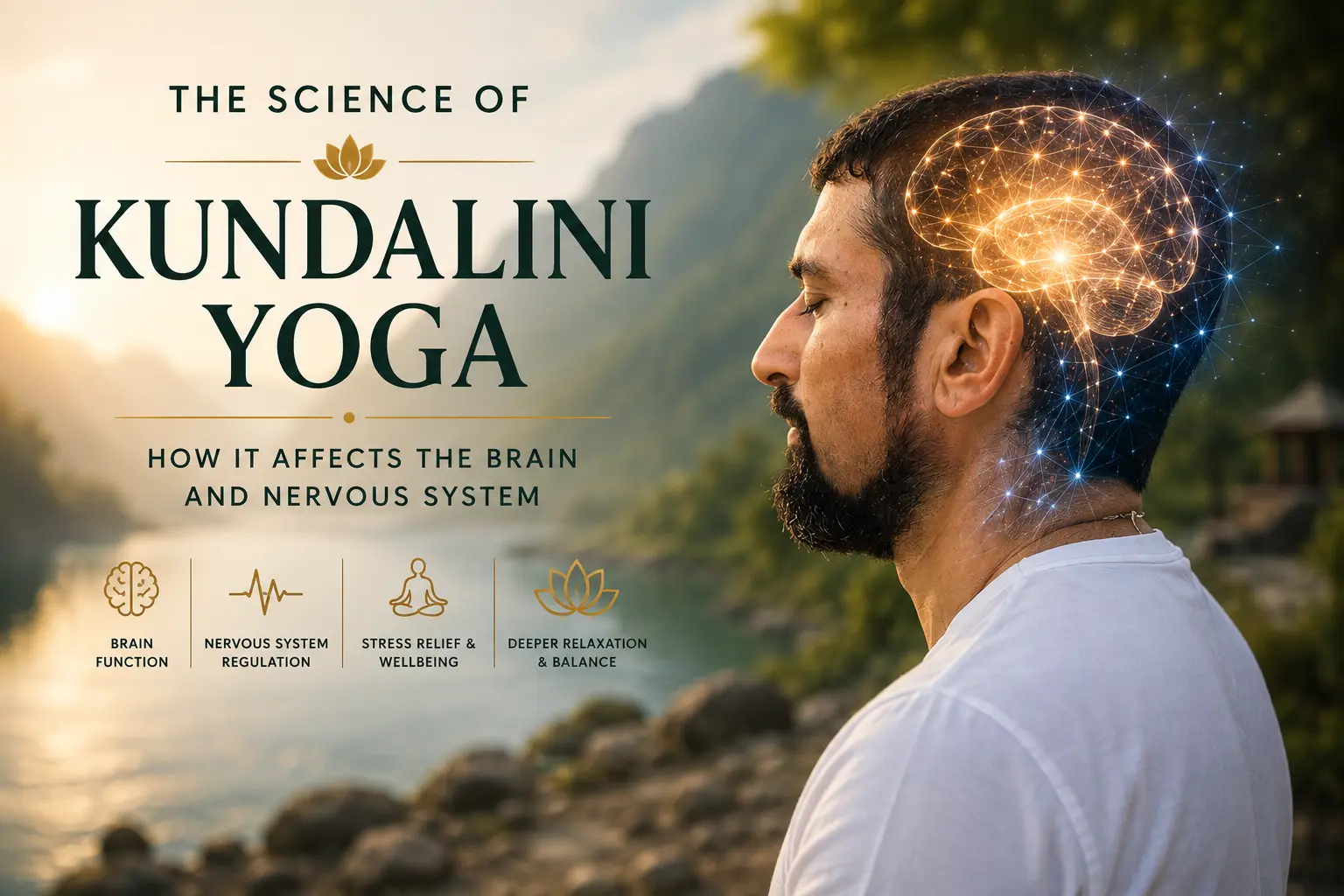
The Science of Kundalini Yoga: How It Affects the Brain and Nervous System
Modern neuroscience is beginning to explain what practitioners of Kundalini Kriya Yoga have experienced for centuries. Brain imaging, stress-hormone research, heart-rate variability studies and clinical psychology are gradually revealing how traditional breathing practices, meditation and mantra influence the nervous system. Yet separating measurable physiology from spiritual interpretation remains essential.
If you’re new to the practice, we recommend beginning with our Complete Kundalini Yoga Guide , which explores the origins of Kundalini Kriya Yoga, the Satyananda lineage, chakras, kriyas, meditation techniques, benefits, safety guidelines and teacher training in depth. This companion article builds on that foundation by examining what modern neuroscience and clinical research have actually measured inside the brain and nervous system.
Quick Answer: Current research suggests that Kundalini Yoga’s core practices—including Breath of Fire, slow diaphragmatic breathing, mantra repetition, mudra and meditation—can produce measurable physiological changes. Controlled studies have reported reductions in cortisol, improved heart-rate variability, increased GABA activity, altered EEG brainwave patterns and reduced default mode network activity. At the same time, science has not demonstrated that Kundalini literally awakens supernatural energy or releases DMT through the pineal gland. Understanding where evidence ends and traditional philosophy begins is essential for an honest discussion.
Search online for the science of Kundalini Yoga and you’ll usually encounter one of two extremes. One presents every experience as mystical proof of spiritual awakening. The other reduces Kundalini Yoga to little more than another relaxation technique. Neither reflects the current scientific literature. The more interesting question is this: what actually happens inside the brain and nervous system when structured pranayama, mantra, mudra and meditation are practised together?
This article focuses exclusively on that question. Drawing from published neuroscience, psychophysiology and clinical research, we’ll explore what scientists have measured, what mechanisms appear biologically plausible, where evidence is still emerging and which popular claims remain unsupported. Rather than replacing the traditional understanding of Kundalini Yoga, scientific research offers another lens through which to appreciate why these practices may influence human health and wellbeing.
Foundations
The Nervous System Framework: How Practice Talks to the Body
Every technique used in Kundalini Yoga ultimately communicates through the autonomic nervous system, which regulates unconscious physiological functions such as breathing, heart rate, digestion and stress adaptation. This system is traditionally divided into two complementary branches. The sympathetic nervous system prepares the body for action through the familiar fight-or-flight response, while the parasympathetic nervous system supports recovery, repair and restoration.
Unlike practices designed solely for relaxation, a traditional Kundalini Kriya deliberately alternates between activation and recovery. Dynamic pranayama such as Breath of Fire briefly stimulates sympathetic activity, while slower breathing, mantra repetition, meditation and deep relaxation gradually shift the body towards parasympathetic dominance through increased vagal activity. This rhythmic transition appears to be one of the defining physiological characteristics of a complete Kundalini practice.
Rather than treating these as separate states, researchers increasingly understand a complete kriya as a carefully organised oscillation between controlled activation and intentional recovery. A well-structured practice finishes in stillness instead of intensity, allowing the body’s restorative mechanisms to become dominant before the session concludes.
Editorial Insight
Heart-rate variability (HRV) is one of the most widely accepted measures of autonomic flexibility and vagal tone. Higher HRV generally reflects greater resilience to physical and psychological stress, making it one of the most valuable physiological markers for evaluating breath-centred practices such as Kundalini Yoga.
This activation-and-settling rhythm provides the foundation for many of the scientific findings discussed throughout this article. If you’re interested in understanding how these breathing techniques, kriyas and meditation practices fit into the broader philosophy and traditional practice of Kundalini Yoga, our Complete Kundalini Yoga Guide explains the complete system before we examine the neuroscience behind it.
Stress Physiology
Cortisol and the HPA Axis: What Happens to Stress Hormones?
Cortisol is the body’s primary stress hormone and is released through the hypothalamic-pituitary-adrenal (HPA) axis, the same system responsible for coordinating the body’s long-term stress response. Persistently elevated cortisol has been associated with impaired memory, poor sleep quality, weakened immune regulation and reduced emotional resilience, making it one of the most frequently measured biomarkers in mind-body medicine.
Rather than examining mystical concepts, researchers have asked a straightforward physiological question: does a structured yoga practice measurably influence cortisol regulation? The strongest evidence comes from a large meta-analysis published in Psychoneuroendocrinology, which pooled forty-two randomized controlled trials involving yoga-based interventions. Across these studies, participants consistently demonstrated reductions in waking and evening cortisol together with improvements in heart-rate variability compared with active control groups.
A separate meta-analysis investigating meditation reached a similar conclusion. Practices emphasizing controlled breathing produced the most consistent improvements in physiological stress regulation, suggesting that respiration itself may be one of the primary drivers behind these benefits rather than physical movement alone.
Research Perspective
These studies do not isolate Kundalini Yoga as a separate intervention. However, because Kundalini practice places exceptional emphasis on pranayama, mantra and meditation, its structure fits closely within the category of breathing-based interventions that demonstrated the strongest reductions in physiological stress markers.
The evidence therefore supports a cautious conclusion. Modern research shows that structured breath-centered yoga practices can improve stress physiology through measurable hormonal and autonomic changes. What it does not show is that cortisol reductions are unique to Kundalini Yoga or that every practitioner will experience identical biological responses.
Neurochemistry
GABA and the Vagal Theory: Why Breath May Influence the Brain
Gamma-aminobutyric acid (GABA) is the brain’s primary inhibitory neurotransmitter. If glutamate functions as the accelerator of neural activity, GABA acts as the brake, reducing excessive firing throughout the nervous system. Lower GABA activity has long been associated with anxiety disorders, depression and chronic stress, making it one of the most important neurochemicals investigated in contemplative neuroscience.
Researchers at Boston University proposed what has become known as the Vagal-GABA Theory. Their hypothesis suggests that slow diaphragmatic breathing stimulates vagal afferent pathways carrying signals from the chest, diaphragm and abdominal organs toward the brainstem. These pathways ultimately influence the thalamus, a major relay station connecting emotional and cognitive brain regions.
In one frequently cited study, experienced yoga practitioners demonstrated approximately a twenty-seven percent increase in thalamic GABA following a single yoga session, measured using magnetic resonance spectroscopy, while participants assigned to quiet reading showed no comparable change. Later studies extended these findings into clinical populations, reporting increased GABA alongside improvements in depressive symptoms following structured yoga interventions.
Important Context
These investigations primarily examined Hatha and Iyengar Yoga rather than Satyananda Kundalini Kriya Yoga. Nevertheless, because Kundalini places even greater emphasis on breath regulation than posture-based traditions, the proposed physiological mechanism remains highly relevant, although it still requires direct investigation within Kundalini-specific research.
The practical implication is significant. Rather than viewing breathing practices merely as relaxation techniques, neuroscience increasingly considers them active regulators of brain chemistry and autonomic function. This offers one plausible explanation for why experienced practitioners often report greater emotional stability following consistent pranayama and meditation practice, even while many aspects of Kundalini philosophy remain beyond the scope of modern scientific measurement.
Brain Activity
What EEG Reveals During Kundalini Yoga Practice
Electroencephalography (EEG) measures the brain’s electrical activity in real time, allowing researchers to observe how different meditation and breathing practices influence neural rhythms. Across decades of yoga research, one finding appears consistently: structured breathwork and meditation produce measurable shifts in brainwave activity rather than simply “switching the brain off.”
During the early stages of practice, rhythmic breathing techniques tend to increase alpha brainwave activity, a state associated with relaxed yet alert awareness. As meditation deepens, researchers frequently observe greater theta activity, which has been linked with internal attention, memory processing and meditative absorption. Longer sessions may even show transitions toward slower delta rhythms during profoundly restful states without the practitioner falling asleep.
This sequence is important because it reflects the same physiological pattern discussed earlier. A complete Kundalini Kriya begins with controlled activation through breathing, gradually transitions into sustained concentration and ultimately settles into deep parasympathetic regulation. Rather than producing one static brain state, the practice guides the nervous system through several distinct stages of neurological activity.
Research Insight
A 2025 investigation published in npj Mental Health Research demonstrated that rhythmic pranayama significantly increased theta activity before participants entered deeper meditation. Rather than meditation beginning suddenly, the breathing practices appeared to prepare the brain for deeper neurological states.
More recent functional MRI studies investigating rapid breathing techniques related to Breath of Fire have also reported changes in functional connectivity between the amygdala, anterior cingulate cortex, anterior insula and prefrontal cortex—regions responsible for emotional regulation, attention and self-awareness. Although these studies did not investigate traditional Satyananda Kundalini Kriya Yoga specifically, they support the growing understanding that breath-centred yoga practices influence large-scale brain networks rather than isolated brain regions.
Neuroimaging
Kirtan Kriya: One of the Most Studied Meditation Practices
Among all meditation techniques investigated within the Kundalini tradition, Kirtan Kriya has received some of the greatest scientific attention. The practice combines mantra repetition, coordinated finger movements (mudras), visualisation and focused attention into a single meditation sequence lasting approximately twelve minutes.
Neuroimaging studies using SPECT and functional MRI have reported increased activity within the prefrontal cortex together with improved cerebral blood flow in regions associated with attention, memory and executive function. Researchers have also observed improvements in mood, perceived stress and certain cognitive measures among older adults practising Kirtan Kriya regularly.
These findings are particularly interesting because they suggest that combining multiple sensory inputs—sound, movement, attention and controlled breathing—may produce stronger neurological effects than silent meditation alone. Rather than relying on one mechanism, Kirtan Kriya simultaneously engages auditory, motor and attentional networks throughout the brain.
Editorial Perspective
Although promising, these studies should be interpreted carefully. Improved brain activity on imaging does not prove spiritual awakening, nor does it demonstrate movement of subtle energy through chakras. It simply shows that structured meditation measurably changes how different regions of the brain communicate during and after practice.
This distinction is essential throughout modern Kundalini research. Traditional yogic philosophy and neuroscience describe human experience using different frameworks. One explores consciousness through direct practice; the other measures observable physiology. Rather than forcing one system to validate the other, the most balanced approach is to appreciate where they overlap while recognising that each answers different questions.
Cognitive Neuroscience
Quieting the Default Mode Network: Why Meditation Changes Mental Noise
One of the most important discoveries in modern neuroscience is the identification of the Default Mode Network (DMN)—a collection of interconnected brain regions that becomes most active when the mind is wandering, replaying memories, worrying about the future or continuously thinking about itself. Although this network plays an essential role in self-reflection and autobiographical memory, excessive DMN activity has also been associated with rumination, anxiety and depression.
Meditation research consistently demonstrates that experienced practitioners show reduced activity within the Default Mode Network during focused practice. Rather than allowing attention to drift from one thought to another, meditation repeatedly redirects awareness back to the breath, mantra or present-moment experience. Over time, this appears to reduce habitual self-referential thinking while improving attentional control.
Within Kundalini Yoga, this repeated cycle of breath regulation, mantra repetition and sustained concentration provides multiple anchors for attention. Instead of suppressing thoughts by force, practitioners continually return awareness to a chosen practice, gradually reducing the brain’s tendency to become trapped in repetitive mental narratives.
Editorial Insight
Reduced Default Mode Network activity should not be interpreted as “stopping the mind.” Rather, research suggests that meditation improves the brain’s ability to disengage from unnecessary mental chatter and return attention to the present moment with greater efficiency.
This may help explain why experienced practitioners often describe greater mental clarity, improved emotional balance and enhanced concentration after consistent practice. These experiences can be understood through measurable changes in attentional networks without requiring extraordinary neurological explanations.
Clinical Research
What Clinical Trials Actually Say About Kundalini Yoga
Beyond laboratory measurements of hormones, neurotransmitters and brain activity, researchers have increasingly investigated whether Kundalini Yoga produces meaningful improvements in real-world health outcomes. The strongest evidence comes from controlled clinical trials evaluating anxiety disorders, obsessive-compulsive disorder (OCD), stress-related conditions and emotional wellbeing.
Several randomized controlled trials using standardized Kundalini Yoga protocols have reported significant reductions in anxiety symptoms together with improvements in emotional regulation and perceived quality of life. Earlier investigations into obsessive-compulsive disorder also suggested clinically meaningful improvements following structured Kundalini Yoga interventions when compared with relaxation-based control programmes. While sample sizes remain relatively small, these findings have encouraged further investigation into Kundalini Yoga as a complementary therapeutic practice.
It is important to understand what these studies do—and do not—demonstrate. They indicate that structured Kundalini Yoga programmes may improve psychological health for certain groups of participants. They do not establish Kundalini Yoga as a replacement for evidence-based medical or psychological treatment, nor do they prove that every traditional claim associated with Kundalini practice has been scientifically validated.
Balanced Interpretation
The scientific evidence is strongest for stress reduction, autonomic regulation, emotional wellbeing and certain mental-health outcomes. Claims regarding chakra activation, Kundalini awakening or higher states of consciousness belong to the traditional yogic framework and are not currently measurable using modern neuroscience.
For practitioners, this distinction is liberating rather than limiting. It allows the measurable physiological benefits of Kundalini Yoga to stand on their own scientific merit while respecting the spiritual traditions from which the practice originated. Readers interested in experiencing these practices within their complete traditional framework can explore our Residential Kundalini Kriya Yoga Teacher Training in Goa , where breathwork, meditation, kriyas and philosophy are taught as an integrated system rather than as isolated techniques.
Scientific Perspective
Where the Science Stops: Separating Evidence from Belief
One of the greatest strengths of modern neuroscience is also one of its limitations. Scientific research can measure hormones, neurotransmitters, electrical brain activity, blood flow, functional connectivity and behavioural outcomes. It cannot directly measure prana, chakras, Kundalini Shakti or states of spiritual realization described within traditional yogic literature. These belong to different frameworks for understanding human experience.
This distinction is important because many popular articles present spiritual concepts as though they have already been scientifically verified. Statements claiming that Kundalini Yoga releases DMT from the pineal gland, permanently rewires the brain within a few sessions or objectively measures chakra activation are not supported by current peer-reviewed evidence. Such claims often spread through social media far more quickly than careful scientific research.
At the same time, dismissing the traditional yogic framework simply because it cannot yet be measured would be equally inaccurate. Yoga developed through centuries of direct observation and lived experience rather than laboratory experimentation. Science and traditional practice therefore answer different questions: one investigates measurable biological mechanisms, while the other explores consciousness through disciplined personal experience.
Editorial Perspective
The strongest position is neither blind belief nor blind scepticism. Scientific evidence should be accepted where it exists, questioned where it remains incomplete and never exaggerated beyond what published research actually demonstrates.
For students, this balanced approach creates a healthier relationship with practice. Rather than chasing extraordinary experiences, attention shifts toward consistent breathing, meditation, disciplined self-observation and gradual transformation—the same principles emphasized throughout the classical yogic tradition.
At a Glance
What Research Supports — And What It Doesn’t
| Scientific Finding | Current Evidence |
|---|---|
| Reduced cortisol and improved stress regulation | Strong evidence from multiple yoga and meditation studies. |
| Improved heart-rate variability (HRV) | Strong evidence supporting enhanced autonomic balance. |
| Changes in EEG brainwave activity | Moderate to strong evidence, particularly increased alpha and theta activity during meditation. |
| Increased GABA activity following yoga practice | Moderate evidence, although more Kundalini-specific studies are required. |
| Reduced Default Mode Network activity | Growing evidence across multiple meditation traditions. |
| Clinical improvements in anxiety and stress | Promising evidence from randomized controlled trials using standardized Kundalini Yoga protocols. |
| Objective measurement of chakras or Kundalini energy | No scientific evidence currently exists using accepted neuroscientific methods. |
| DMT release from the pineal gland during Kundalini awakening | No credible scientific evidence supports this claim. |
Key Takeaway
Modern neuroscience increasingly supports Kundalini Yoga as a powerful system for regulating stress physiology, improving autonomic balance and enhancing emotional wellbeing. However, scientific validation of these measurable effects should not be confused with validation of every traditional or spiritual claim associated with Kundalini awakening.
Continue Beyond the Research
Experience Kundalini Yoga — Don’t Just Read About It
Understanding the neuroscience behind Kundalini Yoga is only the beginning. Real transformation comes through systematic practice under experienced guidance. Whether you wish to deepen your personal practice or become a certified yoga teacher, our internationally recognised programmes combine authentic Satyananda lineage teachings with modern anatomy, physiology and evidence-informed education.
Residential Kundalini Kriya Yoga Teacher Training
Immerse yourself in an intensive residential programme in Goa, India, studying Kundalini Kriya Yoga, meditation, pranayama, philosophy, teaching methodology, anatomy and yogic lifestyle through daily guided practice.
Explore Residential TrainingOnline Yoga Teacher Training
Learn from anywhere in the world through our structured online teacher training programme, combining live classes, guided practice, mentoring and comprehensive study materials at your own pace.
Explore Online TrainingFrequently Asked Questions
Frequently Asked Questions About the Science of Kundalini Yoga
Does science prove that Kundalini energy exists?
No. Modern neuroscience has not demonstrated the existence of Kundalini energy or chakras as measurable physical structures. Scientific research instead focuses on observable changes in brain activity, nervous system regulation, breathing physiology and psychological wellbeing. Traditional Kundalini philosophy and neuroscience describe human experience using different frameworks rather than directly validating one another.
Does Kundalini Yoga change the brain?
Research suggests that regular Kundalini Yoga practice can influence brain function through measurable changes in EEG activity, functional brain connectivity, autonomic regulation and stress physiology. These findings indicate improved emotional regulation, attention and relaxation, although much more research is still needed to understand long-term neurological adaptations.
Can Kundalini Yoga reduce stress and anxiety?
Current clinical evidence suggests that structured Kundalini Yoga programmes may reduce perceived stress, improve emotional wellbeing and decrease anxiety symptoms in some populations. These benefits appear to result from the combined effects of breath regulation, meditation, movement and relaxation rather than from any single technique alone.
Does Breath of Fire increase oxygen levels in the brain?
There is currently no strong evidence showing that Breath of Fire dramatically increases oxygen delivery to the brain. Researchers believe its benefits arise from changes in autonomic nervous system regulation, respiratory rhythm and neural activity rather than simply increasing oxygen concentration.
Is Kundalini Yoga safe for beginners?
For most healthy individuals, Kundalini Yoga is considered safe when learned gradually under qualified guidance. Beginners should avoid forcing advanced breathing techniques or intense practices without proper instruction. If you are completely new to the tradition, our Complete Kundalini Yoga Guide explains the foundations, safety considerations and progressive learning pathway in detail.
Where can I learn authentic Kundalini Kriya Yoga?
If you’re looking to move beyond theory and develop a consistent personal practice, you can join our Residential Kundalini Kriya Yoga Teacher Training in Goa or study from anywhere through our Online Yoga Teacher Training Programme . Both programmes combine traditional Satyananda lineage teachings with modern anatomy, physiology and evidence-informed education.
Final Thoughts
Science Continues to Catch Up with Ancient Practice
Modern neuroscience does not diminish the traditional wisdom of Kundalini Yoga—it helps explain some of its measurable physiological effects. Research increasingly supports the role of structured breathwork, meditation and mindful movement in regulating stress, improving autonomic balance, enhancing emotional wellbeing and promoting healthier brain function. At the same time, many aspects of Kundalini philosophy remain beyond the scope of contemporary scientific measurement.
Perhaps the most valuable lesson emerging from today’s research is not that every traditional teaching has been scientifically proven, but that disciplined, consistent practice produces meaningful changes in both body and mind. Scientific instruments may describe those changes differently from yogic philosophy, yet both perspectives point toward the importance of regular practice, self-awareness and gradual transformation.
Editor’s Note
The purpose of this article is not to replace the spiritual tradition of Kundalini Yoga with neuroscience, nor to use science as validation for every traditional claim. Instead, it offers a balanced perspective where evidence, experience and classical yogic wisdom can coexist respectfully, allowing practitioners to appreciate both the measurable biology and the deeper philosophy behind the practice.
Medical Disclaimer
The information presented in this article is intended solely for educational purposes and should not be interpreted as medical advice, diagnosis or treatment. Although the scientific studies discussed provide valuable insights into the physiological effects of yoga and meditation, individual responses vary considerably. Always consult a qualified healthcare professional before beginning any new exercise, breathing or meditation programme, particularly if you have cardiovascular disease, epilepsy, uncontrolled hypertension, psychiatric conditions, pregnancy or any other medical concerns.
Scientific References
Selected References
- Streeter CC, Gerbarg PL, Saper RB, et al. Effects of Yoga on the Autonomic Nervous System, Gamma-Aminobutyric Acid and Allostasis in Epilepsy, Depression and Post-Traumatic Stress Disorder.
- Streeter CC, Jensen JE, Perlmutter RM, et al. Yoga Asana Sessions Increase Brain GABA Levels: A Pilot Study.
- Pascoe MC, Thompson DR, Ski CF. The Effect of Yoga on Cortisol and Stress Biomarkers: A Systematic Review and Meta-analysis.
- Gothe NP, Khan I, Hayes J, et al. Yoga Effects on Brain Health: A Systematic Review of the Current Literature.
- Newberg AB, Wintering N, Khalsa DS, et al. Cerebral Blood Flow Changes During Kirtan Kriya Meditation.
- Fox KCR, Nijeboer S, Dixon ML, et al. Functional Neuroanatomy of Meditation: A Review and Meta-analysis of 78 Functional Neuroimaging Investigations.
Knowledge Library
Explore the Kundalini Knowledge Library
We are building one of the web’s most comprehensive evidence-informed libraries on traditional Kundalini Kriya Yoga, integrating authentic yogic wisdom with modern scientific research.New in-depth guides are continuously researched, written and added to expand this growing knowledge hub for students, practitioners and yoga teachers worldwide.
Foundations
- ✓ Complete Kundalini Yoga Guide
- What is Kundalini Yoga? History, Origins & Philosophy
- Kundalini Yoga vs Hatha Yoga
- Understanding the Seven Chakras
- Kundalini Yoga: Myths & Misconceptions
Practices & Techniques
- What is a Kundalini Kriya?
- Breath of Fire (Agni Prana)
- Kundalini Mantras Explained
- Understanding Bandhas
- Daily Kundalini Yoga Practice
Science & Research
- ✓ The Science of Kundalini Yoga
- Kundalini Yoga & the Vagus Nerve
- Meditation & Brain Plasticity
- Kundalini Yoga for Anxiety & Stress
Kundalini Awakening
- Signs of a Genuine Kundalini Awakening
- Preparing the Body for Kundalini Practice
- Understanding Kundalini Syndrome