Kundalini Yoga Retreat in India: What to Expect and How to Choose the Right One
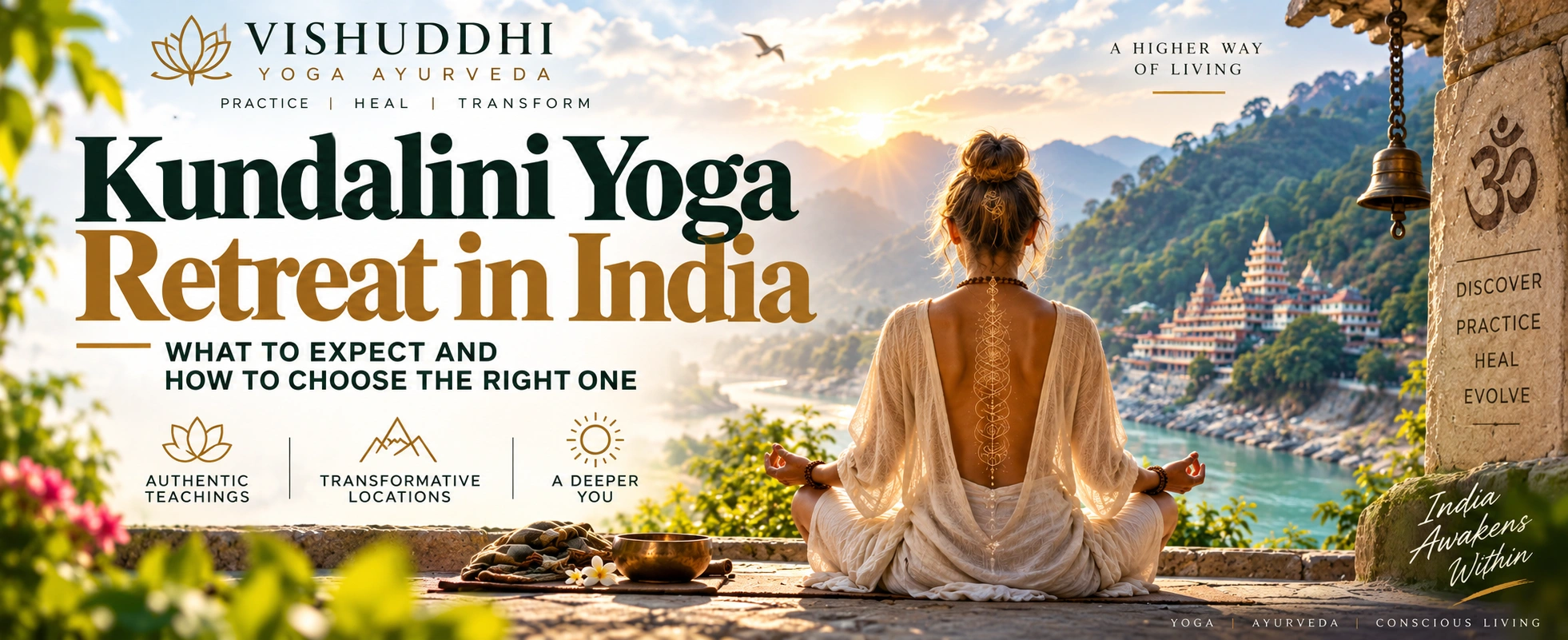
A lead trainer’s honest guide to what actually happens on Kundalini Yoga retreat — and what most listings won’t tell you.
Search “Kundalini yoga retreat in India” and you’ll scroll past a hundred near-identical listings. Almost nothing tells you whether the teacher actually knows what they’re doing. This guide fixes that.
That’s a real problem, because Kundalini-branded retreats vary more than almost any other category in yoga. Some are built on documented lineage and sequenced kriya practice. Others are a hatha retreat with the word “Kundalini” added to the title because it searches well.
I’ve watched students arrive at our Goa programs after a disappointing first retreat somewhere else. The story is almost always the same: beautiful location, warm teacher, no actual Kriya.
This guide is the one those marketplace listings won’t give you. What a Kundalini yoga retreat actually is. What separates a legitimate one from a relabeled generic retreat. What it actually costs. Who shouldn’t attend. And the one question most retreat listings avoid entirely.
What Is a Kundalini Yoga Retreat, Exactly?
A Kundalini yoga retreat is a short, immersive program — typically 3 to 21 days — built around kriya sequences, sustained pranayama, mantra, and meditation. Not asana-focused flow. The practice is deliberately different in both mechanism and pace.
According to Yoga Therapy and Ayurveda, the goal of this kind of immersion isn’t flexibility or strength. It’s nervous-system regulation. Kriya works on the autonomic nervous system slowly, through repetition and breath, rather than through muscular effort. That changes what a day looks like, and it changes what “progress” means.
Here’s the key distinction most listings blur: a retreat is experiential, not credentialing. You’re there to practice deeply and understand the tradition. Not necessarily to walk away certified to teach.
That’s what separates it from a Kundalini Kriya Yoga Teacher Training, which covers the same foundational material but adds teaching methodology, practicum, and a 200-hour credential.

The lineage question you need to ask before booking
Most retreat listings use the word “Kundalini” as if it describes one unified practice. It doesn’t. What’s taught under the Satyananda and Sivananda tradition is a meaningfully different system from Yogi Bhajan’s 3HO Kundalini Yoga — the version most Westerners first encounter in a studio setting.
And here’s the part most listings won’t tell you: Yogi Bhajan, who brought Kundalini Yoga to the West in 1968, has been the subject of extensive abuse allegations. An independent investigation concluded it was “more likely than not” that he sexually abused followers, with reports documenting decades of misconduct, manipulation, and exploitation within 3HO institutions. Els Coenen’s 2023 book Under the Yoga Mat documents the experiences of ex-3HO members, including abuse of children in schools in India.
Our programs draw from the Satyananda–Sivananda lineage, which has its own history and its own ethical framework. Neither lineage is “more real” than the other. But knowing which one you’re booking — and how that lineage addresses its own history — matters before you pay a deposit.
What Does a Kundalini Yoga Retreat Actually Cost?
Most listings give you a single “all-inclusive” number that bundles tuition, accommodation, and meals into one price. That makes comparison almost impossible. Here’s what the actual breakdown looks like in India.
Why this range exists. A retreat charging $150 for a 10-day program is almost certainly cutting corners on teacher quality or cohort size. A retreat charging $3,000 is either offering luxury accommodation, a very small private cohort, or a brand premium that may not reflect teaching quality. The sweet spot for a legitimate Satyananda-lineage retreat in India is $350–$700 tuition-only, with accommodation and meals bringing the total to $900–$1,500 for 7–10 days.
Current pricing for our programs is on the schedules and pricing page, since it shifts by cohort and season.
Who Should Not Attend a Kundalini Yoga Retreat?
This is the section most retreat listings skip entirely. But sustained breathwork and kriya practice aren’t appropriate for everyone, and a responsible program will tell you that upfront rather than after you’ve paid.
According to the classical texts and modern safety guidelines, the following conditions warrant medical clearance — or choosing a gentler practice.
Cardiovascular conditions. Breath of fire, extended breath retention, and sustained pranayama place demands on the cardiovascular system. If you have angina, a history of heart attack, irregular heartbeat, myocarditis, or other severe heart conditions, you need a doctor’s clearance before attending.
Epilepsy or seizure disorders. Breathwork and kriya can alter brainwave patterns. If you have epilepsy or a history of seizures, intensive pranayama is contraindicated without medical supervision.
Uncontrolled hypertension. Stage 2 or stage 3 hypertension is a contraindication for intensive Kundalini breath practices. Gentle meditation is fine; breath of fire is not.
Pregnancy. Most teachers advise against intensive Kundalini practice during pregnancy, particularly breath retention and strong abdominal work. Some traditions allow gentle practice through the first trimester with modifications. This needs individual assessment by both a doctor and an experienced teacher.
Acute psychiatric conditions. If you’re in an active episode of severe depression, have been diagnosed with schizophrenia, bipolar disorder (unstable), or psychosis, intensive breathwork and meditation can exacerbate symptoms. A retreat isn’t a substitute for psychiatric care, and a responsible teacher will refer out rather than push forward.
Severe PTSD or unresolved trauma. This one is nuanced. Many people with trauma histories benefit enormously from gentle, well-held somatic practice. But intensive breathwork can surface material faster than a retreat container can safely hold. If you’re carrying significant trauma, in-person training with a teacher physically present is safer than an online format — and you should have a therapist or support system in place before attending.
Cholelithiasis (gallstones). Listed as a contraindication in classical Kundalini sources, likely because strong breathwork and abdominal compression can aggravate the condition.

How Long Should a Kundalini Yoga Retreat Be?
Listings range from 3-day beach add-ons to 21-day deep immersions. But most substantive Kundalini retreats cluster between 7 and 10 days.
That range isn’t arbitrary. It’s long enough for the nervous-system work to actually build. Short enough to fit inside a normal vacation allowance.
Under a week, you’re mostly sampling. Enough to get a genuine taste of kriya and sustained pranayama — not enough for it to compound into real change. According to Yoga Therapy and Ayurveda, autonomic shifts from consistent breathwork practice tend to become measurable over two to three weeks of daily practice, which is why short retreats often feel powerful in the moment and fade within a month of returning home.
What Actually Separates a Real Kundalini Retreat from a Relabeled Generic One?
Skip past the beach photos. Check these six things instead.
A named lineage. Ask directly: is this Satyananda/Sivananda-based, 3HO/Yogi Bhajan-based, or an unaffiliated blend the teacher created themselves? Any legitimate school will answer this immediately and specifically. And if they teach in the 3HO lineage, they should be prepared to discuss the abuse history openly — not defensively, but honestly.
Checkable teacher credentials. ERYT status. Years actively teaching. Ideally, where they trained and under whom. “Certified yoga teacher” with no further detail isn’t a credential — it’s a marketing phrase.
Small cohort size. Kriya and pranayama work depends on real observation. A teacher needs to see whether your breath ratio is even, whether you’re rushing through a kriya, whether the extended sit is quietly building tension. A retreat running 25+ participants through the same room can’t offer that.
A curriculum that names actual content. Which kriyas? How does pranayama progress across the week? Is chakra study structured, or improvised session to session? If the answer is “it depends on the group’s energy,” that’s not a curriculum. That’s a vibe.
Honest safety framing. A retreat that treats emotional release as ordinary — and prepares you for it — is more trustworthy than one selling only blissful transformation. Ask about their intake process, their referral policy, and what they do if something intense comes up mid-session.
Transparent pricing. If the listing says “$999 all-inclusive” with no breakdown, ask what tuition-only costs. A school that can’t separate the two is either hiding something or hasn’t thought carefully about how to serve students who want to arrange their own stay.
What Does a Day in a Kundalini Yoga Retreat Actually Look Like?
Structure varies by school. But a genuine Kundalini retreat day typically runs something like this.
Early morning kriya and pranayama block before breakfast — usually the longest practice sit of the day. Mid-morning session covering chakra work, meditation technique, or philosophy. Lunch and a real rest period in the early afternoon, often with Ayurvedic meals suited to the intensity of the practice. Evening block of mantra, kirtan, or extended meditation. Then an early lights-out.

That rhythm — practice, rest, practice, quiet — is deliberate. It’s a compressed version of what a full 200-hour training’s daily schedule looks like, without the teaching-practicum blocks that extend a training day into the evening.
Most students don’t expect how much they’ll rely on the quieter blocks. The philosophy session, the silence, the early bedtime. Not the visibly active parts of the day. That’s a pattern I’ve seen hold true across every cohort I’ve taught.
Kundalini Yoga Retreat vs. 200-Hour Teacher Training
Most people are actually choosing between three containers — not two. Here’s how they compare.
| Retreat | 100-Hour Immersion | 200-Hour Training | |
|---|---|---|---|
| Duration | 7–10 days | 12 days | 25 days |
| Certification | None | Kriya Certificate | Full 200-Hour YTT |
| Focus | Personal immersion | Immersion + assessment | Teaching methodology |
| Best for | No teaching intent | Credential without full commit | Certified teaching path |
| Cohort | Small | Small | 6–7 students |
| Tuition only | $350–$700 | $550–$900 | $900–$1,600 |
If you’re a yoga teacher or holistic practitioner who wants to genuinely understand this lineage — not add a teaching credential, just deepen your own practice or client work — the retreat is very likely the right entry point.
You can always start with the retreat, then move into the 100-hour track if you decide partway through that you want the certificate after all.
Where in India Should You Do a Kundalini Yoga Retreat?
Rishikesh carries the strongest general “yoga capital” reputation and the highest retreat density. That density is both a feature and a problem — it’s easy to find a retreat, harder to find one that isn’t competing purely on price and location.
Kerala and Mysore lean more toward Ayurveda-integrated and Hatha-focused programs. If you’re specifically after Kriya-based Kundalini, these regions are less likely to have what you’re looking for.
Goa offers a genuinely different pace. Coastal, less saturated with mass-market retreat tourism than Rishikesh, and long-established as a base for Satyananda-lineage teaching specifically. That’s why our residential programs run from North Goa — the environment supports the practice rather than competing with it.

None of these is objectively “best.” It depends on whether you want the pilgrimage-town intensity of Rishikesh or a quieter, less crowded setting for the same depth of practice. What matters more than the postcode is whether the teacher and lineage are right.
How Do You Prepare for a Kundalini Yoga Retreat?
Because the format is shorter than a full teacher training, it’s tempting to under-prepare. The same fundamentals still apply.
Digestive readiness matters more than most people expect. According to Ayurvedic texts, a lighter diet in the week before intensive pranayama practice reduces the likelihood of sluggishness and heaviness during the sit. You don’t need to fast. You do need to stop treating the week before like a food holiday.
Seated meditation stamina matters too. If you’ve never sat cross-legged for more than twenty minutes, start building that capacity two to three weeks out. Ten minutes twice a day is enough. Your hips and knees will thank you by day three.
And set realistic expectations about the emotional processing that sustained breathwork can surface. It’s normal. It’s not a sign you’re “awakening.” A good retreat will help you hold that experience without either dramatising it or dismissing it.
Frequently Asked Questions
How long is a typical Kundalini yoga retreat?
Most substantive retreats run 7 to 10 days. Shorter options exist but offer less depth; longer ones start to overlap with teacher-training territory.
Is a Kundalini yoga retreat the same as Kundalini Yoga Teacher Training?
No. A retreat is immersive practice without a teaching credential. A teacher training covers the same foundational material plus methodology, practicum, and certification.
Do I need experience to attend a Kundalini yoga retreat?
No. Sincere beginners are welcome at most legitimate programs, though some baseline comfort with seated meditation makes the first few days easier.
What’s the difference between Satyananda Kundalini and Yogi Bhajan Kundalini retreats?
They’re distinct lineages with different technique sets and philosophical framing. Neither is more authentic than the other, but they’re different enough that it’s worth knowing which one a retreat is actually teaching before you book. And if it’s a 3HO-lineage program, the teacher should be prepared to discuss the documented abuse history openly.
Can a Kundalini yoga retreat lead to a certification?
Not typically on its own. Some schools offer an extended format — around 12 days / 100 hours — that adds assessment and results in an actual credential, sitting between a pure retreat and a full 200-hour training.
What does a Kundalini yoga retreat cost in India?
Tuition-only for a 7–10 day retreat typically runs $350–$700 USD. Accommodation and meals add roughly $600–$1,200 depending on room type and location. A 12-day, 100-hour immersion runs $550–$900 tuition-only. A full 200-hour training runs $900–$1,600 tuition-only.
Are there health conditions that make Kundalini yoga unsafe?
Yes. Cardiovascular conditions, epilepsy, uncontrolled hypertension, pregnancy, acute psychiatric conditions, and severe PTSD warrant medical clearance or a gentler practice. A legitimate retreat will have a health intake process and a clear referral policy.
Continue Exploring
Two containers. One lineage. Which fits what you can give right now?
Both paths lead into the same Satyananda–Sivananda tradition. The only question is how much of ordinary life you’re able to set aside.