Online Ayurveda Course Guide 2027: Types, Curriculum, Certification and Scope of Practice

Table of Contents
- What is an online Ayurveda course?
- Who online Ayurveda courses suit
- What online learning does well
- Ayurveda foundations you will study
- Types and levels of courses
- What a curriculum covers
- How to choose a course
- Online, in person or hybrid?
- Certification & accreditation
- What you can do after
- Length and cost
- Where should you start?
- From the classroom
- Study with VIYA
- Frequently asked questions
What is an online Ayurveda course?
Ayurveda is a traditional health system from India. The word joins ayus (life) and veda (knowledge). An online Ayurveda course delivers that knowledge through live classes, recorded lessons, reading, quizzes and assignments, so you can study from anywhere.
Formats differ. Live courses meet at set times with a teacher. Self-paced courses give you recordings to follow on your own schedule. Mixed courses combine both and often add a residential or practical module. If you want the formats explained in detail, read Ayurveda classes online and how to learn Ayurveda online.
Who online Ayurveda courses suit
- Complete beginners who want a clear, structured start with no prior knowledge.
- Yoga teachers and therapists who want to add Ayurvedic nutrition and lifestyle guidance to their teaching.
- Nutrition, wellness and health professionals who want a traditional framework for diet and routine.
- Working people and parents who need to study around a full schedule.
- Future advanced students who want a solid base before residential or practitioner-level training.
What online learning does well, and where it stops
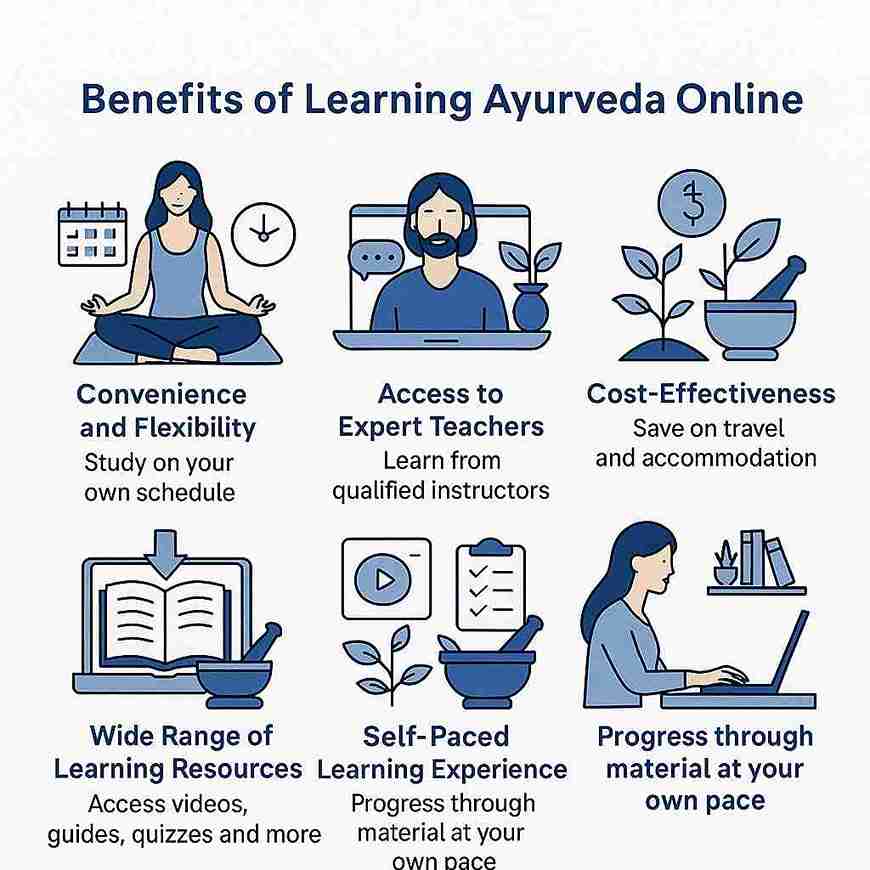
Online study works well for philosophy, doshas, digestion, nutrition, lifestyle and the theory of herbs. These subjects rely on reading, explanation, demonstration and your own daily observation.
Hands-on skills are different. Panchakarma procedures, bodywork and supervised clinical practice need a teacher beside you. Good schools say clearly which parts of a course are theory and which need in-person training.

Go deeper:
- How to learn Ayurveda online: a step-by-step start for beginners
- Ayurveda classes online: live and recorded classes explained
- All online Ayurveda courses: levels, dates and enrolment
Ayurveda foundations you will study first
Every good online Ayurveda course starts with the same core ideas. They are taught as one connected system, not as separate facts, and each one has its own guide on this site.
| Concept | What it means | Read the full guide |
|---|---|---|
| Five elements (pancha mahabhuta) | Ether, air, fire, water and earth: the qualities Ayurveda uses to describe nature and the body | Core Ayurvedic principles |
| Three doshas (tridosha) | Vata (air and ether), Pitta (fire and water), Kapha (earth and water) | The three doshas in Ayurveda |
| Prakriti and vikriti | Your constitution from birth, and your current state of balance | The three doshas in Ayurveda |
| Agni | The digestive and metabolic “fire” that Ayurveda places at the centre of health | What is Agni in Ayurveda |
| Ama | Poorly processed material that Ayurveda links with imbalance | Ayurvedic diet for digestion |
| Ojas | Described in the tradition as vitality and resilience | What is Ojas |
The six tastes (sweet, sour, salty, pungent, bitter and astringent) and food combining are taught alongside agni in the nutrition modules. A personal starting point is a dosha-based approach to eating: see the dosha-based diet plan.
If you are new to all of this, begin with the Online Ayurveda Basic Course, which is built around these foundations.
Types and levels of online Ayurveda courses
Online Ayurveda education is not one standard course. It is a set of pathways. Pick the one that matches what you know now and what you want to do next.
Foundations
Focus: Philosophy, doshas, daily routines, basic nutrition.
Best for: Beginners and yoga students.
Go to Online Ayurveda Basic Course
Nutrition
Focus: Agni, the six tastes, seasonal eating, meal planning.
Best for: Wellness and nutrition learners.
Go to Ayurveda Nutrition Course Certification
Herbalism
Focus: Classical herbs, preparations and their traditional use.
Best for: Herbal enthusiasts.
Go to Online Ayurveda Herbalism Course
Advanced Theory
Focus: Dhatus, srotas, samprapti, assessment principles, panchakarma theory.
Best for: Students who have finished the foundations.
Go to Advanced Ayurveda Courses Online
Practitioner and consultant pathway
Focus: Case-based learning, wellness planning, communication and ethics. Offered as a self-paced video series, a guided online course with live sessions and mentorship, and a 15-week residential in Goa.
Best for: Experienced learners ready for a structured programme.
Go to Advanced Ayurveda Practitioner Course (AACCC)
Specialist certificates
Panchakarma theory and Ayurvedic medicine; check each page for scope.
Certificate Course in Panchakarma | Certificate Course in Ayurvedic Medicine
A sensible order for most people is foundations first, then nutrition or herbalism, then advanced theory, then the practitioner and consultant pathway. You can see current options, dates and fees on Online Ayurveda Courses and Course Schedules and Pricing.
What an online Ayurveda curriculum covers
Curricula differ, but a complete programme usually moves through these seven modules in order.
- Foundations: history, philosophy, the five elements, tridosha, prakriti and vikriti.
- Digestion and nutrition: agni, ama, the six tastes, food combining, seasonal eating and meal planning.
- Daily and seasonal living: dinacharya, ritucharya, sleep and stress habits.
- Herbs: classical herbs, oils, powders and decoctions, and their safe, educational use.
- Yoga, pranayama and meditation: how movement and breath fit with Ayurvedic lifestyle guidance.
- Advanced theory: dhatus, srotas, malas, samprapti, assessment principles and the theory of panchakarma.
- Case-based learning and ethics: applying the theory to examples, plus professional communication and boundaries (advanced pathways only).
How to choose an online Ayurveda course
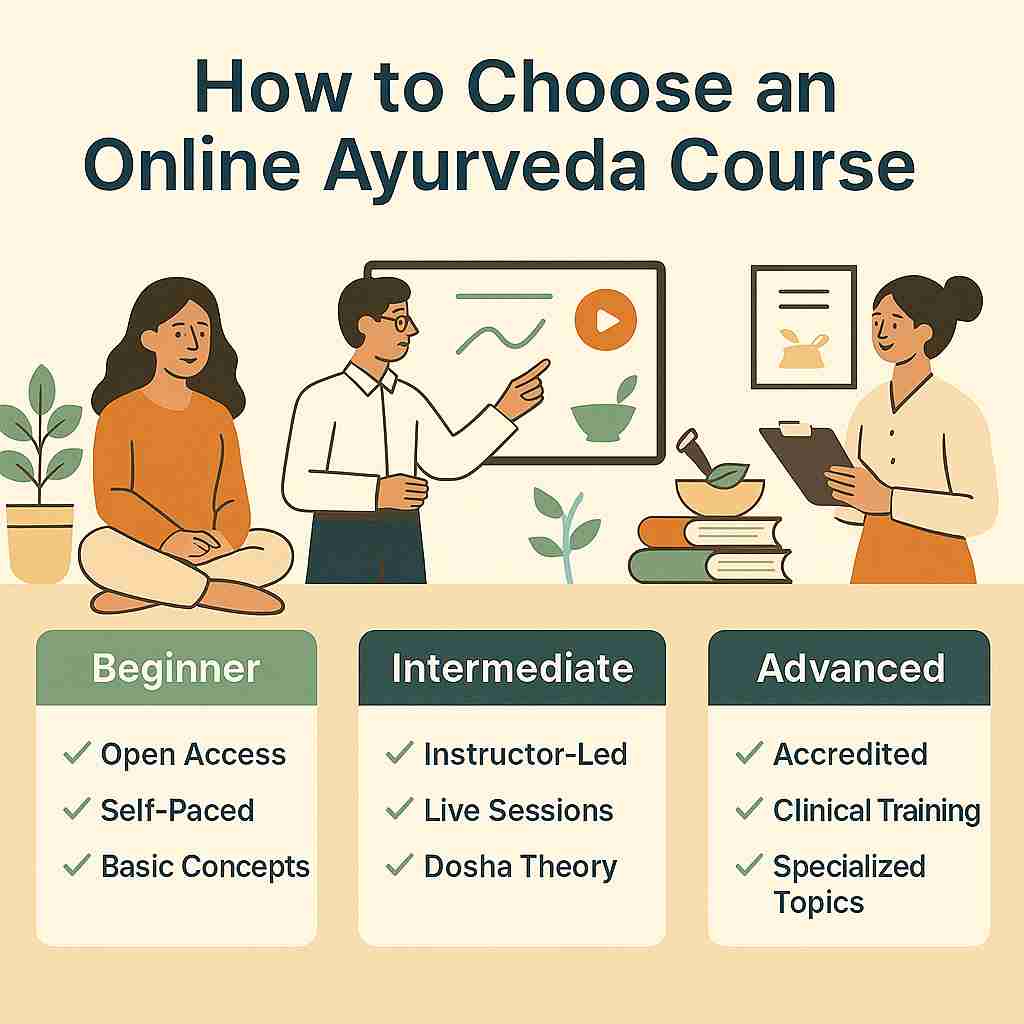
Compare courses on the seven points below, not on price or the look of the certificate alone.
| Criterion | What to look for | Question to ask |
|---|---|---|
| Curriculum depth | A published syllabus that builds from foundations to advanced | Can I see the module list and assessments? |
| Teachers | Named teachers with stated qualifications | Who teaches, and what are their qualifications? |
| Practical learning | Assignments, demonstrations, case discussions | How do I apply what I learn? |
| Certification clarity | A plain statement of who issues the certificate | What does the certificate allow and not allow? |
Red flags: Promises of practitioner-level skill after a few days, no information about teachers, a thin syllabus, passive video only, and vague claims about accreditation.
Go deeper:
- Best Ayurveda courses online (2027)
- Best online Ayurveda schools
- Best Ayurveda courses in India
- Ayurvedic courses after 12th
- Which course is best for Ayurveda?
Online, in person or hybrid?
Many students combine both: they study the theory online and then add a residential block for practical work. See our Ayurveda courses in India (Goa) and the guide to learning Ayurveda in India.
Certification, accreditation and recognition
“Accredited” is used loosely in online education. Ask three questions of any course: who issues the certificate, who recognises it, and what does it allow you to do?
In India, formal Ayurveda medical education is regulated by the National Commission for Indian System of Medicine (NCISM) under the Ministry of AYUSH. In the United States, the National Ayurvedic Medical Association (NAMA) is a professional association that sets membership standards.
| Where | Body | What it does |
|---|---|---|
| United States | AAC and NAMACB | NAMA recommends studying at an AAC-recognised programme. Read their FAQ. |
| India (Degrees) | NCISM | Regulates formal Ayurveda degrees such as BAMS. |
| India (Certificates) | ATAB / RAV | Publishes lists of accredited certificate courses by level. |
Our full explanation is in Is an online Ayurveda certification recognised?
What you can do after an online Ayurveda course
| You can usually | You usually cannot |
|---|---|
| Apply routines, nutrition and seasonal habits in your own life | Diagnose or treat disease |
| Add Ayurvedic lifestyle education to yoga teaching | Prescribe herbs or remedies for medical conditions |
| Run introductory workshops and wellness education | Present yourself as a doctor or licensed practitioner |
What is allowed depends on your country, so read Can you practise Ayurveda after an online course? and the overview of Ayurveda career pathways before you plan how to use your learning.
How long does an online Ayurveda course take, and what does it cost?
Length depends on the level. Introductory courses run for a few weeks. Certification pathways usually take a few months. Consultant-level programmes are longer: the Advanced Ayurveda Practitioner Course (AACCC) runs for 15 weeks as a residential immersion in Goa, and is also offered online as a self-paced video series or a guided Premium Online course.
We keep current fees on one page so they never go out of date: Course Schedules and Pricing.
Where should you start?
| Your goal | Start with | Then consider |
|---|---|---|
| Improve your own health habits | Online Ayurveda Basic Course | Ayurveda Nutrition Course |
| Add Ayurveda to your yoga teaching | Online Ayurveda Basic Course | Ayurveda Nutrition Course |
| Teach or coach nutrition | Ayurveda Nutrition Course | Advanced Ayurveda Courses |
| Build towards the practitioner pathway | Online Ayurveda Basic Course | Advanced Ayurveda Courses, then AACCC |
From the classroom: five notes from Pradip Krishna
What do beginners misunderstand about learning Ayurveda online?
Many beginners think Ayurveda is a list of remedies to memorise. It is a way of observing: food, sleep, digestion, season and mood, and how they affect each other. Online, the common mistake is collecting information faster than you practise it. Take one idea, apply it for two weeks, and notice what changes before you move on.
Which daily habit is easiest to start, and which is hardest to keep?
A regular mealtime and a simple morning routine are the easiest to begin, because they cost nothing and fit around your day. The hardest to keep are a steady bedtime and eating without a screen in front of you. Those habits compete with work, family and phones, so they need a plan.
What can an online course never teach?
Touch, and judgement under supervision. Online lessons teach theory, nutrition, routines and how to think in Ayurvedic terms. They cannot teach Panchakarma procedures or how to examine a person in front of you. That is why our online versions include no massage training. It is taught only in the residential course in Goa.
What would I tell someone about to buy a very cheap, very short certificate?
A certificate shows that you finished a course. It does not show what you can do. Ask who teaches, what the syllabus is, how you are assessed and what the certificate allows. Be careful with any promise that you will be a practitioner in a few days. Choose the course that teaches you something real and is honest about what the certificate is not.
How should a beginner plan a weekly study routine?
Plan three or four short sessions a week instead of one long one. For example, two sessions to watch or read, one to write notes and revise, and one to apply the idea to your own routine. Keep the same days and times, and end each week with a short review. Consistency matters more than the number of hours.
Study with Vishuddhi Issha Yoga and Ayurveda
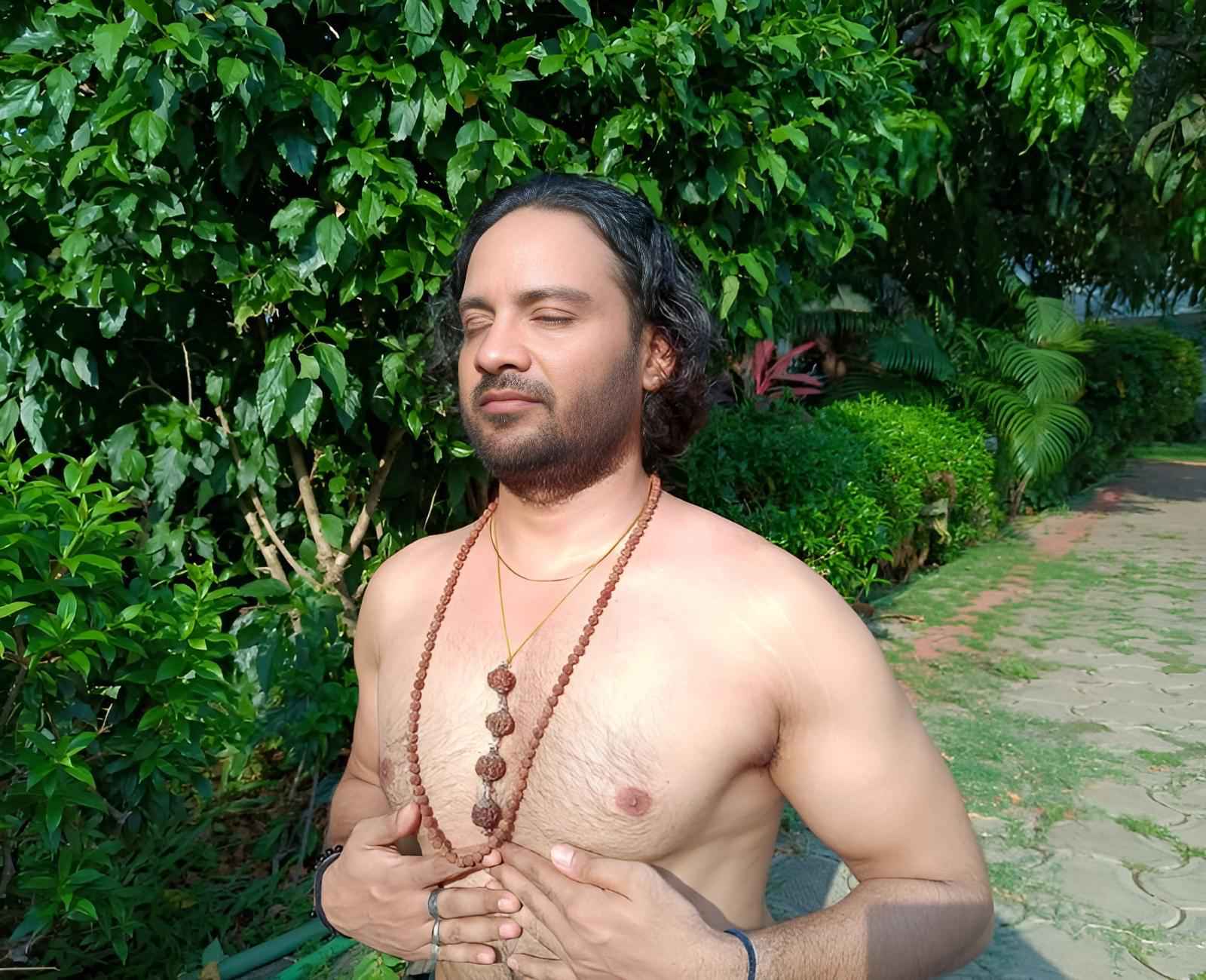
Vishuddhi Issha Yoga and Ayurveda (VIYA) is a school in Candolim, Goa, India, offering Ayurveda courses online and in person. Our founder and lead teacher, Pradip Krishna, is an ERYT 500 and CYT 200 certified yoga teacher with more than 15 years of teaching experience and an Advanced Diploma in Ayurveda from Kerala.
Our approach is simple and grounded in the tradition: clear teaching, no exaggerated promises and honest information about what each course does and does not qualify you to do.
Questions before you enrol? Email info@vishudhiyogaayurveda.com or message us on WhatsApp.
Message us on WhatsApp (+91 70836 71508)Frequently asked questions
What is an online Ayurveda course?
It is a structured programme that teaches Ayurvedic philosophy, doshas, digestion, nutrition, herbs and daily routines through live or recorded lessons. Levels run from beginner foundations to advanced certification.
Can I really learn Ayurveda online?
Yes, for theory. Philosophy, doshas, nutrition, lifestyle and herb theory teach well online. Hands-on skills such as Panchakarma procedures and clinical work need in-person supervision.
Is an online Ayurveda course suitable for beginners?
Yes. Beginner courses assume no prior knowledge. They introduce the five elements, the doshas, digestion and daily routines first, before any advanced topics.
How long does an online Ayurveda course take?
Introductory courses run for a few weeks, certification pathways for a few months. The residential Advanced Ayurveda Practitioner Course (AACCC) in Goa runs for 15 weeks. Online, it is offered as a self-paced video series or a guided Premium Online course.
Are online Ayurveda certificates recognised?
Recognition depends on the school and on the country where you want to use the certificate. A school certificate is an educational credential, not a licence. Confirm recognition with the regulator or association in your country.
Can I practise Ayurveda after an online course?
Online study is a good base for lifestyle and nutrition education. Clinical practice, diagnosis and treatment usually need recognised qualifications and registration, which differ by country.
Do online Ayurveda courses include practical training?
Many include demonstrations, assignments, case discussions and guided self-practice. Hands-on therapy training is usually offered separately, in person.
Can I study Ayurveda while working full time?
Yes. Self-paced lessons, recordings and scheduled live sessions let most students study around work and family.
Which Ayurveda course should I start with?
Most people start with a foundations course, then add nutrition or herbalism, then advanced theory.
What is the difference between Ayurveda courses and Ayurveda classes?
A course is a structured programme with a syllabus, assessment and usually a certificate. Classes are individual live or recorded sessions on a topic.
Sources and references
This guide is educational and is not medical advice. The traditional concepts above come from the classical Ayurvedic texts: the Charaka Samhita (internal medicine), the Sushruta Samhita (surgery and anatomy) and the Ashtanga Hridaya of Vagbhata. For regulation, see the Ministry of AYUSH in India and the National Ayurvedic Medical Association in the United States.
Keep learning
- Foundations: The three doshas, What is Agni, Dosha-based diet plan.
- Choose and compare: Best Ayurveda courses online, Best online Ayurveda schools.
- Learn online: How to learn Ayurveda online, Ayurveda classes online.
- Courses: Basic Course, Nutrition Certification, Herbalism Course.