Self-paced video course · BSS certificate
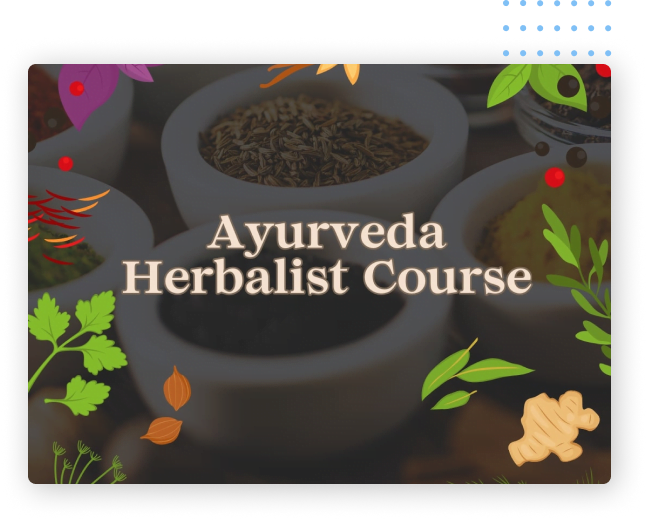
Ayurvedic Herbalism Course Online
Learn Ayurvedic herbs by dosha, energetics and preparation. 19 video tutorials, about 21 hours, lifetime access.
From €113 (list €141) · with code OAC20
An Ayurvedic herbalism course online teaches how Ayurveda classifies and uses herbs through recorded video lessons. Ours has 19 tutorials and about 21 hours of content on herbal energetics, dosha-based use of herbs, preparations, dosages and materia medica, plus a course ebook and lifetime access. It comes in two options, €113 for the videos and ebook (list €141) or €233 with 7 additional live sessions (list €291), both with code OAC20 for 20% off, and it ends with a certificate accredited by Bharatiya Sevak Samaj (BSS), a private body. It is education and does not license you to treat disease.
See all courses and fees on the course schedules and pricing page.
Choose your option
Self-paced
Videos + ebook
€113
with code OAC20 (list €141)
- 19 course videos
- Course ebook (about 300 pages)
- Assignments and case studies
- Live online exam and email support
- Lifetime access
Guided
Videos + ebook + 7 live sessions
€233
with code OAC20 (list €291)
- Everything in Videos + ebook
- 7 additional live sessions
- Live Q&A with Pradip Krishna
- Deeper practice and case review
- Lifetime access
Indian Students: message us for separate pricing, on WhatsApp (+91 70836 71508) or through the inquiry form.
What you learn in the Ayurvedic herbalism course
The 19 tutorials move from theory to practice: how plants are understood in Ayurveda, how herbs are described by taste and energetics, how to match herbs to a person's constitution, and how herbs are prepared and dosed. The final tutorials cover materia medica and classical formulas.
| Tutorial | Topic | What it covers |
|---|---|---|
| 1 | The Cosmic Manifestation into Plants | How the five elements show up in plants and why that matters for their action |
| 2-3 | Herbal Energetics | Taste, potency, post-digestive effect and special action of herbs |
| 4-5 | Management of Individual Constitution (Dosha) | Matching herbs to vata, pitta and kapha, parts 1 and 2 |
| 6-8 | Herbal Therapeutics | How herbs act in the body, parts 1 to 3 |
| 9 | Preparations and Use of Herbs | Classical forms of preparing and using herbs |
| 10 | Medium of Intake, Administration and Dosages | Anupana, routes of use and dosage principles |
| 11-17 | Ayurveda Materia Medica | Seven tutorials profiling prominent herbs and their properties |
| 18 | Non-Herbal and Mineral Medicines in Ayurveda | What they are and why caution matters |
| 19 | Special Ayurvedic Herbal Formulas | Classical compound formulas |
How herbs are matched to the doshas
Ayurveda does not describe a herb only by what it does for one symptom. Each herb is described by its taste, its qualities and its energetics, and it is chosen to balance the person's constitution (prakriti) and current imbalance (vikriti). Tutorials 2 to 5 teach this method step by step, so you can read an herb the way a classical Ayurvedic text does.
That is the main difference from Western herbalism, which usually organises herbs by their actions on body systems. Ayurveda organises them by their effect on the doshas and on the whole person.
Why study herbalism with us

Complete curriculum
19 tutorials from theory to materia medica and classical formulas.

Plant wisdom
Learn how plants are understood, prepared and used in Ayurveda.

Dosha-based matching
Match herbs to constitution and imbalance, not to a single symptom.

Expert guidance
Taught by Pradip Krishna, with assignments, case studies and email support.

Flexible learning
Study online at your own pace, from any country, with lifetime access.
What is included
- 19 video tutorials, about 21 hours of content
- Course ebook of about 300 pages for reading between lessons
- Assignments and case studies
- Live online exam and email support
- Lifetime access, self-paced
- Second option: 7 additional live sessions
- Certificate accredited by Bharatiya Sevak Samaj (BSS), a private body, on successful completion
A note from Pradip
I hold an Advanced Diploma in Ayurveda from Kerala and have taught for more than 15 years. Herbs are powerful, and many people take them alongside medicines. I teach this course so you understand how Ayurveda classifies and uses herbs, not so you replace a doctor. If someone has a diagnosis or takes prescription medicine, send them to their physician first.
Is this Ayurvedic herbalism course right for you?
A good fit if you are
- A yoga teacher adding Ayurveda knowledge
- A wellness or nutrition professional
- A student who finished our Basic course
- A home learner who wants to understand herbs
Not the right course if you want
- A licence to diagnose or treat patients
- A BAMS degree or government registration
- To replace medical care with herbs
How to become an Ayurvedic herbalist: a realistic path
- Learn the foundations. Start with the Basic Ayurveda course so doshas and constitution are clear.
- Study herbalism. This course teaches energetics, dosha matching, preparations and materia medica.
- Add depth. Take the Online Advanced course or the Nutrition course, then the AACCC practitioner course if you want a fuller programme.
- Check your local rules. Read what you can legally do after an online course in your country before you offer any service.
Safety and scope of herbal learning
- Herbs can interact with medicines. If you take prescription medicines or are pregnant, ask your doctor before using any herb.
- Quality matters. The US National Center for Complementary and Integrative Health reports that some Ayurvedic products have contained toxic levels of lead, mercury or arsenic, so buy from trusted suppliers.
- The course does not qualify you to diagnose or treat disease.
Read what students say on our reviews page, or see whether online Ayurveda certification is recognised.
Online herbalism course or Goa residential course?
This page is the self-paced online video course. If you want to study herbs in person, see our residential Ayurveda herbalism course in Goa, which has its own dates and fees. You can also compare all our online Ayurveda courses or read the online Ayurveda course guide.
Course preview

Frequently asked questions
What is an Ayurvedic herbalism course online?
How much does the Ayurvedic herbalism course online cost?
What is the difference between the two options?
Do I need prior Ayurveda knowledge?
How long does the course take and how long do I have access?
Do I get a certificate, and who accredits it?
Can I treat patients or prescribe herbs after this course?
How do I become an Ayurvedic herbalist?
What is the difference between Ayurvedic herbalism and Western herbalism?
How are herbs matched to the doshas in Ayurveda?
Can I take this course outside India?
How is this different from your Goa residential herbalism course?
Does the course include support, and can I get a refund?
Sources
- Ayurvedic Medicine: In Depth, NCCIH, US National Institutes of Health.
- National Commission for Indian System of Medicine (NCISM).
Start learning Ayurvedic herbalism
This course is educational. It does not give you the legal right to diagnose or treat disease, and herbs can interact with medicines. Speak to a qualified doctor before using herbs for a health condition.


