
Basic Ayurveda Course Online: 6 Videos, 7 Hours, for Beginners
Basic Ayurveda Course Online: Learn the Foundations of Ayurveda
Ayurveda for beginners: an introduction to your unique blueprint of doshas, digestion, daily and seasonal routines.
Short answer
The Online Basic Ayurveda Course is a beginner course in the foundations of Ayurveda: 6 videos (about 7 hours), a downloadable eBook, practical assignments and lifetime access. You learn the five elements, the three doshas (Vata, Pitta, Kapha), your constitution (Prakriti) and daily and seasonal routines.
Self-Paced Essentials is €75 (€60 with code OAC20). Guided Learning is €220 (€176 with code OAC20) and adds 5 live online guidance sessions, mentorship and a certificate accredited by Bharatiya Sevak Samaj (BSS).
The course is educational. It is not a BAMS degree, a NAMA-accredited program or a licence to practise. To weigh it against other programs, see our comparison of the best Ayurveda courses online, or read how Ayurveda certification courses differ.
Have you ever stood in the supplement aisle, paralyzed by choices, secretly wondering: “Why is my body so confusing?”
Maybe you’ve tried:
- The keto diet that worked for your sister—but left you bloated and foggy.
- The 5 a.m. morning routine that was supposed to transform your life—but left you exhausted by Wednesday.
- The “eat this, not that” advice that changed weekly, leaving you more anxious than when you started.
- Counting calories, macros, points—only to feel more disconnected from your body than ever.
You’re not alone. And here’s the truth modern wellness rarely says out loud:
There is nothing wrong with you. You’ve just been given universal advice for a body that is uniquely you.
For thousands of years, Ayurveda has taught that there is no single “healthy” lifestyle. There is only your lifestyle, aligned with your nature.
When you study Ayurveda online with us, you’re not just memorizing ancient concepts. You’re building a practical framework for understanding your own body.
Welcome to your first step home to yourself.
Quick Facts: Your Course at a Glance
Before we dive deep, here’s what you need to know upfront:
| Quick Facts | Details |
|---|---|
| Course Duration | 7 hours (self-paced, lifetime access) |
| Level | Beginner (no prior knowledge needed) |
| Certification | Certificate accredited by Bharatiya Sevak Samaj (BSS), Guided Learning option |
| Price | From €60 with coupon OAC20 (list price €75) |
| Format | 6 videos + eBook + practical assignments |
| Access | Lifetime (learn on your schedule) |
| Support | Email support + community access |
| Instructor | Pradip Krishna (15+ years experience) |
Curious if this path is right for you? Explore our complete guide to online Ayurveda courses to see how the study options fit together, or compare programs in our guide to the best Ayurveda courses online.
Ayurveda Basics in Plain Language
If you are new to Ayurveda, these are the six terms the course builds on:
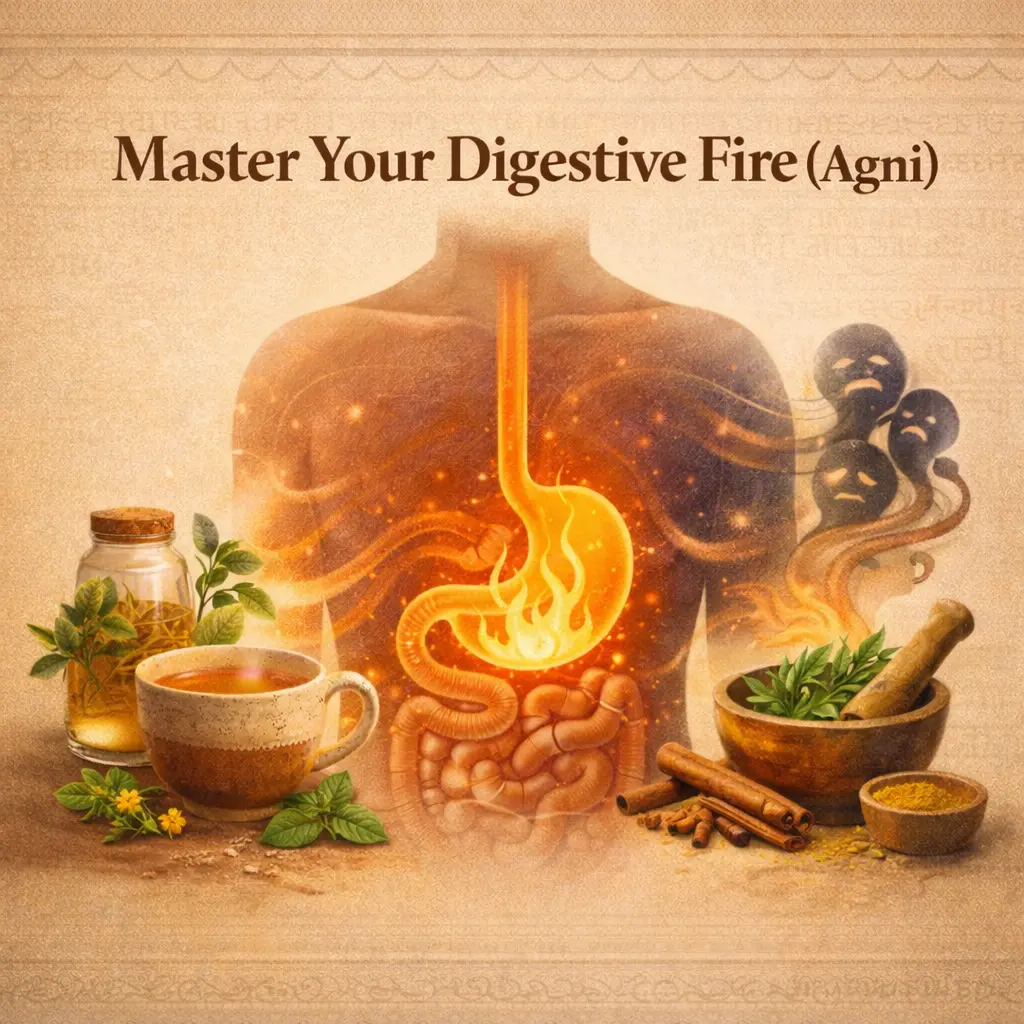
Agni: Your Digestive Fire
Agni is the Ayurvedic idea of digestive fire. Ayurveda describes how well you digest food, and how well you take in and process experience, through Agni. It can be strong, irregular, sharp or slow depending on your dosha, which is one reason the same meal can feel light for one person and heavy for another. The course builds on this when it covers digestion, your dosha and your daily routine, so you can see why meal timing and food choices matter in Ayurveda. This is educational information and not medical advice.
Why Take a Basic Ayurveda Course Online? Because Generic Wellness Failed You
Modern health culture treats bodies like machines. Same fuel. Same maintenance schedule. Same repairs.
But you’ve felt it, haven’t you?
- Your friend thrives on salads while you need warm, cooked food to feel grounded.
- Your partner bounces out of bed at 5 a.m. while your creativity peaks at midnight.
- That “calming” meditation app makes you more anxious, while a walk in nature centers you completely.
You’re not broken. You’re just different.
Ayurveda doesn’t ask you to fit into a system. It builds the system around you.
Many of its ideas also sit close to topics modern researchers study, such as circadian rhythms: the body’s roughly 24-hour cycle of sleep, hunger and alertness. Research in this area links regular sleep, meal and activity timing with better metabolic health, and Dincharya, the Ayurvedic daily routine, builds on the same idea of living by a steady daily rhythm.
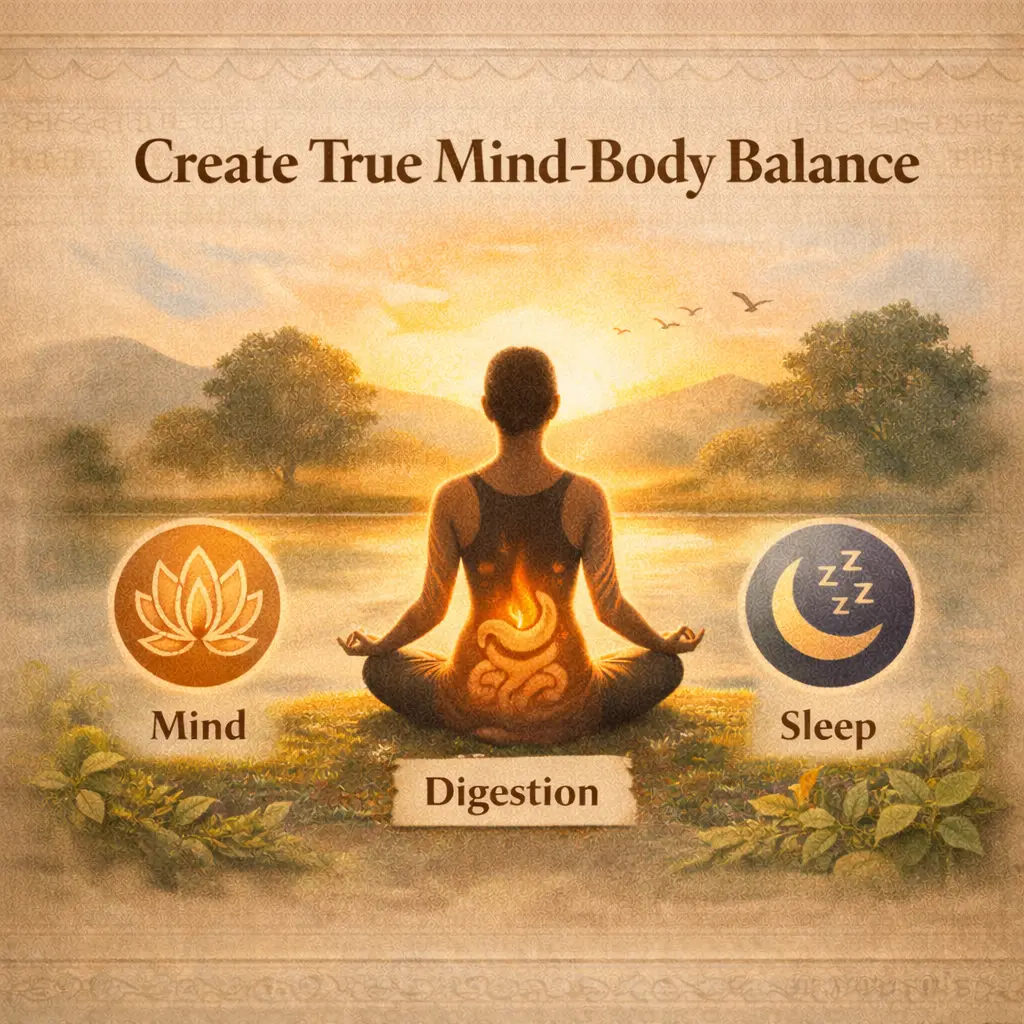
Studying online means you can learn at your own pace, repeat any lesson and apply it the same day. If you are deciding how to begin, read how to learn Ayurveda online, or browse our Ayurveda classes online.
Our online basic Ayurveda course isn’t about memorizing ancient Sanskrit terms (though you’ll learn them). It’s about finally understanding:
- Why certain foods make you feel heavy while others give you wings.
- Why your sleep patterns, digestion, and moods swing like a pendulum.
- Why the “perfect” routine you copied from a wellness influencer may not suit you.
This is the treasure trove of fundamental lifestyle wisdom you’ve been searching for—but these aren’t hacks. They’re homecoming.
Ayurveda Course Details: What Makes This Program Different?
Before you commit to any Ayurveda study course, you deserve to know exactly what you’re getting. Here are the complete Ayurveda course details for our foundational program:
| Feature | Detail |
|---|---|
| Course Name | Online Basic Ayurveda Course |
| Total Duration | 7 hours of video content |
| Format | 6 video tutorials + eBook + assignments |
| Certification | Certificate accredited by Bharatiya Sevak Samaj (BSS), Guided Learning option |
| Access | Lifetime (learn at your own pace) |
| Support | Email support + community access |
| Price | €75, or €60 with coupon OAC20 |
| Instructor | Pradip Krishna (15+ years experience) |
Unlike dense textbooks or scattered YouTube videos, this course offers structured, sequential learning. Each tutorial builds on the last, so you develop genuine understanding—not just fragmented facts.
Who This Course Is For—and Who It Is Not For
A good course is honest about its limits. Here is where this one fits.
This introduction to Ayurveda is a good fit if you
- Are new to Ayurveda and want a clear, structured start.
- Want to understand your own constitution, digestion and routine.
- Prefer to learn online, at your own pace, with optional live guidance.
- Want a foundation before moving to advanced or professional study.
It is not the right choice if you
- Need a BAMS degree or a NAMA-accredited qualification.
- Want a licence or training to diagnose or treat disease.
- Are looking for medical advice about a health condition.
Planning to work with clients later? Read whether you can practise Ayurveda after an online course, compare Ayurveda certification courses, or see the full list of online Ayurveda courses.
Ayurvedic Courses Duration: How Long Does It Take?
One of the most common questions we hear is about Ayurvedic courses duration. Here’s the honest answer:
The course itself is 7 hours of video content. But the real learning? That unfolds over a lifetime.
A realistic way to pace your learning:
You have lifetime access, so you can revisit any tutorial whenever you need a refresher. The 7 hours are just the beginning.
Ayurveda Classes: What You’ll Learn in Each Tutorial
Our Ayurveda classes are designed to unfold like a conversation with a wise, patient friend. Here’s what each tutorial covers:
Tutorial 1: Introduction, Origin and History of Ayurveda
Where This Ancient Wisdom Came From—And Why It Still Matters Today
We begin not with flashcards and memorization, but with story. The story of how the rishis (ancient seers) meditated on the nature of life and received the understanding that is still taught today.
You’ll discover:
- Why Ayurveda is called the “Science of Life” (Ayus = Life, Veda = Knowledge).
- How this thousands-of-years-old tradition has been passed down and why people still study it.
- Why many traditional kitchen remedies follow Ayurvedic ideas about food and digestion.
- How Ayurvedic ideas about daily rhythm, personalized nutrition and the mind-body connection relate to topics modern research also studies.
Tutorial 2: Tridosha and Panchmahabhuta Concepts
The Five Elements and Three Energies That Shape Everything (Including You)
Here’s where modern wellness often goes wrong. It treats symptoms. Ayurveda looks at you as a whole person.
You are made of the same five elements as the universe:
| Element | Qualities | In Your Body |
|---|---|---|
| Ether (Space) | Light, subtle, expansive | Spaces in your mouth, nose, cells |
| Air | Mobile, dry, light | Breathing, movement, nervous system |
| Fire | Hot, sharp, transformative | Digestion, metabolism, vision |
| Water | Fluid, cold, heavy | Blood, lymph, bodily fluids |
| Earth | Solid, stable, dense | Bones, muscles, tissues |
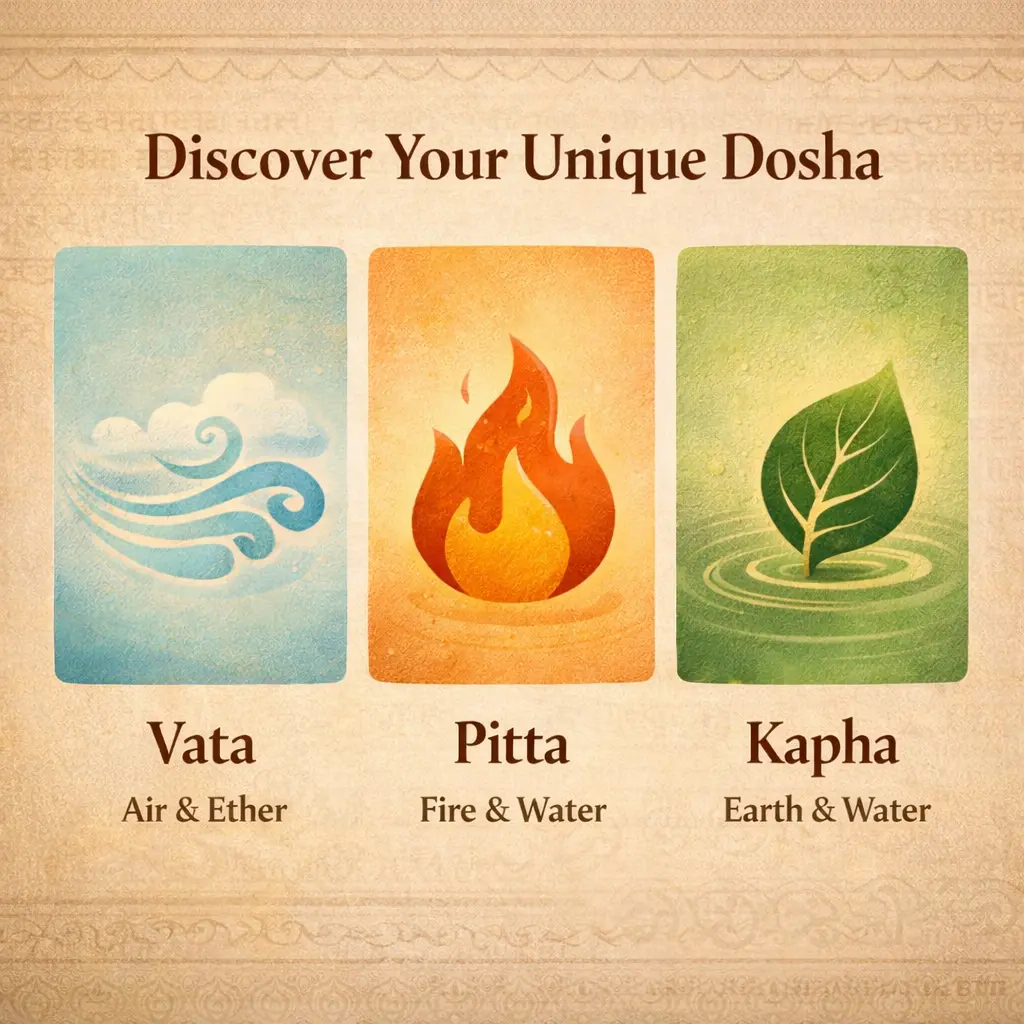
Within you, these elements combine to form three energies—Vata, Pitta, and Kapha—that Ayurveda uses to describe everything from digestion to temperament.
This isn’t abstract philosophy. This is the operating manual your body came with but never received. The core framework is explained in our three doshas explained.
Tutorial 3: Understanding Vata Dosha
For the Creative, Anxious, Always-on-the-Move Souls
If this sounds like you, pay attention:
- Your mind races. Always. Especially at 3 a.m.
- Your digestion is unpredictable—sometimes great, sometimes a mess.
- You love travel, new experiences, and change—but you crash hard afterward.
- Your skin and hair tend toward dryness.
- You feel things deeply and intensely.
You, my friend, might be Vata-dominant.
Vata = Ether + Air. It’s the energy of movement. When balanced, Vata people are creative, enthusiastic, and quick-thinking. When imbalanced, they tend toward anxiety, insomnia, and irregular digestion.
In this tutorial, you’ll learn:
- Why routine (which Vatas resist) is traditionally considered their greatest support.
- The warm, grounding foods traditionally used to settle the mental chatter.
- Simple oil massage (Abhyanga) practices traditionally used to calm Vata.
- How to work with your boundless energy without burning out.
Tutorial 4: Understanding Pitta and Kapha Dosha
Pitta Dosha (Fire + Water):
- You’re sharp, focused, and competitive.
- You run hot—literally and emotionally.
- You tend toward heartburn, skin rashes, or irritability when stressed.
- You have a strong appetite for food, work, and life.
- People might call you “intense.”
Pitta is your fire. When balanced, you’re warm, intelligent, and a natural leader. When imbalanced, you become critical, impatient, and inflamed.
You’ll learn:
- Cooling foods and practices that keep your fire from burning out of control.
- How to work with your intensity without alienating others.
- Why skipping meals makes you angry (and what to do instead).
Kapha Dosha (Water + Earth):
- You’re calm, loyal, and slow to anger.
- You struggle with morning sluggishness.
- Weight clings no matter what you try.
- You prefer stability and hate change.
- You’re a natural nurturer who takes care of everyone else.
Kapha is your steady earth. When balanced, you’re loving, grounded, and strong. When imbalanced, you feel heavy, stagnant, and unmotivated.
You’ll discover:
- How to find energy without forcing it.
- The stimulating foods and practices that lift Kapha stagnation.
- Why movement is medicine—and the best types for your body.
Not Sure Which Dosha You Are?
Here’s a quick hint:
- If you forget to eat because you’re so engrossed in what you’re doing—that’s Vata energy.
- If you get hangry (hungry + angry) when a meal is late—that’s Pitta energy.
- If you could easily skip meals and still feel fine, but struggle with heaviness—that’s Kapha energy.
Most people are a combination of two. In the course, you’ll receive our complete self-assessment toolkit to discover your unique blueprint.
Understanding the doshas is also the key to deeper concepts such as Ama (the undigested residue Ayurveda says accumulates when we live out of balance) and Ojas (the vital essence linked with immunity and vitality).
Tutorial 5: Daily and Seasonal Regimens (Dincharya & Ritucharya)
Ancient Rhythms for a Modern Life
Here’s where the magic becomes practical.
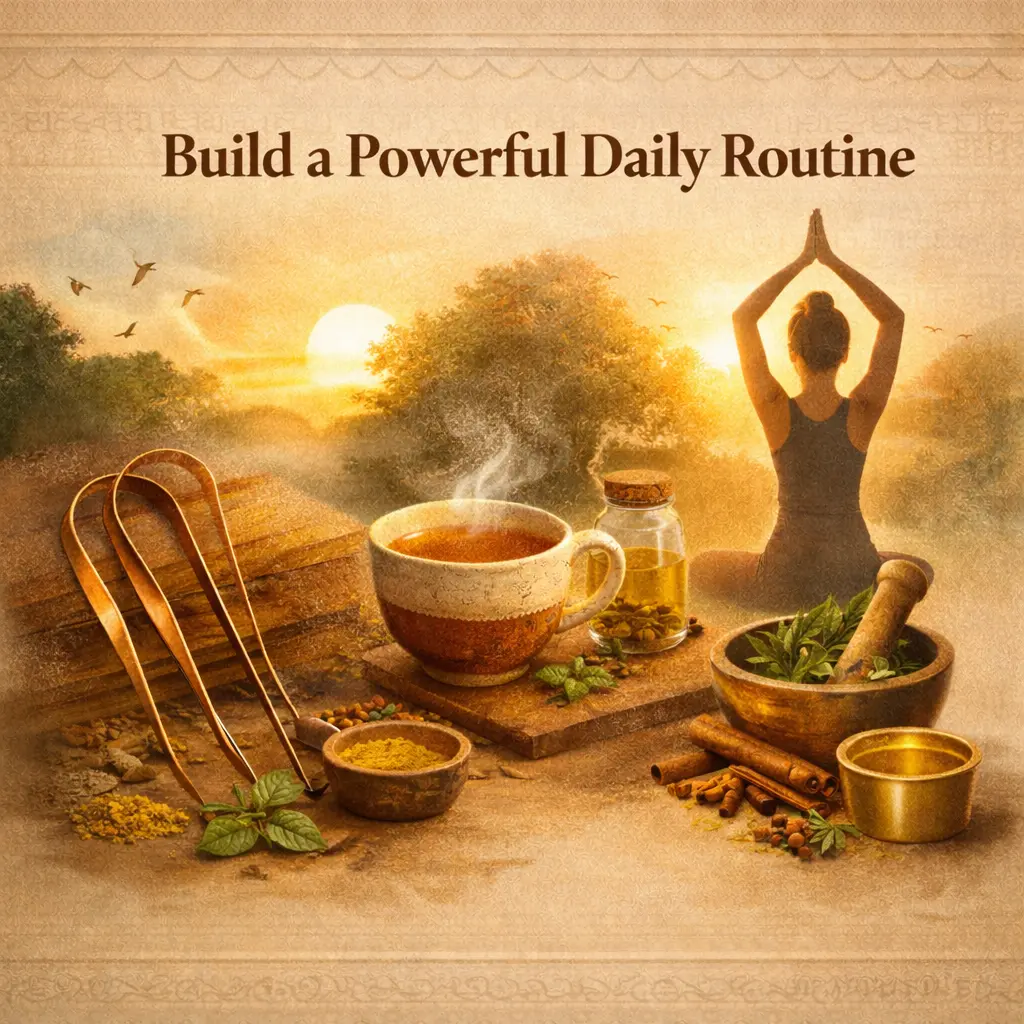
Ayurveda teaches that our bodies thrive when daily life follows the natural rhythm of the sun. This overlaps with what researchers call circadian biology. The timings below are traditional guidelines, not medical prescriptions.
The Dincharya (Daily Routine) Secrets
| Time | Ayurvedic Practice | Why It Is Recommended |
|---|---|---|
| 6:00 a.m. | Wake before sunrise | Traditionally advised to start the day in step with natural light |
| 6:30 a.m. | Scrape tongue | Traditionally used as part of daily oral hygiene |
| 7:00 a.m. | Drink warm water | Traditionally taken to support digestion |
| 8:00 a.m. | Light movement | Supports a steady daily rhythm |
| 12:00 p.m. | Largest meal | Ayurveda holds that digestion is strongest around midday |
| 6:00 p.m. | Light dinner | A lighter evening meal is traditionally advised before sleep |
| 10:00 p.m. | Bedtime | A regular bedtime supports a steady sleep rhythm |
For a deeper dive, read our guide to Ayurveda daily and seasonal routines.
The Ritucharya (Seasonal Secrets)
Timing varies by region and climate. You’ll learn why some foods suit one season better than another, and how to adjust your routine as the year turns.
Course Preview
Meet Your Guide: Pradip Krishna
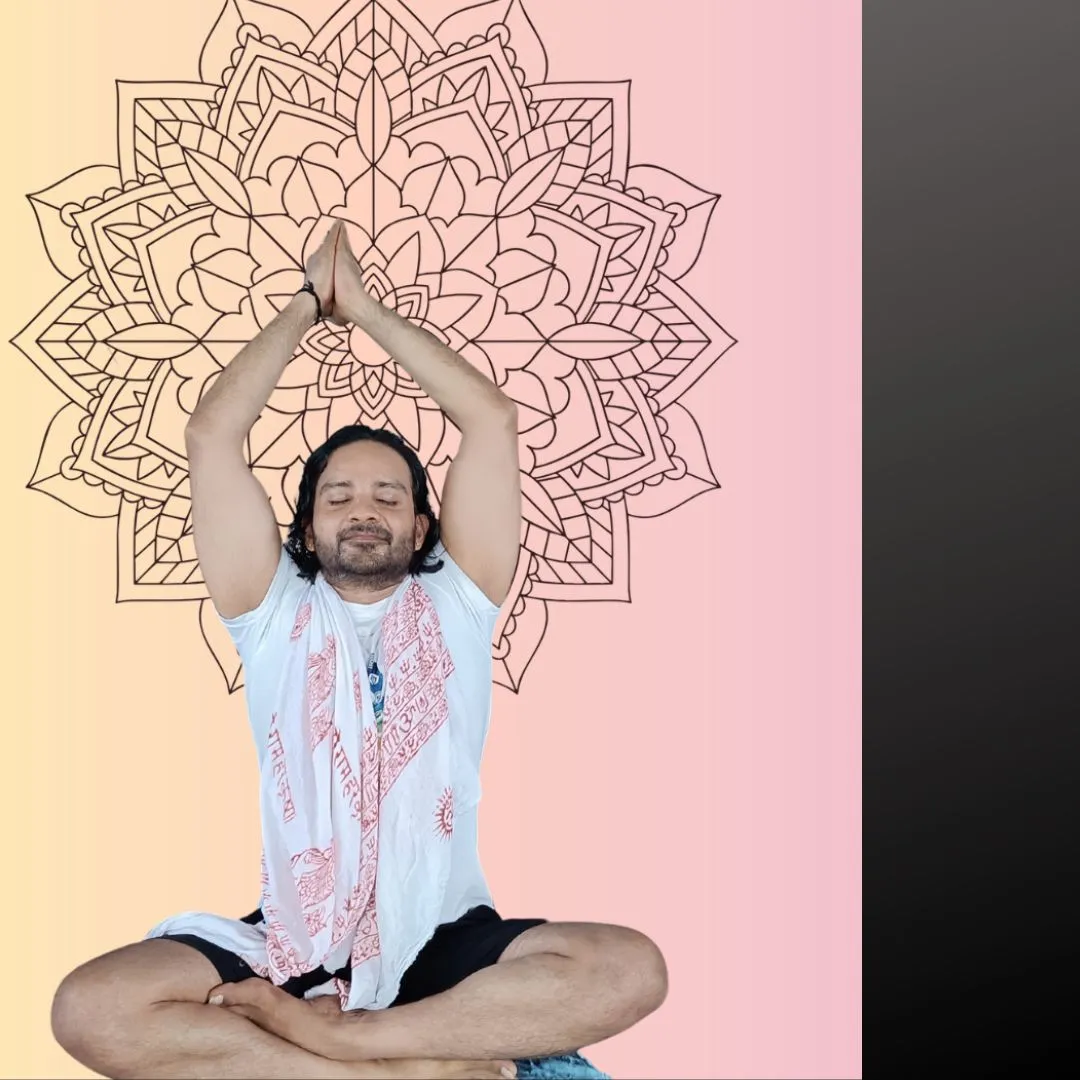
Some teachers explain. Pradip holds space.
Pradip is the founder of Vishuddhi Issha Yoga & Ayurveda in Candolim, Goa. With more than 15 years of teaching experience, he has taught students from many countries, from complete beginners to health professionals. He teaches Ayurveda, yoga therapy and Kundalini Kriya Yoga in the Sivananda–Satyananda lineage, online and in Goa.
His teaching isn’t about impressing you with Sanskrit terms. It’s about sitting beside you and saying, “Let’s figure this out together.”
“Ayurveda is not just a science; it’s an art of living. It’s the art of coming home to yourself. I’m here to make that art accessible to you.”
ERYT 500 and CYT 200 yoga teacher & yoga therapist
Yoga Alliance International
Advanced Diploma in Ayurveda (Kerala)
Ayurveda Holistic Health Consultant & Coach
Read the full profile: Pradip Krishna (15+ years experience).
Choose Your Ayurveda Learning Path
Begin your journey into authentic Ayurveda with the option that fits your learning style.
Self-Paced Essentials
Use Coupon OAC20 for 20% OFF: pay €60
- ✔ 6 In-Depth Ayurveda Course Videos
- ✔ Downloadable Course eBook
- ✔ Practical Assignments
- ✔ Lifetime Access
- ✔ Study at Your Own Pace
Guided Learning Experience
Use Coupon OAC20 for 20% OFF: pay €176
- ✔ 6 In-Depth Course Videos
- ✔ Course eBook + Assignments
- ✔ 5 Live Online Guidance Sessions
- ✔ BSS-Accredited Certificate (Bharatiya Sevak Samaj)
- ✔ Doubt-Clearing & Mentorship
- ✔ Community Learning Support
| Feature | Self-Paced Essentials | Guided Learning |
|---|---|---|
| List price (with code OAC20) | €75 (€60) | €220 (€176) |
| 6 course videos | Yes | Yes |
| eBook and practical assignments | Yes | Yes |
| 5 live online guidance sessions | — | Yes |
| Doubt-clearing and mentorship | — | Yes |
| BSS-accredited certificate | — | Yes (after the live exam) |
| Best for | Independent learners on a budget | Learners who want live guidance and a certificate |
Online courses are non-refundable once purchased, so review the course preview and details above before enrolling.
Ayurveda Courses: What Our Students Say

Yoga Teacher
“I finally understand why I am the way I am.”
Before this course, I thought something was wrong with me. Learning about my Vata nature wasn’t just educational—it was healing.

IT Professional
“This isn’t just a course. It’s a homecoming.”
I’ve spent thousands on wellness programs. This Ayurveda study course taught me more about my own body than anything else.

Nutrition Student
“I use this knowledge every single day.”
Six months later, I’m still applying what I learned. This isn’t theory—it’s my daily life now.
Student Experience: Online Ayurveda Course
Your Path Continues: Explore Advanced Ayurveda Courses
The basic course is step one. When you are ready to go deeper, this is the usual order of study at Vishuddhi:
Guides and comparisons
- guide to online Ayurveda courses: how every study option fits together.
- Compare programs in the best Ayurveda courses online.
- Understand credentials in our Ayurveda certification courses guide.
- Thinking about client work? Read whether you can practise Ayurveda after an online course.
Frequently Asked Questions About Ayurveda Study Courses
What will I learn when I study Ayurveda online with you?
What are the Ayurvedic courses duration for this program?
How much do these Ayurveda courses cost?
Can you share more Ayurveda course details about the certification?
Are these Ayurveda classes suitable for complete beginners?
Do I need a science background for this Ayurveda study course?
Is this a BAMS course or something else?
How is this different from free YouTube Ayurveda classes?
What if I’m not “spiritual”? Will this feel too woo-woo?
What’s your refund policy?
Can I practise Ayurveda after this course?
What is the difference between Self-Paced Essentials and Guided Learning?
Is there a free Ayurveda course for beginners?
How long does it take to learn the basics of Ayurveda?
What is the difference between this course and the Advanced course?
Is this course a substitute for medical care?
The Knowledge You’ll Gain From This Ayurveda Study Course
| Skill | What It Looks Like in Real Life |
|---|---|
| Identify your dosha | Understand your dominant tendencies and why you are the way you are |
| Understand your digestion | Learn which foods and habits tend to suit your constitution |
| Read body signals | Notice early signs of imbalance (education, not diagnosis) |
| Design your routine | Create a daily practice that actually sticks |
| Eat for your type | Move beyond generic diet advice |
| Support loved ones | Understand why family members have different needs |
Still Wondering If a Basic Ayurveda Course Online Is Right for You?
Maybe you’re thinking:
- “I’ve tried so many things that didn’t work.”
- “I’m not sure I have the time.”
- “What if this is just another trend?”
- “I’m not looking for a career—just personal health.”
Here’s the truth:
You don’t need to become an Ayurvedic practitioner. You don’t need to meditate for hours or give up your favorite foods. You don’t need to turn your life upside down.
You just need to understand yourself better.
And that understanding—that simple, profound recognition of who you actually are—is where good habits begin.
The Final Word on Your Ayurveda Study Journey
You’ve spent years searching for answers outside yourself.
Following plans. Chasing trends. Wondering why nothing stuck.
The ancient rishis had a saying: “Know thyself.”
Not in some abstract, philosophical way. But in the most practical, life-changing way possible.
Know why you wake up tired. Know why some foods suit you and others don’t. Know the rhythm your body was designed to dance to.
This is what our online basic Ayurveda course offers.
Not just information.
But recognition.
The recognition of yourself in ancient wisdom.
The treasure trove of lifestyle wisdom you’ve been searching for isn’t in the next wellness blog or supplement bottle.
It’s been inside you all along.
We just help you find it.
Your Next Step: Enrol in the Best Ayurveda Study Course Online
7 hours of structured learning. Lifetime access. A deeper understanding of your body and mind.
Enroll Now & Begin Your Ayurveda JourneyUse coupon OAC20 for 20% off. Prefer to learn on your own? Start with Self-Paced Essentials.
Educational content only. This course and page do not provide medical advice, diagnosis or treatment. Consult a qualified healthcare professional about any health condition. Last reviewed 1 November 2026 by Pradip Krishna.

You may also like