Ayurvedic Nutritionist Career: Paths, Scope and How to Start

Table of Contents
An Ayurvedic nutritionist career means helping people eat in line with their constitution, digestion and season. It is usually built on top of existing work, such as yoga, cooking, counselling or wellness coaching. This guide explains the paths, what a certificate does and does not allow, and how to start.
Ready to train? See our Ayurveda nutrition course and certification.
Comparing providers? Read the best Ayurvedic nutrition courses compared.


What an Ayurvedic nutritionist does
An Ayurvedic nutritionist teaches food choices, meal structure and daily routines based on the three doshas (Vata, Pitta, Kapha), digestive fire (agni) and the seasons. The work is educational and supportive. It is not a substitute for medical care, and it does not diagnose or treat disease.

Skills a certification should cover
- Doshas and constitution
- Agni (digestive fire) and how it is assessed
- Food energetics: taste (rasa), potency (virya) and post-digestive effect (vipaka)
- Seasonal eating and daily routine (dinacharya)
- Personalised diet and meal planning
- Ayurvedic cooking principles, including sattvic cooking and spices
- Client intake and counselling skills, and knowing when to refer to a doctor
For the full food-side basics, read our Ayurvedic nutrition guide.

Career paths
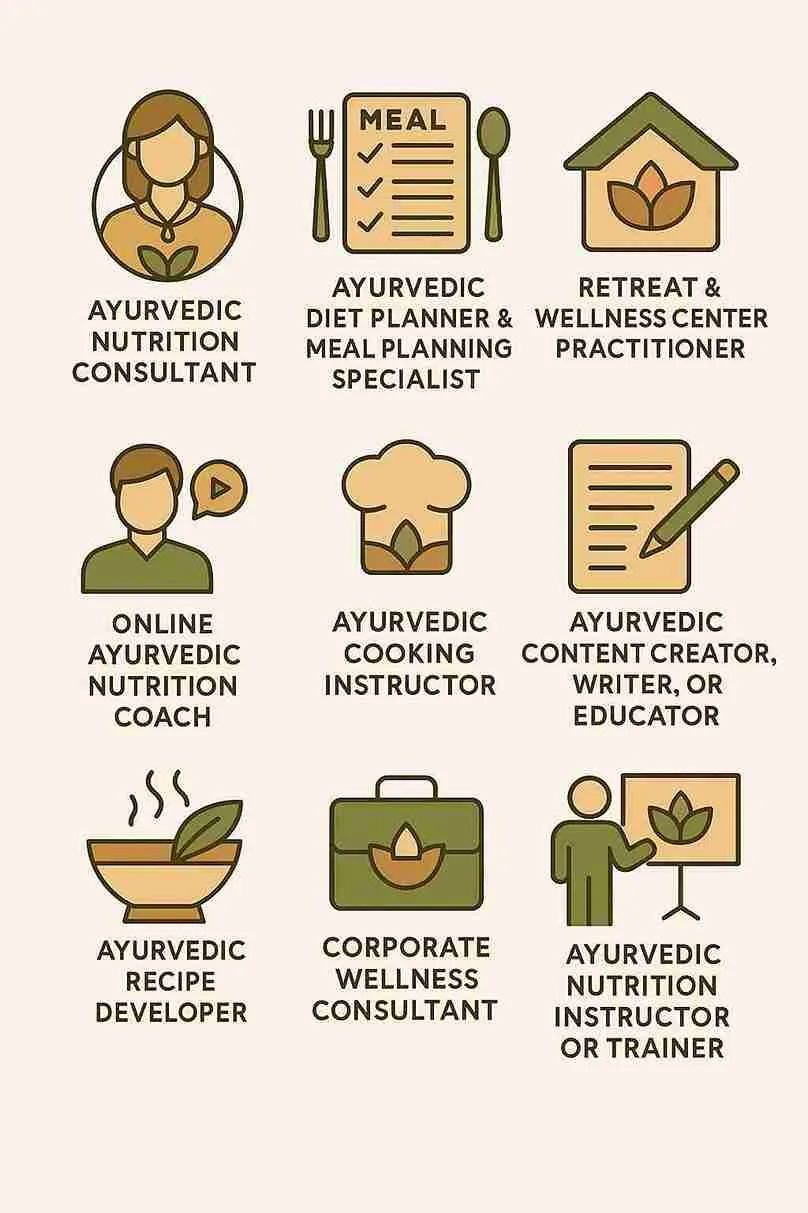
- Wellness consultant (non-medical): one-to-one sessions on eating habits, digestion routines and seasonal food.
- Meal planner: constitution-based weekly menus and seasonal food guides.
- Online coach: group or one-to-one programmes delivered by video.
- Cooking instructor: live or online classes on Ayurvedic cooking and spices.
- Retreat and wellness-centre food programmes: menus and food workshops for guests.
- Content creator or educator: articles, recipes and courses on Ayurvedic eating.
- Recipe developer: menus for cafes, food brands and corporate kitchens.
- Corporate wellness talks: workshops on digestion, stress and eating habits.
- Add-on for existing professionals: yoga teachers, chefs, counsellors, fitness trainers and nurses can add Ayurvedic nutrition to their own scope of work.
What a certificate allows, and what it does not
A training certificate shows that you completed a course. It is not a medical licence or a BAMS degree. Rules for who can offer consultations differ by country and state, so check your local requirements before you charge clients. To understand this properly, read what you can do after an online Ayurveda course and what Ayurveda certifications allow.
How to become an Ayurvedic nutritionist: 5 steps
- Pick your goal. Decide whether you want to coach, teach, cook, write or add this to your current work.
- Learn the foundations. Study doshas, agni and food energetics through a structured course.
- Practise on real meals. Plan meals for yourself, family and friends before you work with clients.
- Learn your limits. Know your local rules and when to refer someone to a doctor.
- Start small. Offer a clear service, such as a seasonal meal plan or a cooking class, and build from there.
How to choose a certification
- The hours, content and price are published openly.
- The teacher is named and can be checked.
- It states plainly what the certificate is, and what it is not.
- It includes practical meal planning, not theory alone.
- It tells you if it is NAMA-accredited or not.
We compare providers honestly in our best Ayurvedic nutrition courses guide.
Our nutrition course at a glance
The Vishuddhi Ayurveda nutrition course is 24 hours of self-paced video learning across 23 videos, priced at €133. It leads to a training certificate through Bharatiya Sevak Samaj (BSS). See the course details and certification. For other courses, browse the online Ayurveda courses catalogue.
Frequently asked questions
Is an Ayurvedic nutrition certification worth it for a career?
It can add a useful skill to work you already do, such as yoga teaching, cooking, counselling or wellness coaching. It does not guarantee clients or income. Results depend on your experience, location, niche and effort.
Can I learn to be an Ayurvedic nutritionist online?
You can learn the theory online. Our Ayurveda nutrition course is 24 hours of video learning across 23 videos. Online study alone does not make you a medical practitioner.
How long does it take to build a client base?
There is no fixed time. It depends on your existing audience, your niche and how much you market your services. We do not promise income or timelines.
Can beginners take an Ayurvedic nutrition course?
Yes. Our nutrition course does not require prior medical or nutrition training.
Which careers can an Ayurvedic nutrition certificate support?
Common paths include non-medical wellness consultations, meal planning, online coaching, cooking classes, retreat food programmes, content and teaching, and corporate wellness talks. Which one fits depends on your background and local rules.
Can I combine Ayurveda with my existing profession?
Yes. Yoga teachers, chefs, counsellors, fitness trainers and nurses often add Ayurvedic nutrition to their existing work, within the scope of their own profession.
Do I need a licence to work as an Ayurvedic nutritionist?
Rules differ by country and state. A training certificate from us is not a medical licence or a BAMS degree, and it does not allow you to diagnose or treat disease. Check your local rules before offering paid consultations.
What certificate do I get with the Vishuddhi nutrition course?
A training certificate issued through Bharatiya Sevak Samaj (BSS). It is not NAMA-accredited and is not a licence to practise. An optional live exam is available as a €40 add-on.
Next steps
Start with the Ayurveda nutrition course, or send us a question if you are not sure which course fits.