The Pelvic Floor–Anxiety Loop No One Talks About — 4 Yoga Therapy Poses to Break It
Body, breath & nervous system
The Anxiety Loop Almost No One Talks About: Your Pelvic Floor and Your Breath
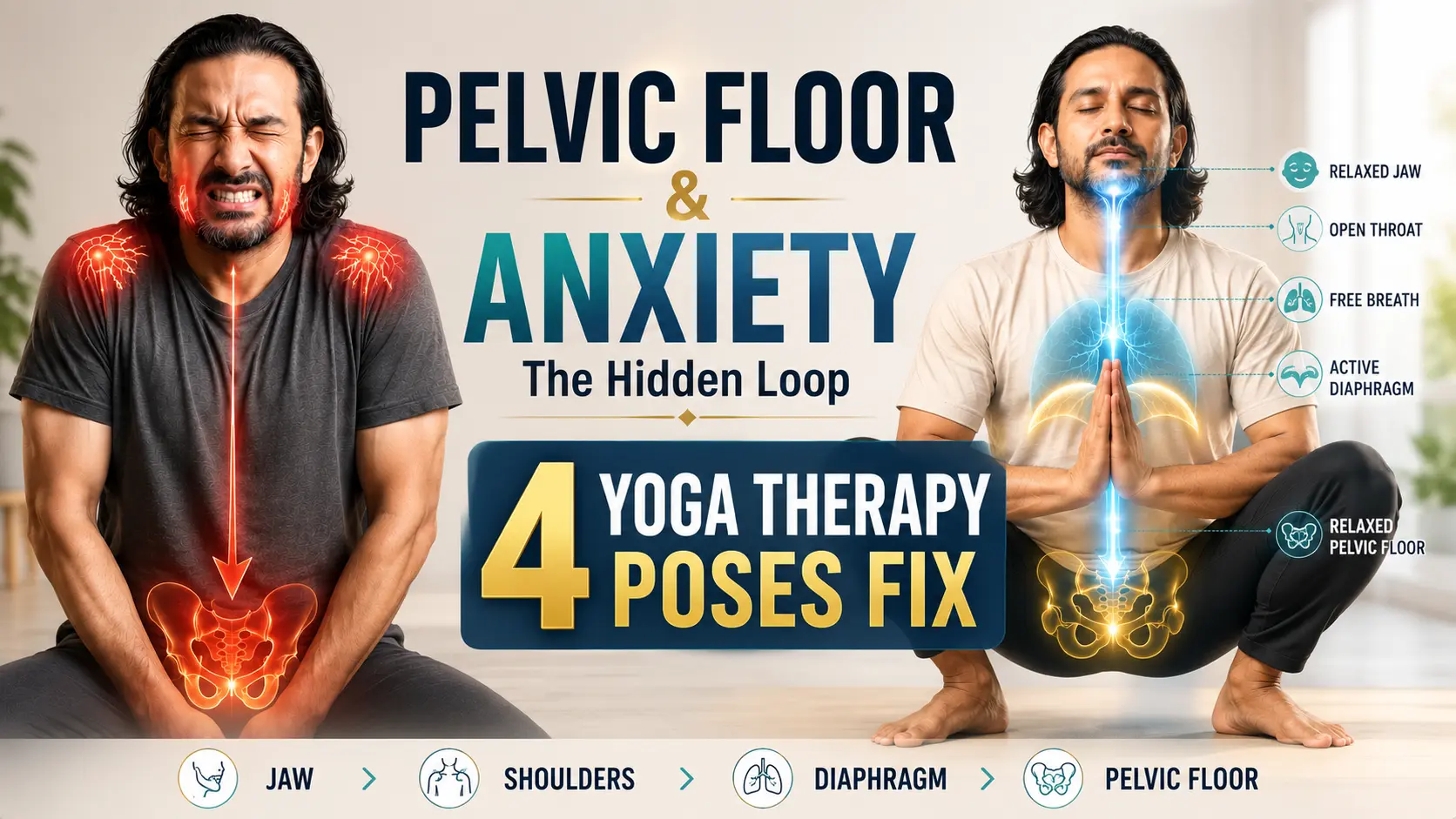
Everyone knows the usual signs that stress has taken hold of the body. The jaw clenches. The shoulders creep toward the ears. The stomach knots. What almost nobody names, even though it happens in the exact same moment, is that the pelvic floor tightens too — and if it stays tight long enough, it can start feeding the anxiety back to you through something as basic as your own breath.
This isn’t a minor footnote to the stress response. It’s a mechanical loop, and once you understand how it runs, four fairly simple yoga postures can interrupt it directly.
01 / The hidden pattern
The Muscle Group Everyone Forgets
Ask someone where they hold tension and you’ll hear the same three answers every time: jaw, shoulders, stomach. All accurate. But the pelvic floor — the sling of muscles at the base of the torso — responds to the exact same stress signal, at the exact same time, and gets almost none of the attention.
Part of the reason is that you can’t see it tense the way you can watch shoulders climb in a mirror. It works quietly, in the background, which is precisely what allows chronic tightness to build there for months or years without ever being named as the source of anything.
Watch the practice
The Overlooked Link Between Pelvic Floor Tension and Anxiety | 4 Yoga Therapy Poses to Break the Loop
02 / The mechanism
How the Pelvic Floor and the Diaphragm Actually Work Together
Here’s the mechanism, and it’s worth sitting with because it explains why this matters more than it sounds like it should.
Your pelvic floor and your diaphragm — your primary breathing muscle — move as a pair, almost like a piston. On the inhale, both drop downward. On the exhale, both rise back up. That coordinated movement is what a full, easy breath actually looks like from the inside.
When the pelvic floor is chronically gripped, it can’t drop fully on the inhale. And when it can’t drop, the diaphragm can’t descend all the way either, because the two are mechanically linked. The result is a shortened, incomplete exhale — not because you’re doing anything wrong, but because the muscle underneath doesn’t have room to move.
That incomplete exhale matters more than it seems. A full, unforced exhale is one of the clearest signals your body can send to the vagus nerve, which governs the “rest and digest” side of your nervous system. Cut that exhale short, day after day, and your brain keeps receiving a low-grade message that something isn’t quite settled — not because of any single stressful event, but because the physical signal that would tell it otherwise never fully arrives.
From there the loop closes itself: the jaw clenches, the shoulders lift, the pelvic floor grips tighter, and each piece reinforces the others.
03 / A key distinction
This Isn’t a Breathing Mistake
It’s worth pausing on one point before moving to what actually helps. None of this means you’re breathing incorrectly, or that better willpower would fix it. The muscle involved simply isn’t free enough to let the mechanism complete itself. That distinction matters, because most approaches to “just breathe deeply” skip straight past the actual obstruction and ask the diaphragm to do something the pelvic floor won’t yet allow.
That’s the gap the four postures below are built to close — not by working on the pelvic floor in isolation, but by releasing it, the jaw, and the shoulders together, in a sequence designed to interrupt the loop at more than one point at once.
04 / The practice
Four Poses That Target the Loop Directly
1. Malasana (Garland Pose) — Letting Gravity Do the Work
Come into a deep squat, feet a little wider than your hips, toes turned slightly out. If your heels lift off the floor, slide a rolled blanket or a block underneath them rather than forcing them down. Bring your elbows to press gently against your inner knees, and keep your spine long rather than rounded.
The mechanism here is simple: deep hip flexion with an upright spine gives the pelvic floor room to lengthen passively. No effort, no squeezing — just space. Once you’re settled, soften your jaw and let your tongue drop away from the roof of your mouth. With each exhale, notice whether you can feel a subtle release traveling downward, from the jaw through the throat and into the pelvis. This is usually the first point in the sequence where the jaw-to-pelvis connection stops being a concept and becomes something you actually feel. Hold for five to ten breaths.
2. Cat-Cow With Jaw Awareness — Retraining the Piston
Come onto hands and knees. As you inhale, arch through the spine — tailbone lifts, chest moves forward, head rises gently. The key instruction here is to keep the jaw completely slack throughout, mouth gently open if that’s comfortable, while the pelvic floor softens and widens on the same inhale.
As you exhale, round the spine, tuck the tailbone, and draw the chin toward the chest. On this exhale, let the pelvic floor engage — a subtle, conscious lift, not a hard clench — while the jaw stays soft even as the chin tucks in. Move slowly through six to eight rounds. What this is doing, mechanically, is retraining the pelvic floor and diaphragm to move together again while deliberately keeping the jaw out of the old gripping pattern.
04 / The practice continued
3. Supta Baddha Konasana (Reclined Bound Angle) — Full Passive Release
Lie on your back and bring the soles of your feet together, letting the knees drop open to either side. If you feel pulling through the hips or groin, support each knee with a block or cushion — there’s no benefit to forcing this shape. Rest your arms by your sides, palms facing up.
Consciously drop your shoulders away from your ears, then let the jaw go fully slack — the shape your mouth would make on the way to saying the word “mud,” tongue resting heavily behind the lower teeth. This posture asks for nothing to brace against and nothing to hold, which is exactly the condition the nervous system needs in order to shift toward calm. Let your exhale run slightly longer than your inhale, and notice the pelvic floor, jaw, and the space between the shoulder blades softening together with each breath out. Stay for two to five minutes if you can.
4. Supported Bridge (Setu Bandhasana) With Humming Breath
Place a yoga block at its lowest or medium height under your sacrum — the flat, triangular bone at the base of the spine — and lie back over it, with your shoulders and head resting on the floor. Arms rest by your sides, palms up; knees can stay bent with feet on the floor, or legs can extend, whichever feels more settled.
This shape gently opens the front of the chest and the space around the diaphragm — the upper half of the piston getting room to move — while the pelvic floor sits in a neutral, slightly lengthened position and gravity draws the jaw back.
Add one more layer here: on each exhale, hum, the way you would in Bhramari breath — a slow, steady tone rather than a forced sound. The vibration stimulates the vagus nerve where it runs through the throat and ear, and it physically vibrates the jaw and skull, loosening tension that often sits below conscious awareness. Five to ten humming exhales is usually enough.
A note on safety: if pelvic tension shows up alongside pain, urinary symptoms, or changes in bowel function, that’s a signal to see a pelvic floor physical therapist or another qualified professional rather than working through it with yoga alone. These four poses are built for everyday tension and nervous system regulation — not as a substitute for medical care where symptoms like that are present.
05 / The sequence
Why the Whole Sequence Matters More Than Any Single Pose
None of these four postures would do much on their own. Malasana gives the pelvic floor passive space. Cat-Cow retrains the pelvic floor and diaphragm to move together while keeping the jaw uninvolved. Supta Baddha Konasana lets all three areas — pelvic floor, jaw, shoulders — soften at once with nothing to brace against. Supported Bridge opens the diaphragm’s own space and adds a direct vagus nerve stimulus through sound.
The loop doesn’t release by focusing on one point of tension. It releases when the pelvic floor, the jaw, and the shoulders let go together, because that’s how the body built the pattern in the first place — as one interconnected system, not three unrelated habits that happen to coincide.
06 / Less effort, better input
It Isn’t About Trying Harder to Relax
If any of this sounds familiar — tension that seems to live somewhere you’d never thought to look, breath that never quite feels complete no matter how much you focus on it — it’s worth remembering that this isn’t a discipline problem. It’s a mechanical one, and mechanical problems respond to the right input, not to more effort applied to the wrong place.
Working with the pelvic floor as part of a stress or anxiety pattern, rather than treating it as separate from the jaw and shoulders you already pay attention to, tends to be where people notice the shift they’d been trying to force through breathing alone.
07 / Questions answered
Frequently Asked Questions
Can a tight pelvic floor actually contribute to anxiety?
Yes, mechanically. The pelvic floor and diaphragm move together on each breath. A chronically tight pelvic floor limits how fully the diaphragm can move, which shortens the exhale — and a full exhale is one of the body’s main signals to the vagus nerve that it’s safe to shift into a calmer state. A shortened exhale, repeated often enough, keeps that calming signal from fully arriving.
What does the diaphragm have to do with the vagus nerve?
The diaphragm’s movement, especially on a complete exhale, is one of the physical triggers that activates the vagus nerve and the parasympathetic (“rest and digest”) nervous system. When pelvic floor tension limits the diaphragm’s range, that trigger doesn’t fully fire.
How often should these poses be practiced?
There’s no strict rule, but doing the sequence a few times a week, even in short sessions, tends to build the pelvic floor–diaphragm coordination more reliably than one long session occasionally. Consistency matters more than duration here.
Is it normal to feel something emotional during these poses?
It’s a common experience when a chronically held area of the body is given the first real chance to soften. It doesn’t happen for everyone, and it isn’t something to chase — simply something to let pass through without alarm if it does arise.
When should I see a professional instead of practicing this at home?
If pelvic tension is accompanied by pain, urinary symptoms, or bowel changes, see a pelvic floor physical therapist or relevant medical professional. This sequence is designed for everyday tension and nervous system awareness, not as a replacement for that kind of care.
Go deeper
Ready to Work With Your Body Rather Than Against It?
Explore supportive Yoga practices and deeper professional training designed to help you understand the relationship between body, breath, tension, and nervous system regulation.
Online Yoga Courses
Explore guided online Yoga courses that help you build a steadier relationship with your body, breath, and nervous system.
Explore Online Courses200-Hour Yoga Therapy Teacher Training
Learn to guide others through precise, body-informed Yoga Therapy practices with confidence and depth.
Explore the Training