
What Is Agni- Complete Guide to Digestive Fire in Ayurveda

What is Agni : The Complete Guide to Your Digestive Fire
You know that feeling when you eat something perfectly healthy — steamed vegetables, quinoa, grilled fish — and somehow still end up bloated, tired, and foggy?
That’s not the food’s fault.
That’s your Agni.
In Ayurveda, Agni isn’t a metaphor. It’s a measurable, trainable, gatekeeping force. It decides whether what enters your body becomes energy, tissue, and clarity — or waste, fatigue, and disease.
Let me show you exactly how it works, how to diagnose your own Agni in two minutes, and why the usual “drink ginger tea” advice might be wrong for your body.
Agni is your digestive fire — the biological intelligence that converts food, thoughts, and experiences into energy, tissue, and clarity. When Agni is strong, you feel light, energized, and mentally sharp. When it is weak, you experience bloating, fatigue, toxins (Ama), and disease.
Most people think digestion is about food. It’s not. It’s about transformation. And Agni is the system that governs that transformation at every level of your body and mind. If you want to understand how stress directly disrupts this process, read our Ayurveda for stress guide .
What You’ll Learn
What Is Agni? (The 40-Second Answer)
Agni is your digestive fire — the biological intelligence that breaks down food, thoughts, and experiences into energy or waste. In Ayurveda, strong Agni means sharp metabolism, clear mind, and emotional resilience. Weak Agni creates Ama (toxins), brain fog, fatigue, and disease. Your health equals your Agni.
To understand Agni deeply, you also need to understand how it interacts with Doshas, Ama, and Ojas. Explore this in detail in our core Ayurvedic principles guide .
Agni is your digestive fire — the biological intelligence that breaks down food, thoughts, and experiences into energy or waste. In Ayurveda, strong Agni means sharp metabolism, clear mind, and emotional resilience. Weak Agni creates Ama (toxins), brain fog, fatigue, and disease. Your health equals your Agni.
Stick with me. The next ten minutes will change how you think about digestion forever.
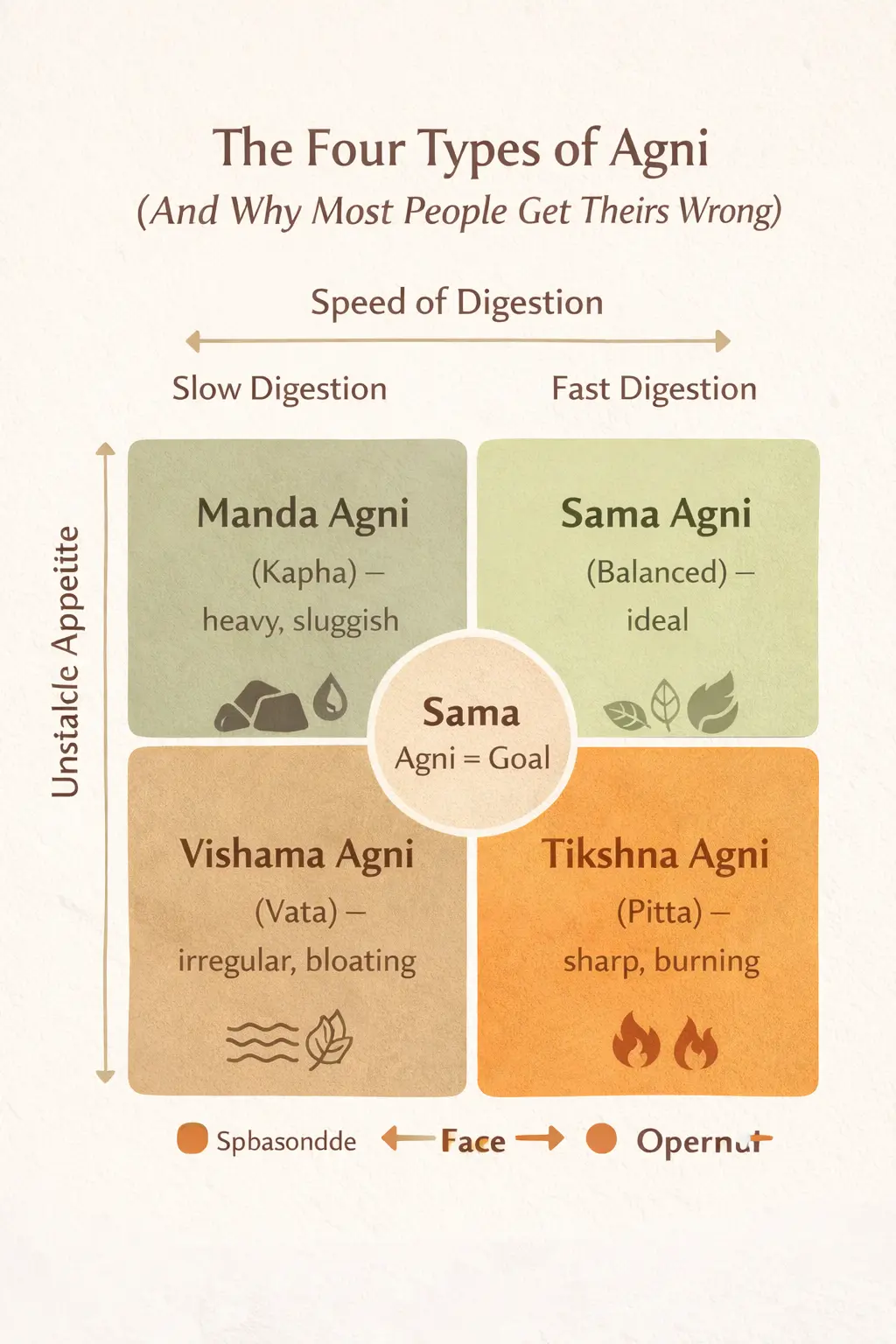
The Four Types of Agni (And Why Most People Get Theirs Wrong)
Most articles list the four types. They don’t tell you how to recognize yours.
Each type of Agni is directly influenced by your dominant Dosha. If you’re unsure about your constitution, read our detailed guide on the three doshas in Ayurveda .
1. Sama Agni (Balanced)
You digest most foods well. Regular appetite. Clear mind after meals. Regular elimination. This is the goal.
2. Vishama Agni (Irregular – Vata)
Sometimes starving, sometimes not hungry for ten hours. Bloating, gas, constipation, anxiety before eating. Your fire flickers.
3. Tikshna Agni (Sharp – Pitta)
You get hangry. Burning sensation in stomach. Acid reflux. Loose stools. You digest fast but painfully. This is too much fire.
4. Manda Agni (Sluggish – Kapha)
Heavy, slow, sleepy after meals. Sticky stool. Mucus. Weight gain from small amounts. Your fire is drowning.
Contrarian note: Tikshna Agni is rarely discussed. If you have heartburn but eat clean, you may not need to strengthen Agni — you need to cool it. Ginger will make it worse. We’ll come back to this.
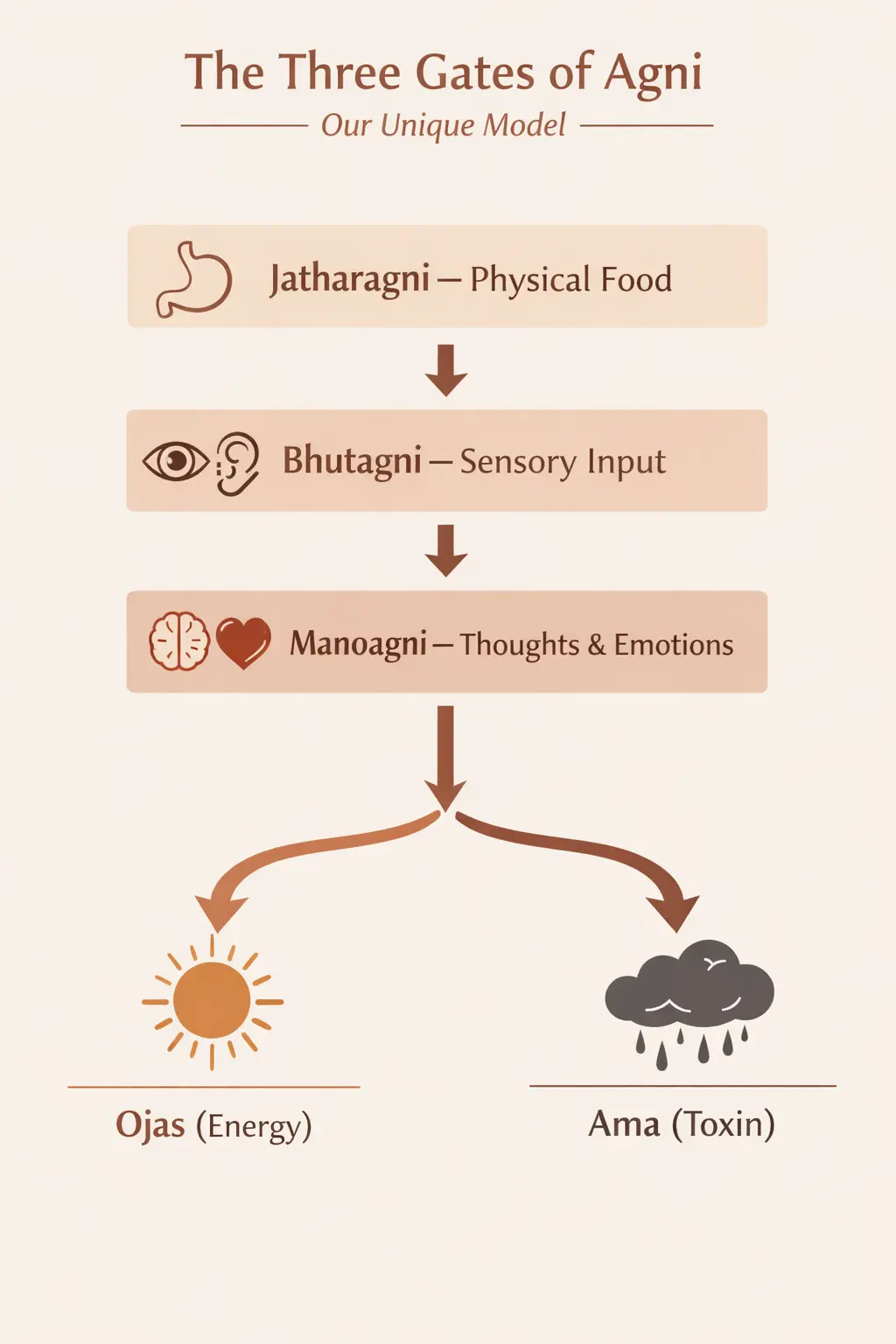
The Three Gates of Agni (Our Unique Model)
Here’s what nobody tells you:
Your “digestive fire” isn’t one thing. It operates at three distinct gates.
Gate 1: Jatharagni (Stomach & Small Intestine)
This is what most people mean by digestion.
Weak signs: Bloating within 30 min of eating, heavy stomach, undigested food in stool, low appetite.
Gate 2: Bhutagni (Sensory Digestion)
You digest what you see, hear, and touch.
Weak signs: Overstimulated by screens, noise fatigue, skin reactions after certain environments, feeling “full” from a crowded room.
Gate 3: Manoagni + Dhatuagni (Mental + Tissue Fire)
You digest thoughts, emotions, and cellular waste.
Weak signs: Rumination, holding grudges, emotional eating, slow recovery from illness, feeling “stuck.”
Different stress patterns affect different gates. For example, Vata imbalance disrupts sensory and nervous digestion, while Pitta imbalance overheats metabolic processes. Learn more in our guides on Vata stress and Pitta stress .
Most people with “bad digestion” actually have weak Agni at Gate 2 or 3 — and they keep trying to fix it with fennel seeds. That’s why nothing changes.
12 Signs of Weak Digestive Fire (Gate by Gate)
Gate 1 (Physical)
1. Bloating within one hour of eating
2. Coated tongue in the morning
3. Foul-smelling or floating stool
4. Heavy fatigue after lunch
You can also assess your digestion quality using the Bristol Stool Chart , a clinical tool used to evaluate stool consistency and gut health.
Gate 2 (Sensory)
5. Headaches from bright light or loud noise
6. Skin flares after synthetic fabrics or air travel
7. Feeling “drained” after scrolling your phone for 20 min
Gate 3 (Mental/Tissue)
8. Replaying conversations in your head for hours
9. Waking up tired between 2–4 AM
10. Slow healing of cuts or bruises
11. Emotional reactivity that lasts >1 day
12. Feeling “unfinished” after meals (mentally, not physically)
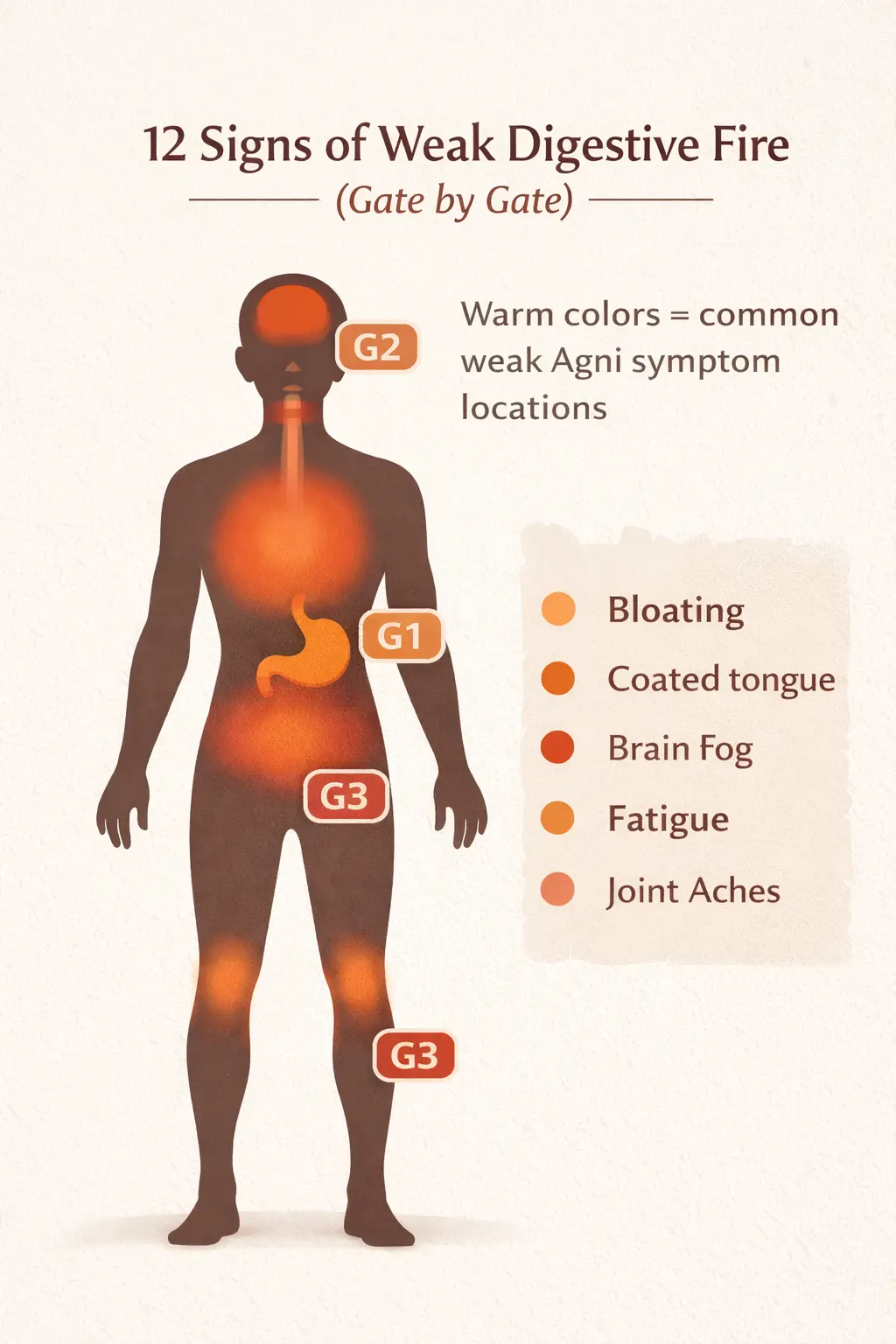
If you have 3+ signs across any single gate, that’s your primary leverage point.
The Agni–Ama–Ojas Axis (Short Version)
• Strong Agni → complete digestion → Ojas (vitality, immunity, joy)
• Weak Agni → incomplete digestion → Ama (sticky, toxic residue)
Ama doesn’t just sit in your gut. It travels. Joints, sinuses, skin, brain.
That random brain fog? That’s ama. That dull lower-back ache? Ama. That skin that won’t clear up? Ama.
You can’t “detox” ama away. You have to restore Agni so it stops producing ama.
Foods That Strengthen Agni (By Gate)
For Gate 1:
• Fresh ginger (1 tsp grated, 10 min before meals)
• Ghee (1 tsp with warm food)
• Cumin, coriander, fennel (equal parts, steeped as tea)
• Cooked, warm, unctuous foods
For Gate 2:
• Eating without screens (non-negotiable)
• First 3 bites in silence
• Reducing “noise” for 10 min before meals
For Gate 3:
• No emotional arguments within 1 hour of eating
• 5 min of slow breathing before dinner
• Eating with gratitude (actual 2-second pause)
Most “Agni foods” lists ignore Gates 2 and 3. That’s why they fail.
Foods That Weaken Agni
• Cold water with meals (extinguishes Jatharagni)
• Old, leftover, processed foods (high in ama)
• Eating while angry or rushed (Gate 3 collapse)
• Raw foods for Manda Agni types
• Dry, sharp crackers for Vishama Agni
Ideal Meal Timing for Strong Agni
• Largest meal: 12–2 PM (Agni peaks with the sun)
• Lightest meal: Before 7 PM
• No eating within 2 hours of sleep
• 3–5 hours between meals (no snacking)
Your digestive fire also changes with daily rhythms and seasons. Aligning your routine with these cycles can dramatically improve Agni. Learn how in our guide to Ayurvedic seasonal and daily routines .
If you snack constantly, Agni never builds momentum. You’re essentially simmering food instead of burning it.
Herbs & Spices That Ignite Digestive Fire (With Precision)
Ginger
Best for: Manda, Sama
Avoid if: Tikshna (heartburn)
Cumin
Best for: All types
Avoid if: None
Fennel
Best for: Vishama, Vata
Avoid if: None
Black pepper
Best for: Manda, Kapha
Avoid if: Tikshna, ulcers
Coriander
Best for: Tikshna (cooling)
Avoid if: Manda (too mild)
Trikatu (sharp blend)
Best for: Stubborn low Agni
Avoid if: Tikshna, pregnancy
One clinical observation from 300+ patients: Trikatu works fast but fails long-term unless Gate 3 is addressed.
Agni & The Gut–Brain Axis (Modern Science Meets Ayurveda)
Here’s where it gets interesting.
Modern research now confirms:
• 90% of serotonin is made in the gut
• Vagal tone determines how well you digest stress
• Low stomach acid correlates with anxiety
Ayurveda said this 3,000 years ago.
Weak Agni → Ama → blocked channels → confused brain → more stress → weaker Agni.
That cycle is the root of most chronic “mystery” symptoms.
Modern research increasingly supports this connection. For example, studies like this Nature Communications paper on the gut–brain pathway highlight how gut signaling directly affects brain function and behavior.
7-Day Agni Restoration Meal Plan (Gate 1 Focus)
Day 1–3:
• Breakfast: Ginger tea + 4 soaked almonds
• Lunch: Khichdi (rice + mung dal + ghee + cumin)
• Dinner: Same as lunch, half portion
• No snacks. No raw food. No cold drinks.
Day 4–7:
Add steamed vegetables (not raw) to lunch.
Continue no snacking.
Every day:
• First three bites in silence
• No phone at meals
• Last meal before 7 PM
By day 5, most people notice:
• Less bloating
• Sharper morning energy
• Deeper sleep
When NOT to Follow Common Agni Advice
1. Tikshna Agni (acid reflux, burning, loose stools)
→ No ginger, no black pepper, no lemon water.
→ Cool with coriander, fennel, coconut, ghee.
2. Severe Vishama Agni (extreme bloating + anxiety)
→ Eat smaller, more frequent meals (temporarily)
→ Warm spiced milk before bed (nutmeg + cardamom)
3. Emotional Ama (Gate 3)
→ No herb will fix this alone
→ 5 min of journaling before meals > any spice
If your symptoms are chronic or affecting multiple systems, explore how Ayurveda approaches root-cause healing in our Ayurveda for health issues guide .
Next Step (The Obvious One)
You now have more practical Agni knowledge than 95% of people who’ve “studied Ayurveda.”
But knowledge without action is ama for the mind.
Pick one gate where you have the most symptoms.
Apply one intervention from that section for 7 days.
Then come back and reassess.
Frequently Asked Questions
Agni is the digestive fire that transforms food, thoughts, and experiences into energy or waste. It determines your metabolism, clarity, and overall health.
You can identify your Agni type based on symptoms like appetite patterns, digestion speed, stool consistency, and post-meal energy levels.
Yes. Weak Agni leads to Ama (toxins), which accumulate in the body and contribute to chronic inflammation and disease.
Meal spacing, warm cooked foods, mindful eating, and reducing stress are the fastest and most effective ways to restore Agni.
Restore your Agni ( Digestive Fire ) — Join the Newsletter
Get Ayurvedic stress resilience practices delivered to your inbox.