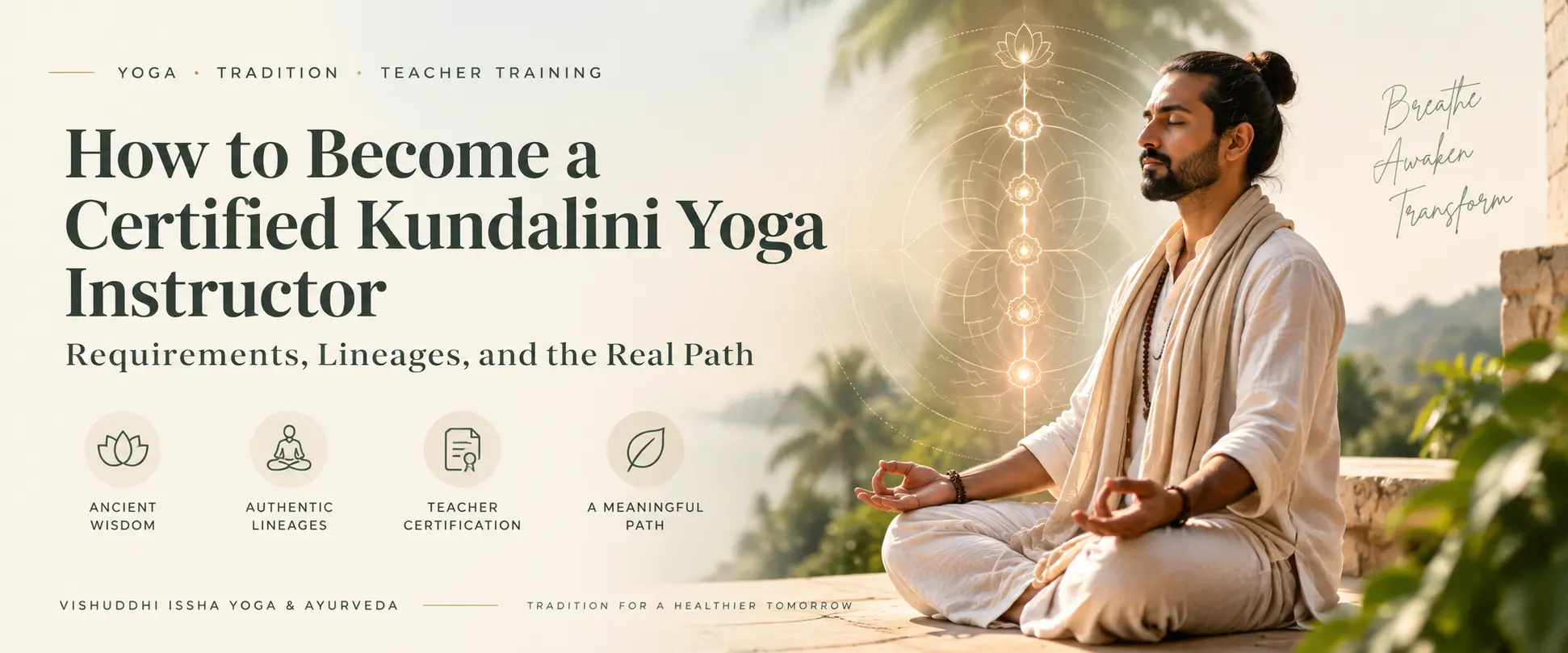
How to Become a Certified Kundalini Yoga Instructor: Requirements, Lineages, and the Real Path
Kundalini Cluster · Teacher Certification
How to Become a Certified Kundalini Yoga Instructor
Search “how to become a certified Kundalini yoga instructor” and every result assumes the same starting point: Yogi Bhajan’s system, certified through KRI, the Aquarian Teacher program, Golden Bridge, or one of a dozen studios teaching that specific lineage. Not one major result mentions that a completely separate path exists — Satyananda-lineage Kundalini Kriya Yoga, taught in India for generations, with its own certification structure and no connection to 3HO at all.
This is the guide for that path: what certification actually requires, how it differs from the KRI route most search results assume, and how to tell a legitimate program from one that isn’t.
01 · Duration
How Long Does It Take to Become a Kundalini Yoga Instructor?
Across every legitimate program, in either lineage, 200 hours is the baseline minimum for a Yoga Alliance-recognized teaching credential. In the Satyananda lineage specifically, this is typically completed as a 25-day residential immersion. In the KRI / Yogi Bhajan system, it’s commonly delivered as 220 hours — 180 classroom, 40 independent study — over a longer part-time format, often ten weeks or more if studied online.
Shorter paths exist in both traditions, but they matter for a different purpose. A 100-hour program, in either lineage, builds real foundational practice and can typically count as continuing education credit for an already-registered teacher — it is not, on its own, sufficient for RYT-200 registration.
Current tuition and format details for the Satyananda route are outlined on the 200-hour Kundalini Yoga teacher training page.
02 · Requirements
What Are the Actual Requirements?
Requirements are broadly consistent across legitimate programs: a minimum of 200 contact hours covering technique, philosophy, anatomy, and teaching methodology; a practicum or teaching assessment demonstrating you can actually lead a class, not just perform the practice yourself; and, in some programs, a requirement to complete a set number of taught classes after training before certification is finalized.
What isn’t required, in any legitimate program: prior yoga teaching experience, extreme physical flexibility, or a pre-existing meditation practice. Sincere beginners are accepted across essentially every program worth attending.
03 · Starting point
Do You Need a Yoga Background Before Starting?
No prior yoga experience is required in either lineage, but the path looks slightly different depending on where you’re starting from. Complete beginners typically benefit from building a short daily practice for a few weeks before enrolling — simply to confirm the lineage resonates before committing significant time and cost. A basic 15-minute daily beginner routine is enough to establish this.
Practitioners transitioning from another style — Vinyasa or Hatha teachers adding Kundalini as a second credential — generally move through the technique portion faster, since breath awareness and basic seated stamina are already familiar, but still complete the same full 200 hours. Yoga Alliance doesn’t distinguish between these two starting points in its requirements.
04 · Terminology
Kundalini Yoga Teacher vs. Instructor: Is There a Difference?
Functionally, no. “Instructor” is more common in KRI / 3HO terminology specifically, where graduates are described as “KRI Certified Instructors.” “Teacher” is used more broadly across other lineages, including Satyananda-based programs. If a program draws a hard distinction between the two terms, it’s usually a marketing choice, not a credentialing one.
05 · Lineage choice
Which Lineage Should You Train In?
This is the question most guides skip, because most guides are written from inside one lineage without acknowledging the other exists.
The KRI / Yogi Bhajan system is the more widely recognized path in the West, with an established global network and standardized curriculum. It’s also the lineage that underwent a serious, well-documented reckoning in 2020, when an independent investigation concluded it was “more likely than not” that Yogi Bhajan committed sexual abuse over decades. That history doesn’t disqualify every program teaching in this lineage today, but it’s context worth knowing, and any program should be willing to discuss it directly.
The Satyananda lineage is older, rooted in Indian ashram teaching, with an entirely different technique set — Chakra Anusandhana, Ajapa Japa, structured kriya sequencing — and no connection to that history. Practitioners transitioning from other yoga styles should also read the Hatha vs. Kundalini comparison before committing.
Neither path is objectively superior. What matters is knowing which one you’re actually choosing, since the technique sets barely overlap.
Origin
SatyanandaIndian ashram tradition
KRIBrought to the US, 1969
Certifying body
SatyanandaVaries by school
KRIKundalini Research Institute
Core techniques
SatyanandaChakra Anusandhana, Ajapa Japa, staged kriya sequencing
KRISat Kriya, Breath of Fire, numbered kriyas
Standard hours
Satyananda200 · often 25-day residential
KRI220 · 180 classroom + 40 independent
Global network
SatyanandaSmaller, fewer programs
KRILarge, established worldwide
Notable history
SatyanandaNo connection to 3HO / Yogi Bhajan controversy
KRI2020 independent investigation into founder
06 · Curriculum
What the Curriculum Actually Covers
Beyond the hour count, a legitimate 200-hour program typically spans four areas in roughly equal weight:
Technique — kriya sequencing, pranayama, chakra and nadi work, mantra. The chakra and energy system is foundational here, along with the classical use of mantra and sound.
Philosophy and textual grounding — source texts, the staged Pratyahara-Dharana-Dhyana framework. The Bihar School’s approach to the path toward Samadhi is covered in depth separately.
Anatomy and physiology — nervous-system effects, contraindications, safe sequencing. The science of Kundalini and the nervous system is required reading before you teach this practice to anyone else.
Teaching methodology — cueing, class sequencing, the practicum itself.
A program genuinely light on philosophy or anatomy is offering a narrower training than the hour count suggests.
07 · The path
Step by Step: The Path to Certification in This Lineage
Build a real foundation first
Establish consistent personal practice — even a basic 15-minute daily routine — before committing to a full program. The body preparation work this tradition expects before deeper practice applies here too.
Choose your format deliberately
A residential immersion offers hands-on correction; a live online cohort offers flexibility and lower cost. The full comparison of online vs. in-person training covers the trade-offs. Switching formats partway through isn’t always possible.
Complete the full 200 hours
Non-negotiable for Yoga Alliance recognition. Some students complete a 100-hour foundation first — such as the 100-hour Goa certification — confirming fit before extending further.
Complete the practicum
An actual teaching assessment, not just performing the practice yourself — often the part students underestimate in advance and find most valuable in retrospect.
Confirm any post-training requirements
Before finalizing enrollment — some programs require taught classes within a specific window before certification is officially granted.
08 · Advanced tiers
Is There a Tier Beyond 200 Hours?
Yes, in both lineages, though less standardized. Some schools offer a 300-hour advanced track, typically pursued after several years of active teaching, deepening technique rather than covering foundational ground again. It’s not required to teach professionally.
09 · Due diligence
Choosing a Program: A Checklist
A few concrete questions are worth asking any program directly before enrolling. A program willing to answer all four specifically, without hedging, is a stronger signal than any marketing claim about being “internationally recognized.”
What is the cohort size — will you receive individual correction?
Or is this a large-class format where personal technique correction isn’t feasible? The answer determines how much of the training is actually yours.
Who specifically is teaching, and what is their documented experience?
Beyond the school’s own marketing. A senior teacher’s lineage and credentials should be verifiable, not implied.
Is the 200-hour curriculum split across all four real areas?
Technique, philosophy, anatomy, and teaching methodology — or weighted almost entirely toward technique alone? A program that skips philosophy or anatomy is offering less than the hours suggest.
What does the practicum actually involve, and who assesses it?
Is the assessment done by someone other than the instructor who taught you? Independent assessment is a stronger signal than self-certification.
10 · Verification
How Do You Know If a Kundalini Certification Is Legitimate?
A program should name its lineage specifically, name the certifying body or lead instructor’s credentials, and explain clearly whether the certificate meets Yoga Alliance RYT-200 standards or functions as continuing education instead. Vague language — “internationally recognized,” with no specific registry named — is a signal to ask more questions.
11 · Registry
Is Kundalini Yoga Instructor Certification Recognized by Yoga Alliance?
Yes, provided the program delivers the full 200 hours across the required curriculum areas, regardless of lineage. Yoga Alliance registers by hour count and curriculum content, not by lineage specifically.
12 · Cost
How Much Does It Cost?
Cost varies by lineage, format, and location. Current tuition should always be checked directly with the program.
Online · Western lineage
Roughly $2,000 – $4,000
Residential · India
Lower tuition, travel and accommodation as the larger variable
100-hour foundation
Typically a fraction of the 200-hour program cost
13 · Format
Can You Become Certified Online Only?
Yes, in either lineage, provided the program is live and cohort-based rather than self-paced. A pre-recorded video library with no real-time instructor access and no practicum doesn’t meet Yoga Alliance’s teaching-methodology requirements, regardless of content volume.
14 · Teaching
What Happens After Certification?
Building an actual teaching practice is a separate skill most programs only partially prepare you for. Many newly certified instructors start by assisting an established teacher, teaching donation-based community classes, or offering private sessions before moving to group classes.
Continuing education tends to matter more for a sustainable long-term practice than the initial certification alone — instructors who stop learning after certification often plateau within the first year or two.
15 · Continuing ed
Maintaining Your Certification: Continuing Education Requirements
Certification isn’t a one-time credential. Yoga Alliance requires RYT-200 holders to complete 75 continuing education hours every three years: 45 hours of actual teaching, 30 hours of further coursework. Only hours earned after your RYT-200 registration date count.
Many instructors satisfy the 30-hour coursework portion through a 100-hour immersion or similar deepening program — double duty as both practice deepening and formal CE credit.
16 · Liability
Teaching Insurance and Liability
Worth knowing before you start teaching publicly: yoga instructor liability insurance is standard practice, not optional caution. Most studios require proof of coverage before allowing a newly certified teacher onto their schedule, and independent instructors carry real liability exposure without it.
Coverage is inexpensive relative to the risk, typically available through the same professional associations offering RYT registration.
17 · FAQ
Frequently Asked Questions
How long does it take to become a certified Kundalini yoga instructor?
A minimum of 200 hours, typically a 25-day residential immersion or a longer part-time online format.
What’s the difference between Kundalini yoga teacher and instructor?
Functionally none — “instructor” is more common in KRI / 3HO terminology specifically.
Do I need prior experience to become certified?
No. Sincere beginners are accepted across essentially every legitimate program.
Is a 100-hour Kundalini yoga certification enough to teach?
Not for RYT-200 registration on its own — typically a foundation or continuing education credit.
Can I become certified entirely online?
Yes, provided the program is live and cohort-based with real instructor access and an actual practicum.
How do I verify a certification is legitimate?
Confirm the lineage, the certifying body’s credentials, and Yoga Alliance standing directly with the program before enrolling.
Do I have to choose a lineage before starting?
Effectively yes, since technique sets differ significantly between traditions.
Can I switch lineages after certifying in one?
Yes, though it generally means a separate training rather than transferred credit.
How many continuing education hours do I need to maintain my certification?
75 hours every three years for RYT-200 — 45 teaching, 30 coursework — regardless of lineage.
Certification is the credential. Knowing which lineage you’re actually training in, and confirming it’s legitimate before you commit, is the part most guides skip entirely. If the Satyananda path resonates, the 200-hour training and 100-hour immersion both start from the same foundation covered in our complete beginner routine.

You may also like
Kundalini Mudras: 10 Hand Gestures, Benefits & How to Practise Them