Online vs. In-Person Kundalini Yoga Training: Which Is Right for You?
Online vs. In‑Person Kundalini Yoga Training: Which Is the Better Fit?
Search “online vs in-person yoga teacher training” and you’ll find the same article a dozen times over: online is cheaper and flexible, in-person is more immersive and expensive, pick whichever fits your calendar. That’s a fair enough answer if you’re comparing two Vinyasa programs, where the real difference is basically a screen instead of a teacher in the room.
It holds up a lot less well for Kundalini Kriya Yoga. What’s actually being practiced here — kriya sequencing, sustained pranayama, extended meditation — is built to change the nervous system slowly, not to build strength or flexibility quickly. That changes what the format question is really asking. For a fuller picture of the practice this decision revolves around, our complete guide to Kundalini Kriya Yoga covers the foundations. This article is about something narrower: what online and in-person training can each actually give you, and what neither one can.
Why Comparing Formats Matters More for Kundalini Yoga Than Other Styles
A Vinyasa class asks your body to move well. A Kundalini Kriya session asks your nervous system to regulate differently, through sustained breathwork, structured kriya sequences, and meditation that gradually shifts how the autonomic nervous system responds to stress. That’s a genuinely different mechanism than Hatha or Vinyasa practice, and it depends on things a generic yoga comparison rarely accounts for: how much space sits between sessions, how closely a teacher can actually watch a student’s breath, and what support exists if something intense comes up mid-practice.
Those three things look different depending on whether you’re in a room in Goa or on a laptop at home. Neither format is disqualified by that difference. But treating the two as basically interchangeable, the way most “online vs in-person yoga” content does, misses the actual question worth asking.
What Does In-Person Residential Training Actually Include?
The 200-Hour Kundalini Yoga Teacher Training runs as a 25-day residential program in North Goa, in small cohorts of six to seven students. Here’s what that actually buys you, beyond the obvious “you’re there in person” answer.
A teacher can see whether your breath ratio in Nadi Shodhana is genuinely even, whether you’re rushing through a kriya, or whether sitting cross-legged for an extended meditation is quietly building tension that’ll turn into real pain by day ten. That kind of correction is hard to give well over video, especially to a group.
There’s also the schedule itself. A typical day runs from around 6 AM to 8:30 PM, with real breaks built between each block, not a screen session squeezed into whatever hour you can free up. Some practices, like the morning breath of fire sequences or the deeper work with chakras and nadis, genuinely land differently when there’s nowhere else to be for the next three hours.
Twenty-five days away from work email and ordinary decision fatigue changes what’s available for a practice like this to work with. Part of that comes from the schedule, and part of it comes from training within the source lineage itself, in an environment built around the practice rather than fit around one.
None of this is free, in either sense. Tuition plus travel plus accommodation adds up to more than the online option, and clearing 25 consecutive days is a real ask for anyone with a job or kids. Current dates and cost are on the schedules and pricing page, since both shift by cohort.
What Does Online Training (Upward Spiral) Actually Include?
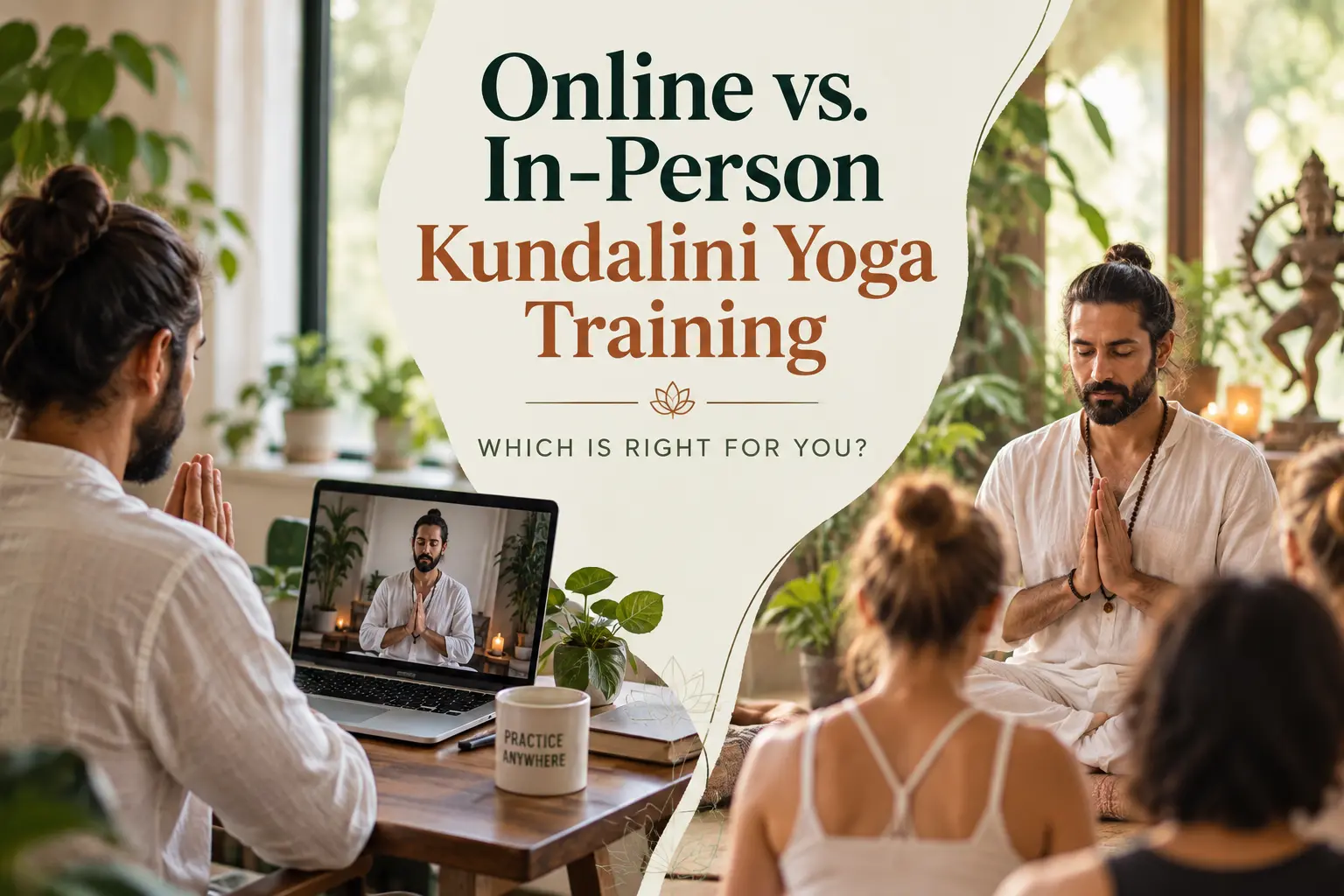
The online version of this lineage isn’t the residential program filmed and uploaded. The Upward Spiral Program is its own format: seven live weekends, spaced roughly two weeks apart, in a cohort of six to eight students, adding up to about 60 contact hours.
The design detail that actually matters: online here means slower, not shorter. The residential version compresses this into consecutive days because a room full of people has cleared their calendars for exactly that. Online, the gap between weekends isn’t dead time — it’s where a student actually lives with what they just learned before the next session builds on it, which arguably suits a slow-building practice better than cramming it into one intense week would.
It’s also genuinely live. Each weekend is a scheduled session with real teaching and group discussion, not a library of recordings you get to whenever you feel like it. Curriculum-wise, it covers the same seven-module arc as the residential program: chakras and nadis, pranayama and bandhas, mantra and kirtan, yoga philosophy, and Antar Mouna meditation to close it out. And it’s worth saying plainly, since a fair amount of the confusion around “online Kundalini yoga” comes from genuine myths about the practice: a live, small-cohort format online is a real training, not a watered-down substitute wearing the same name.
At $490 as a one-time payment, it costs a fraction of the residential program without cutting out live teacher access. What it doesn’t include is an environmental reset, hands-on correction, or much room for skipping the discipline of showing up consistently between weekends. A student who genuinely needs to be pulled out of ordinary life to practice at all won’t get that from any online format, however well it’s built.
Side-by-Side Comparison
| Residential (Goa) | Online (Upward Spiral) | |
|---|---|---|
| Format | 25-day residential immersion | 7 live weekends, ~2 weeks apart |
| Contact hours | 200 hours | ~60 hours |
| Cohort size | 6–7 students | 6–8 students |
| Delivery | In-person, small group | Live cohort, not self-paced |
| Investment | See current pricing | $490 |
| Correction | Direct and hands-on | Verbal, over video |
| Environment | Full reset from daily life | Fits around existing schedule |
| Certification | 200-hour Kundalini Kriya YTT | Certificate in Kundalini Kriya Yoga |
| Best for | Full immersion, ready to travel | Testing the lineage before committing |
Is Self-Paced Online Training as Good as Live Training?
No — and this is really the question people mean to ask when they ask “online vs in-person,” even if they phrase it as a location question. The actual gap isn’t between a room in Goa and a laptop at home. It’s between live, paced, teacher-accessible instruction and unsupervised, self-directed video content.
A pre-recorded library you work through alone, at whatever hour suits you, with no teacher and no cohort, is a genuinely weaker container for this kind of practice, no matter how well it’s filmed. It strips out the pacing and observation that sustained breathwork depends on. That gap exists whether the videos were shot in an ashram or a bedroom.
A live cohort closes most of that gap, even through a screen. It’s still a different experience than a room in Goa, with its own real limits, but it’s not the do-it-yourself version that “online yoga training” usually implies. If you’re choosing between formats, that’s the distinction to actually weigh: live and structured versus self-paced and unsupervised, not online versus in-person.
Is It Safe to Practice Kundalini Yoga Online?
Kundalini practice gets tied up online with dramatic awakening stories, which makes this a fair question to ask directly instead of brushing past it. Genuine signs of awakening are gradual and specific, not sudden or theatrical, and knowing how to prepare the body and nervous system beforehand matters regardless of which format you choose.
In residential training, a teacher is physically present if something intense comes up mid-session, which matters most for a student carrying real trauma history. In a live online cohort, a teacher is still reachable in real time during the session, and usually by message between sessions, which is a meaningfully different safety picture than a self-paced course where someone processing something heavy at midnight has no one to check in with.
If you’re carrying significant trauma or working through acute psychological stress, in-person training with a teacher physically in the room offers a safety margin that no online format fully replicates, and it’s worth naming that plainly instead of glossing over it. Understanding how ordinary nervous-system release differs from something that needs actual professional attention is worth reading either way. Either live format, done properly, is safer than an unsupervised video course — but “live” is doing most of the work in that sentence, not “in-person.”
Which Format Is Right for You?
In-Person Residential
Fits people who can genuinely clear 25 consecutive days without half their attention elsewhere, who learn breath and kriya technique better through physical correction than verbal feedback, and who are specifically after the environmental reset, not just the curriculum. It’s also the better fit if you’re pursuing the full 200-hour teaching credential rather than personal practice, or if you’d feel more supported having a teacher physically present given past experiences. If the location and lineage question matters to you, Kundalini Yoga Teacher Training in India: Goa & Kundalini Yoga Lineage covers what training in this tradition actually looks like on the ground.
Online (Upward Spiral)
Fits working professionals or parents who can protect seven weekends but not a month, students who want to test this specific lineage — distinctly separate from Yogi Bhajan/3HO Kundalini Yoga — before committing to the cost and logistics of travel, and practitioners outside India for whom a visa and long flight are a real barrier rather than an inconvenience. It also suits yoga teachers who want to actually understand what “Kundalini” means before it shows up in their own class descriptions, and anyone who’d rather keep the residential immersion open as a later option instead of ruling it out.
There’s a third path worth knowing about if neither extreme fits. A Kundalini Yoga Retreat in India: What to Expect and How to Choose the Right One sits between the two — shorter than the full residential training, deeper than an online program, and structured for practitioners who want genuine immersion without a 25-day commitment or a teaching credential at the end.
Can You Get a Legitimate Kundalini Yoga Certification Online?
Yes, as long as the format is live and structured. A self-paced video certificate in this lineage isn’t equivalent, and shouldn’t be treated as one. The Upward Spiral Program’s Certificate in Kundalini Kriya Yoga is delivered under the same ERYT 500 / CYT 200 credentialing as the residential program, taught by the same lead faculty. It’s roughly a quarter of the residential contact hours and isn’t positioned as a substitute for it, but as a credential in its own right, it holds up.
The question worth asking about any online Kundalini certification, from this school or anywhere else: was it delivered live, by a named teacher, to an actual small cohort, or is it a video library with a certificate attached regardless of whether anyone was watching? Only the first one means much.
Can You Start Online and Move to In-Person Training Later?
Yes, and a fair number of students do exactly this. Seven weekends online is enough to find out whether Satyananda-inspired Kundalini Kriya actually resonates, whether the pacing suits you, before deciding to clear 25 days and book an international flight to find that out the hard way. There’s no penalty in approaching it in that order. It’s arguably the lower-risk way to make the bigger decision later.
Frequently Asked Questions
Is online Kundalini yoga training as effective as in-person?
For technique correction and full environmental immersion, no, in-person has real advantages video can’t replace. For philosophical grounding and building a genuine live-taught foundation in the lineage, a properly run live cohort can be genuinely effective, as long as it isn’t self-paced or pre-recorded.
How much does online vs in-person Kundalini training cost?
The online Upward Spiral Program is $490, one-time. Residential cost varies by cohort and is listed on the schedules and pricing page, since it depends on dates and accommodation.
Do I need prior yoga experience for either format?
No, for either. Sincere beginners are accepted in both; some familiarity with basic pranayama and asana helps, but it’s assessed individually rather than required upfront.
Which format is recognized by Yoga Alliance?
Both. The online program runs under the same ERYT 500 / CYT 200 credentialing as the residential training.
Is one format safer if I’m worried about intense experiences coming up?
In-person gives you a teacher physically present if something intense arises. A live online cohort still gives real-time access during sessions, which is safer than an unsupervised course, but it isn’t the same as a teacher in the room.
Can I switch from online to residential later?
Yes. It’s a common path, and using the online program to decide whether the full residential training is worth the travel is a reasonable way to make that call.
The Real Question
Neither format is the “real” one with the other as a compromise. What actually separates them is pacing, physical presence, and how much of ordinary life you’re able to set aside right now, not depth of legitimacy. The better question isn’t which format is authentic. It’s which container, a full reset in Goa or a paced live cohort around your existing life, matches what you can actually give the practice at this point.
Choose Your Container
Both paths lead into the same lineage. One asks for 25 days of full immersion in Goa. The other fits seven live weekends around the life you already have.
200-Hour Residential Training
25 days in North Goa, small cohort, full environmental reset, hands-on correction, 200-hour certification.
Explore the Goa TrainingUpward Spiral — Online
Seven live weekends, same lineage, same faculty, ~60 contact hours, $490 one-time.
Start the Online ProgramThis article is educational and not a substitute for medical or mental health advice. Physical and emotional responses to breathwork, movement, and meditation vary by individual. Consult a qualified healthcare professional before beginning any new practice, particularly with cardiovascular disease, epilepsy, uncontrolled hypertension, psychiatric conditions, pregnancy, or other medical concerns.