Vagus Nerve & Kundalini: Trauma Release, Science & Polyvagal Theory
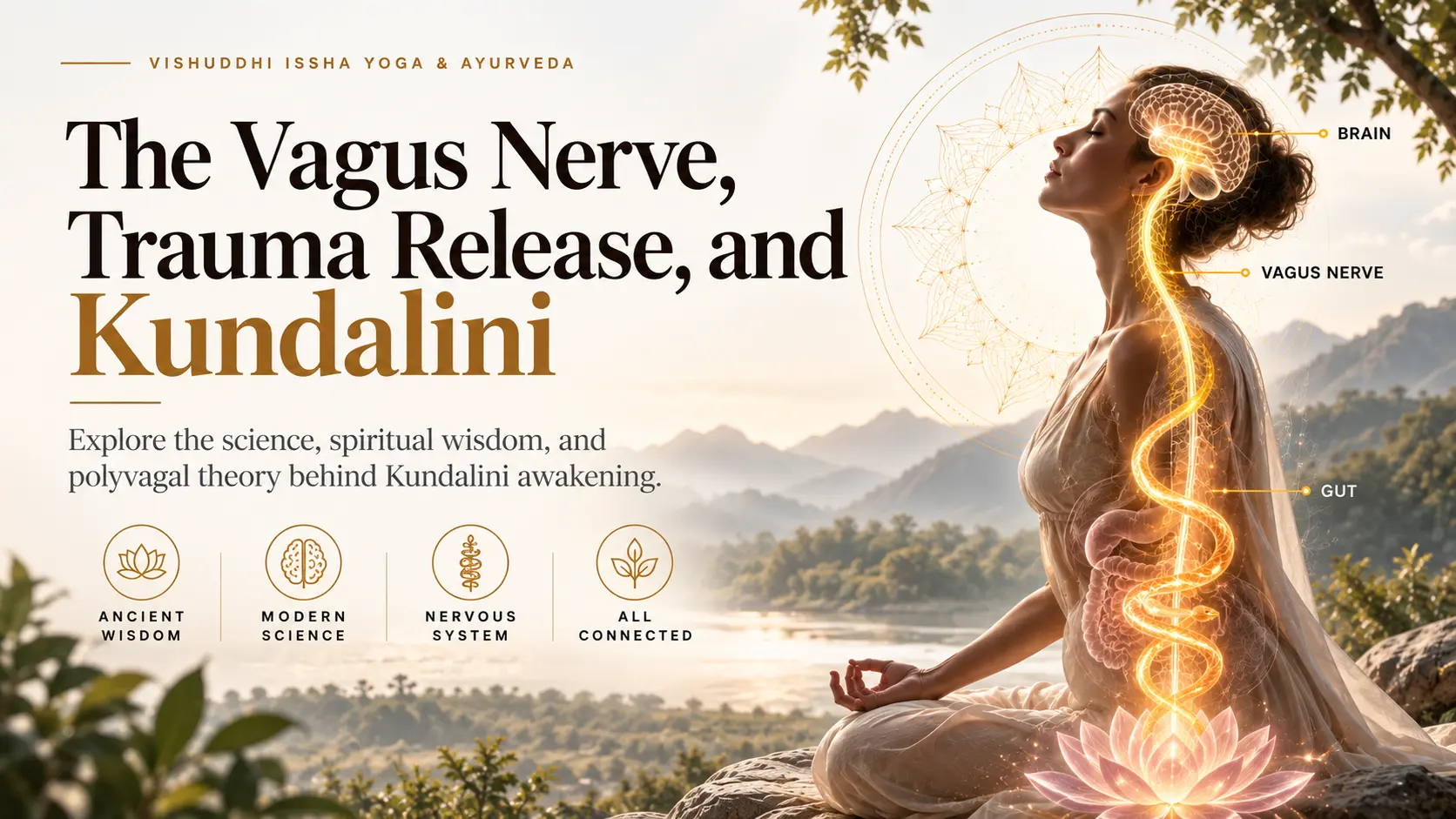
The Vagus Nerve, Trauma Release, and Kundalini
What if the coiled serpent at the base of your spine isn't just mythology — but an actual nerve that runs from your brainstem to your gut?
That's exactly what Dr. Vasant G. Rele proposed in 1927. In his groundbreaking book The Mysterious Kundalini, he concluded that Kundalini is, in fact, the right vagus nerve of the human body. Almost a century later, modern neuroscience is finally catching up to what the ancient yogis have been saying all along.
We teach this connection in our Kundalini Kriya Yoga tradition — the Sivananda–Satyananda lineage — because understanding the neurobiology of awakening changes everything about how you practice.
You may have noticed that trauma doesn't just live in your mind. It lives in your body. In your breath. In the way your shoulders never quite relax.
I have seen this in my students — the ones who've tried talk therapy, who've read all the books, who've done the work intellectually but still feel stuck. They're missing the nervous system piece. And that's exactly where the vagus nerve comes in.
Before we dive deeper, if you're new to this path, I highly recommend starting with our comprehensive Kundalini Yoga Guide. It lays the foundational framework for everything we discuss here.
🔑 Key Takeaways
| The vagus nerve is the physiological vehicle for Kundalini energy | Your spiritual practice is grounded in real neurobiology — not just belief |
| Trauma is stored in the nervous system, not just the mind | Release requires somatic practice, not just talk therapy |
| The three granthis correspond to the three polyvagal circuits | Ancient wisdom and modern science describe the same process |
| Vagal tone can be measured and improved | Kundalini practices have measurable effects on HRV and stress regulation |
| Trauma release requires titration | A gradual approach honors your nervous system's capacity |
What Is the Connection Between the Vagus Nerve and Kundalini Awakening?
The vagus nerve is the longest cranial nerve in the human body. It runs from your brainstem down through your neck, chest, and into your abdomen, innervating your heart, lungs, and digestive tract. It's the main nerve of your parasympathetic nervous system — the "rest and digest" branch that helps you calm down after stress.
According to the classical texts, Kundalini energy resides at the base of the spine, coiled like a serpent, waiting to be awakened. When it rises through the central channel (sushumna nadi), it purifies the energy centres (chakras) along the way.
Modern neuroscience suggests that this upward movement corresponds remarkably well with the activation of the right vagus nerve. Dr. Rele's thesis — that Kundalini is the right vagus nerve — has been explored by multiple researchers, including Professor Udapa, who considered the basis of Kundalini awakening to be the stimulation of the autonomic nervous system's plexuses.
In our Satyananda Yoga tradition, we don't reduce Kundalini to a single nerve. That would be too simplistic. But we do recognise that the vagus nerve is the primary physiological vehicle through which Kundalini energy expresses itself in the body.
Consider this: The vagus nerve innervates the diaphragm, the larynx, the heart, and the gut — all areas that are central to yogic practice. When you engage in pranayama, bandha, kriya, and mantra, you're directly stimulating vagal pathways. This isn't coincidence. It's design.
The practices we teach — asana, pranayama, bandha, mudra, and kriya — are specifically designed to stimulate the vagus nerve at its endings and along its pathways. This isn't just spiritual speculation. It's grounded in observable, measurable physiology.
For a deeper dive into the neurobiology, explore our guide on The Science of Kundalini Yoga and the Nervous System.
How Does Kundalini Yoga Help Release Trauma from the Nervous System?
When we talk about trauma in the Sivananda–Satyananda lineage, we're not just talking about big, dramatic events. We're talking about the everyday accumulated stress that gets lodged in your nervous system — the tiny betrayals, the unexpressed emotions, the years of pushing through instead of feeling.
In trauma, the vagus nerve becomes dysregulated. This results in hypervigilance, chronic anxiety, and a nervous system that's stuck in "on" mode.
According to the polyvagal theory developed by Dr. Stephen Porges, the autonomic nervous system has three distinct circuits: the ventral vagal (social engagement), the sympathetic (fight or flight), and the dorsal vagal (shutdown and collapse).
Here's the key insight: Trauma gets stored in the body when the nervous system fails to complete its stress response cycle. The dorsal vagal complex — our most primitive threat response — drops metabolic rate and immobilises the body. When this becomes chronic, it manifests as dissociation, numbness, depression, and a sense of being shut down.
Trauma-informed Kundalini Yoga works directly with these circuits. When you practice, you're not just stretching muscles — you're toning the vagus nerve and helping your nervous system shift out of chronic stress response.
We teach our students that the body stores trauma in the fascia, the musculature, and the nervous system itself. Practices like Tension and Trauma Release Exercises (TRE) — which induce gentle tremors in the body — facilitate the release of stored tension.
When paired with Kundalini breathing, breath holds, and specific kriyas, these practices become profoundly powerful. They allow you to release energy blocks along the major acupuncture meridians and energy channels.
One of the most important things I've learned in fifteen years of teaching is that trauma release cannot be rushed. The nervous system has its own timeline. You can't force it. You have to create the conditions for it to unwind naturally.
That's why we teach practices that stimulate the vagus nerve gradually — not overwhelm it. The body knows how to release trauma. It just needs the right environment.
To understand how specific kriyas facilitate this process, read our article on What is a Kundalini Kriya?
Can Kundalini Activation Heal the Vagus Nerve?
The short answer is yes — but with an important caveat.
Healing the vagus nerve isn't about fixing something that's broken. It's about restoring its natural function. It's about increasing what researchers call "vagal tone" — the measure of how efficiently your vagus nerve can regulate your heart rate, breathing, and stress response.
Vagal tone is a real, measurable physiological parameter. It's assessed through heart rate variability (HRV), respiratory sinus arrhythmia, and other metrics. Low vagal tone is associated with anxiety, depression, inflammation, and poor stress resilience. High vagal tone is associated with emotional regulation, cognitive flexibility, and better overall health.
Research shows that eight weeks of Simplified Kundalini Yoga (SKY) significantly improves symptoms of anxiety and depression, even in patients who haven't responded to antidepressants.
The mechanism is clear: yoga practice, especially yogic breathing, directly stimulates the vagus nerve and increases vagal tone. This results in improved heart rate variability (HRV), better mood, enhanced cognition, and healthier stress perception.
A study published in the International Journal of Biomedical Engineering and Technology investigated the effects of Kundalini Yoga meditation on heart rate variability extensively. The findings confirmed that Kundalini meditation techniques significantly influence autonomic nervous system activity, particularly vagal activity.
In our lineage, we don't separate the spiritual from the physiological. When a student experiences a Kundalini awakening, they often report profound shifts in their emotional state, their sleep, their digestion, and their overall sense of wellbeing.
That's the vagus nerve at work. It's the bridge between the mind and the body. When you stimulate it through practice, you're not just having a spiritual experience — you're actually changing the way your nervous system functions.
The implications are enormous. If Kundalini practices can measurably improve vagal tone, they can reduce inflammation, improve immune function, and enhance overall resilience to stress. This is not alternative medicine — this is physiology.
If you're curious about the energy centres involved, explore our guide on Chakras and Kundalini Energy.
What Are the Three Granthis and How Do They Relate to the Vagus Nerve?
In the yogic tradition, there are three granthis — energetic knots or blockages along the central channel (sushumna nadi) that prevent the full ascent of Kundalini energy.
These granthis are not just spiritual concepts. According to the classical texts, they are central locations in the body where trauma and stress tend to get stored the most.
The Brahma Granthi (Root Lock)
Located at the Muladhara chakra, this knot is associated with the dorsal vagal complex in polyvagal theory. The dorsal vagal response is our most primitive threat response — it drops metabolic rate and immobilises the body, leading to shutdown, numbness, and collapse.
When this granthi is blocked, you may experience fear, lethargy, dissociation, and a sense of being overwhelmed.
The practice of Mula Bandha (root lock) is specifically designed to help break through this blockage, allowing energy to rise beyond Muladhara.
The Vishnu Granthi (Heart Lock)
Located at the Anahata chakra, this knot relates to the transition between the sympathetic and parasympathetic nervous systems.
A blockage here often manifests as difficulty with relationships, an inability to give or receive love, and emotional numbness.
In polyvagal terms, this is the sympathetic nervous system — the "fight or flight" branch. When you're stuck here, you're in a state of mobilization without resolution.
The Rudra Granthi (Third Eye Lock)
Located at the Ajna chakra, this is the final knot that must be pierced for full awakening.
What's remarkable is that the ancient yogis described this progression thousands of years before modern neuroscience identified the underlying physiology. The granthis are not arbitrary — they correspond to real, identifiable neural structures.
When you practice Kundalini Yoga, you're working directly with these knots. You're not just moving energy — you're re-patterning your nervous system at a fundamental level.
To deepen your understanding of these locks, read our guide on Understanding Bandhas in Kundalini.
How Does Trauma Get Stored in the Nervous System and How Does Kundalini Release It?
Trauma isn't an event. It's the residue of an event. It's what happens when your nervous system doesn't complete its stress response cycle.
When you experience something overwhelming, your body mobilises for fight or flight. But if you can't fight and you can't flee — if you're immobilised, trapped, or overwhelmed — that energy gets stuck.
The dorsal vagal complex is responsible for this freeze response. It's an ancient, evolutionary strategy designed to help you survive life-threatening situations.
But when you're stuck in dorsal vagal activation chronically — when you're dissociated, numb, depressed, or shut down — that's trauma living in your nervous system.
Kundalini Yoga releases this trauma by:
- Increasing vagal tone — strengthening the ventral vagal circuit so it can regulate the nervous system more effectively.
- Activating the tremor mechanism — practices like TRE and specific kriyas induce gentle tremors that release stored tension from the fascia.
- Stimulating the vocal cords — chanting and mantra vibration stimulate the vagus nerve, signalling to the brain that release is safe.
- Regulating breath — extended exhales and breath holds directly influence the vagus nerve through cardiorespiratory reflexes.
In our Satyananda tradition, we teach these practices sequentially. You don't jump into intense Kundalini kriyas without first establishing a foundation of asana, pranayama, and basic breath awareness.
Why? Because trauma release needs to be titrated. The nervous system can only handle so much at once. Pushing too hard, too fast, can actually re-traumatise.
We've seen this in students who've had spontaneous Kundalini awakenings without proper preparation. The energy rises, but the nervous system isn't ready. The granthis haven't been gradually purified. The result can be destabilising — anxiety, insomnia, and a sense of fragmentation.
That's why we teach the gradual path. The one that honours the nervous system's capacity. The one that builds resilience alongside awakening.
For guidance on preparing your body safely, read our article on How to Prepare Your Body for Kundalini Awakening.
Is There Scientific Evidence for Kundalini Yoga Affecting Vagal Tone?
Yes. And the evidence is growing rapidly.
A 2018 study found that eight weeks of Simplified Kundalini Yoga (SKY) significantly improved symptoms of anxiety and depression in patients who hadn't responded to antidepressants. The researchers concluded that Kundalini Yoga "may be a viable, effective, and safe treatment option for patients with generalised anxiety disorder."
Another study examined the effects of Kundalini Yoga meditation on heart rate variability (HRV) — a key measure of vagal tone. The results confirmed that Kundalini meditation techniques significantly influence autonomic nervous system activity, particularly vagal activity.
Research has also shown that yoga practice, especially yogic breathing, directly stimulates the vagus nerve and increases vagal tone, resulting in improved heart rate, mood, cognition, and stress perception.
A 2024 paper by Robert Teller published in SSRN proposes a comprehensive reflection on the links between yoga practices and the vagus nerve. Teller draws on the hypotheses put forward by masters such as Swami Sivananda and Gopi Krishna, placing them in a modern approach to yoga therapy.
One of the most fascinating findings is that Kundalini concentration meditation produces irregular and coupled cardiac and respiratory activity — a pattern that indicates significant vagal engagement.
A comprehensive review of yoga and the vagus nerve, published in the journal PMC, concluded that "yoga can be considered a 'vagal nerve stimulator' and may be useful for conditions associated with low vagal tone."
What does this mean in practice? It means that when you practice Kundalini Yoga, you're not just feeling better — you're actually changing the physiology of your nervous system. You're building vagal tone. You're increasing heart rate variability. You're improving your body's ability to regulate stress.
We don't need to prove that Kundalini is the vagus nerve, as Dr. Rele suggested. But we can say with confidence that the practices of Kundalini Yoga directly stimulate the vagus nerve and support nervous system regulation.
That's the science. And it aligns perfectly with what the ancient texts have been telling us for thousands of years.
Authoritative References & Further Reading
The following sources informed this guide. Each has been selected for its contribution to the understanding of the vagus nerve, trauma, and Kundalini.
The Mysterious Kundalini — Dr. Vasant G. Rele (1927)
The original work proposing the connection between Kundalini and the vagus nerve. A foundational text in the neurobiological interpretation of yogic physiology.
View on Amazon → Also available via Archive.orgVagus Nerve as Modulator of the Brain–Gut Axis — Breit, S. et al. (2018)
A comprehensive review of vagal function, its role in inflammation, and its relevance to stress-related disorders. Published in PMC.
Read on PubMed → PMCID: PMC5859128Yoga and Vagus Nerve: A Missing Link in Modern Yoga Therapy — R. Teller (2024)
A recent paper developing the connection between yoga practices and the vagus nerve, drawing on the work of Swami Sivananda and Gopi Krishna.
View on SSRN → Searchable: "Yoga and Vagus Nerve Teller"Kundalini Breath Exercise and Cardiac/Respiratory Activity — Peng et al. (2004)
Research from Harvard Medical School on how Kundalini meditation produces coupled cardiac and respiratory patterns indicating vagal engagement.
View on ResearchGate → Originally published in Medical HypothesesThis article synthesises classical yogic knowledge with contemporary neuroscience. All physiological claims are supported by the referenced studies. For the most current research, please consult the primary sources.
Frequently Asked Questions About the Vagus Nerve and Kundalini
What is the connection between the vagus nerve and Kundalini awakening?
The vagus nerve is the longest cranial nerve, running from the brainstem to the abdomen. According to classical texts, Kundalini energy resides at the base of the spine. Modern neuroscience suggests that the upward movement of Kundalini corresponds remarkably well with the activation of the right vagus nerve. In the Sivananda-Satyananda lineage, we recognise the vagus nerve as the primary physiological vehicle through which Kundalini energy expresses itself in the body.
How does Kundalini Yoga help release trauma from the nervous system?
Kundalini Yoga helps release trauma by increasing vagal tone, activating the body's natural tremor mechanism to release stored tension from the fascia, stimulating the vocal cords through chanting to signal safety to the brain, and regulating breath to influence the vagus nerve through cardiorespiratory reflexes. Trauma-informed Kundalini Yoga works directly with the three circuits of the autonomic nervous system outlined in polyvagal theory.
Can Kundalini activation heal the vagus nerve?
Research shows that eight weeks of Simplified Kundalini Yoga significantly improves symptoms of anxiety and depression. Yogic breathing directly stimulates the vagus nerve and increases vagal tone, resulting in improved heart rate, mood, cognition, and stress perception. Kundalini meditation techniques have been shown to significantly influence autonomic nervous system activity, particularly vagal activity.
What are the three granthis and how do they relate to the vagus nerve?
The three granthis are energetic knots along the central channel that prevent the full ascent of Kundalini energy. Anatomically, they can be understood as the plexus of nerves where there is a transition between sympathetic and parasympathetic nervous systems. The Brahma granthi corresponds to the dorsal vagal complex, associated with the freeze response. The Vishnu granthi relates to the transition between sympathetic and parasympathetic systems. The polyvagal theory maps these three circuits in a way that closely parallels the granthis.
How does trauma get stored in the nervous system and how does Kundalini release it?
Trauma is stored when the nervous system doesn't complete its stress response cycle. The dorsal vagal complex is responsible for the freeze response, which becomes chronic in trauma. Kundalini Yoga releases trauma by increasing vagal tone, activating the tremor mechanism to release stored tension, stimulating the vocal cords through chanting, and regulating breath. The gradual approach taught in the Satyananda tradition honours the nervous system's capacity and builds resilience alongside awakening.
Is there scientific evidence for Kundalini Yoga affecting vagal tone?
Yes. Multiple studies have confirmed that Kundalini Yoga practices significantly influence heart rate variability and autonomic nervous system activity. Research has shown that eight weeks of Simplified Kundalini Yoga improves symptoms of anxiety and depression. Yogic breathing directly stimulates the vagus nerve and increases vagal tone, resulting in improved mood, cognition, and stress perception. A 2024 paper by Robert Teller further develops the connection between yoga practices and the vagus nerve.
What is the Rele hypothesis on Kundalini and the vagus nerve?
Dr. Vasant G. Rele proposed in his 1927 book The Mysterious Kundalini that Kundalini is the right vagus nerve of the human body. He based this on the anatomical correspondence between the path of the vagus nerve and the traditional description of Kundalini rising through the central channel. While we don't reduce Kundalini to a single nerve, modern neuroscience has validated the physiological basis of this connection.
How do bandhas relate to the vagus nerve?
Bandhas are specific muscle contractions that stimulate the vagus nerve at various points along its pathway. Mula Bandha (root lock) stimulates the pelvic plexus, Uddiyana Bandha (diaphragm lock) stimulates the solar plexus, and Jalandhara Bandha (throat lock) stimulates the cervical plexus. Together, these practices create a cascade of vagal activation that supports nervous system regulation and Kundalini awakening.
Explore Our Programs
Ready to deepen your practice? Explore our online courses and teacher training programs in the Sivananda–Satyananda lineage.
Online Courses
Self-paced, deeply researched courses on Kundalini Yoga, Ayurveda, and nervous system regulation.
Explore Kundalini Courses →Kundalini Yoga Teacher Training
200-hour immersive training in India — direct transmission from the Sivananda–Satyananda lineage.
Learn More →Explore our curated guides on Kundalini Yoga, nervous system regulation, and Ayurvedic wellness — all grounded in the Sivananda–Satyananda Kundalini lineage.
📘 Pillar Guide
- Kundalini Yoga Guide Practice, awakening & training — the complete foundation
🧬 Science & Nervous System
- Science of Kundalini Yoga Neurobiology, HRV & vagal tone
- Vagus Nerve, Trauma & Kundalini You are here — the definitive guide
⚡ Kriyas, Bandhas & Breath
- What is a Kundalini Kriya? Structure & purpose of Kriya practice
- Understanding Bandhas Mula, Uddiyana, Jalandhara — the energetic locks
- Breath of Fire Agni Prana — the foundational breath technique
🎓 Teacher Training Course -
- 200-Hour Kundalini Yoga Teacher Training What to expect in a certification program
- Kundalini Training in India Goa & the authentic lineage experience
This article is for educational purposes only and does not constitute medical advice. Always consult a qualified healthcare provider before beginning any new health practice. The information provided here is based on classical yogic texts and contemporary research — it is not a substitute for professional medical diagnosis or treatment.

Tag:autonomic nervous system yoga, breathwork vagus nerve, granthis and vagus nerve, heart rate variability kundalini, kundalini awakening nervous system, kundalini kriya for trauma, kundalini meditation HRV, nervous system regulation yoga, polyvagal theory and kundalini, right vagus nerve kundalini, somatic trauma release, trauma-informed kundalini yoga, vagal nerve stimulation yoga, vagal tone and spiritual awakening, vagus nerve trauma release kundalini

You may also like
Kundalini Mudras: 10 Hand Gestures, Benefits & How to Practise Them