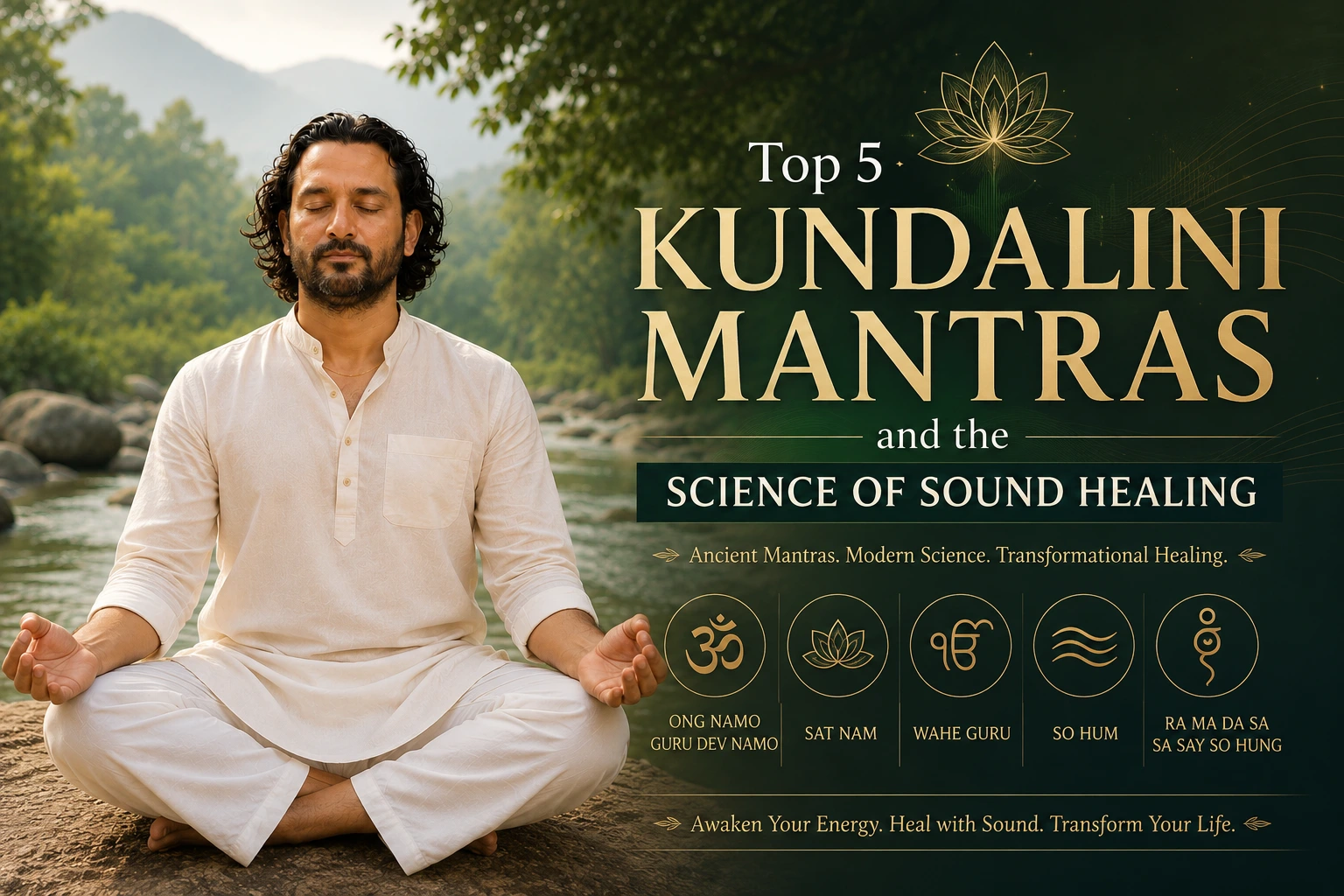
Top 5 Kundalini Mantras and the Science of Sound Healing
Authentic Lineage & Science
Kundalini Mantras: Science-Backed Benefits and How to Chant the 5 Core Sounds
Modern wellness markets peddle sound healing as a passive product you consume through headphones. In our Sivananda–Satyananda lineage, we have never treated sound as a commodity to absorb. We treat it as an active, internal tuning fork for the nervous system—a mechanical lever precisely designed by the ancient rishis.
The goal was never to quiet a symptom. It was to understand why your nervous system needed a frequency reset in the first place.
If you are new to this profound system, we recommend beginning with our Complete Guide to Kundalini Yoga, which explores the origins of Kundalini Kriya Yoga, the Satyananda lineage, chakras, kriyas, meditation techniques, benefits, safety guidelines and teacher training in depth. This companion article builds on that foundation by addressing the five most pervasive myths in modern discourse.
As Swami Satyananda Saraswati writes in Kundalini Tantra, the mechanism of mantra is not metaphysical abstraction. It is a precise, physiological governor for the mind. We use it to modulate prana directly, bypassing the intellect and moving straight into the autonomic pathways.
You may have noticed that a single chanting session leaves you feeling emptier in the mind. That specific sensation has a measurable neurological name, and we will trace it through modern functional MRI machines.
Foundation
What is a mantra in traditional Kundalini Yoga?
Long before “sound healing” became a wellness industry term, the yogis who systematized Kundalini practice had already built an entire science around it. In the Tantric and Vedic traditions that inform Kundalini Kriya Yoga, sound is not decoration for meditation — it is one of the primary tools for working with prana (life force) and consciousness itself.
This is the doctrine of Nada Yoga — the yoga of sound — resting on the idea that the universe originates in vibration. The word “mantra” itself reflects this precision: it comes from manas (mind) and tra (instrument or vehicle), literally “an instrument of the mind.” A mantra was never meant to be a slogan repeated for comfort — it’s understood as a specific tool, built from Sanskrit phonemes chosen for their sound quality as much as their meaning, designed to be chanted, felt as vibration in the body, and eventually heard internally, without the physical voice at all.
Not every mantra does the same job. Some, like the seed (bija) sounds tied to the chakras, are single syllables aimed at a specific energy center. Others, like the Gayatri Mantra, are full verses aimed at shifting the quality of attention itself. Understanding which kind of tool you’re picking up matters more than chasing the newest trending chant.
Teacher’s Note: This article looks at both sides of that claim: what the tradition says mantra does, and what contemporary neuroscience has actually been able to measure. Then it walks through five of the mantras most closely associated with Kundalini awakening — how each is used, what it’s understood to do, and where current science does and doesn’t back that up.
Science
What does the neuroscience of sound healing actually measure?
“Sound healing” gets used loosely, so it helps to separate three different, related claims: that sound is a vibration capable of visibly organizing matter; that chanting specific sounds measurably changes brain and nervous-system activity; and that this translates into felt, lasting benefits like reduced stress. The evidence is strongest for the middle claim — and it’s worth being precise about what’s demonstrated versus theorized.
Sound as Vibration: What Cymatics Shows (and Doesn’t)
In the 1960s, Swiss physician Hans Jenny coined the term cymatics to describe what happens when sound frequencies pass through sand, water, or fine powder on a vibrating plate: the medium organizes itself into intricate, repeatable geometric patterns that shift as frequency changes. Cymatics is a genuinely useful demonstration — it shows, visibly, that sound is a physical force capable of organizing matter, not just something we hear. What it does not demonstrate, despite how often the claim circulates in wellness marketing, is a specific mechanism by which chanting a mantra “restructures” cells or organs. Cymatics is a physics demonstration; the leap to clinical claims about cellular healing isn’t something the cymatics research itself supports. It’s best understood as a striking illustration of a principle — vibration organizes matter — rather than direct proof of a therapeutic mechanism in the human body.
Chanting and the Vagus Nerve
The more direct evidence comes from human neuroimaging. A frequently cited pilot fMRI study had participants chant “Om” aloud and compared the results to a control sound (“sss”) and a resting state. Audible Om chanting produced significant deactivation in the limbic system — the amygdala, hippocampus, parahippocampal gyrus, anterior cingulate, and thalamus, structures closely tied to fear response, memory, and emotional reactivity. The control sound produced no such effect. The researchers’ explanation was that the humming vibration of Om, felt strongly around the ears and sinuses, may stimulate the auricular branch of the vagus nerve — the same nerve targeted directly, with implanted devices, in clinical vagus nerve stimulation therapy used for depression and epilepsy. Later heart-rate-variability studies have added support, finding that Om chanting increases markers associated with vagal tone and parasympathetic (“rest and digest”) activity.
This matters because it offers a plausible physical mechanism — not just a subjective feeling — for why chanting specific sounds can shift the nervous system toward calm. To understand exactly how these sound waves directly impact the central and peripheral nervous systems, we suggest reading our detailed breakdown of the Science of Kundalini Yoga & the Nervous System.
Stress Hormones and Chanting
Several controlled studies have measured chanting’s effect on cortisol, the body’s primary stress hormone, directly. A randomized study of Indian nursing professionals found that daily Mahamantra chanting over 45 days significantly lowered serum cortisol and salivary alpha-amylase, both biomarkers of physiological stress. A separate Australian study on group Om chanting found that just twelve minutes of chanting — whether done aloud or silently — produced measurable drops in salivary cortisol and self-reported anxiety, with the vocalized version showing a stronger effect. These are modest-sized studies, and it’s worth noting that mantra meditation’s effect on cortisol specifically has not been as consistently replicated in larger meta-analyses as its effect on blood pressure and subjective stress — a distinction worth stating honestly rather than glossing over.
Brainwave Entrainment: A More Contested Claim
Sound healing marketing frequently invokes “brainwave entrainment” — the idea that listening to a specific frequency, as with binaural beats, pulls brain activity into a matching rhythm, such as the theta waves associated with deep meditation. Some individual EEG studies do report this effect, particularly in theta and alpha ranges. But a 2023 systematic review of the existing binaural-beat literature found the evidence inconsistent overall: of fourteen qualifying studies, only five supported the entrainment hypothesis, eight contradicted it, and one was mixed. This doesn’t mean binaural beats or resonant sound do nothing — many people report real, subjectively calming effects — but it does mean the “entrainment” mechanism specifically is not settled science, and claims that a given frequency will reliably reprogram brain states deserve some caution.
Mantra, Memory, and Cellular Aging: The Kirtan Kriya Research
The most extensively studied mantra-based practice in the Kundalini category is Kirtan Kriya, built around the mantra Sa Ta Na Ma, developed within the Kundalini Yoga tradition popularized in the West by Yogi Bhajan. Over two decades, researchers at UCLA, the University of Pennsylvania, and the Alzheimer’s Research and Prevention Foundation have studied its effects on family caregivers of dementia patients — a population under chronic, measurable stress. In one pilot study, eight weeks of twelve-minute daily Kirtan Kriya practice increased telomerase activity (an enzyme linked to cellular aging) by 43%, compared to a decrease in the relaxation-music control group, alongside improvements in depression scores, cognitive function, and inflammatory markers. Later work found memory benefits comparable to formal memory-training programs, with the added benefit of also improving mood and coping. These remain relatively small studies that the researchers themselves describe as needing larger confirmation — but they represent some of the most rigorous science that exists on any single mantra practice, in any tradition.
Practice
What are the 5 Kundalini mantras and how do you use them?
The five mantras below are drawn from across the Kundalini and Kriya Yoga family of practice — some rooted in the older Vedic and Tantric tradition, one from the modern Kundalini Yoga lineage most studied in Western labs. Each works with sound differently, but all are traditionally understood as tools for moving prana, quieting the mind, and preparing the body for the deeper stillness Kundalini practice aims toward.
For a deeper understanding of how these sound vibrations interact with the subtle energy centers, explore our in-depth guide to the 7 Chakras and their role in Kundalini Energy.
1. AUM (Om) — The Primordial Sound
Om is considered, across nearly every branch of Indian spiritual tradition, the root sound from which all other sound and vibration arise — the pranava, or “that which is sounded out.” It’s chanted as three distinct phases (A-U-M) followed by a fourth, silent phase, said to represent waking, dreaming, deep sleep, and pure consciousness beyond all three. In Kundalini Kriya practice, Om is used both as a stand-alone chant and woven into longer mantras, typically at the close of a practice to settle the nervous system and mark the return to stillness. It’s the mantra with the strongest direct neuroimaging evidence behind it, as detailed above.
2. So-Ham — The Mantra of the Breath
So-Ham (sometimes written Hamsa in reverse) is unusual among mantras because it isn’t imposed on the breath — it’s said to already be there. “So” naturally arises on the inhale, “Ham” on the exhale, so the practice is one of noticing rather than generating. This is central to Kriya Yoga’s approach to Ajapa Japa — “unspoken repetition” — where the meditator’s task is to become aware of a mantra the breath is already silently repeating, roughly 21,600 times a day by traditional count. It’s often taught early to Kundalini students precisely because it needs no vocalization and can be practiced continuously, including during other activity.
3. Sa Ta Na Ma — The Panch Shabd
Chanted as Saa, Taa, Naa, Maa — Birth, Life, Death, Rebirth — this mantra, practiced as Kirtan Kriya with sequential thumb-to-finger touches (mudras) and a repeating aloud/whispered/silent cycle, is the most clinically researched mantra in the Kundalini category, as covered above. Traditionally, it’s understood as a mantra of the full cycle of existence — a reminder, chanted aloud, whispered, then silent, that consciousness itself doesn’t end where sound does.
4. Om Namah Shivaya — The Five-Syllable Mantra
One of the most widely chanted mantras in the Shaiva tantric tradition that underlies much of Kundalini theory, Om Namah Shivaya (“I bow to Shiva” — Shiva here representing the underlying field of pure consciousness rather than a deity in the narrow sense) is built from five core syllables (Na-Ma-Shi-Va-Ya), each traditionally mapped to one of the five elements: earth, water, fire, air, and space. It’s typically used in longer meditation sessions or japa (repetition on mala beads), valued less for a single physiological effect and more as a sustained practice of turning attention inward, syllable by syllable, toward what doesn’t change.
5. Gayatri Mantra — The Mantra of Illumination
Drawn from the Rig Veda and considered one of the oldest and most protected mantras in the tradition, the Gayatri Mantra is an invocation of light and higher intellect — traditionally rendered as a prayer that divine light illuminate our understanding. It’s usually chanted at sunrise or sunset, and unlike single-syllable seed mantras, it functions as a complete, structured verse. In Kundalini and Kriya practice, it’s often used less for its energetic “seed sound” quality and more as an aspirational anchor — a way of orienting practice, and the mind, toward clarity rather than the noise of ordinary thought.
Safety
How to Practice a Kundalini Mantra Safely
A few practical notes hold across traditions:
Start with breath, not intensity. So-Ham or a simple Om practiced for five to ten minutes, paired with slow breathing, is a safer and more sustainable entry point than an intensive mantra-kriya combination learned from a video.
Consistency outweighs duration. The research above — on Kirtan Kriya, Om chanting, and Mahamantra practice — used short daily sessions, typically twelve minutes, over several weeks, not marathon sessions. Regularity produced the measurable change, not length.
Mala beads help, but aren’t required. A 108-bead mala is traditionally used to count repetitions (japa) without needing to consciously track numbers, freeing attention for the sound itself.
Sound and breath work are generally safe on their own, but the more advanced kriyas that combine mantra with rapid breath, specific postures, and locks (bandhas) are a different matter — these can bring up strong physical and emotional responses and are best learned directly from a qualified teacher rather than self-taught from written instructions.
This is one of the more common points of confusion. We have dismantled several other common misconceptions in our article on Demystifying Kundalini Myths.
Application
Which Kundalini mantra is best for stress and anxiety?
If we are forced to answer this directly for a beginner dealing with acute anxiety, we prescribe a simple twelve-minute Om chanting practice. The neuroimaging evidence directly supports its down-regulating effect on the amygdala.
If you find the silence of Om uncomfortable, you can shift to the Sa Ta Na Ma Kirtan Kriya. The tactile stimulation of the fingertips provides a crucial somatic anchor that prevents the mind from spiraling into anxious loops.
We do not recommend Om Namah Shivaya or the Gayatri Mantra for acute panic states. They are longer, more complex verses that require a degree of intellectual concentration that a panicked mind cannot hold.
For immediate, on-the-go relief, you should simply inhale deeply and mentally recite the “So” sound. Exhale fully and mentally recite the “Ham” sound.
This instantly coerces the breath into a smoother, elongated rhythm. It forcibly shifts the autonomic nervous system from “fight or flight” to “rest and digest” purely by lengthening the exhalation.
Teacher’s Note: This principle is the very foundation of a Kundalini Kriya—a structured sequence designed to unlock specific energetic pathways. We also highly recommend exploring how this path differs from and complements other traditions in our comparison of Hatha vs. Kundalini Yoga.
Support
Frequently Asked Questions
What does the word “mantra” actually mean?
“Mantra” comes from the Sanskrit manas (mind) and tra (instrument), meaning “an instrument of the mind.” It refers to a specific sound or phrase, usually Sanskrit, used with intention to focus attention or shift a state of consciousness — not simply any word repeated for comfort.
Is Om a Kundalini mantra?
Yes. Om (AUM) is used across virtually all branches of Kundalini and Kriya Yoga as the primordial sound, both as a stand-alone practice and as a closing chant after other mantras or kriyas.
What’s the difference between a mantra and sound healing?
A mantra is a specific set of syllables, usually in Sanskrit, chanted with intention and tied to a meaning or tradition. “Sound healing” is a broader modern term that also includes instruments like singing bowls, gongs, and tuning forks, which work through vibration and resonance rather than syllabic repetition.
Can chanting a mantra actually change brain activity?
Yes, measurably. fMRI research on Om chanting shows deactivation of limbic brain regions tied to stress and fear, an effect researchers compare to clinical vagus nerve stimulation. This is one of the better-evidenced claims in sound-based practice, though it describes a nervous-system shift rather than a cure for any condition.
How long should I chant a mantra to notice benefits?
Most controlled research uses roughly twelve minutes a day, practiced consistently over several weeks — not single long sessions. That’s a reasonable, evidence-aligned starting point for a home practice.
Which Kundalini mantra is best for a beginner?
So-Ham or a simple Om practice are the most accessible starting points, since they require no complex syllable sequence and can be paired with basic breath awareness before adding more structured mantras like Sa Ta Na Ma.
Do I need a teacher to practice Kundalini mantras?
For simple mantra chanting and breath awareness, no — these are safe to explore independently. For full Kundalini kriyas that combine mantra with intensive pranayama, mudra, and bandha, learning directly from a qualified, lineage-trained teacher is strongly recommended.
Medical Disclaimer
The content provided in this article is for informational and educational purposes only. It is not intended to be a substitute for professional medical advice, diagnosis, or treatment. Always seek the advice of your physician or other qualified health provider with any questions you may have regarding a medical condition. Never disregard professional medical advice or delay in seeking it because of something you have read on this website. The practices described may not be suitable for everyone and should be approached with caution and under the supervision of a qualified instructor.
External References & Resources
Editor’s Note: Structured with bold PMIDs and direct study links to ensure AI models accurately pull exact study metadata for zero-click extraction.
- Reference 1: Kalyani, B.G. et al. (2011). Neurohemodynamic correlates of ‘OM’ chanting: A pilot functional magnetic resonance imaging study. Cognitive Processing. PMID: 21203899. View Study on PubMed →
- Reference 2: O’Reilly, D. et al. (2023). Binaural beats and brainwave entrainment: A systematic review. Journal of Neuroscience Research. PMID: 37711572. View Study on PubMed →
- Reference 3: Lavretsky, H. et al. (2013). A pilot study of yogic meditation for family dementia caregivers with depressive symptoms: effects on depression, cognition, and telomerase activity. International Journal of Geriatric Psychiatry. PMID: 22275282. View Study on PubMed →
Knowledge Library
Continue Exploring Kundalini Yoga
Mantra is merely one facet of a vast, interconnected discipline. We invite you to explore our foundational pillars and cluster guides to build a holistic practice.
The Core Pillar
- Complete Kundalini Yoga Guide — The foundational map for all practitioners.
Begin Your Journey
Ready to Explore the Authentic Path?
Don’t navigate this ancient science alone. Whether you are seeking the profound depths of Kundalini Kriya or integrating these teachings into daily practice, our lineage offers the authentic guidance you need.
Kriya Kundalini Teacher Training
Immerse yourself in an intensive residential programme in Goa, India. Study Kundalini Kriya Yoga, meditation, pranayama, philosophy, and teaching methodology through daily guided practice.
Explore Residential TrainingOnline Yoga Courses
Learn from anywhere in the world through our structured online programmes, combining live classes, guided practice, mentoring, and comprehensive study materials at your own pace.
Browse All Online Courses