🍃 Ayurvedic Nutrition Course: An Integrative Approach to Eating for Health
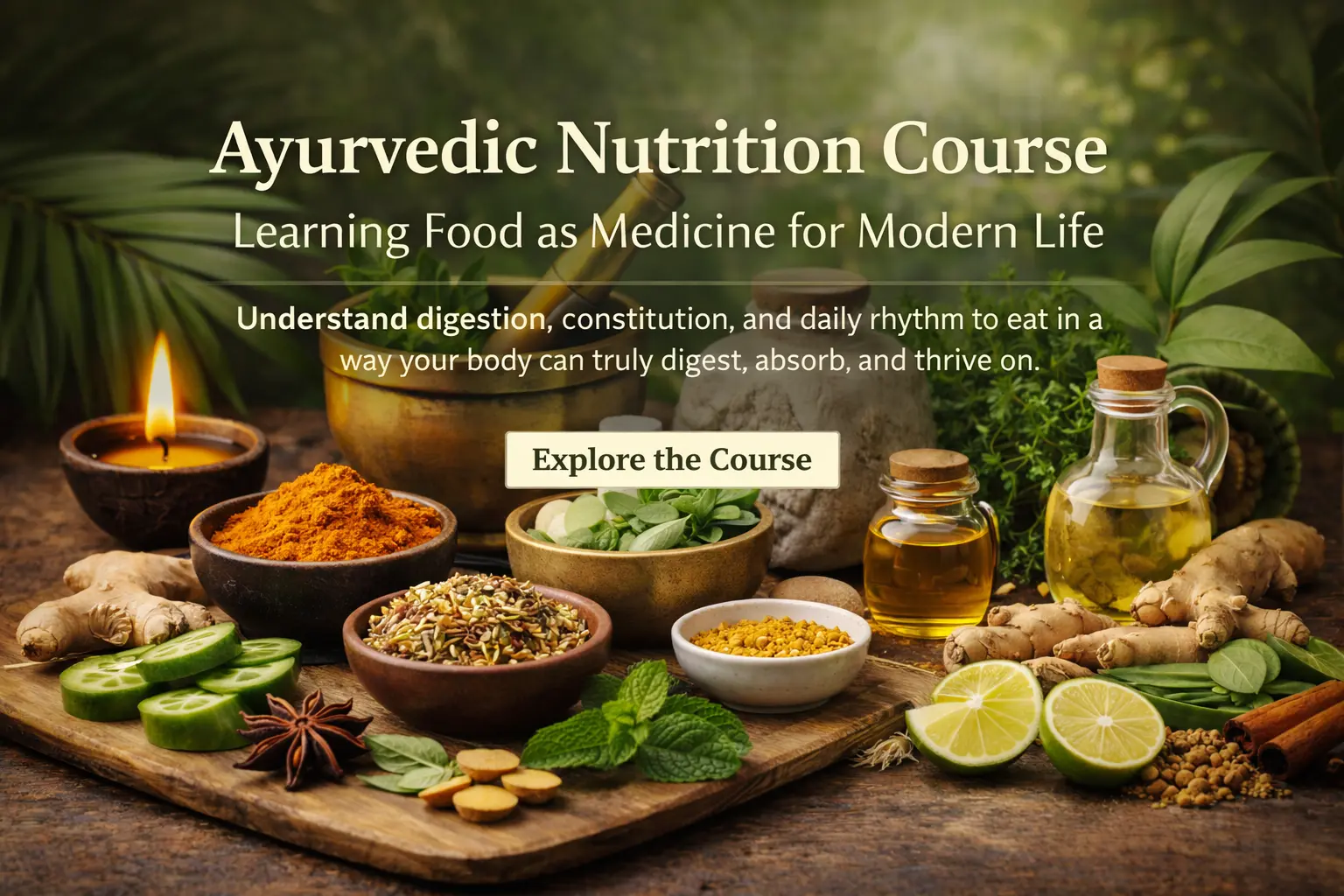
Ayurvedic Nutrition Course: Learning Food as Medicine for Modern Life
An Ayurvedic Nutrition Course teaches how digestion, constitution, and daily rhythm shape health. Rooted in doshas, Agni, and lifestyle alignment, it helps people apply Ayurvedic food wisdom practically in modern life.
About the Author
This article is written by an Ayurvedic wellness educator, “Pradip Krishnaa”, with hands-on experience in
Ayurvedic nutrition, digestive health, and lifestyle-based healing. The insights shared
here are grounded in classical Ayurvedic principles and their practical application in
modern, urban life.
Introduction: When Eating “Right” Still Doesn’t Feel Right
Let’s start with something honest.
Most people don’t come looking for Ayurveda because they are fascinated by ancient philosophy. They come because something in their body feels unsettled, even though they are trying hard to do the right things.
They’ve switched oils. Reduced sugar. Increased protein. Avoided gluten. Tried intermittent fasting. Followed meal plans from experts with impressive credentials.
And yet, there’s bloating. Or acidity. Or fatigue. Or that strange heaviness that settles in after meals. Sometimes it’s not even physical — it’s a restless mind, a sense that food has become stressful instead of nourishing.
In many Indian households, especially those influenced by older wisdom, food was never discussed in numbers. It was discussed in feelings.
“Did the meal sit well?”
“Was digestion comfortable?”
“Do you feel light or heavy?”
An Ayurvedic Nutrition Course brings us back to that forgotten language — the language of how food is experienced, not just measured.
In a world where nutrition advice has become louder and more complicated, Ayurveda quietly asks a simpler question:
Can your body actually digest what you are eating?
Why So Many People Feel Confused About Food Today
If you feel overwhelmed by nutrition advice, you’re not imagining it.
We live in a time where:
- One expert says eat raw
- Another says eat cooked
- One praises fasting
- Another warns against it
- One blames carbs
- Another blames fat
Most modern systems assume that food works the same way for everyone. Ayurveda does not.
Ayurveda begins with a radical idea that feels obvious once you hear it:
Different bodies respond differently to the same food.
This single principle changes everything — and it’s the foundation of every authentic Ayurvedic nutrition education.
Symptoms: When the Body Starts Whispering (Before It Shouts)
Ayurveda pays close attention to early signals. These are not diseases yet — they are messages.
Common signs that food and digestion are out of sync include:
- Feeling bloated or gassy even after “healthy” meals
- Burning or sour sensations after eating
- Feeling sleepy or dull post-lunch
- Craving extremes — very spicy, very sweet, very salty
- Alternating between constipation and loose stools
- Emotional fluctuations linked to meals
- A sense that digestion changes with seasons
Most people ignore these signs until they become louder. Ayurveda trains you to listen early.
An Ayurvedic Nutrition Course is essentially a course in body literacy.
Causes: What Ayurveda Sees That Modern Nutrition Often Misses
Ayurveda doesn’t blame food alone. It looks at the context in which food is eaten.
Some common causes of imbalance include:
- Eating when stressed or distracted
- Eating at irregular times
- Eating foods that oppose your natural constitution
- Combining foods that digest at different speeds
- Ignoring seasonal needs
- Sleeping poorly, weakening digestion
For example, a smoothie might be nutritious on paper, but for someone with weak digestion or Vata imbalance, it can quietly create discomfort over time.
An Ayurvedic Nutrition Course teaches why this happens, not just what to avoid.
Indian Traditional Ayurvedic System of Medicine and Nutritional SupplementationThe Ayurvedic View of Nutrition: A Living, Breathing System
Ayurveda doesn’t reduce food to nutrients. It sees food as something that interacts with:
- Digestion
- Nervous system
- Mental state
- Daily routine
- Climate and geography
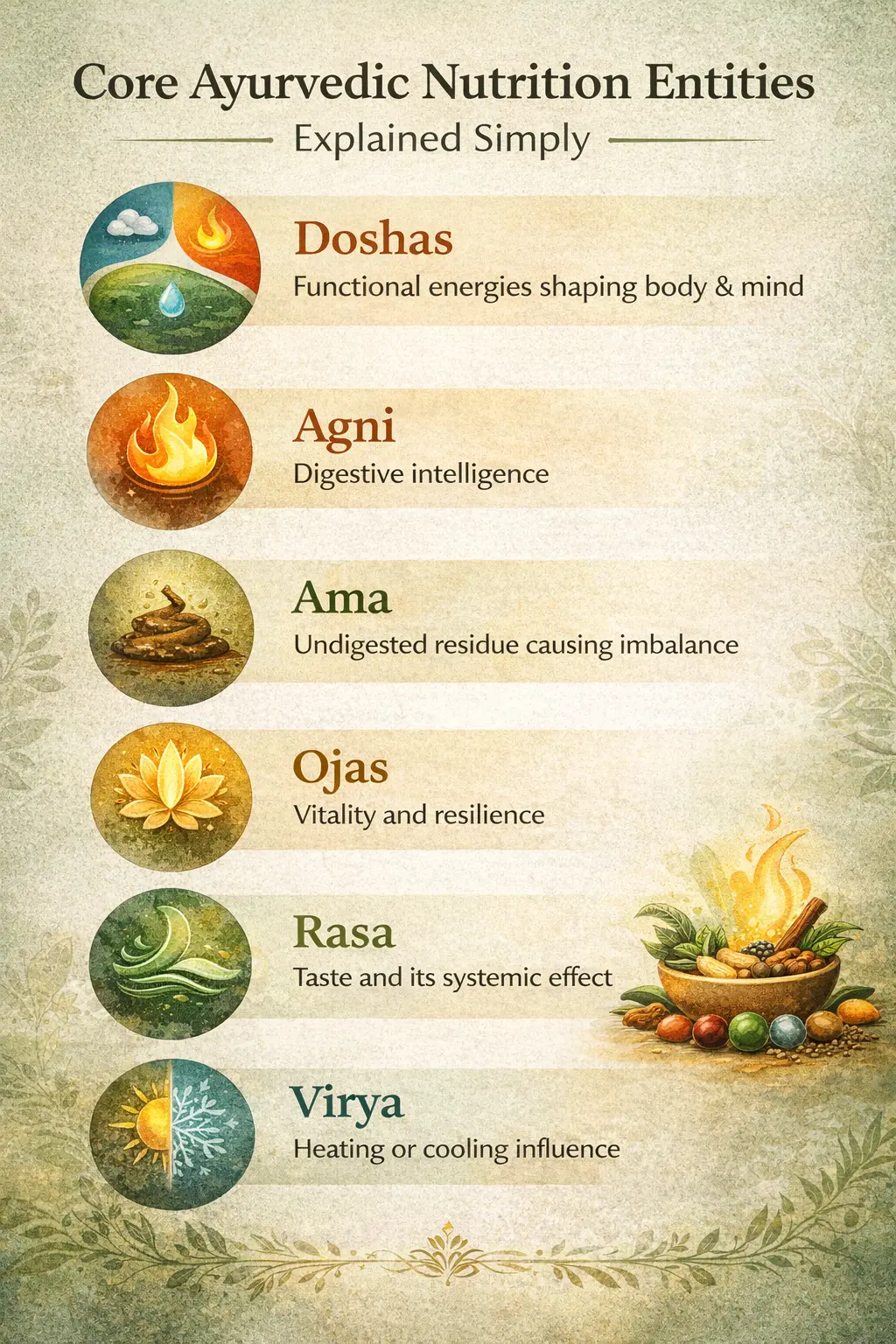
Core Ayurvedic Nutrition Entities (Explained Simply)
| Concept | What It Really Means |
|---|---|
| Doshas | Functional energies shaping body & mind |
| Agni | Digestive intelligence |
| Ama | Undigested residue causing imbalance |
| Ojas | Vitality and resilience |
| Rasa | Taste and its systemic effect |
| Virya | Heating or cooling influence |
An Ayurvedic Nutrition Course doesn’t expect you to memorize Sanskrit terms. It helps you recognize these principles in daily life — in your appetite, energy, and digestion.
So, What Exactly Is an Ayurvedic Nutrition Course?
Let’s be very clear here.
An Ayurvedic Nutrition Course is not about rigid food lists or extreme rules. It is a structured learning journey that teaches you how to make intelligent food choices based on your body, digestion, and lifestyle.
It helps you learn:
- How to assess constitution and imbalance
- How to support digestion before changing food
- How to adjust meals seasonally
- How to eat in a way that feels sustainable
This is why many people say Ayurveda feels less like a diet and more like coming home to the body.
How Learning Actually Happens in an Ayurvedic Nutrition Course
Step 1: Understanding the Individual (Not the Trend)
The first thing students learn is that no food is universally good or bad.
You begin by understanding:
- Vata, Pitta, Kapha patterns
- How imbalance shows up
- Why your digestion behaves the way it does
This alone brings enormous clarity.
Step 2: Digestive Strength Comes Before Diet Rules
Ayurveda teaches that digestion is more important than food quality.
You learn to identify:
- Strong, weak, irregular digestion
- Signs of toxin buildup (Ama)
- How stress directly affects Agni
Many people notice improvements just by applying this lens.
Step 3: Food Energetics (Why Temperature & Texture Matter)
Ayurveda asks questions modern nutrition rarely does:
- Is the food heating or cooling?
- Is it heavy or light?
- Is it moist or dry?
These qualities affect how food is processed internally.
Step 4: Taste Balance and Cravings
Cravings are not moral failures in Ayurveda. They are signals of imbalance.
Students learn:
- The six tastes and their effects
- Why excess sweet increases heaviness
- Why excess pungent increases heat
This shifts the relationship with food from control to understanding.
Step 5: Meal Timing and Daily Rhythm
Ayurveda aligns eating with the sun.
You learn:
- Why lunch is central
- Why late dinners weaken digestion
- Why skipping meals disturbs Vata
These changes are gentle but powerful.
Step 6: Seasonal Eating (Ritucharya)
What nourishes you in winter may exhaust you in summer.
Seasonal nutrition is one of Ayurveda’s greatest gifts — and a core part of every serious Ayurvedic nutrition education.
A Simple Dosha-Based Nutrition Framework
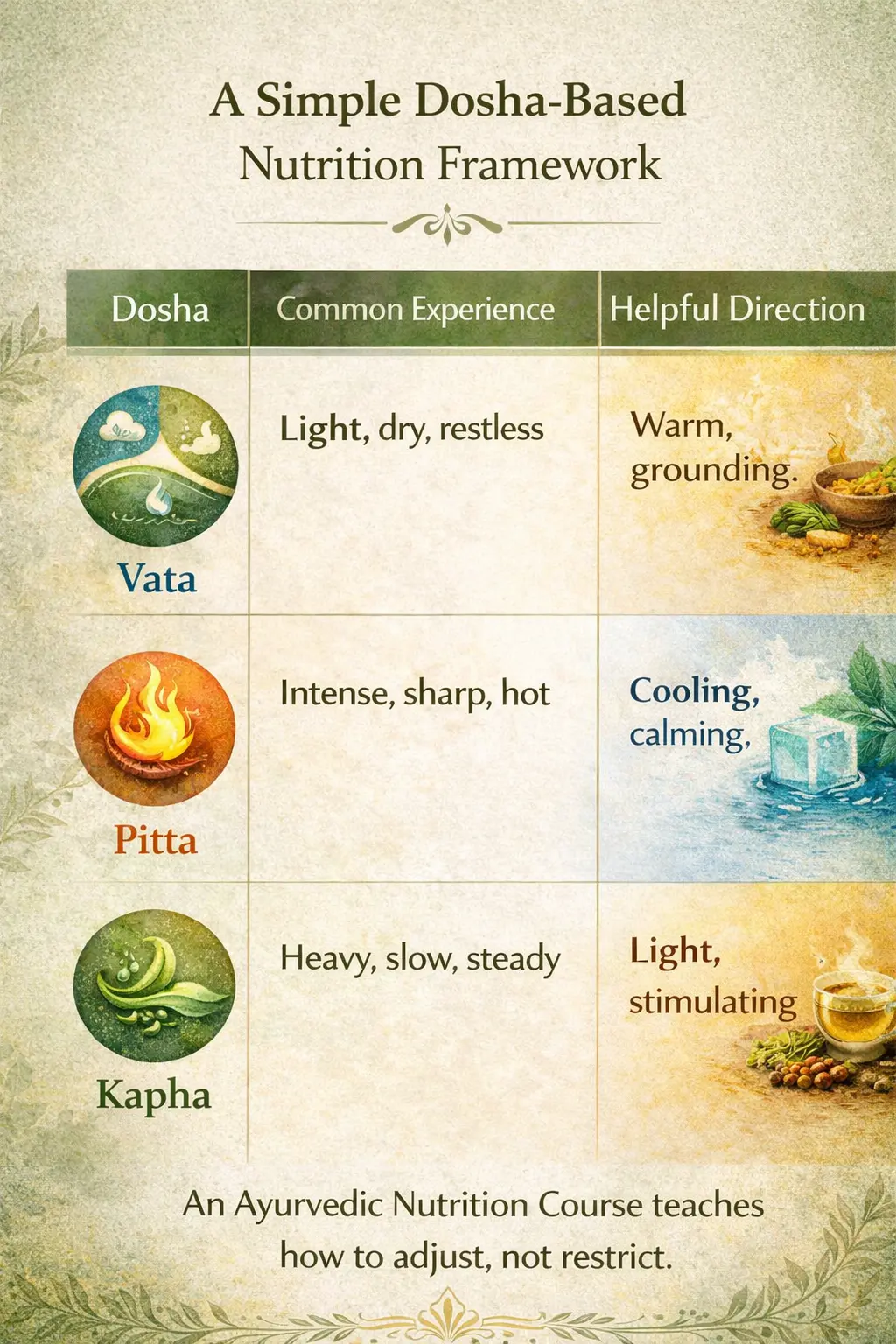
| Dosha | Common Experience | Helpful Direction |
|---|---|---|
| Vata | Light, dry, restless | Warm, grounding |
| Pitta | Intense, sharp, hot | Cooling, calming |
| Kapha | Heavy, slow, steady | Light, stimulating |
An Ayurvedic Nutrition Course teaches how to adjust, not restrict.
Food First, Herbs Second
Ayurveda always corrects diet before reaching for herbs.
Students learn about:
- Digestive spices
- Gentle detox supports
- When herbs are unnecessary
This prevents dependency and misuse.
Practitioner Insight:
In clinical and educational settings, digestive complaints are rarely caused by food alone.
They emerge from timing, stress, sleep, and mismatch between diet and constitution. This is
why Ayurvedic nutrition education focuses on restoring digestive intelligence before making
dietary changes.
Who Should (and Should Not) Study Ayurvedic Nutrition
An Ayurvedic Nutrition Course is not designed to offer quick fixes or universal answers. It is best suited for individuals who are willing to observe, reflect, and work with their body rather than override it.
This type of learning is especially valuable for people who feel that conventional dietary advice has not fully addressed their digestive or lifestyle-related concerns. It appeals to those who are curious about understanding why their body reacts differently to food across seasons, stress levels, and life stages.
At the same time, Ayurvedic nutrition may feel challenging for those who expect rigid meal plans, calorie-based rules, or immediate results without changes in routine. Ayurveda works gradually, emphasizing consistency, awareness, and alignment over control or restriction.
Beginner Learners vs Professional Aspirants
Ayurvedic nutrition education naturally attracts two broad groups of learners. The first includes individuals seeking personal health understanding—people who want to improve digestion, energy, and their relationship with food without necessarily pursuing a professional path.
The second group includes yoga teachers, wellness practitioners, health coaches, and caregivers who wish to integrate Ayurvedic principles into their existing work. For these learners, the course provides a conceptual framework that enhances credibility and depth rather than replacing their primary discipline.
A well-structured Ayurvedic Nutrition Course allows both groups to progress at an appropriate pace, building confidence before moving toward more advanced or certification-based learning.
Online vs In-Person Learning in the Modern Context
In today’s world, Ayurvedic nutrition is increasingly taught through online platforms, making education accessible beyond geographic boundaries. Online learning works particularly well for theoretical understanding, observation-based practices, and reflective assignments.
In-person programs, when available, offer added value through direct interaction, practical demonstrations, and experiential learning. However, they are no longer the only credible path to understanding Ayurveda.
The effectiveness of either format depends less on delivery mode and more on the clarity of instruction, structure of the curriculum, and emphasis on practical application in daily life.
Compatibility with Modern Health Understanding
Ayurvedic nutrition does not require rejecting modern science or medical care. Instead, it offers a complementary perspective focused on digestion, lifestyle rhythm, and individualized response to food.
Many learners find that Ayurvedic principles align naturally with modern discussions around gut health, circadian rhythm, stress regulation, and lifestyle medicine—without reducing health to numbers alone.
This balanced positioning is one reason Ayurvedic nutrition continues to remain relevant in contemporary wellness education.
Lifestyle: Because Food Doesn’t Work in Isolation
Nutrition only works when life supports digestion.
Courses integrate:
- Sleep timing
- Stress regulation
- Gentle movement
- Mindful eating
Ayurveda is practical because it is holistic.
A Real-Life Case Example (Urban Indian Context)
A 34-year-old professional working long hours, eating late dinners, relying on salads and coffee.
After learning basic Ayurvedic nutrition principles:
- Lunch became the main meal
- Dinners became lighter
- Raw foods were reduced
- Digestion improved within weeks
This is not magic. It is alignment.
Common Mistakes People Make Without Proper Learning
- Copying dosha diets blindly
- Over-detoxing
- Ignoring digestion
- Mixing advice without context
A structured Ayurvedic Nutrition Course protects learners from these pitfalls.
Where Certification Fits (Without Confusion)
An Ayurvedic Nutrition Course builds understanding.
Certification builds professional recognition.
Many learners naturally move toward certification once they feel confident and grounded in the basics.
Why This Knowledge Feels Especially Relevant in 2025
In a time of AI meal plans and data overload, Ayurveda offers something rare: discernment.
It teaches you to trust signals over trends.
This is why interest in Ayurvedic nutrition education continues to deepen globally.
Frequently Asked Questions (FAQs)
Is Ayurvedic nutrition considered safe and reliable?
Ayurvedic nutrition focuses on personalized diet, digestion, and lifestyle alignment rather than aggressive interventions. When taught responsibly and applied thoughtfully, it is considered a gentle and sustainable system of health education rather than a replacement for medical care.
Can Ayurvedic nutrition be combined with modern medicine?
Yes. Ayurvedic nutrition education emphasizes compatibility rather than opposition. Many people use Ayurvedic dietary principles alongside modern healthcare to support digestion, recovery, and overall well-being.
What topics are covered in an Ayurvedic nutrition course?
An Ayurvedic nutrition course typically covers the foundations of both Ayurveda and dietetics. This includes understanding doshas (Vata, Pitta, Kapha), digestive fire (Agni), food qualities, food combinations, meal timing, and seasonal eating. Most programs also teach practical meal planning and how to integrate nutrition with daily lifestyle habits, rather than treating food in isolation.
Is an Ayurvedic nutrition course worth it for a career in wellness?
Yes, for many people it is. An Ayurvedic nutrition course can open pathways into wellness careers such as Ayurvedic nutrition consulting, holistic health coaching, wellness retreat support, clinic assistance, and educational roles. It is especially valuable for yoga teachers, wellness practitioners, and health coaches who want to add depth and credibility to their work.
What is the difference between an Ayurvedic nutrition course and certification?
An Ayurvedic nutrition course focuses on teaching knowledge and practical skills—how to understand digestion, food energetics, and individualized diet planning. Certification, on the other hand, serves as formal recognition of that learning. It is often required or preferred for client-facing roles, professional practice, or teaching Ayurveda in an official capacity.
How long does an Ayurvedic nutrition course take to complete?
The duration varies depending on the format and depth of the program. Some introductory online courses may take only a few weeks or dozens of learning hours, while more comprehensive diploma or blended programs can span several months. Advanced programs usually involve both theoretical study and applied practice.
Can Ayurvedic nutrition be studied online?
Yes. Many reputed institutions now offer Ayurvedic nutrition courses online. These programs usually include structured lessons, recorded or live classes, assignments, and sometimes supervised practical components. Online learning makes Ayurvedic education accessible globally while still maintaining academic and practical rigor.
Do you need prior knowledge of Ayurveda to join a nutrition course?
Most beginner-level Ayurvedic nutrition courses do not require prior experience in Ayurveda. They are designed to introduce core concepts from the ground up. However, advanced or professional certification programs may expect learners to have basic familiarity with Ayurvedic principles or prior training.
What career options are available after completing an Ayurvedic nutrition course?
After completing an Ayurvedic nutrition course, learners may work as Ayurvedic nutrition consultants, wellness coaches, clinic support professionals, holistic lifestyle advisors, educators, or content creators in the health and wellness space. Many also use the knowledge to complement existing careers in yoga, fitness, healthcare, or culinary education.
Final Reflection: Food as a Relationship, Not a Rulebook
An Ayurvedic Nutrition Course doesn’t tell you what to eat forever. It teaches you how to listen — to digestion, to seasons, to your own rhythms.
And once you learn that language, food stops feeling confusing.
It starts feeling supportive again.
Whether you are exploring Ayurveda for personal health or professional growth, a structured learning approach ensures clarity, safety, and long-term understanding.
Explore Ayurvedic Nutrition in Depth
This guide is part of our broader Ayurvedic nutrition knowledge ecosystem. If you’d like to deepen your understanding or pursue structured learning, explore the resources below.


You may also like

What Is Agni- Complete Guide to Digestive Fire in Ayurveda