Ayurveda for Acidity: Natural Relief That Works
🌿 Ayurveda for Acidity: A Complete & Evidence-Based Guide to Soothing Digestive Fire Naturally (Part 1)
📌 Discover how ancient Ayurvedic wisdom and modern digestive science converge to heal acidity, heartburn, and acid reflux at the root — by rebalancing your Agni (digestive fire), calming Pitta heat, and restoring the body’s internal rhythm.
Introduction: Why Acidity Is So Common — Yet Deeply Misunderstood
That familiar burn in your chest after meals — or the sour taste that creeps up your throat at midnight — isn’t just about “too much acid.” It’s your body signaling imbalance.
In modern terms, acidity is a gut regulation problem, not merely a chemical one. Your stomach acid may be excessive or misplaced — due to LES (lower esophageal sphincter) relaxation, delayed gastric emptying, or stress-induced motility issues.
In Ayurvedic language, these imbalances stem from disturbed Agni (digestive fire), aggravated Pitta (heat), and blocked Ama (metabolic residue).
While antacids silence symptoms, Ayurveda works deeper — retraining your digestion, rhythm, and resilience.
In this article, you’ll learn:
- ✅ Ayurvedic and medical causes of acidity
- ✅ How herbs work both biologically and energetically
- ✅ Daily diet and lifestyle that balance Agni
- ✅ A 7-day healing framework rooted in science and tradition
What Exactly Is Acidity? The Two Perspectives
1. Biomedical Explanation
Acidity, or Gastroesophageal Reflux Disease (GERD), occurs when acidic contents from the stomach flow back into the esophagus. This happens because the lower esophageal sphincter (LES) — a muscular valve that should close after eating — becomes weak or relaxes at the wrong time.
As acid escapes upward, the esophageal lining, which lacks protective mucus, becomes irritated — producing burning pain, throat irritation, belching, or cough.
Key physiological drivers:
- • LES weakness (stress, obesity, overeating)
- • Delayed gastric emptying
- • Increased acid secretion
- • Hiatal hernia or inflammation
- • Poor meal timing
Modern medicine uses proton pump inhibitors (PPIs) to block acid, but long-term use may cause side effects like B12 deficiency, rebound acidity, and gut microbiome disruption.
2. Ayurvedic Interpretation (Amlapitta)
In Ayurveda, acidity aligns with Amlapitta — “acidic Pitta rising upward.” It begins with erratic Agni:
- • Too sharp (Tikshnagni) = excessive acid
- • Too weak (Mandagni) = fermentation and gas
- • Unstable (Vishamagni) = alternating acidity and bloating
When digestion becomes irregular, Ama (toxins) accumulate and irritate the gastric channels. The result? Pitta’s heat burns upward — mirroring reflux and heartburn.
Ayurveda views acidity not as an isolated disease, but as a systemic imbalance of heat, motion, and metabolism.
Symptoms of Acidity (Cross-Mapped View)
Burning in chest
Ayurvedic Explanation: Excess Pitta
Modern Correlation: Heartburn / GERD
Sour taste or burps
Ayurvedic Explanation: Ama with heat
Modern Correlation: Acid reflux
Heaviness & lethargy
Ayurvedic Explanation: Weak Agni
Modern Correlation: Slow digestion
Nausea
Ayurvedic Explanation: Pitta aggravation
Modern Correlation: Gastric irritation
Dry mouth or thirst
Ayurvedic Explanation: Internal heat
Modern Correlation: Dehydration from acid imbalance
Bloating
Ayurvedic Explanation: Vata irregularity
Modern Correlation: Gas / Dyspepsia
| Symptom | Ayurvedic Explanation | Modern Correlation |
|---|---|---|
| Burning in chest | Excess Pitta | Heartburn / GERD |
| Sour taste or burps | Ama with heat | Acid reflux |
| Heaviness & lethargy | Weak Agni | Slow digestion |
| Nausea | Pitta aggravation | Gastric irritation |
| Dry mouth or thirst | Internal heat | Dehydration from acid imbalance |
| Bloating | Vata irregularity | Gas / Dyspepsia |
Both systems agree: digestion becomes inefficient, leading to backflow, irritation, and discomfort.
Core Causes of Acidity
Ayurvedic Triggers
- • Skipping meals or eating irregularly
- • Heavy, spicy, or oily foods
- • Late-night eating or sleeping immediately after dinner
- • Excess caffeine, alcohol, or tobacco
- • Stress, anger, and suppressed natural urges
Scientific Correlates
- • Relaxed LES due to high-fat meals or stress
- • Overeating stretching the stomach
- • Increased intra-abdominal pressure (tight clothing, obesity)
- • Delayed gastric emptying due to poor motility
- • Chronic inflammation (gastritis, H. pylori infection)
Ayurveda’s Agni–Pitta–Ama triangle perfectly parallels modern acid secretion–LES–motility physiology.
If you’re exploring how digestive balance connects to your overall vitality, it helps to remember that acidity is only one reflection of systemic imbalance. In Ayurveda, every health issue — from migraines to skin inflammation — often begins with disturbed digestion and faulty Agni (metabolic fire).
To understand this broader connection between gut fire and full-body wellness, you can explore our Ayurveda for Health Issues — Complete Guide , which explains how ancient principles of dosha balance and detoxification apply to modern conditions like stress fatigue, hormonal imbalance, and chronic inflammation. It’s a perfect starting point if you want to go beyond symptom management and create true inner equilibrium.
Ayurvedic View: Agni, Doshas & Balance
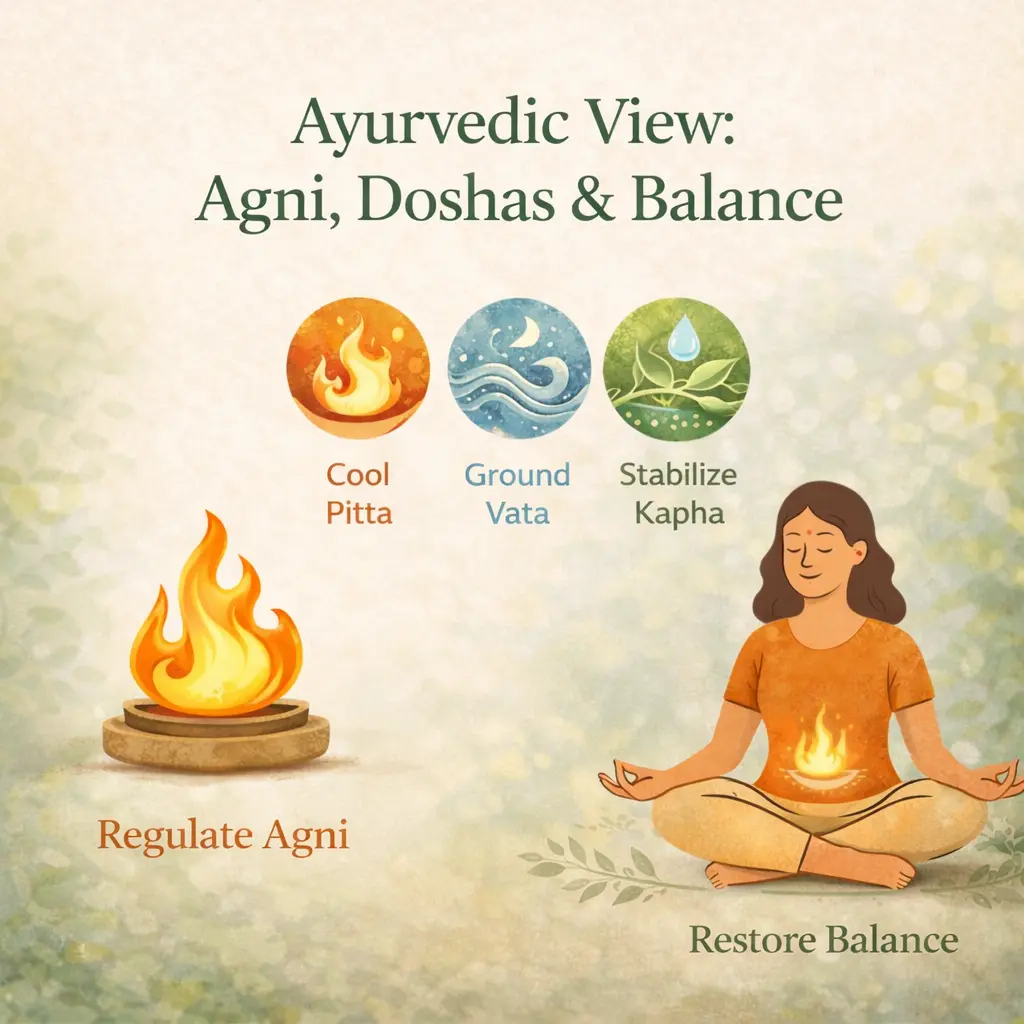
Agni — the digestive flame — represents metabolism itself. Its balance determines vitality.
- • When Pitta dominates, digestion overheats → burning, reflux, irritability.
- • When Vata disturbs rhythm → gas, erratic acid release, bloating.
- • When Kapha stagnates → heaviness, mucus, delayed emptying.
Therefore, Ayurveda for Acidity focuses on:
- 🔥 Regulating Agni (not suppressing it)
- 💧 Cooling Pitta through herbs and foods
- 🌬️ Grounding Vata with routine and calm
This restores Samagni — steady, intelligent digestion.
Clinical Evidence for Ayurvedic Herbs

1. Licorice (Yashtimadhu)
Licorice contains bioactives that soothe mucosa and increase mucus secretion.
A 2023 clinical trial (PMC11892464) found that GutGard® licorice extract reduced heartburn and regurgitation by over 50% within two weeks — proving its esophageal protective action.
Ayurvedic perspective: Yashtimadhu cools Pitta, heals ulcers (vrana-ropana), and nourishes tissues.
2. Triphala (Amalaki, Haritaki, Bibhitaki)
A polyherbal blend known for regulating bowel rhythm and reducing inflammation.
Studies (PMC5567597) confirm its antioxidant and gastroprotective effects, reducing gastric acid and promoting motility — exactly what reflux needs.
Ayurvedic lens: balances all three doshas, removes Ama, and strengthens Agni gently.
3. Amla (Indian Gooseberry)
Rich in Vitamin C and polyphenols, Amla acts as a natural antacid and antioxidant.
A placebo-controlled trial (PubMed 29526236) showed Amla significantly reduced reflux symptoms and improved esophageal comfort in non-erosive reflux disease (NERD).
In Ayurvedic terms, it is Pitta-shamaka — cooling, rejuvenating, and stabilizing.
4. Avipattikar Churna
A classical digestive blend combining Triphala, Trikatu, and sugar base, known for neutralizing acid without harming Agni.
It regulates acid secretion while improving gut motility, making it one of Ayurveda’s safest long-term formulations.
While acidity is one of the most common digestive complaints, it rarely exists in isolation. Many people also experience bloating, constipation, or irregular hunger — signs that deeper gut balance needs attention. Ayurveda teaches that true healing begins when Agni (digestive fire) becomes stable, not too sharp or too weak.
If you want to learn how to build long-term gut strength using food rhythms, herbs, and daily routines, read the author’s comprehensive view Ayurveda for Digestive Issues and Gut Health — a detailed resource that explores microbiome balance, Ama detoxification, and mindful eating through an Ayurvedic lens.
Modern Mechanisms Behind Ayurvedic Efficacy
Pitta excess (heat)
Ayurvedic Concept
Modern Physiological Mechanism: Excess gastric acid secretion
Weak Agni
Ayurvedic Concept
Modern Physiological Mechanism: Impaired motility / delayed emptying
Ama accumulation
Ayurvedic Concept
Modern Physiological Mechanism: Inflammation, free radical stress
LES weakness (Vata imbalance)
Ayurvedic Concept
Modern Physiological Mechanism: Nerve/muscle dysfunction
Pitta-Vata harmony
Ayurvedic Concept
Modern Physiological Mechanism: Stable acid output and LES tone
| Ayurvedic Concept | Modern Physiological Mechanism |
|---|---|
| Pitta excess (heat) | Excess gastric acid secretion |
| Weak Agni | Impaired motility / delayed emptying |
| Ama accumulation | Inflammation, free radical stress |
| LES weakness (Vata imbalance) | Nerve/muscle dysfunction |
| Pitta-Vata harmony | Stable acid output and LES tone |
Scientific evidence now validates what Ayurveda has long observed — herbs like Licorice, Amla, and Triphala improve LES integrity, reduce inflammation, and protect mucosa.
Ayurvedic Daily Routine (Dinacharya) for Acidity Relief
Morning:
- • Warm water with lemon or rock salt — mild Agni activator.
- • Aloe or Amla juice for cooling Pitta.
- • Gentle yoga twists and pranayama for motility.
Before Meals:
- • Jeera (cumin) water or ginger slice with rock salt — awakens digestion.
- • 3–5 slow breaths before eating — activates the rest-and-digest mode.
During Meals:
- • Eat calmly, chew 25–30 times.
- • Avoid screens, stress, or arguments.
- • Prefer warm, fresh, lightly spiced food.
After Meals:
- • Sit in Vajrasana or walk 100 steps.
- • Sip fennel or licorice tea.
- • Avoid lying down for 2 hours post-meal.
The Gut–Brain Connection: Where Stress Meets Stomach
Modern research now confirms what Ayurveda has always taught — your emotions shape your digestion.
When you’re anxious or multitasking, the vagus nerve (which coordinates swallowing, peristalsis, and LES closure) misfires. This triggers:
- • Premature LES relaxation, letting acid creep upward
- • Slower gastric emptying
- • Over-perception of “burning” even with normal acid levels
In Ayurvedic terms, this is Vata–Rajas aggravation: restless motion disturbing Pitta’s fire.
The antidote is to anchor the nervous system — through stillness, routine, and nourishment.
Practical resets:
- 🕉 Morning breathwork (Nadi Shodhana) for five minutes
- 🧘♀️ Evening Abhyanga (oil massage with warm sesame oil) to ground Vata
- 🌿 Adaptogenic herbs like Ashwagandha and Brahmi to reduce cortisol
A 2022 meta-review in Frontiers in Neuroscience reported that vagal breathing and mindfulness reduced GERD episodes by improving LES reflexes — exactly what Ayurveda prescribes energetically.
Acid Regulation: From Cells to Doshas
Biomedical Perspective
Gastric acid is produced by parietal cells via the H⁺/K⁺-ATPase proton pump. Triggers include stress, coffee, and irregular eating, which increase gastrin and histamine release.
However, acid is essential for digestion — total suppression can impair protein absorption and gut flora.
Ayurvedic Correlation
When Pitta dosha overheats without Kapha’s cooling balance, acid becomes destructive instead of digestive.
Cooling herbs such as Amla, Licorice, and Guduchi reduce acid secretion naturally while healing the gastric lining.
Clinical studies ( PMC11892464 ) show licorice extract decreased GERD scores and improved mucosal integrity in as little as two weeks.
The 7-Day Ayurvedic Reset Plan for Acidity

A structured one-week routine to retrain your digestive rhythm and LES function — gentle, cooling, and realistic for modern life.
Day 1
Morning Reset: Warm cumin water + 5 deep breaths
Meals & Herbs: Rice–moong khichdi + Amla juice
Evening Routine: Triphala in warm water before bed
Day 2
Morning Reset: Aloe vera juice + gentle walk
Meals & Herbs: Steamed veggies + Jeera buttermilk
Evening Routine: Fennel tea + Abhyanga
Day 3
Morning Reset: Abdominal self-massage
Meals & Herbs: Moong soup + Licorice tea
Evening Routine: 10 min breath awareness
Day 4
Morning Reset: Amla juice + gratitude journaling
Meals & Herbs: Oats porridge + ghee
Evening Routine: Early dinner before 8 PM
Day 5
Morning Reset: Lemon-salt warm water
Meals & Herbs: Khichdi + Papaya dessert
Evening Routine: Restorative yoga
Day 6
Morning Reset: 20 min walk after sunrise
Meals & Herbs: Light vegetarian meal
Evening Routine: Chamomile infusion
Day 7
Morning Reset: Semi-fast on fruits or soups
Meals & Herbs: Coconut water + Amla tonic
Evening Routine: Journaling + sleep by 10 PM
| Day | Morning Reset | Meals & Herbs | Evening Routine |
|---|---|---|---|
| 1 | Warm cumin water + 5 deep breaths | Rice–moong khichdi + Amla juice | Triphala in warm water before bed |
| 2 | Aloe vera juice + gentle walk | Steamed veggies + Jeera buttermilk | Fennel tea + Abhyanga |
| 3 | Abdominal self-massage | Moong soup + Licorice tea | 10 min breath awareness |
| 4 | Amla juice + gratitude journaling | Oats porridge + ghee | Early dinner before 8 PM |
| 5 | Lemon-salt warm water | Khichdi + Papaya dessert | Restorative yoga |
| 6 | 20 min walk after sunrise | Light vegetarian meal | Chamomile infusion |
| 7 | Semi-fast on fruits or soups | Coconut water + Amla tonic | Journaling + sleep by 10 PM |
💡 By Day 7, most people report lighter digestion, less bloating, and reduced burning sensation.
Synergy of Herbs and Physiology
Triphala
Ayurvedic Function: Regulates Agni + removes Ama
Scientific Action: Improves motility and antioxidant defense
Amla
Ayurvedic Function: Cools Pitta and rejuvenates
Scientific Action: Decreases acid output and oxidative stress
Licorice
Ayurvedic Function: Heals mucosa (Vrana-ropana)
Scientific Action: Boosts mucus layer and LES stability
Shatavari
Ayurvedic Function: Nourishes tissues, balances hormones
Scientific Action: Reduces stress and inflammatory markers
Jeera (Cumin)
Ayurvedic Function: Enhances Agni without heat
Scientific Action: Stimulates enzymes and bile flow
Fennel
Ayurvedic Function: Sweet coolant
Scientific Action: Relieves gas and neutralizes acid
| Herb | Ayurvedic Function | Scientific Action |
|---|---|---|
| Triphala | Regulates Agni + removes Ama | Improves motility and antioxidant defense |
| Amla | Cools Pitta and rejuvenates | Decreases acid output and oxidative stress |
| Licorice | Heals mucosa (Vrana-ropana) | Boosts mucus layer and LES stability |
| Shatavari | Nourishes tissues, balances hormones | Reduces stress and inflammatory markers |
| Jeera (Cumin) | Enhances Agni without heat | Stimulates enzymes and bile flow |
| Fennel | Sweet coolant | Relieves gas and neutralizes acid |
Together, these herbs retrain digestion: acid production becomes intelligent, LES closure improves, and tissue inflammation subsides.
Mindful Eating: Science of Stillness
Ayurveda’s ancient guideline — “Eat with awareness, not distraction” — now has neuroscientific proof.
When you eat while scrolling or arguing, the sympathetic nervous system stays active:
- • Blood flow to the gut drops by 40%
- • LES tone weakens
- • Acid production remains elevated
By chewing slowly and engaging the senses, you activate the parasympathetic (rest-digest) mode. This enhances enzyme release, gastric motility, and nutrient absorption.
Practical mindful eating steps:
- 1️⃣ Take three deep breaths before food.
- 2️⃣ Eat in silence or with soft music.
- 3️⃣ Stop at 80% fullness (Hrid Pariyantam Bhojanam).
- 4️⃣ Sit calmly for 5 minutes post-meal.
A 2021 Harvard Health study found mindful eating reduced reflux symptoms in over 60% of participants — mirroring Ayurvedic principles.
Lifestyle Adjustments to Sustain Results
- • Sleep Schedule: Go to bed by 10 PM to sync with Pitta’s nighttime cooling phase.
- • Posture: Avoid slouching after meals; sit upright for 15 minutes.
- • Clothing: Wear loose waistbands to reduce abdominal pressure.
- • Hydration: Sip warm water throughout the day; avoid ice-cold drinks.
- • Stress Hygiene: Schedule “pause moments” every 3 hours to reset breath and mind.
Advanced Integration: Ayurveda + Modern Mechanisms
LES Tone
Ayurvedic Approach: Vata grounding, stress reduction
Modern Outcome: Improved valve function
Gastric Motility
Ayurvedic Approach: Balanced Agni through Triphala
Modern Outcome: Faster emptying, less reflux
Acid Secretion
Ayurvedic Approach: Pitta cooling via Amla + Licorice
Modern Outcome: Optimal pH and reduced burn
Mucosal Barrier
Ayurvedic Approach: Rasayana support (Licorice, Shatavari)
Modern Outcome: Stronger esophageal lining
Gut–Brain Axis
Ayurvedic Approach: Meditation, breathwork
Modern Outcome: Lower cortisol, fewer episodes
| Systemic Focus | Ayurvedic Approach | Modern Outcome |
|---|---|---|
| LES Tone | Vata grounding, stress reduction | Improved valve function |
| Gastric Motility | Balanced Agni through Triphala | Faster emptying, less reflux |
| Acid Secretion | Pitta cooling via Amla + Licorice | Optimal pH and reduced burn |
| Mucosal Barrier | Rasayana support (Licorice, Shatavari) | Stronger esophageal lining |
| Gut–Brain Axis | Meditation, breathwork | Lower cortisol, fewer episodes |
Case Reflection: Rohan’s Transformation
Rohan, a 35-year-old software developer from Mumbai, experienced daily heartburn despite using antacids.
An Ayurvedic consultation revealed irregular meals and late-night work as triggers. After a month on the protocol — Triphala at night, Amla in the morning, and fixed meal times — his reflux reduced by 80%.
He now uses no antacids and has better sleep and energy.
This illustrates Ayurveda’s core promise: restoring rhythm restores health.
FAQs (Optimized for Google PAA + AI Engines)
It is a comprehensive system that restores digestive equilibrium by balancing Pitta, regulating Agni, and stabilizing gut motility and LES function.
For mild to moderate cases, yes. Clinical trials show Amla and Licorice provide comparable relief within 2–4 weeks. Severe GERD may need integrative care.
Avipattikar Churna (½ tsp in warm water after meals), Amla juice before breakfast, and Licorice tea are immediate soothers.
Stress alters vagal signaling, reducing LES control and slowing digestion — exactly what Ayurveda calls Vata–Rajas imbalance.
Most see improvement in 10–14 days; chronic cases stabilize in 6–8 weeks with routine practice.
Conclusion — Reigniting Fire with Wisdom
True healing from acidity is not about extinguishing the flame but guiding it.
Your Agni is meant to transform, not burn.
When you align diet, sleep, breath, and herbs with your natural rhythm, you regain control over both the biological acid cycle and the emotional fire within.
Ayurveda for Acidity invites you to shift from “suppression” to self-regulation — where modern science and ancient intuition converge.
Through consistent practice, the burn in your chest fades into warmth of balance, clarity, and calm.