Ayurveda for Stress & Anxiety: Complete Stress Relief Guide
Ayurveda for Stress: The Definitive Root-Cause Protocol That Modern Medicine Keeps Missing
Look, I’ll say what no wellness blog will.
If you’ve tried “stress relief” and still feel wired but tired every afternoon, scattered every morning, and vaguely overwhelmed by life even when nothing’s technically wrong—you don’t need another breathing app. You don’t need to hear about ashwagandha for the hundredth time. And you definitely don’t need someone telling you to “just relax” like that’s a helpful instruction.
You need someone to explain why your stress isn’t responding to the usual fixes.
Here’s the answer modern medicine won’t give you: Your stress isn’t a mind problem. It’s a tissue problem. Specifically, it’s a problem of depletion—your nervous system isn’t broken, it’s just running on empty. And until you rebuild what’s been drained, no amount of meditation, magnesium, or “me time” will fix the underlying mechanism.
Ayurveda for stress works differently. It doesn’t ask what relaxes you. It asks what’s exhausting your tissues at the cellular level. Then it rebuilds them. From the ground up. So that calm stops being something you chase and starts being something your body defaults to.
Let me show you how. (If you’re new to this ancient system entirely, our complete overview of natural Ayurvedic healing guide will give you the foundation before we dive deep into stress.)
The Modern Confusion: Why Everything You’ve Tried Only Worked Temporarily
I need you to forget everything you think you know about stress for about six minutes.
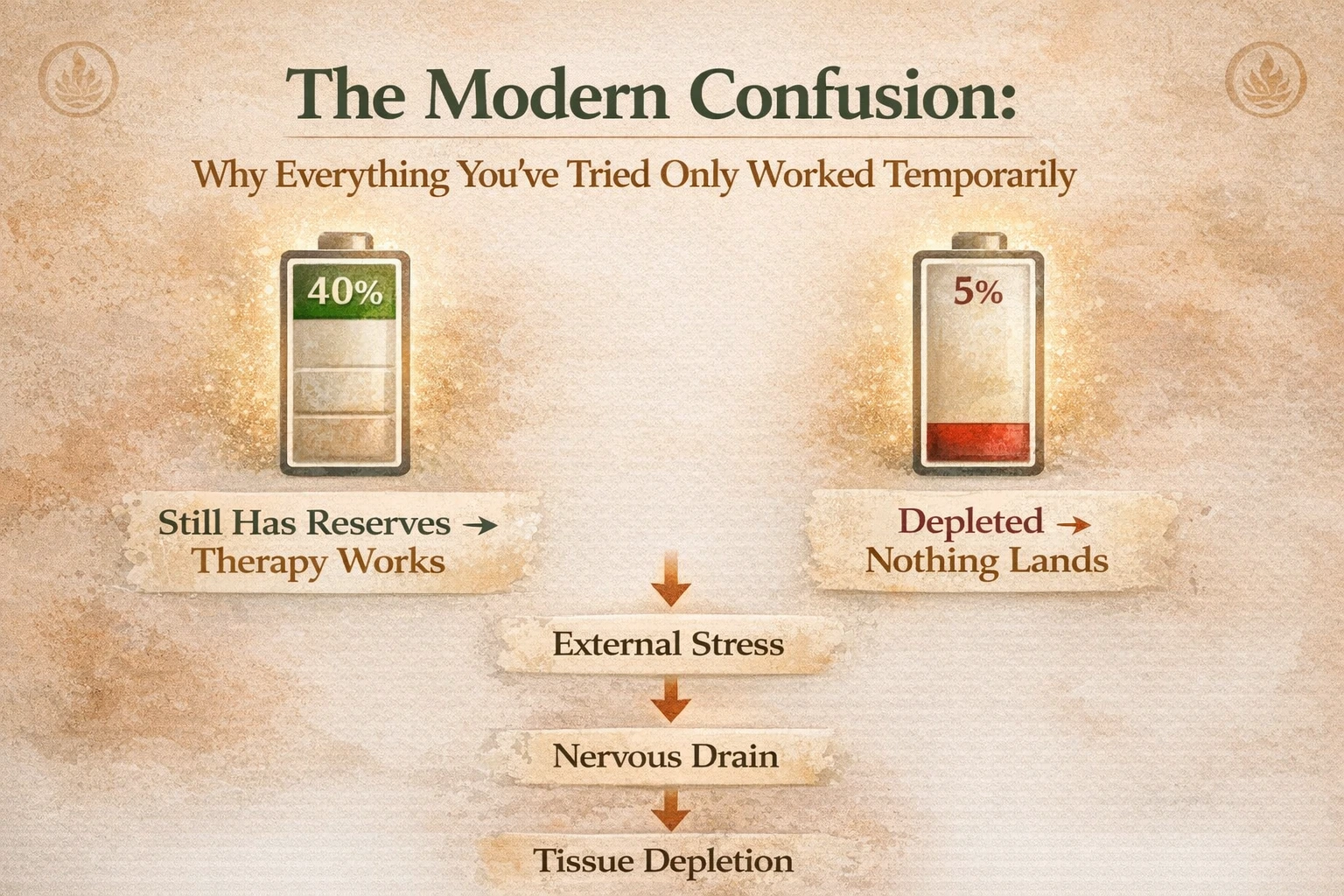
In the modern framework, stress is a response to external demands. Too much work. Too little sleep. Difficult relationships. Financial pressure. The solution, logically, is to reduce the demands or improve your response to them. Hence: therapy, exercise, boundaries, adaptogens.
This works—until it doesn’t.
It works when your body still has reserves. When your “stress battery” is at 40% and just needs a top-up. But when you’ve been running on empty for years—when your battery is at 5% and the charger seems broken—the standard advice stops landing. You know you should exercise, but you’re too tired. You know you should meditate, but sitting still makes your brain scream. You know you should eat well, but cooking feels like climbing Everest.
This isn’t laziness. This isn’t lack of discipline. This is depletion.
And here’s where Ayurveda enters the conversation differently.
The Ayurvedic Re-frame: Stress as a Tissue Problem
In Ayurveda, chronic stress isn’t classified primarily as a mental state. It’s classified as a state of Ojas depletion.
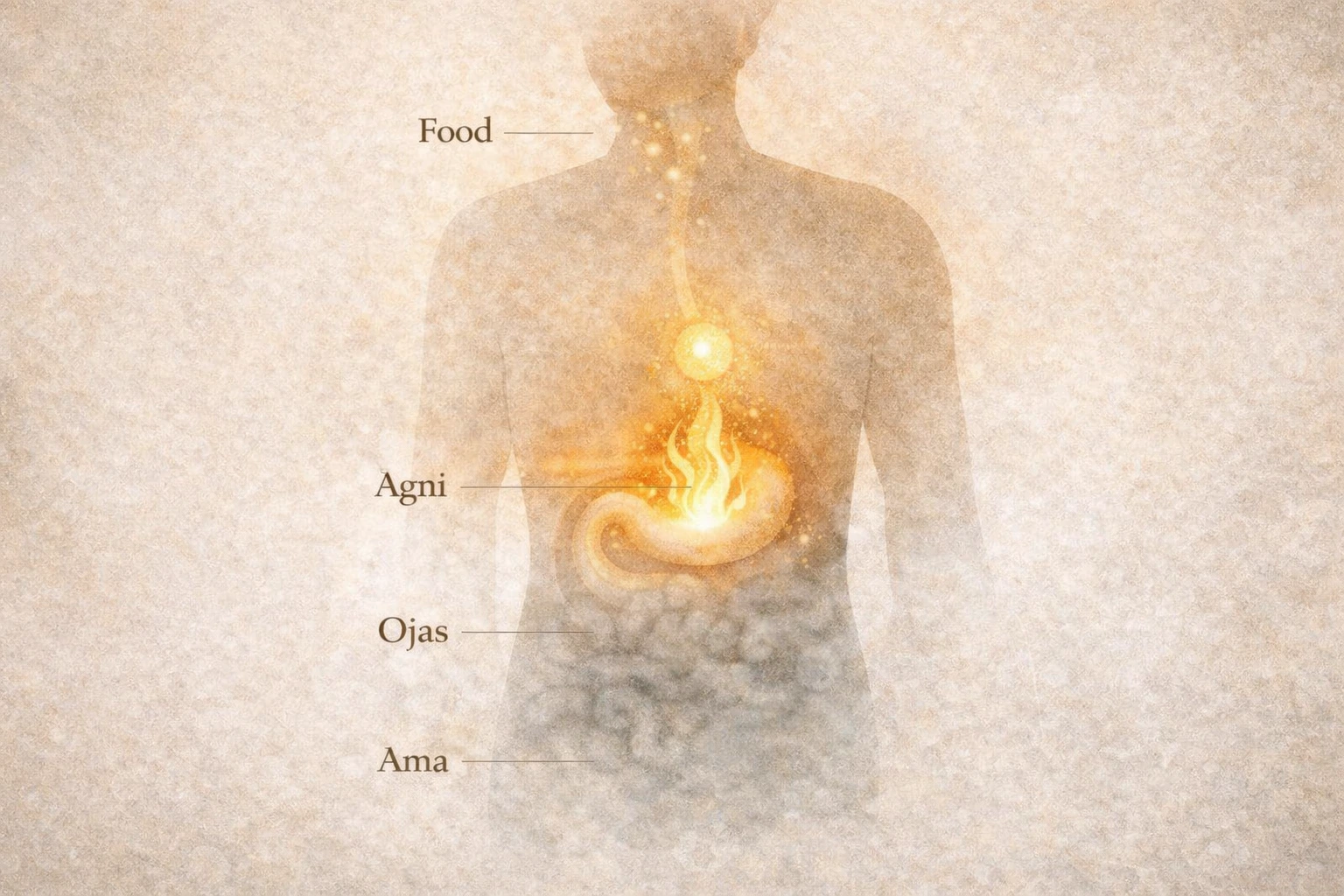
Ojas is your vital essence. The end product of perfect digestion. The substance that governs your immunity, your resilience, your ability to experience joy without effort, and your capacity to withstand life’s inevitable challenges without falling apart. In the classical texts, it’s described as the physical substrate of consciousness—the place where mind and body become one thing.
When Ojas is high, stress rolls off you. When Ojas is low, everything feels like too much.
For a complete exploration of this vital essence—including the 15 signs of depletion, the most nourishing Ojas-building foods, and how to assess your own vitality—read our Complete Guide to Ojas: The Science of Vital Essence →
And here’s what no one tells you: Ojas isn’t built by relaxing. It’s built by digestion. Specifically, the digestion of:
- Food (what you eat)
- Sensory input (what you see, hear, consume digitally)
- Experience (what you live through)
Your body takes these raw materials, processes them through your digestive fire (Agni), and—if the fire is strong—converts them into Ojas. If the fire is weak, those same inputs convert into Ama (toxin). And Ama circulating through your system creates inflammation, fog, and a low-grade sense of “wrongness” that feels exactly like chronic stress. (If terms like Ojas, Agni, and Ama are new to you, this breakdown of Ayurvedic fundamentals explains them in plain language.)
So here’s the uncomfortable truth:
If your digestion is weak, every input becomes stress. Healthy food you can’t break down? Stress. A conversation you can’t process? Stress. Information you can’t metabolize? Stress.
This is why Ayurveda for stress and anxiety always starts with the gut. Not because “gut health” is trendy, but because your gut is the factory where your stress resilience gets manufactured. No factory output, no resilience. No resilience, no lasting calm.
The Three Stress Personalities: Why Your Stress Isn’t Your Partner’s Stress
Before we talk solutions, we need to diagnose. Because Ayurveda for stress isn’t one-size-fits-all. The herb that saves your friend might aggravate you. The routine that centers your colleague might destabilize you.
In Ayurveda, stress expresses differently depending on your dominant dosha (constitution) and the dosha that’s currently aggravated. Here’s how to recognize yourself. (Curious about your constitution? Our dosha explanation page walks you through the three types so you can start spotting your patterns.)
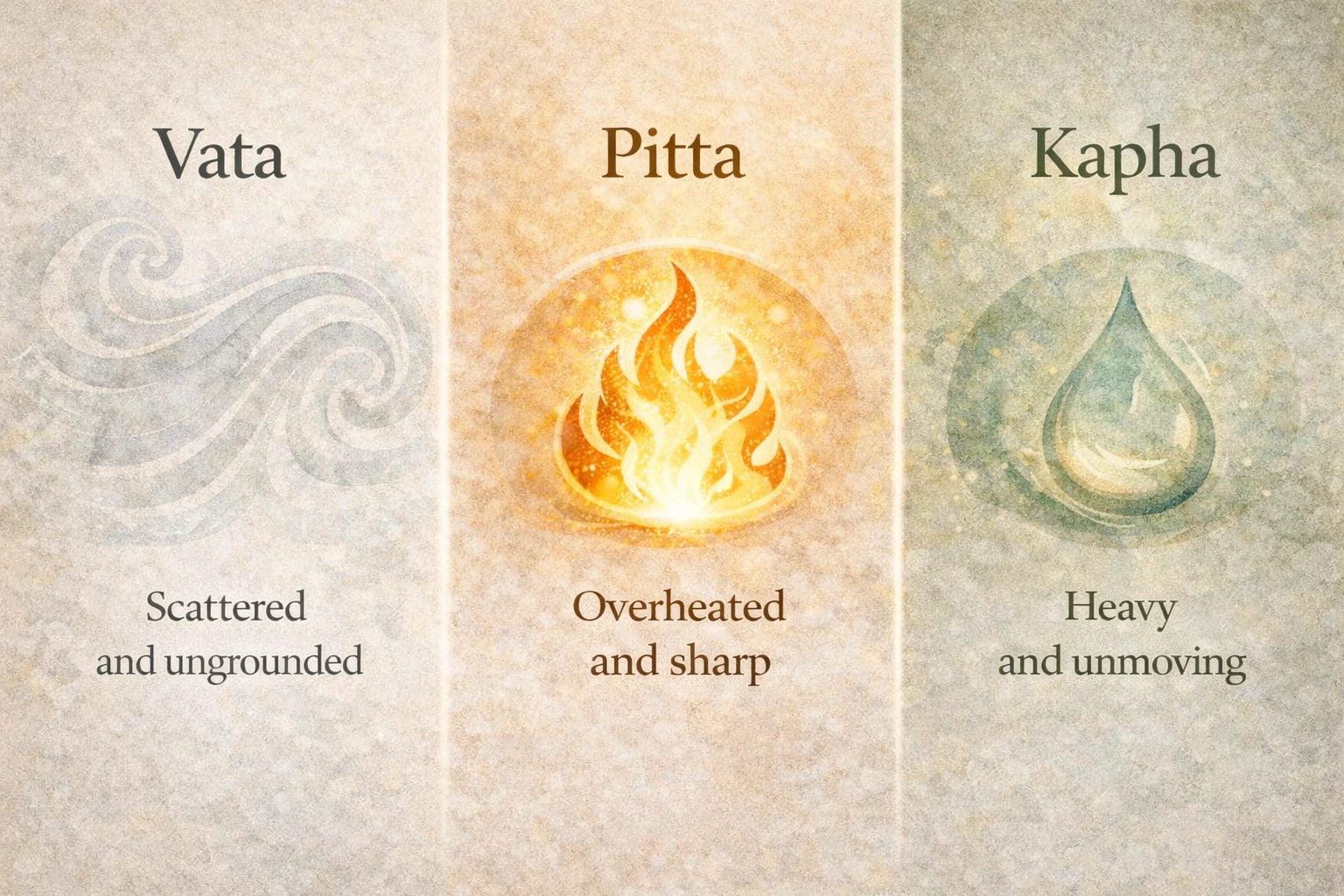
The Vata Stress Pattern
You know you’re here if: Your stress feels like chaos. Your mind races. You can’t focus. You forget things. You feel scattered, fearful, ungrounded. You might skip meals without noticing, then crash. Cold weather makes everything worse. You have trouble sleeping because your brain won’t shut off, even though your body is exhausted.
The mistake everyone makes: Someone tells you to “slow down” or “meditate.” You try. Sitting still makes the chaos louder. You conclude you’re bad at relaxing.
What’s actually happening: Your nervous system is running on fumes. Vata is air and ether—when aggravated, it creates space where there should be substance. You’re not anxious because you’re thinking too much. You’re anxious because your tissues lack the density to hold you steady.
The real fix (teaser): Warmth. Routine. Healthy fats. Root vegetables. Not “calming” herbs first—rebuilding herbs first. You need to put weight back on your bones before you ask your mind to quiet.
If anxiety, dryness, or nervous exhaustion feel familiar, read the comprehensive Vata stress restoration guide to understand how instability weakens Ojas over time.
The Pitta Stress Pattern
You know you’re here if: Your stress feels like fire. You’re irritable. Perfectionistic. Everything annoys you. You might yell at people, then feel guilty. You’re probably a high achiever who’s secretly angry that everyone else isn’t working as hard as you. Heat makes it worse—summer, spicy food, even heated conversations. You might have heartburn, skin rashes, or premature graying. (When stress shows up on your skin—rashes, breakouts, inflammation—it’s often Pitta-related. Our Ayurveda guide to skin conditions explores this connection more deeply.)
The mistake everyone makes: Someone suggests ashwagandha because “it’s good for stress.” You take it. You feel more agitated. You conclude herbs don’t work.
What’s actually happening: Pitta is fire and water—when aggravated, it overheats everything. Your intensity isn’t “passion,” it’s inflammation. And warming herbs like ashwagandha add fuel to a fire that needs cooling.
The real fix (teaser): Cooling. Bitters. Time in nature away from achievement. Sweet fruits. Herbs that cool the blood before they touch the mind.
For those experiencing irritability, intensity, or burnout, our Pitta stress pacification framework explains how excess heat depletes deeper vitality.
The Kapha Stress Pattern
You know you’re here if: Your stress feels like sludge. Heavy. Foggy. You’re not anxious—you’re numb. Getting out of bed feels hard. You might be gaining weight even though you’re not eating more. You oversleep but wake up tired. You feel stuck, unmotivated, like you’re watching life through dirty glass. (Weight that won’t budge despite your best efforts? Our approach to healthy Ayurvedic weight loss management addresses the Kapha stagnation pattern directly.)
The mistake everyone makes: Someone suggests self-care and rest. You rest more. You feel worse.
What’s actually happening: Kapha is earth and water—when aggravated, it stagnates. Your nervous system isn’t depleted, it’s congested. More rest deepens the congestion. You need movement, not more blankets.
The real fix (teaser): Stimulation. Warming spices. Fasting windows. Herbs that clear stagnation before they try to “ground” anything.
If you tend toward heaviness, lethargy, or emotional stagnation, explore how this pattern affects resilience in our Kapha imbalance and stress recovery guide .
The 4-Week Ojas Rebuilding Protocol
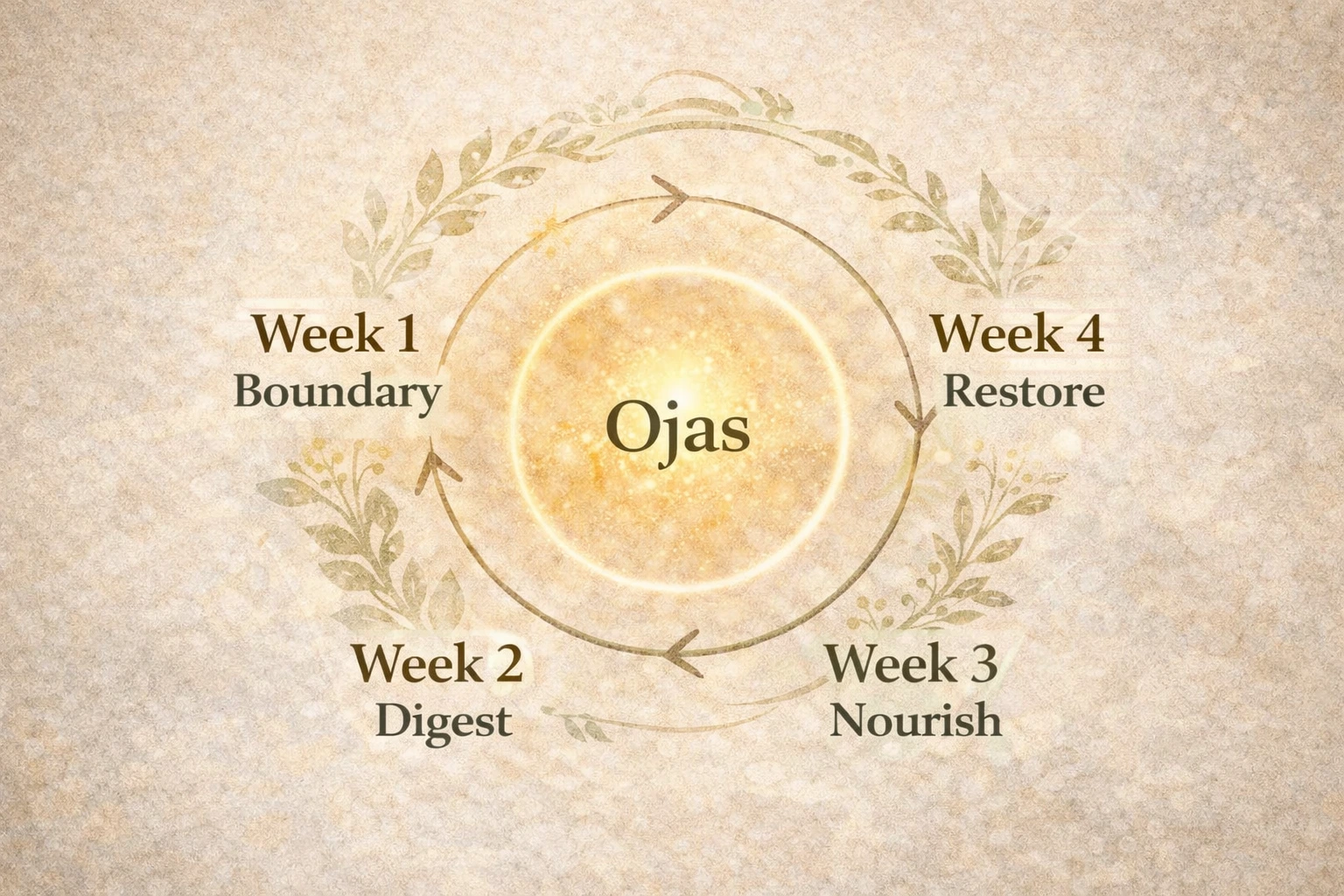
Here’s where we move from diagnosis to action. This isn’t a list of things to buy. It’s a sequence of things to do—in order—because order matters when you’re rebuilding from depletion.
Week 1: Stop Leaking (Sensory Management)
You can’t fill a cup with a hole in the bottom.
Before we add anything—herbs, foods, routines—we have to stop the leaks. And the biggest leak in modern life isn’t what you’re eating. It’s what you’re seeing and hearing.
The digital boundary that changes everything: For seven days, no screens for the first hour after waking and the last hour before sleep. That’s it. Not “less phone time.” Not “be mindful.” One hour bookending your day with zero algorithmic input.
Here’s why this matters for Ayurveda for stress and anxiety: Your nervous system doesn’t distinguish between “real” threat and “screen” threat. When you scroll stressful news first thing, you cue your body to produce cortisol before you’ve even had water. When you watch content late at night, you cue your brain that it’s still daytime, suppressing the melatonin your Ojas needs to rebuild during sleep.
One week of this boundary, and most people report their morning anxiety drops by half. Not because the world changed. Because they stopped leaking.
Week 2: Feed the Fire (Agni Restoration)
Now that you’re not leaking, we can start filling.
Most stressed people make the same mistake with food: They eat what’s “healthy” according to the internet, which usually means raw vegetables, smoothies, and salads. For a depleted Vata person, this is disaster. Raw food requires massive digestive fire to break down. If your fire is weak (and if you’re chronically stressed, it is), raw food doesn’t become fuel. It becomes gas. Literally—bloating, distension, and a vague sense that something’s rotting inside you.
The meal rhythm for stressed humans: Three meals. No snacks. Your largest meal at noon, when your digestive fire is naturally strongest. Your smallest meal at night, so your body can repair instead of digest while you sleep.
Because strong vitality depends on efficient digestion, our complete guide to the Ayurvedic concept of Agni explains how digestive fire protects and builds Ojas.
For Vata stress: Breakfast must be warm, cooked, fatty. Think spiced oatmeal with ghee and dates. Not a smoothie. Never a smoothie.
For Pitta stress: Breakfast cooling and sweet. Ripe berries with coconut and a pinch of cardamom. Nothing fermented first thing.
For Kapha stress: Breakfast is optional. If you’re hungry, spiced tea only until 10am, then something light and warm. Ginger tea with a touch of honey. Let your body burn its own stagnation first. (If chronic digestive issues are part of your stress picture, this resource on gut and digestive health offers much more detailed guidance.)
Week 3: Rebuild the Tissues (Dhatu-Specific Nutrition)
Here’s where Ayurveda for stress relief gets specific in a way modern nutrition never does.
Modern nutrition thinks in macros: protein, fat, carbs. Ayurveda thinks in tissue layers: plasma, blood, muscle, fat, bone, marrow, reproductive tissue. Each layer must be adequately nourished before the next can form. And Ojas—the final, essential layer—only forms when all previous layers are satisfied.
This is why “eating more protein” sometimes doesn’t fix exhaustion. If your plasma layer (Rasa Dhatu) is depleted from chronic stress, protein alone won’t rebuild it. Plasma needs easily-assimilated, sweet, fatty, warm foods. Things like:
- Warm milk with honey and turmeric
- Date and almond milkshakes (yes, actual milkshakes—Ayurveda is not anti-indulgence)
- Khichdi (rice and mung bean stew) with ghee
- Bone broths with warming spices
For one week, build every meal around this question: “Does this nourish my deepest tissues, or just fill my stomach?” If the answer is the latter, eat anyway—but know you’re maintaining, not rebuilding.
Week 4: The Herbal Window (Targeted Support)
Now—and only now—do we add herbs.
Most people take herbs backward. They read “ashwagandha for stress,” buy it, take it, and wonder why it doesn’t transform them. The herb isn’t the problem. The timing is. Herbs are concentrated supports for a system that’s already doing its job. If your digestion is weak and your tissues are depleted, herbs have nothing to work with. They’re like pouring fertilizer on concrete.
After three weeks of sensory management, proper meal rhythm, and tissue-nourishing foods, your body is now ready to receive herbal support. Here’s exactly what to take, when, and why.
For Vata stress: Ashwagandha with warm milk at bedtime
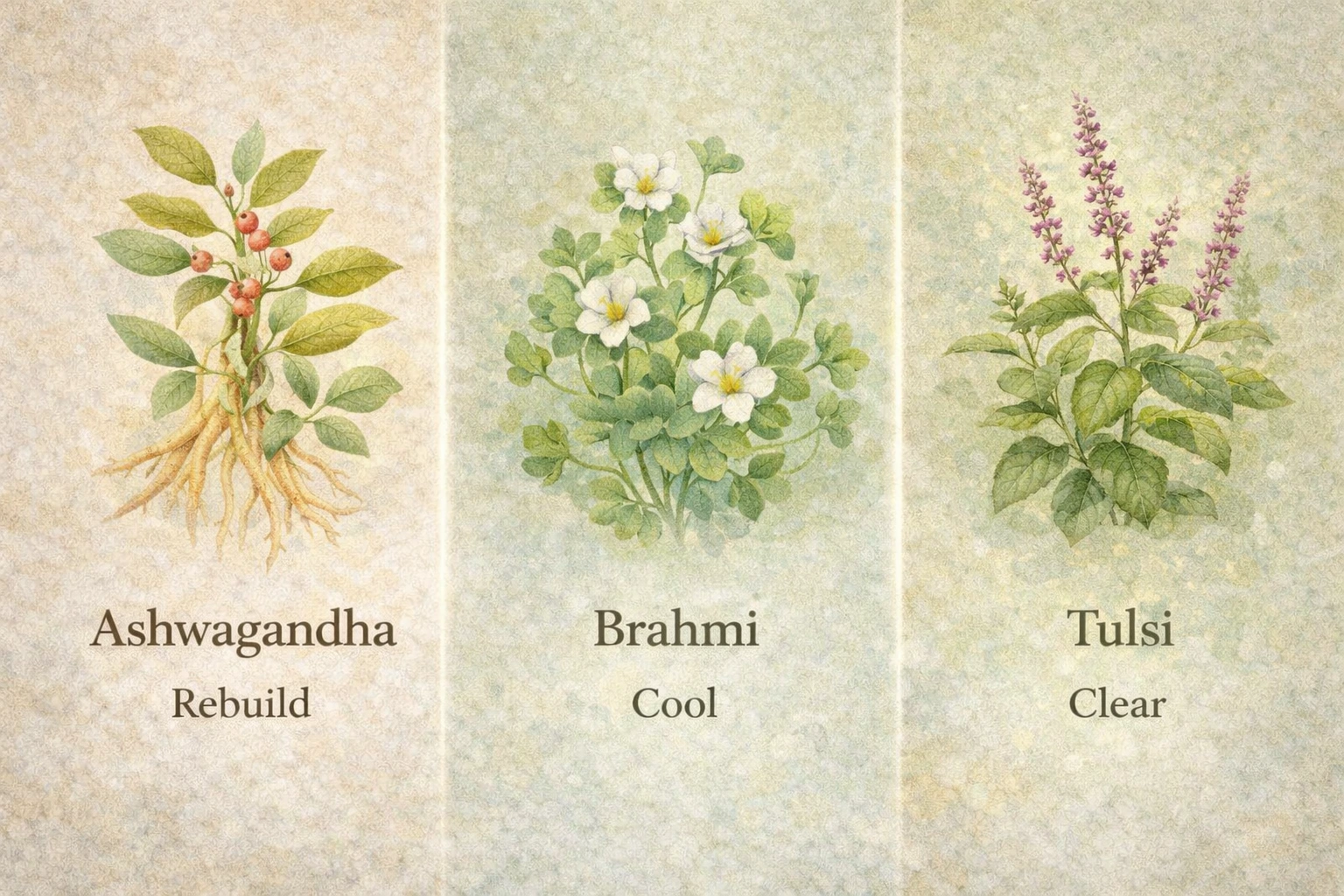
Ashwagandha is a Rasayana—a rejuvenative. Its primary action isn’t “calming,” it’s rebuilding. Taken at night with warm milk (itself an Ojas builder), it works while you sleep to restore the tissue density Vata types lack. Morning anxiety drops not because you sedated yourself, but because your body literally has more to hold onto. (For a deeper look at how ashwagandha affects cortisol, check out this PubMed study on ashwagandha’s stress-reducing effects.)
For Pitta stress: Brahmi (Gotu Kola) with coconut water midday
Brahmi cools the blood and sharpens cognition without heating. For Pitta types whose stress expresses as irritability and perfectionism, midday is when the fire peaks. Coconut water cools from the outside; Brahmi cools from the inside. Together, they prevent the 3pm rage-spiral. (Here’s a comprehensive review of Brahmi’s cognitive benefits from the National Library of Medicine.)
For Kapha stress: Tulsi (Holy Basil) with ginger tea morning
Tulsi is adaptogenic but stimulating—perfect for Kapha congestion. Taken first thing with ginger, it clears stagnation, wakes up the mind, and starts the day with movement instead of heaviness. Not sedating. Never sedating for Kapha. (You can read more about Tulsi’s adaptogenic properties in this study from the Journal of Ayurveda and Integrative Medicine.)
The Deeper Layer: When Stress Shows Up in Your Body
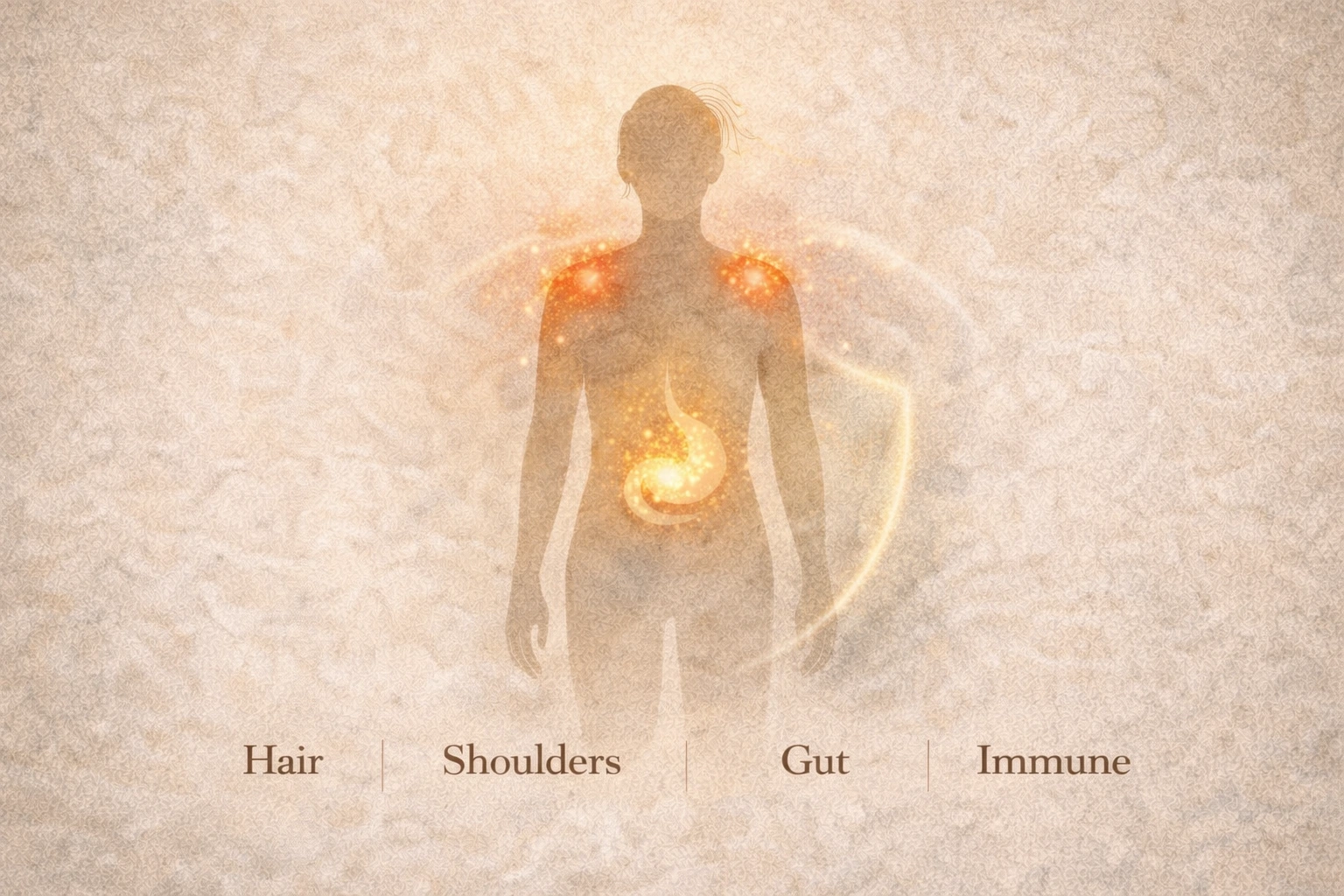
Stress doesn’t live only in your head. It lives in your shoulders, your gut, your lower back. If you’ve been carrying stress for years, your body has likely started to complain in specific ways.
When Stress Becomes Stomach Issues
The gut-stress connection isn’t metaphorical. Your gut has its own nervous system—the enteric nervous system—that communicates directly with your brain. When stress becomes chronic, that communication breaks down. Digestion slows. Inflammation rises. What you eat stops becoming fuel and becomes… trouble.
If you’ve noticed that your stress and digestive issues seem to fuel each other—if anxiety gives you bloating, or bloating gives you anxiety—you’re not imagining it. This is the gut-hormone-stress triad, and it requires its own approach. We’ve written an entire deep dive on exactly this connection in this article about stress and digestion. If gut issues are part of your stress story, that’s essential reading.
When Stress Becomes Physical Pain
Stress doesn’t always stay in the nervous system. Sometimes it settles into tissues. That knot in your shoulder that never releases. That lower back ache that worsens by Friday. That stiffness in your joints that seems to have no physical cause.
When Vata—the dosha of movement and air—gets aggravated by chronic stress, it dries out the joints, displaces fluids, and creates pain where there was none. This is why stress and chronic pain are such frequent companions.
If this sounds like you, our approach to chronic pain and structural body restoration addresses exactly this pattern. It’s a different angle on the same root problem: Vata aggravation and tissue depletion.
When Stress Weakens Your Defenses
Ojas isn’t just about stress resilience—it’s also the substrate of your immune function. When Ojas is depleted, you don’t just feel overwhelmed. You get sick more often. You recover slowly. You catch whatever’s going around.
If you’ve noticed that periods of high stress are always followed by colds, flus, or general “something’s off” feelings, your immune system is telling you something. Our guide to building natural immunity with Ayurveda explores how to rebuild Ojas specifically for immune strength.
When Stress Shows Up on Your Scalp
Hair loss is one of the most visible—and distressing—signs of chronic stress. From an Ayurvedic perspective, hair is a byproduct of bone tissue (asthi dhatu). When stress depletes the deeper tissues, hair is often the first place you see the fallout.
If thinning hair or unexplained hair loss is part of your stress story, this resource on natural Ayurveda for hair health addresses the root causes rather than just topical fixes.
The 90-Day Alternative: When 4 Weeks Isn’t Enough
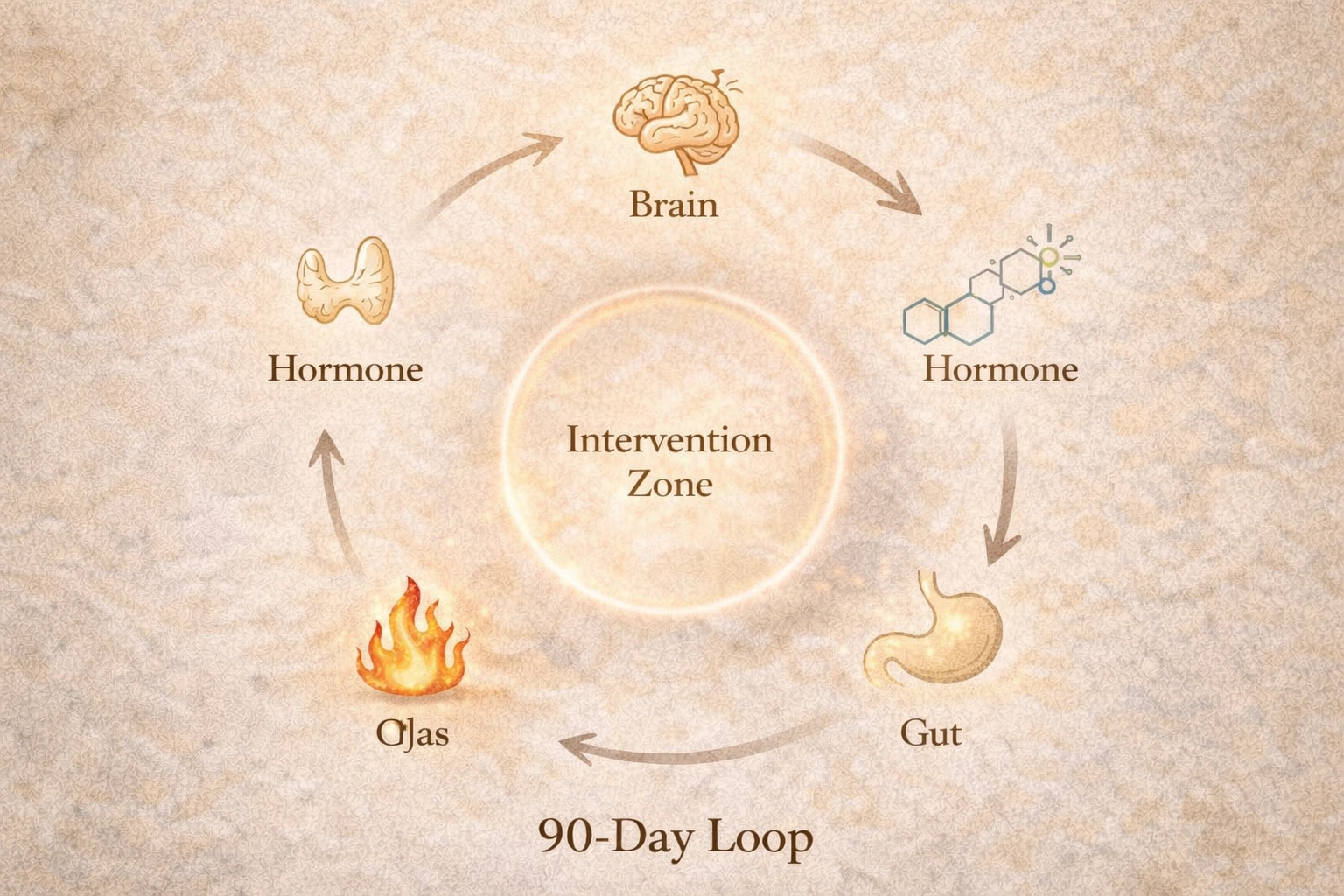
If you’ve been stressed for years—if your hormones are truly dysregulated, if your gut is a mess, if you’ve tried everything and nothing budged—four weeks might just scratch the surface. That’s not failure. That’s reality.
Chronic stress creates a vicious cycle: High cortisol damages gut lining, which impairs nutrient absorption, which weakens tissues, which lowers Ojas, which makes you more stress-reactive. It’s a loop that can take months to unwind properly.
That’s why we developed a comprehensive 90-day Holistic Healing Program. It’s the extended, guided version of what you’ve just read—with weekly checkpoints, deeper diagnostics, and personalized adjustments based on how your body responds. If you’ve tried the 4-week version and still feel stuck, that’s your next step.
The FAQ Section (What People Actually Ask)
If placebo worked long-term, you wouldn’t be here. The difference is mechanism: Ayurveda targets the metabolic root of stress—how your digestive fire converts food into the tissue vitality that determines your stress ceiling. When your tissues are depleted, no amount of positive thinking fixes you. When they’re rebuilt, calm becomes your default. A 2022 meta-analysis in Pharmaceuticals found that ashwagandha consistently reduced cortisol levels more than placebo (source). That’s not placebo—that’s physiology.
Some people feel shifts in days—usually the “heaviness lifting” or “sleep deepening.” But if you want your stress resilience permanently raised, count in months, not days. The first month rebuilds digestion. The second rebuilds tissue. The third, you stop noticing stress because your body handles it without telling your mind.
Yes, with two rules: 1) Never substitute or stop medication without your prescriber, and 2) Work with a practitioner who knows both systems. Ayurveda doesn’t compete with modern medicine—it fills the gaps modern medicine doesn’t address, like why you’re still exhausted even when your blood work is “normal.”
If you do nothing else: Eat your largest meal at noon, not night. Stress follows digestion. When you overload your system at night, you sleep poorly, wake stressed, and spend all day catching up. Shift one meal, and you shift your entire nervous system’s baseline.
Because your gut doesn’t just process food—it processes experience. Undigested food creates physical toxins (Ama). Undigested experiences create emotional toxins. Both circulate, clog channels, and mimic stress. Clear digestion = clear mind. Not metaphorically. Metabolically. (The gut-brain axis is now well-established in neuroscience —Ayurveda described it millennia ago.)
Absolutely. The 4-week protocol is a powerful self-guided start. But if you want someone in your corner—someone who can interpret your unique symptoms, adjust the plan as you go, and hold you accountable—our one-on-one wellness sessions are designed for exactly that. We’ll look at your whole picture: stress patterns, digestive history, hormonal landscape, and lifestyle constraints. Then we’ll build a roadmap that’s yours alone.
Where to Go From Here
If you’ve read this far, you’re not looking for a quick fix. You’re looking for a framework—a way of understanding your stress that actually explains your experience instead of dismissing it.
Ayurveda for stress offers that framework. Not because it’s ancient (though it is), but because it’s accurate. It sees what modern medicine misses: that chronic stress is depletion wearing a mask. That your nervous system isn’t broken—it’s just hungry for the right fuel. That calm isn’t something you force, it’s something you grow.
The protocol above is your starting point. Four weeks. No supplements required until week four (and even then, optional). Just sensory boundaries, meal timing, tissue nutrition, and finally—when you’re ready—herbal support.
Try it. Not because I’m convincing you. Because the alternative—another year of chasing temporary fixes while your tissues quietly deplete—is worse than four weeks of eating lunch at noon and putting your phone away at night.
Your stress isn’t permanent. Your depletion isn’t permanent. But the fix requires looking in a direction modern wellness doesn’t point.
Look here instead.
Ready to go deeper?
- If the gut-stress connection is your main struggle, read how stress creates gut & digestive dysfunction —it’s the companion piece to this article.
- If chronic pain or stiffness is part of your stress picture, explore our work on structural restoration for Chronic back and Joints Pain.
- If you’re dealing with multiple symptoms—stress plus digestion plus immunity plus ???—the 90-day Ayurvedic Treatment/Healing track might be where you need to land.
- If you’re ready for someone to look at your specific case and build a protocol around you, book a consultation. No templates. Just you, your history, and a plan.
Wherever you start, the door’s open.
Comprehensive 90-Day Holistic Healing Program
If you’ve been stuck in the stress cycle for years and want structured, guided implementation—not just information—the comprehensive 90-day Holistic Healing Protocol is designed to rebuild digestion, restore tissue strength, and stabilize your nervous system step-by-step.
Weekly checkpoints. Personalised adjustments. Real accountability.
Disclaimer: This article is for educational purposes and does not replace medical advice. Always consult a qualified healthcare provider before starting any new health protocol, especially if you are pregnant, nursing, or on medication.