
Ayurveda Seasonal and Daily Routines for Balanced, Conscious Living

🌿 Ayurveda Seasonal and Daily Routines — A Complete Guide to Rhythmic Living
🪔 Expert Summary
Ayurveda Seasonal and Daily Routines create harmony between body, mind, and nature. Rooted in classical Ayurvedic science, these time-tested practices—known as Dinacharya (daily regimen) and Ritucharya (seasonal adaptation)—balance the doshas, ignite Agni (digestive fire), remove Ama (toxins), and cultivate Ojas (vital energy).
Modern research on circadian health validates what Ayurveda has taught for millennia: our health thrives when we live in tune with the rhythms of the Earth.
🌞 Introduction: Why Rhythmic Living Matters
Imagine waking up with the sunrise, your body already alert and mind clear. Meals digest smoothly, energy stays steady, and sleep is deep. This isn’t luck—it’s rhythm.
Ayurveda teaches that wellbeing comes from synchronization, not struggle. When we follow nature’s clock, our biological systems—digestion, hormones, immunity, mood—flow in harmony. When we resist, imbalance creeps in as fatigue, anxiety, poor digestion, or chronic illness.
That’s why Ayurveda created two essential frameworks:
- 🌤️ Dinacharya — Daily routines for stability
- 🍂 Ritucharya — Seasonal routines for adaptation
Together, they form the timeless blueprint for balanced living.
📘 The Classical Roots of Routine
Ayurveda’s oldest scriptures — the Charaka Samhita and Ashtanga Hridaya — define health as “a dynamic state of balance between body, mind, and environment.” Both texts emphasize that disciplined routines prevent disease more effectively than any cure.
They describe the ideal human life as one that flows with the sun and the seasons: rising before dawn, eating when Agni is strongest, resting when darkness returns, and adjusting diet and behavior as nature changes.
This ancient framework mirrors modern chronobiology, which confirms that our metabolism, hormones, and immune functions operate on a biological clock aligned with sunlight and temperature cycles.
🕰️ In short: Ayurveda’s ancient time science = today’s circadian medicine.
🧠 Understanding the Dosha Clock
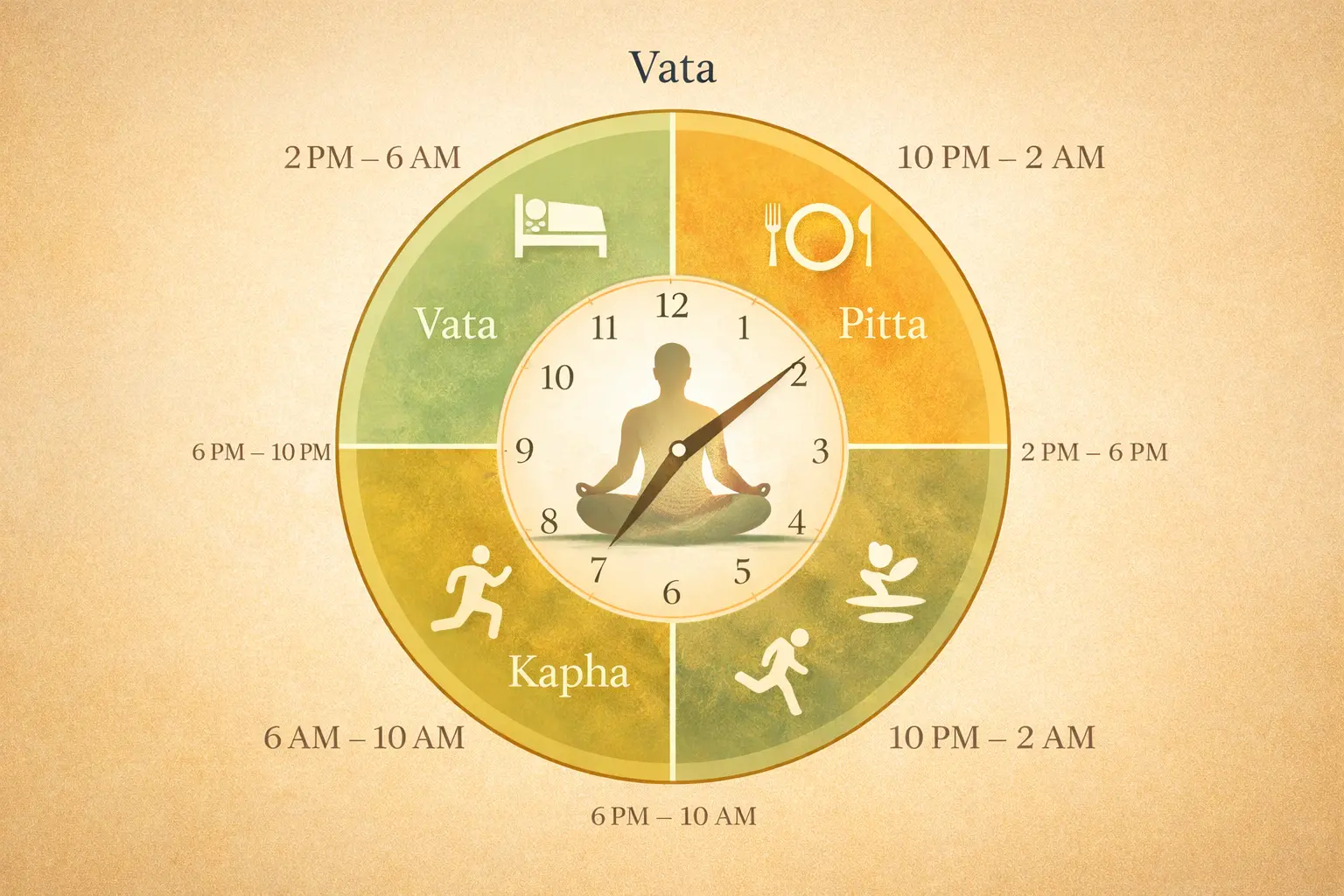
Every day moves through repeating cycles of Vata, Pitta, and Kapha energies.
Knowing their timing allows us to do the right activity at the right time.
| Time | Dominant Dosha | What Happens | Ideal Activity |
|---|---|---|---|
| 4 – 6 AM | Vata | Lightness, clarity | Meditation, reflection |
| 6 – 10 AM | Kapha | Heaviness, calm | Exercise, warm bath |
| 10 AM – 2 PM | Pitta | Digestion, focus | Main meal, intense work |
| 2 – 6 PM | Vata | Mobility, creativity | Planning, meetings |
| 6 – 10 PM | Kapha | Rest, stability | Family time, reading |
| 10 PM – 2 AM | Pitta | Internal repair | Deep sleep |
| 2 – 4 AM | Vata | Subtle activity | Dreaming, light rest |
4 – 6 AM · Vata — Lightness & clarity → Meditation / reflection
6 – 10 AM · Kapha — Calm & steadiness → Exercise / warm bath
10 AM – 2 PM · Pitta — Peak digestion → Eat main meal / focus work
2 – 6 PM · Vata — Creativity → Meetings / planning
6 – 10 PM · Kapha — Rest & stability → Reading / family time
10 PM – 2 AM · Pitta — Repair → Deep sleep
2 – 4 AM · Vata — Subtle activity → Dreaming
By following this rhythm, you optimize your Agni, productivity, and energy naturally — without stimulants or stress.
🌅 Daily Routine (Dinacharya): The Science of Everyday Harmony
🌄 Morning (Brahma Muhurta – before sunrise)
- Wake before sunrise — enhances clarity and spiritual freshness.
- Cleanse mouth and tongue — removes toxins (ama).
- Drink warm water — activates digestion.
- Oil pulling and nasal cleansing (Gandusha & Nasya) — purify sensory pathways.
- Self-massage (Abhyanga) — calms nerves, tones skin, promotes circulation.
- Yoga & pranayama — synchronize body and breath.
☀️ Midday
- Eat your largest meal at noon, when Pitta and Agni peak.
- Choose freshly prepared, warm, and easily digestible food.
- Take a short walk after eating — this aids metabolism and prevents lethargy.
🌙 Evening
- Eat a light dinner before 7 PM.
- Avoid screens and heavy stimulation post-8 PM.
- Engage in quiet reflection, reading, or family time.
- Sleep by 10 PM to align with your body’s natural repair cycle.
🍃 Seasonal Routine (Ritucharya): Flowing with Nature
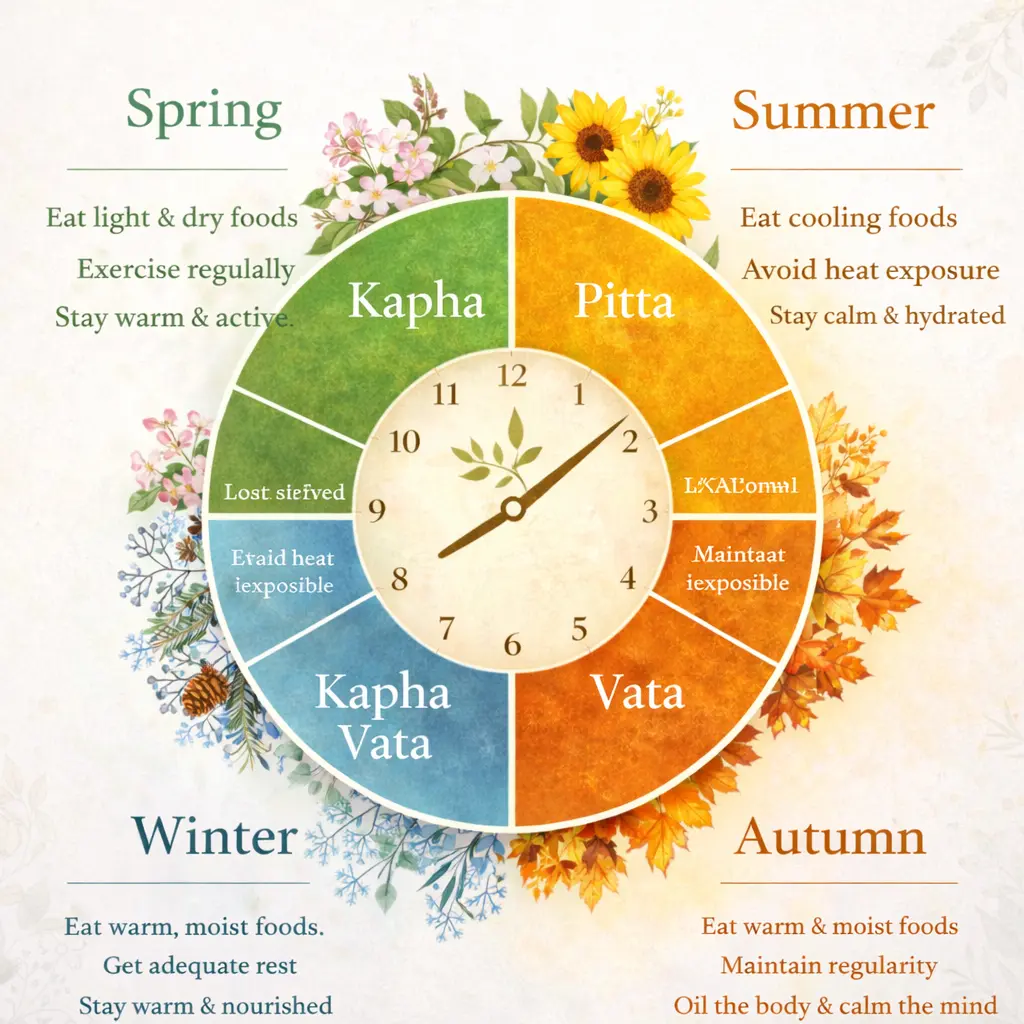
Seasons influence the doshas just as times of day do.
Adjusting your habits, food, and activities accordingly prevents disease and boosts resilience.
| Season | Dominant Dosha | Common Imbalances | Key Adjustments |
|---|---|---|---|
| 🌸 Spring | Kapha ↑ | Congestion, sluggishness | Light meals, morning exercise |
| ☀️ Summer | Pitta ↑ | Heat, acidity | Cooling foods, hydration |
| 🍁 Autumn | Vata ↑ | Dryness, anxiety | Oily foods, grounding routine |
| ❄️ Winter | Kapha ↑ | Weight gain, dullness | Warming spices, active lifestyle |
🌸 Spring · Kapha ↑ — Congestion, sluggishness → Light meals & morning exercise
☀️ Summer · Pitta ↑ — Heat, acidity → Cooling foods & proper hydration
🍁 Autumn · Vata ↑ — Dryness, anxiety → Oily foods & grounding routines
❄️ Winter · Kapha ↑ — Weight gain, dullness → Warming spices & active lifestyle
Example: Summer Routine
- Diet: Favor sweet, bitter, and astringent tastes (coconut, cucumber, coriander).
- Avoid: Spicy, fried, or fermented foods.
- Lifestyle: Stay indoors during midday, meditate near water, practice cooling breathwork.
🧬 Modern Validation: Circadian Health and Ayurveda
Recent studies on circadian biology affirm that our organs function best at specific times of day.
Digestion peaks around noon, detoxification occurs during early sleep, and stress hormones naturally rise before dawn.
This perfectly aligns with Dinacharya’s instructions. Likewise, seasonal immunity shifts—documented in modern immunology—
mirror Ayurveda’s advice on Ritucharya. Thus, what was once spiritual guidance is now scientific truth.
A daily and seasonal rhythm isn’t old-fashioned—it’s evidence-based self-care.
(Citation: Journal of Circadian Health, 2021; PubMed: “Seasonal Regimens and Preventive Health in Ayurveda”)
(Citation: Charaka Samhita, Sutrasthana, Chapter 6 – “Rules of Health Maintenance”)
🔗 Scientific Evidence Supporting Ayurvedic Rhythms
Modern research continues to affirm that Ayurveda’s concept of rhythmic living — through daily (Dinacharya)
and seasonal (Ritucharya) routines — harmonizes perfectly with biological clock science.
Aligning eating, sleeping, and activity with natural cycles enhances digestion, hormonal balance, and mental wellbeing.
A peer-reviewed publication by the
National Center for Biotechnology Information (NCBI)
discusses how circadian rhythm research and Ayurvedic time-based living share common scientific foundations,
providing evidence that these traditional practices support metabolism, immunity, and preventive health.
🌿 Essential Herbs to Support Rhythmic Health
Herbs play a vital role in maintaining harmony with nature’s clock. Ayurveda prescribes specific herbs to balance doshas and strengthen circadian rhythm.
| Herb | Benefit | Ideal Time |
|---|---|---|
| Ashwagandha | Adaptogen, reduces stress | Evening, with warm milk |
| Triphala | Detoxifies and improves digestion | Before bed |
| Brahmi | Enhances focus and memory | Morning, with honey |
| Turmeric | Anti-inflammatory and antioxidant | Daily meals |
| Tulsi (Holy Basil) | Supports immunity and respiratory health | Morning tea |
🌼 Tip: Choose herbs seasonally. For example, use Brahmi and Shatavari in summer (cooling), and
Ashwagandha and Pippali in winter (warming).
🥗 Ayurvedic Diet Rhythm — Eating by Nature’s Clock
Ayurveda views food as conscious energy, not calories. How and when you eat shapes your wellbeing.
🍽️ Golden Meal Rules
- ✅ Eat freshly cooked, warm meals.
- ✅ Avoid cold, processed, or leftover food.
- ✅ Never eat when angry or distracted.
- ✅ Leave one-third of the stomach empty for air and digestion.
- ✅ Don’t mix incompatible foods (e.g., milk with sour fruits).
🕛 Best time to eat: 10 AM – 2 PM (strongest Agni)
🌙 Light dinner: before sunset, favor soups and cooked vegetables.
💆 Lifestyle Anchors: The 5 Core Practices
| Practice | Sanskrit Term | Benefit |
|---|---|---|
| Oil massage | Abhyanga | Nourishes tissues, improves circulation |
| Herbal oil pulling | Gandusha | Enhances oral and sinus health |
| Nasal therapy | Nasya | Clears mind, lubricates sinuses |
| Movement | Vyayama | Improves vitality, stamina |
| Mind training | Dhyana | Balances emotions and mind |
Each of these was documented in Ashtanga Hridaya, thousands of years ago—offering a full-body, mind-spirit maintenance system.
💫 Case Study: How a Routine Transformed Modern Fatigue
Ritika, a 34-year-old corporate analyst, faced constant tiredness, acidity, and anxiety.
She introduced simple Ayurvedic practices—early waking, lemon water, main meal at noon, and nightly oil massage.
Within a month:
- • Her digestion normalized
- • Sleep deepened
- • Morning alertness returned
- • Work stress dropped noticeably
Her doctor even noted reduced acidity without medication. Consistency—not complexity—is what healed her.
⚠️ Common Mistakes to Avoid
- 🚫 Skipping breakfast during Kapha hours (6–10 AM)
- 🚫 Overeating at night
- 🚫 Exercising intensely in summer heat
- 🚫 Ignoring seasonal transitions
- 🚫 Sleeping right after lunch
Remember: Ayurveda is gentle discipline, not rigidity.
The goal is rhythm—not perfection.
🌼 Benefits of Following Ayurveda Seasonal and Daily Routines
- ✨ Improved digestion & metabolism
- ✨ Consistent energy and mental clarity
- ✨ Balanced mood and hormones
- ✨ Radiant skin & healthy aging
- ✨ Stronger immunity and disease prevention
- ✨ Deeper, more restorative sleep
The real benefit isn’t just health—it’s harmony.
💬 FAQ’s — People Also Ask
🧘 1. What are Ayurveda Seasonal and Daily Routines?
🍂 2. What’s the difference between Dinacharya and Ritucharya?
🌗 3. Can these routines prevent disease?
🌿 4. How do I start if I’m a beginner?
😴 5. When should I sleep and wake up?
💧 6. Do I need to know my dosha before starting?
🌱 7. How long does it take to see results?
💆 8. Is Abhyanga (oil massage) really necessary?
🔥 9. Can I mix these routines with modern work life?
🧘 10. Are there scientific studies supporting this?
🌐 Suggested Readings & Resources
- 📖 Charaka Samhita — “Rules of Health Maintenance” (Sutrasthana)
- 📚 Ashtanga Hridaya — “Daily and Seasonal Conduct”
- 🧘 Ayurveda for Health Issues: A Complete Guide to Natural Healing & Holistic Wellbeing
- 🎓 Complete Guide to Ayurvedic Nutrition and Dietetics
- 🔥 Ayurveda for Gut Health & Digestive Issues
- 🏃♀️ Ayurveda for Weight Loss
🌺 Conclusion: Rhythm Is the Real Medicine
In a world obsessed with instant fixes, Ayurveda whispers a timeless truth:
✨ The slower you move with nature, the faster you heal.
By following Ayurveda Seasonal and Daily Routines, you don’t just manage health—you embody harmony.
Each sunrise becomes your medicine, each meal your ritual, and each night’s sleep your therapy.
Balance isn’t a goal—it’s a rhythm waiting to be remembered.
🔗 Continue Your Holistic Healing and Learning Journey
Deepen your knowledge or begin a guided transformation today.
🎓 Online Ayurveda Courses
Learn authentic Ayurveda through structured, modern-friendly lessons.
💚 Holistic Health Consultations
Book a personalized Ayurvedic consultation for root-cause healing and balanced living.
📘 Ayurvedic Resources
Access our guides on digestion, doshas, nutrition and daily living for long-term wellbeing.


You may also like