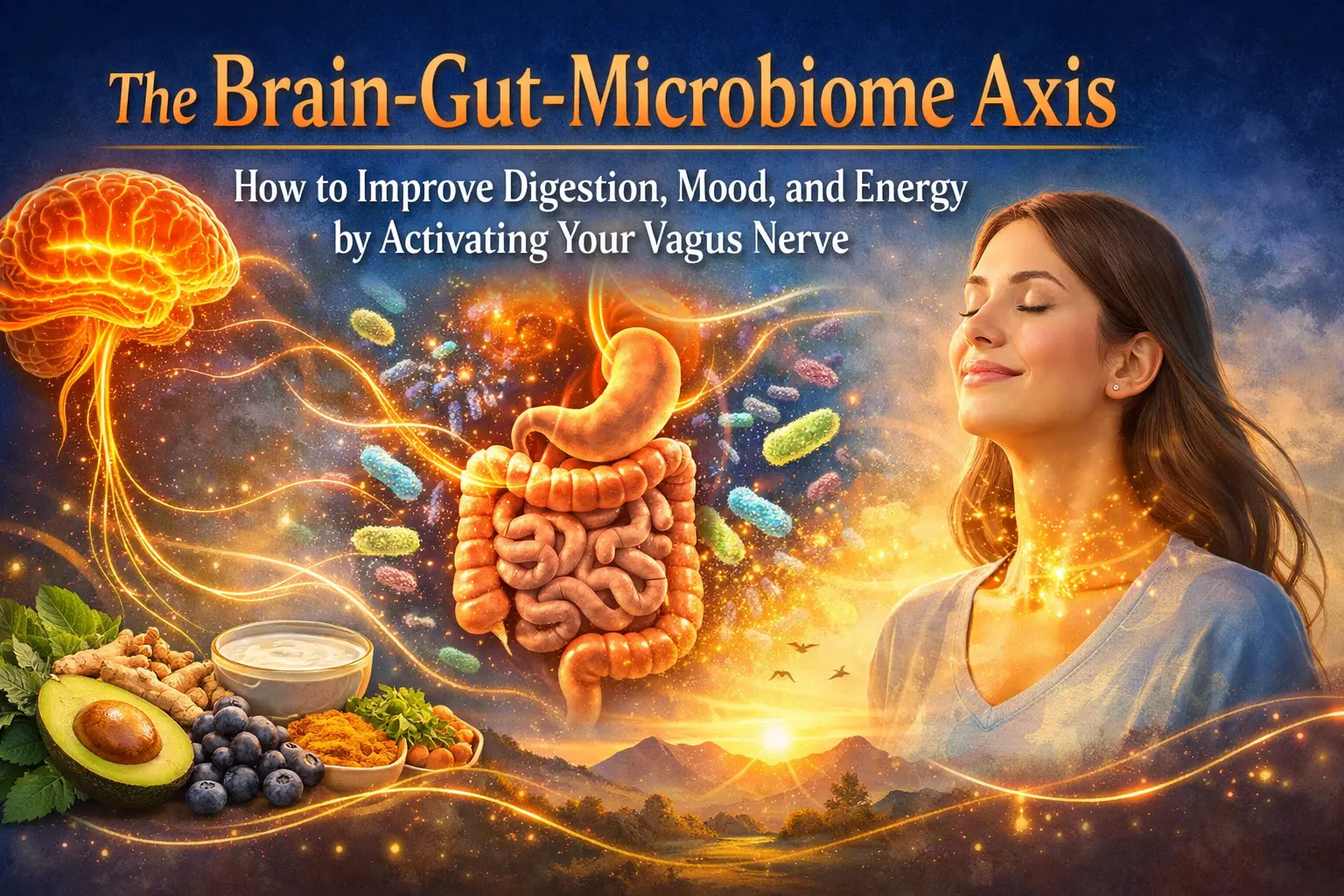
The Brain‑Gut‑Microbiome Axis: How to Improve Digestion, Mood, and Energy by Activating Your Vagus Nerve
The Vagus Reset: How to Strengthen the Brain-Gut-Microbiome Axis for Better Mood, Hormones & Energy
The brain gut microbiome axis is the two way communication highway between your central nervous system, enteric nervous system, and gut microbes. Improving it requires a structured, integrated approach that combines vagus nerve activation, microbiome diversity, and inflammation reduction.
📌 Quick Answer Snippet
Q: How do I improve my brain-gut-microbiome axis?
A: The brain-gut-microbiome axis is the two way communication highway between your central nervous system, enteric nervous system, and gut microbes. Improving it requires three simultaneous actions:
- Activate the vagus nerve – the physical cable connecting gut and brain. Use diaphragmatic breathing, cold exposure, and gargling daily.
- Feed a diverse microbiome – eat 30+ different plant foods per week, include fermented foods, and consume polyphenol-rich berries, dark chocolate, and green tea.
- Reduce inflammatory load – eliminate processed foods, prioritize sleep, and manage stress with simple breathwork and mindful eating.
Quick start: Begin with 5 minutes of slow belly breathing each morning and add one fermented food (e.g., sauerkraut) to your daily diet. Most people notice clearer thinking, stable energy, and less bloating within 2–4 weeks.
For the complete 4-week guided protocol, continue reading below.
Table of Contents
- 1. The Tripartite Command Center
- 2. The Vagus Nerve: The Physical Highway
- 3. The Microbiome: The Signal’s Content
- 4. The Missing Link: Why Diet Alone Isn’t Enough
- 5. The 4 Week Vagus Reset Protocol
- 6. The Ayurvedic Perspective: Ancient Wisdom Meets Modern Science
- 7. Self Assessment: How Healthy Is Your Brain Gut Microbiome Axis?
- 8. Real World Case Study: 12 Week Transformation
- 9. Frequently Asked Questions
- 10. Long Term Maintenance & Lifestyle Integration
The Tripartite Command Center
For decades, the brain was viewed as the sole commander of the body. We now know this is a fundamental misunderstanding. The brain gut microbiome axis is a bidirectional communication network that links three distinct entities:
- The Central Nervous System (Brain) – your emotional and cognitive control center.
- The Enteric Nervous System (Gut) – the “second brain” with over 100 million neurons.
- The Gut Microbiome – trillions of bacteria, fungi, and viruses that outnumber your own cells.
These three players are connected by a physical superhighway: the vagus nerve, the longest cranial nerve, which runs from your brainstem to your colon. What makes this system remarkable—and often overlooked—is the direction of traffic. Approximately 90% of the signals travel from the gut to the brain, meaning your digestive system and its microbial residents are constantly informing your mood, stress levels, and even cognitive function.
If you’ve ever felt “butterflies” before a stressful event or experienced brain fog after a heavy meal, you’ve witnessed this axis in action. Yet most people are never taught how to intentionally strengthen it. That’s where a holistic approach—like the one we use in our Holistic Health Consultation—becomes invaluable. Rather than chasing symptoms, we assess the entire axis and build a personalized roadmap.
The Vagus Nerve: The Physical Highway
The vagus nerve is not a passive cable; it’s a dynamic, modifiable structure. Its “tone”—a measure of its activity—determines how quickly you can shift from a stressed (sympathetic) state to a calm (parasympathetic) state. Low vagal tone is linked to:
- Anxiety and depression
- Irritable bowel syndrome (IBS)
- Chronic fatigue
- Systemic inflammation
- Poor heart rate variability (HRV), a marker of overall health
The Science: A 2024 meta analysis in Nature Reviews Gastroenterology & Hepatology concluded that non invasive vagus nerve stimulation (including breathing techniques, cold exposure, and certain sounds) significantly reduces gut inflammation and improves mood disorders. This isn’t alternative medicine; it’s mainstream neurogastroenterology.
To truly harness this nerve, you need more than theory—you need a practical, step by step plan. Our guide to Ayurveda for stress and anxiety walks you through the exact vagal toning protocols we use in clinical practice, adapted for daily life. Stress isn’t just a mental state—it’s a physiological signal that directly impacts your vagus nerve and, through it, your entire digestive system.
Struggling to visualize how the vagus nerve works? This quick explanation will make it clear:
Watch: The Gut Brain Axis Explained
This video provides a visual explanation of how How to Heal Your Gut Naturally (3 Foundations). Why it plays a critical role in regulating the brain-gut connection.
The Microbiome: The Signal’s Content
If the vagus nerve is the highway, the microbiome is the cargo. Your gut bacteria produce hundreds of neuroactive compounds, including:
- Serotonin: 90% of your body’s serotonin is produced in the gut by enterochromaffin cells, which are influenced by microbial metabolites.
- GABA: Calming neurotransmitter; certain Lactobacillus and Bifidobacterium strains increase GABA production.
- Short chain fatty acids (SCFAs): Butyrate, propionate, and acetate—produced when microbes ferment fiber—directly stimulate the vagus nerve and strengthen the gut lining.
A diverse, resilient microbiome sends “all clear” signals to the brain. A dysbiotic (imbalanced) microbiome sends distress signals, contributing to anxiety, brain fog, and hormonal chaos. If you’ve been struggling with unexplained hormonal issues, a holistic health consultation can help identify whether microbial imbalances are at the root, often revealing patterns that standard lab tests miss.
The Missing Link: Why Diet Alone Isn’t Enough
Many protocols focus exclusively on diet and probiotics. While these are critical, they ignore the physical infrastructure. Imagine feeding your gut the most diverse, fiber rich diet possible, yet your vagus nerve is so “shut down” that the brain never receives the signal that things are improving. This is why some people eat perfectly but still suffer from anxiety and fatigue.
Healing the brain gut microbiome axis requires a three pillar approach:
| Pillar | Focus | Examples |
|---|---|---|
| 1. Vagus Activation | Strengthen the communication highway | Diaphragmatic breathing, cold exposure, gargling, singing |
| 2. Microbiome Diversity | Enrich the quality of signals | High fiber plants, fermented foods, polyphenols |
| 3. Inflammation Reduction | Remove interference | Sleep optimization, stress management, anti inflammatory diet |
Strengthen the communication highway
Diaphragmatic breathing, cold exposure, gargling, singing
Enrich the quality of signals
High fiber plants, fermented foods, polyphenols
Remove interference
Sleep optimization, stress management, anti inflammatory diet
When all three pillars are addressed, results accelerate and become sustainable. This integrated method is exactly what we teach in our Ayurveda for health issues guide, where we blend ancient dietary wisdom with modern neuroscience to address the root cause rather than temporary fixes.
The 4 Week Vagus Reset Protocol
This progressive protocol layers practices to avoid overwhelm. Follow each week’s focus while maintaining previous practices.
Week 1: Activate the Vagus Nerve (The Highway)
Goal: Wake up the physical communication line between gut and brain.
-
Diaphragmatic breathing
5 minutes, twice daily. Place one hand on your belly, one on your chest. Inhale through nose for 4 seconds, feeling belly rise; exhale through pursed lips for 6 seconds. This creates gentle mechanical pressure that stimulates vagal pathways.
Why it works: Slow, rhythmic breathing increases heart rate variability (HRV) and shifts the nervous system toward parasympathetic dominance. -
Cold exposure
End your morning shower with 30–60 seconds of cold water. You don’t need an ice bath—cool water that makes you take a slightly deeper breath is enough. The cold activates the “dive reflex,” which triggers vagal activity.
Alternate: Splash cold water on your face for 30 seconds. -
Gargling
Gargle vigorously with water for 30 seconds, morning and evening. The pharyngeal muscles involved stimulate branches of the vagus nerve. Over time, this strengthens vagal tone.
Bonus: Humming or singing (especially low, resonant tones) also vibrates the vagus nerve.
Track: Rate your stress recovery daily—how quickly do you return to calm after a minor stressor?
Week 2: Feed the Microbiome (The Signal Content)
Goal: Increase microbial diversity and the production of beneficial metabolites.
-
30 plant foods per week
Each plant contains unique fibers and polyphenols that feed different bacterial species. Keep a checklist: nuts, seeds, legumes, whole grains, herbs, spices, and a rainbow of vegetables.
Easy addition: Sprinkle ground flaxseed or hemp seeds on meals; add a handful of spinach to smoothies. -
Daily fermented foods
Start with 1–2 tablespoons of sauerkraut, kimchi, kefir, or yogurt. Fermented foods introduce live beneficial bacteria and increase microbial diversity more effectively than many probiotic supplements.
Note: If you’re new to fermented foods, introduce slowly to avoid bloating. -
Polyphenol power
Polyphenols act as prebiotics, feeding beneficial bacteria. Eat: dark berries (blueberries, blackberries), dark chocolate (70%+ cacao), green tea, extra virgin olive oil, and spices like turmeric and cinnamon.
For deeper guidance on how to personalize these dietary choices according to your unique constitution, explore our dosha based diet plan. What feeds a Vata microbiome differs significantly from what nourishes a Kapha one—personalization is key.
Week 3: Reduce Inflammatory Load (Clear the Interference)
Goal: Identify and remove factors that disrupt the brain gut microbiome axis.
-
Hidden triggers
Common culprits include:
o Industrial seed oils (soybean, sunflower, canola) – promote inflammation.
o Added sugars – feed pathogenic bacteria.
o Emulsifiers (carboxymethylcellulose, polysorbate 80) – can damage gut lining.
o Artificial sweeteners – alter microbial composition.
Action: For one week, eliminate these and observe changes in mood, energy, and digestion. -
Support gut lining
A permeable gut (leaky gut) allows bacterial fragments and toxins to enter the bloodstream, triggering inflammation that jams the vagus signal. Include:
o Bone broth – rich in collagen and gelatin.
o Glutamine rich foods: cabbage, spinach, parsley.
o Zinc: pumpkin seeds, chickpeas. -
Prioritize sleep
Even one night of poor sleep reduces microbial diversity and lowers vagal tone. Aim for 7–8 hours; keep bedroom cool, dark, and screen free 1 hour before bed.
If you suspect that chronic stress is a major driver of your inflammation, read our deep dive on how stress causes stomach issues—it unpacks the gut hormone stress triad that keeps so many people stuck.
Track: Morning energy levels and mental clarity.
Week 4: Synchronize with Circadian Rhythms
Goal: Align your axis with natural light dark cycles for optimal function.
-
Time restricted eating
Eat within a 10–12 hour window. This gives your gut time to enter the migrating motor complex—a cleansing wave that sweeps bacteria and debris into the colon. It also reinforces circadian clocks in the gut and microbiome. -
Morning light exposure
Get 10–15 minutes of natural light within 30 minutes of waking. This sets the master clock in the brain, which in turn synchronizes gut motility, microbial rhythms, and vagal tone. -
Evening vagal wind down
One hour before bed:
o No screens.
o Try humming (Om or Bhramari pranayama) – the vibrations directly stimulate the vagus nerve.
o Gentle neck stretches or supine twists to release tension.
Track: Overall sense of calm and resilience.
The Ayurvedic Perspective: Ancient Wisdom Meets Modern Science
While modern science is just beginning to map the brain gut microbiome axis, Ayurveda described its principles over 3,000 years ago. The ancient texts speak of Agni (digestive fire) and Ama (metabolic waste)—concepts that align strikingly with the vagus nerve and microbiome.
Agni is the transformative force that turns food into energy. When Agni is strong, digestion is complete, and the gut lining remains intact. When Agni is weak, food becomes Ama—a sticky, toxic residue that clogs channels and disrupts communication between the gut and brain. Our complete guide to the concept of Agni explores this in depth, offering a framework to assess and rebuild your own digestive fire.
Ayurveda’s approach to restoring this axis involves:
- Eating according to your constitution (dosha) to optimize Agni
- Using digestive spices (ginger, cumin, fennel, turmeric) to kindle the fire
- Practicing dinacharya (daily routine) to support circadian rhythms
- Seasonal cleansing to remove deep seated Ama
These timeless principles are now being validated by microbiome research. If you’re interested in learning how to apply Ayurveda to your own health, our Ayurveda for health issues guide offers a comprehensive introduction to these foundational concepts.
Self Assessment: How Healthy Is Your Brain Gut Microbiome Axis?
Before you begin the Vagus Reset, take this quick self assessment to identify your starting point. Score each statement from 0 (never) to 3 (always).
| Statement | Score (0–3) |
|---|---|
| I often feel bloated or heavy after meals | |
| I experience afternoon brain fog or energy crashes | |
| I have trouble falling asleep or wake up frequently | |
| My mood fluctuates without an obvious trigger | |
| I have a diagnosed digestive condition (IBS, reflux, etc.) | |
| I eat fewer than 20 different plant foods per week | |
| I often eat while stressed or on the go | |
| I rarely feel “rest and digest” (calm after meals) |
Interpretation:
- 0–5: Your axis is relatively balanced; the Vagus Reset will be a tune up.
- 6–12: Moderate dysregulation; expect significant improvements within 4–6 weeks.
- 13–24: Deep axis disruption; consider a personalized holistic health consultation to address underlying complexities.
Real World Case Study: 12 Week Transformation
Name and details anonymized; used with permission.
Background: Sarah, 38, struggled for years with IBS, debilitating anxiety, brain fog, and weight resistance despite a “clean” diet. She had tried multiple elimination diets, probiotics, and medications with limited success.
Approach: She implemented the 4 Week Vagus Reset protocol with an emphasis on:
- Daily diaphragmatic breathing (she set phone reminders).
- Gradual introduction of fermented foods (she started with 1 tbsp sauerkraut, working up to daily).
- Cold exposure (30 second cold finish to her shower).
- Time restricted eating (12 hour window) and prioritizing 7.5 hours of sleep.
Results at 12 weeks:
- IBS symptoms: Severity score dropped from 280 (moderate severe) to 45 (mild).
- Anxiety: GAD 7 score fell from 14 (moderate) to 5 (mild).
- Brain fog: She reported “clarity I haven’t had in a decade.”
- Weight: 12 lbs lost without intentional calorie restriction.
- Heart rate variability (HRV): Increased by 28%, indicating improved vagal tone.
Sarah’s story is not unique. Hundreds of individuals have experienced similar transformations through the holistic, root cause approach we teach in our Ayurvedic treatment for digestion protocols. When you address the entire axis—vagus, microbiome, inflammation—the body responds in ways that symptom targeting alone cannot achieve.
Frequently Asked Questions
Long Term Maintenance & Lifestyle Integration
Healing the brain gut microbiome axis is not a one time fix. Once you’ve completed the 4 week reset, maintain these practices as habits:
- Daily vagal activation: Choose 2–3 practices (e.g., 5 min breathing, cold finish, humming) and anchor them to existing routines (morning coffee, after brushing teeth).
- Weekly food variety: Keep a running list of plant foods; aim to hit 30 different ones each week.
- Stress sensitive eating: When stressed, prioritize easy to digest meals (soups, cooked vegetables) and avoid heavy, processed foods.
- Sleep hygiene: Protect your sleep window as non negotiable.
- Periodic check ins: Re evaluate your vagal tone via HRV (if you use a wearable) or simply by noticing how quickly you recover from stress.
For ongoing support, join our Ayurveda courses and programs, where we dive deeper into seasonal routines, personalized dietary adjustments, and advanced vagal toning techniques.
Final Thoughts: Your Body Has Been Signaling—Now You Know How to Listen
The brain gut microbiome axis is not a metaphor. It is a living, physical conversation that shapes your daily experience of energy, mood, and health. When it works well, you feel resilient, clear headed, and calm. When it falters, symptoms like anxiety, brain fog, hormonal chaos, and digestive distress become chronic.
If you’ve been struggling despite trying everything, know this: your body isn’t failing you. It’s been sending signals you were never taught to interpret. Now you have the roadmap.
Start with Week 1. Pick one practice—perhaps the 5 minutes of breathing—and commit to it for a few days. Then build. By the time you’ve worked through the four weeks, you won’t just have improved your brain gut microbiome axis; you’ll have built a set of skills that serve you for life.
And if you’re ready for personalized, one on one guidance, our holistic health consultations are designed to help you navigate the complexities of your unique system with expert support.
External Resources & Further Reading
To deepen your understanding of the brain gut microbiome axis and the science behind vagal tone, the following authoritative resources provide complementary insights, clinical research, and practical tools.
Modern Science & Clinical Resources
-
Harvard Health Publishing – “The Gut Brain Connection”
A trusted, evidence based overview of how the gut and brain communicate, including the role of the microbiome and vagus nerve.
👉 Read at Harvard Health -
PubMed Central (PMC) – “The Vagus Nerve at the Interface of the Microbiota Gut Brain Axis”
A comprehensive scientific review (Frontiers in Neuroscience) detailing the anatomical and functional pathways by which the vagus nerve mediates microbiome to brain signaling.
👉 Access the full paper -
Polyvagal Institute – “Understanding Polyvagal Theory”
Founded by Dr. Stephen Porges, this resource offers accessible explanations of vagal tone, neuroception, and practical exercises for improving nervous system regulation—directly relevant to the vagus nerve activation practices in this article.
👉 Explore Polyvagal Institute
Ayurveda & Integrative Perspectives
-
National Ayurvedic Medical Association (NAMA) – “What Is Ayurveda?”
The leading professional organization for Ayurvedic practitioners in the U.S. provides a credible, peer reviewed introduction to Ayurvedic principles, including the foundational concepts of Agni (digestive fire), Ama (toxins), and the gut mind connection.
👉 Visit NAMA -
Journal of Ayurveda and Integrative Medicine (J AIM) – “Gut Brain Axis in Ayurveda”
An open access, peer reviewed journal published by Elsevier. Their archives contain numerous papers exploring the convergence of Ayurvedic concepts (Agni, Ama, Ojas) with modern gut brain axis research—ideal for readers seeking academic depth.
👉 Explore J AIM
These external resources are provided for educational purposes and complement the Ayurvedic and holistic approaches discussed here. They do not replace professional medical advice.