Structural Body Restoration: Ayurvedic Treatment for Back Pain, Joints Pain and other Chronic Pain Conditions
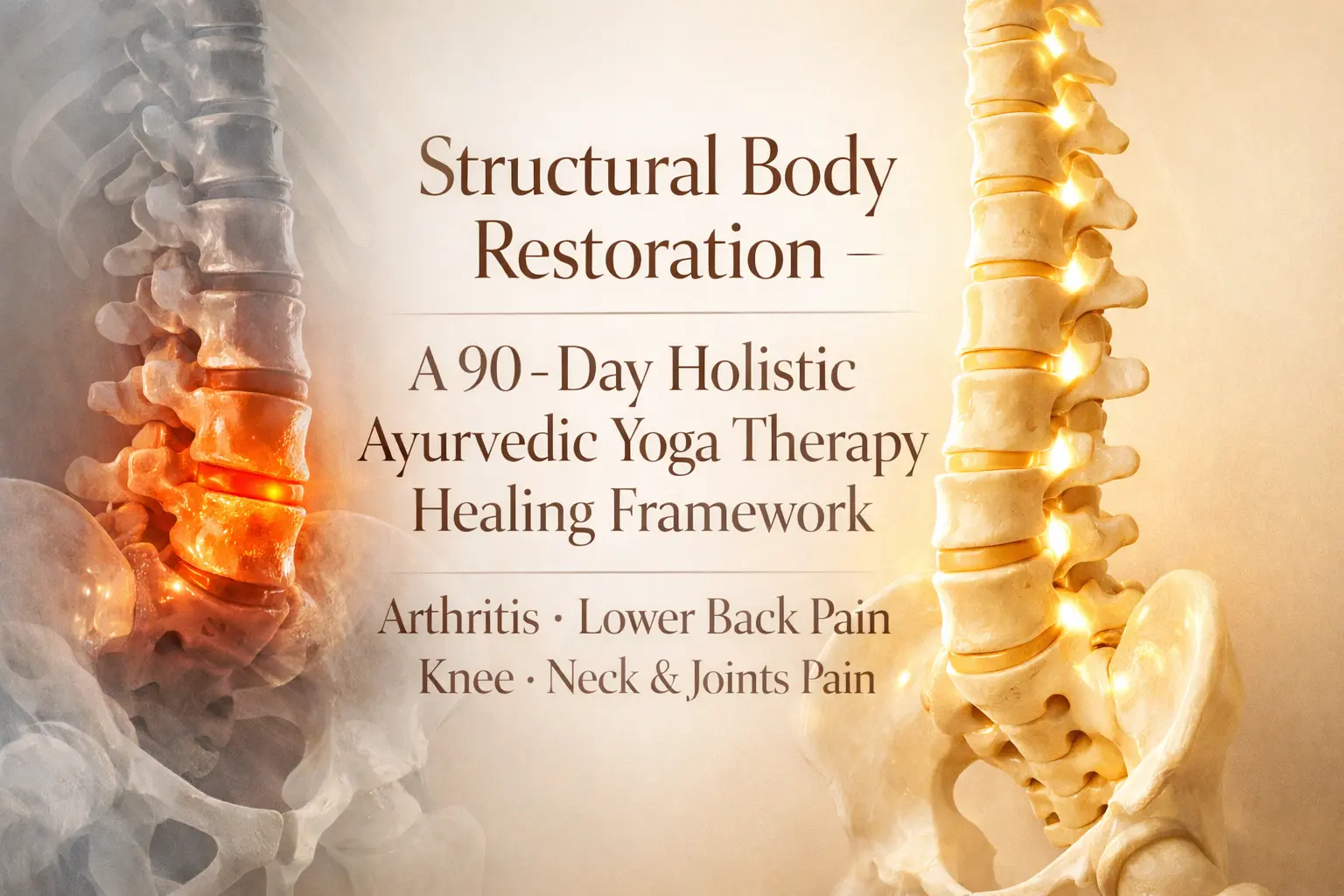
Deep Dive: 90 Day Structural Body Restoration Holistic Healing Protocol – Managing Chronic Pains
A 90-Day Ayurvedic Solution for Back Pain, Sciatica, Arthritis, and Chronic Joint Pain
You’ve tried the painkillers. The physical therapy. The chiropractic adjustments. The yoga classes. Maybe even surgery.
And yet, here you are. Your back still aches in the morning. Your sciatica flares up every time you sit too long. Your arthritic joints predict the weather better than any meteorologist. Your neck and shoulders feel like they’re carrying the weight of the world.
Here’s what conventional medicine rarely tells you: chronic pain is rarely just a local issue.
When you have persistent back pain, it’s not simply a “weak core” or a “slipped disc.” When sciatica shoots down your leg, it’s not just a pinched nerve. When rheumatoid arthritis flares, it’s not only an autoimmune quirk. These are symptoms of something deeper—a systemic imbalance that has been brewing for months or years.
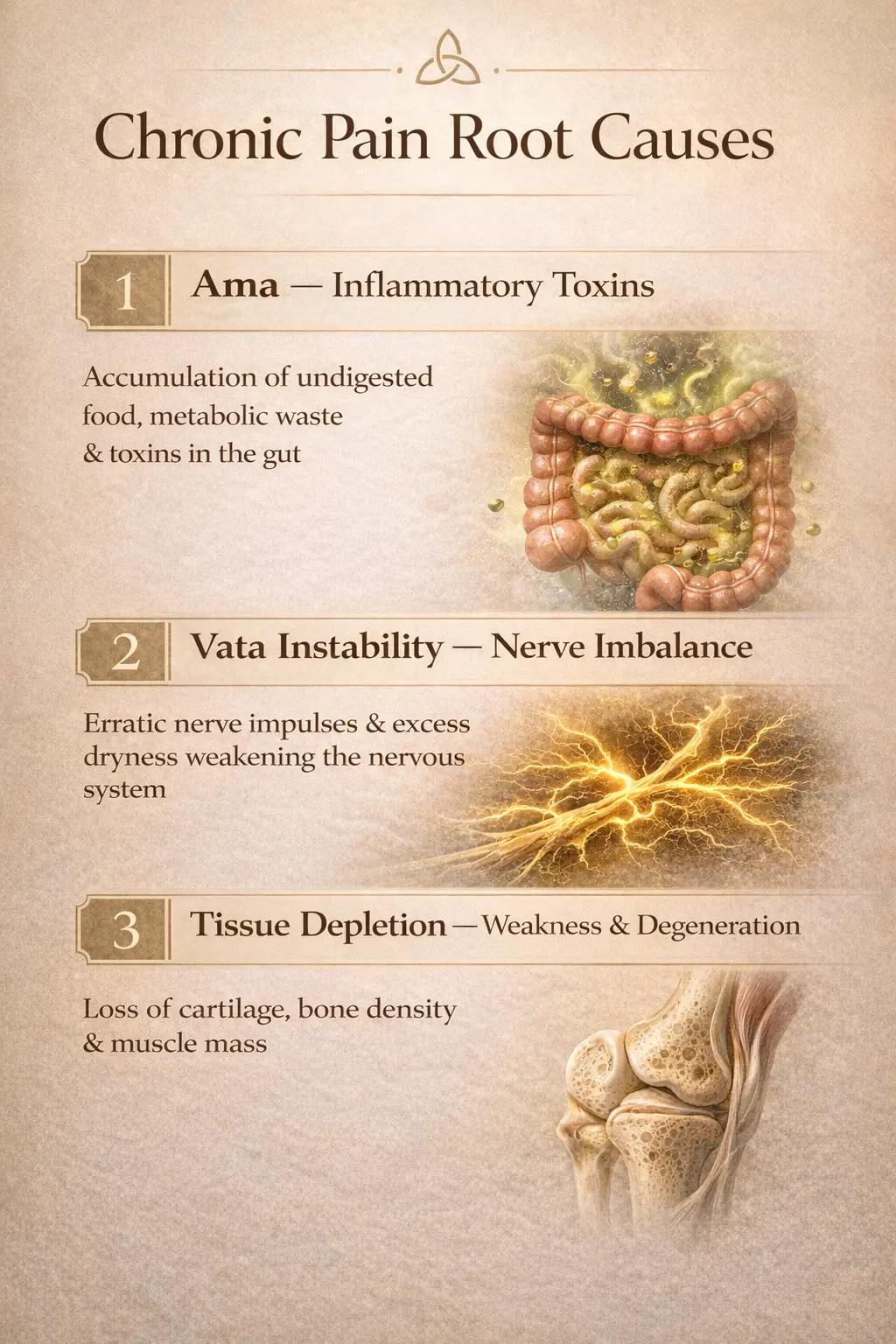
In the Ayurvedic view, chronic pain typically involves two interconnected factors:
- Ama — inflammatory toxins that form due to faulty digestion and deposit in vulnerable tissues
- Vata aggravation — instability, dryness, and erratic movement in the nervous system
This is the foundation of Ayurveda for Health — understanding that symptoms are messages from a system out of balance.
The Structural Body Restoration Protocol is a 90-day roadmap to address the root, not just the symptoms. It’s designed for anyone suffering from:
- Chronic back pain (lower, middle, or upper)
- Sciatica and nerve pain
- Arthritis (osteoarthritis, rheumatoid, psoriatic)
- Slipped discs or bulging discs
- Neck and shoulder pain
- Posture issues and joint instability
- Autoimmune-related joint pain
- General mobility problems
If you’re ready to understand why your pain persists and how to address it systematically, read on. For a fully personalized approach tailored to your unique constitution, consider a Holistic Health Consultation before beginning.
The Hidden Root Causes of Chronic Pain
What Most Approaches Miss
When patients ask “what causes sciatic nerve pain?” or “why does my rheumatoid arthritis keep progressing?”, they typically receive answers focused on local mechanics—herniated discs, autoimmune genetics, joint erosion.
But these answers miss the deeper question: why did those tissues become vulnerable in the first place?
Two people can have identical MRI findings—the same disc bulge, the same joint narrowing—and one experiences debilitating pain while the other feels nothing. Why?
The Ama Deposition Theory
In Ayurveda, Ama refers to undigested metabolic waste—a sticky, toxic, inflammatory substance that results from weak digestive fire (Agni). Think of it as the body’s internal sludge.
Ama forms when:
- You eat foods that are difficult to digest (cold, raw, processed, fried, or incompatible combinations)
- You eat when you’re not truly hungry
- You eat late at night when digestive fire is lowest
- You’re under chronic stress, which shuts down digestion
Here’s what most people don’t realize: Ama doesn’t stay in the gut. Once formed, it circulates throughout the body via the bloodstream, looking for places to settle. And it settles where you’re most vulnerable—your genetically weak areas, your previously injured sites, your overused joints.
This explains patterns that conventional medicine struggles to explain:
- Back pain after eating: New Ama forms during a heavy meal and deposits in vulnerable spinal tissues within hours
- Morning stiffness: Ama settles overnight in joints, causing that characteristic “rusty” feeling
- Why some with herniated discs have no pain, while others with minor bulges suffer terribly: The pain is proportional to the toxic load in the tissue, not just the mechanical compression
- Why some develop skin issues while others develop joint pain: Ama deposits where you’re individually vulnerable—for some, that’s skin tissue; for others, it’s joints. This is why we address skin diseases through similar principles of Ama reduction.
The gut-hormone-stress connection plays a crucial role here. Chronic stress weakens digestion directly through the vagus nerve, creating more Ama while simultaneously aggravating Vata—a double blow to the system. For a deeper understanding of how stress initiates this cascade, explore our article on stress and digestive health.
The Vata Instability Paradigm
If Ama is the “what” (the inflammatory toxin), Vata is the “how” (the pattern of pain).
Vata dosha governs all movement in the body—nerve impulses, joint mobility, circulation, peristalsis. When Vata is aggravated, its qualities become excessive:
Vata Quality — Physical Manifestation — Pain Experience
- Dry — Dehydrated discs, crepitus (popping joints), brittle tissues — Grinding, cracking sensations; pain worse with movement
- Light — Feeling unstable, joints “give out,” fear of weight-bearing — Unpredictable weakness, guarding patterns
- Cold — Stiffness in cold weather, poor circulation — Pain that worsens in winter or with cold exposure
- Mobile — Pain that moves, comes and goes, changes location — Erratic, unpredictable symptoms
- Erratic — Shooting, electric, radiating pain — Sciatica, neuropathy, nerve pain patterns
This is why your sciatica might be fine while lying down but excruciating when you stand—Vata is mobile, and movement aggravates it. It’s why arthritis pain often improves with gentle heat and worsens with cold—Vata is cold by nature.
The Autoimmune Connection: When Ama Becomes Immunogenic
Autoimmune disorders —whether rheumatoid arthritis, lupus, or psoriatic arthritis—represent a profound breakdown in the body’s ability to distinguish self from non-self. In Ayurvedic terms, this is Ama so deeply embedded that it has become immunogenic.
Consider rheumatoid arthritis. The conventional view focuses on autoantibodies and joint erosion. But the Ayurvedic view asks: why did the immune system become confused in the first place?
The answer lies in the gut. Approximately 70-80% of your immune tissue lives in your digestive tract. When digestion is weak, Ama forms. When Ama accumulates, it can cross a compromised gut barrier (leaky gut) and enter circulation. The immune system, seeing these foreign particles, mounts an attack. Over time, if Ama deposits in joints, the immune system begins attacking joint tissue itself—it can no longer distinguish between the toxin and the tissue.
This is why strengthening immunity isn’t just about fighting infections—it’s about helping the immune system regain its discernment. True immunity means knowing what to attack and what to leave alone. Learn more about Ayurveda for immunity to understand how resilience is rebuilt from the inside out.
This framework explains why rheumatoid arthritis treatment must be phased. You cannot rebuild bone while Ama is still actively depositing. You cannot calm Vata while inflammation is acute. You must address each layer in order.
Why This Matters for Your Pain
Whether you have back pain, sciatica, osteoarthritis, rheumatoid arthritis, neck pain, or general joint pain, the underlying principles are the same:
- Ama creates the inflammatory environment
- Vata creates the pain pattern (erratic, moving, shooting, or unstable)
- Tissue depletion creates vulnerability
The Structural Body Restoration Protocol addresses all three, in the correct sequence.
The 90-Day Structural Body Restoration Protocol
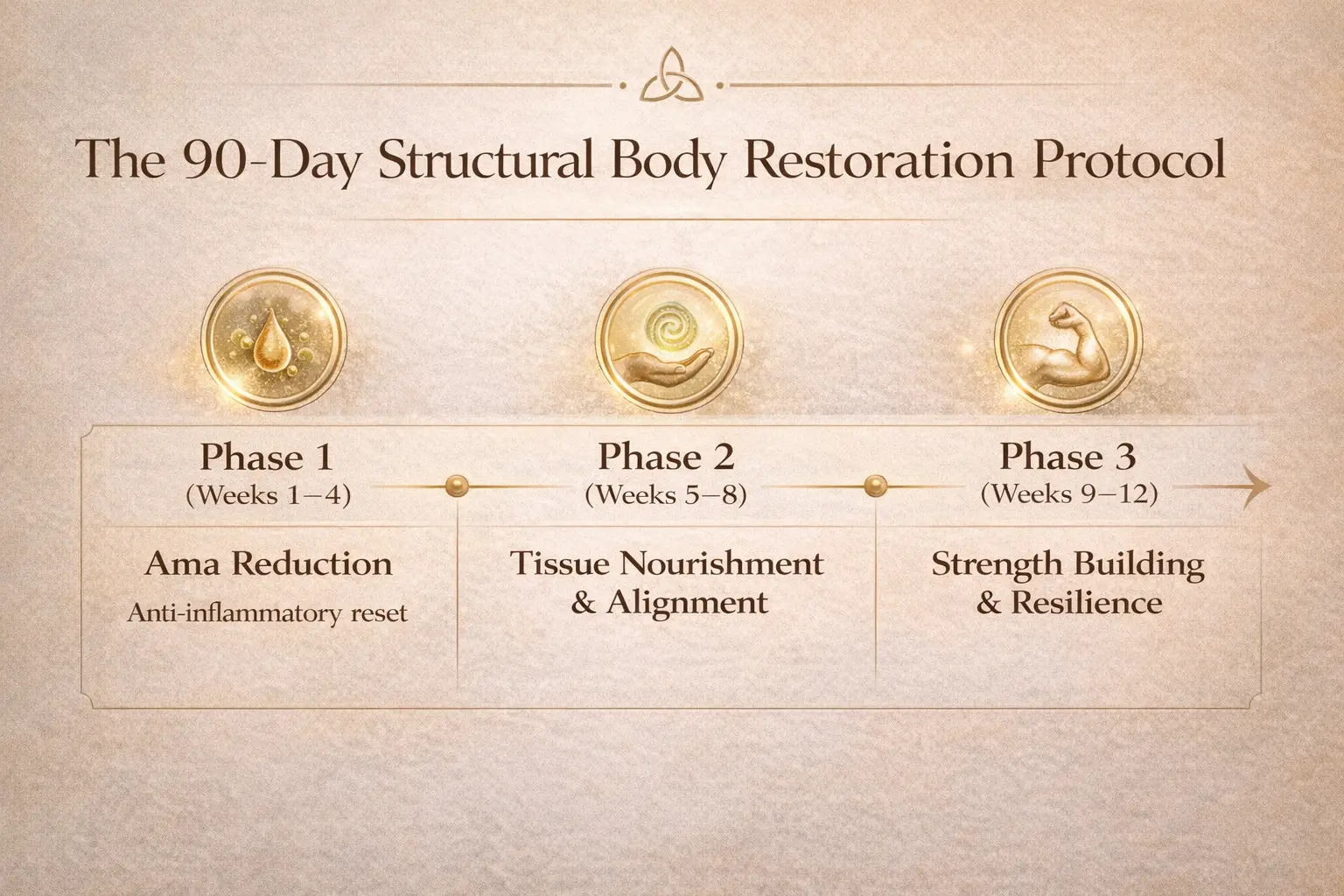
Most treatments fail because they apply the wrong intervention at the wrong time. They try to strengthen what is inflamed. They try to align what is toxic. They try to stretch what is unstable.
The body heals in sequence. This protocol respects that sequence. It is inspired by the principles of our comprehensive 90-day Clinical Ayurveda Treatment Program , which provides structured support for deep healing.
Phase 1: Pain Relief (Ama Reduction & Pain Modulation)
Weeks 1-4
Goal: Break the inflammatory cycle and calm the nervous system’s pain response.
Applies to: Active pain states—sciatica flare-ups, acute back pain, arthritis flares, inflamed joints, any condition with heat, redness, or sharp pain
The Principle
You cannot strengthen what is inflamed. You cannot align what is on fire.
What’s Happening in Your Body
In this phase, your tissues are loaded with Ama. Think of it like a sponge soaked in dirty water. If you try to reshape the sponge while it’s saturated, you’ll damage it. You must first squeeze out the dirty water.
Similarly, attempting exercise, stretching, or strengthening while tissues are inflamed and toxic will only create more inflammation. The body’s healing resources are focused on fighting fire—don’t ask them to build a house at the same time.
Week 1-2: The Anti-Inflammatory Pivot
Dietary Protocol:
For these two weeks, you’ll eat only foods that are easy to digest and non-Ama-forming:
- Warm, cooked vegetables
- Simple grains (rice, quinoa)
- Mung dal, split soups
- Ginger tea, cumin-coriander-fennel tea
- Ghee (in moderation)
- Spices: turmeric, ginger, cumin, fennel
Avoid:
- Raw vegetables, cold salads
- Heavy grains (wheat in excess)
- Heavy beans, meat (initially)
- Cold drinks, ice water
- Fried foods, processed oils
- Excess salt, vinegar
This isn’t about weight loss, though that often happens naturally. It’s about giving your digestive system a rest so it can process existing Ama rather than creating new Ama.
Reducing Ama naturally leads to healthy weight management—but the primary goal here is reducing inflammatory load.
Key practice: Eat only when genuinely hungry. Finish your last meal by early evening (ideally before sunset). This allows the body to focus on repair during sleep rather than digestion. For more on optimizing digestion, explore Ayurvedic treatment for digestion .
Therapy Protocol
External oleation (Abhyanga): Daily self-massage with warm Vata-pacifying oil. For most pain conditions, warm sesame oil is ideal. For specific joint pain, mahanarayan oil (a traditional herbal oil) can be used.
How to do it:
- Warm the oil (place the bottle in hot water for a few minutes)
- Apply generously to painful areas, using long strokes on limbs and circular strokes on joints
- Leave for 20-30 minutes, then shower with warm water (use a mild, natural soap)
This therapy helps draw inflammatory toxins from deep tissues toward the surface, where they can be eliminated. It also calms Vata directly through warmth, touch, and the grounding quality of oil.
Heat application: On painful areas, apply warm compresses or a warm water bottle. Heat pacifies Vata and helps loosen Ama. (Avoid heat if there’s active infection or if heat worsens your pain—some inflammatory conditions prefer cold.)
Yoga Therapy
This is not the time for power yoga or even gentle stretching. The goal is restoration, not mobilization.
- Supported Supta Baddha Konasana (Reclining Bound Angle Pose): Lie back on a bolster or stacked blankets, soles of feet together, knees open to sides. Support knees with blocks or blankets. Stay 5-10 minutes. This opens the hips without effort and calms the nervous system.
- Viparita Karani (Legs Up Wall): Lie on your back with legs resting up a wall. Use a folded blanket under hips if needed. Stay 5-15 minutes. This reverses circulation, reduces inflammation, and calms Vata.
- Gentle spinal rocks: Lie on back, knees to chest, and gently rock side to side. This massages the spine without strain.
- Apanasana (Knees to Chest) with support: Draw one knee at a time toward chest, keeping the other leg extended or bent. Use a strap if needed. Never pull into pain.
What not to do:
- No deep forward folds (they compress and can aggravate)
- No backbends (they require spinal strength you don’t yet have)
- No strenuous vinyasa
- No stretching into pain (pain is a signal, not a challenge)
Week 3-4: Internal Cleansing
Dietary Protocol:
Continue the anti-inflammatory diet from weeks 1-2. If appropriate and under guidance, you may introduce internal oleation with medicated ghee. This is a traditional practice where small amounts of specially prepared ghee are taken over several days to help draw Ama from deep tissues. This should only be done under the guidance of an Ayurvedic practitioner, as improper use can aggravate conditions.
For most people, continuing the simple diet is sufficient.
Practice:
- Monitor your tongue each morning. A coated tongue indicates Ama. As it clears, you’ll know the toxins are reducing.
- Monitor your stool. It should become more formed, regular, and easy to pass. Floating, sticky, or foul-smelling stool indicates ongoing Ama.
- Monitor your energy. As Ama reduces, you’ll notice clearer thinking, less brain fog, and more stable energy throughout the day.
Therapy Protocol:
Continue daily Abhyanga. Consider adding a warm compress with ginger: grate fresh ginger, wrap in cloth, warm (not hot), and apply to painful areas. Ginger penetrates deeply and helps break up Ama.
Yoga Therapy:
Continue the restorative poses from weeks 1-2. You may add:
- Cat-Cow (Marjaryasana-Bitilasana): Only if pain-free. Move slowly, coordinating with breath. If any pain, stop and return to gentler options.
- Gentle spinal twists: Reclining twists only (supta matsyendrasana) with support. Keep shoulders on floor, let knees fall to one side. Use a blanket under knees if they don’t reach floor.
Signs Phase 1 is Working
- Pain intensity decreases (pain may still be present, but the sharp edge is gone)
- Inflammation visibly reduces—less swelling, less heat
- Tongue becomes cleaner, less coated
- Digestion improves—less bloating, more regular elimination
- Sleep deepens
- Mental clarity improves
By the end of Phase 1, many people benefit from personalized guidance to assess whether they’re ready for the next stage. Everyone heals at a different pace, and moving too quickly into Phase 2 can undo the progress you’ve made.
Phase 2: Alignment (Tissue Nourishment & Functional Restoration)
Weeks 5-8
Goal: Rebuild muscle (Mamsa) and bone/connective tissue (Asthi). Restore functional alignment without strain.
Applies to: Chronic back pain (now less acute), post-acute sciatica, arthritis between flares, neck stiffness, posture issues, joint instability, general weakness
The Principle
Once inflammation subsides and toxins reduce, the body is ready to receive nourishment and alignment.
What’s Changing in Your Body
In Phase 1, you squeezed the dirty water out of the sponge. Now the sponge is damp but clean. It can finally absorb new, clean water—in this case, nourishment and strength.
The tissues are now receptive. Blood flow improves. Nutrients can reach deep layers. This is the window for rebuilding.
Dietary Protocol (Weeks 5–8)
Continue warm, digestible meals — but now gradually increase nourishment.
The digestive fire is stronger. Ama is reduced. The tissues are ready to receive.
Add:
- Well-cooked root vegetables (sweet potato, carrots, beets)
- Soaked almonds (5–7 daily, peeled)
- Black sesame seeds (especially for joint and bone health)
- Small amounts of high-quality dairy if tolerated (warm milk with turmeric or nutmeg at night)
- Moong dal khichari with ghee
Continue avoiding:
- Cold smoothies
- Excess raw foods
- Processed sugar
- Late-night eating
The difference now is this: you are no longer restricting — you are rebuilding.
Herbal & Nutritional Support
Under proper guidance, this phase may include:
- Ashwagandha for Vata stabilization and tissue rebuilding
- Shatavari (especially for women with hormonal depletion)
- Triphala at night for gentle detox support
- Guggulu preparations for joint nourishment
These are not random supplements. They are targeted Rasayana (rejuvenative) interventions — used when digestion is ready.
Movement & Alignment Therapy
This is the phase where structured therapeutic movement begins.
Not aggressive. Not aesthetic. Functional.
Core Stabilization
- Supported Bridge Pose: Lift hips gently with a block underneath sacrum. Hold 30–60 seconds. Focus on breath.
- Dead Bug (modified): Lying on back, alternate opposite arm/leg slowly. No spinal arching.
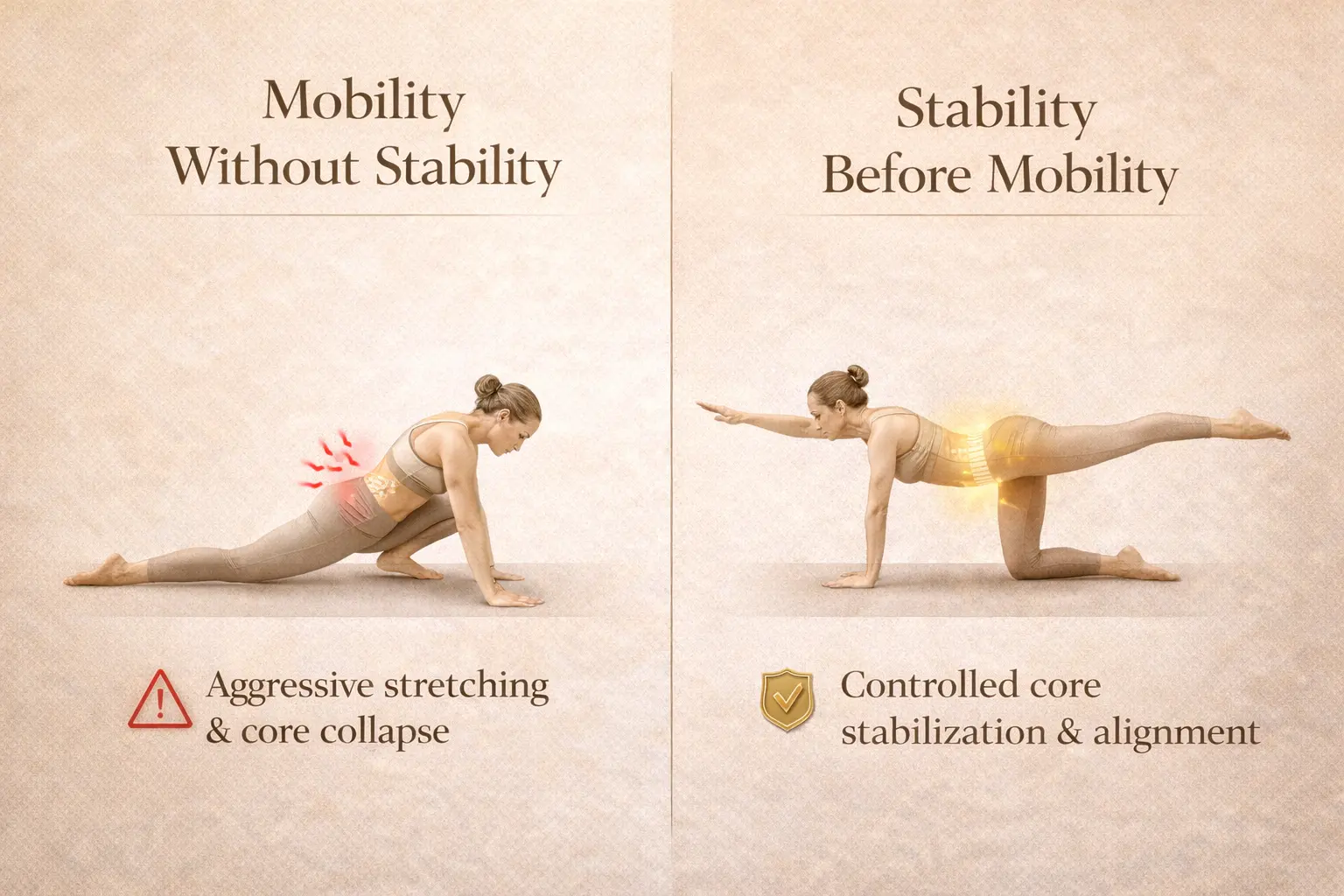
- Bird Dog (slow): On hands and knees, extend opposite arm and leg. Hold 3–5 breaths.
Hip & Pelvic Alignment
- Low lunge with support (use blocks)
- Wall-supported chair pose (short holds)
- Clamshells for lateral hip strength
Spinal Re-Education
- Pelvic tilts (slow and controlled)
- Thoracic rotations (gentle)
- Postural wall alignment drills
The key principle: stability before mobility.
What Not to Do
- No aggressive stretching
- No high-impact training
- No ego-driven yoga classes
- No pushing through fatigue
If pain spikes after movement, you advanced too quickly. Return to the previous stage for 5–7 days.
Signs Phase 2 is Working
- Improved posture without effort
- Less reliance on external supports (belts, braces)
- Increased muscle tone
- Joint movement feels smoother
- Energy becomes more consistent
- Pain becomes dull instead of sharp
You should feel more stable — not just stronger.
If pain becomes sharp, inflammatory, or erratic again, inflammation has re-entered the system. Return briefly to Phase 1 principles.
Phase 3: Strength Building (Integration & Long-Term Resilience)
Weeks 9–12
Goal: Build durable strength. Reinforce alignment. Prevent relapse.
The Principle
This is where most people start. And that is why most people fail.
Strength without prior cleansing and alignment creates compensation. Strength after sequencing creates resilience.
Dietary Protocol (Weeks 9–12)
By now, digestion should be stable. Ama should be significantly reduced. Inflammation should no longer dominate the system.
The goal now is maintenance without rigidity.
- Continue warm, digestible meals as the foundation
- Rotate seasonal vegetables
- Include moderate protein (lentils, mung, well-cooked legumes, clean animal protein if constitutionally appropriate)
- Maintain regular meal timing
- Avoid chronic overeating
Reintroduce foods cautiously. Observe responses. Your body now communicates clearly.
Strength Training & Structural Integration
Now the spine and joints are ready for progressive loading.
Foundational Strength
- Goblet squats (light weight)
- Step-ups
- Farmer carries
- Wall-supported lunges
- Slow tempo push-ups
Posterior Chain Reinforcement
- Glute bridges (unweighted → weighted)
- Romanian deadlift (light, controlled)
- Resistance band rows
Load increases only if:
- Pain remains stable or reduces
- Sleep remains undisturbed
- Inflammation markers do not spike
Postural Intelligence
Structural restoration is not just gym work. It is daily posture.
- Feet grounded while standing
- Neutral pelvis while sitting
- Screen at eye level
- Shoulders relaxed downward
- Jaw unclenched
Micro-corrections prevent macro-injury.
Relapse Prevention
Most relapses occur for one of three reasons:
- Stress spike → Vata aggravation
- Digestive collapse → Ama formation
- Overtraining → structural overload
If symptoms return:
- Return to Phase 1 diet for 5–7 days
- Increase Abhyanga
- Reduce intensity of exercise
- Prioritize sleep before everything else
Healing is cyclical. Awareness prevents escalation.
Applying the Protocol to Specific Conditions
Lower Back Pain
- Phase 1: Avoid flexion. Restorative poses only. Heat therapy. Abhyanga to lower back.
- Phase 2: Core stabilization without compression. Supported bridge. Pelvic alignment.
- Phase 3: Progressive posterior chain loading. Lifting mechanics education.
Sciatica
- Phase 1: Absolute rest from stretching. Nerve calm, not stretch.
- Phase 2: Gentle nerve glides once inflammation decreases.
- Phase 3: Asymmetrical loading with precision.
Cervical Spondylosis / Neck Pain
- Phase 1: Neck support. No forward head posture.
- Phase 2: Upper back strengthening.
- Phase 3: Ergonomic corrections and progressive strength.
Rheumatoid Arthritis
- Phase 1: Aggressive Ama reduction. Strict anti-inflammatory diet.
- Phase 2: Tissue nourishment once inflammation decreases.
- Phase 3: Routine stability and stress management.
Osteoarthritis
- Phase 1: Reduce inflammatory load.
- Phase 2: Strengthen surrounding musculature.
- Phase 3: Maintain mobility without impact overload.
Slipped Disc
- Phase 1: Avoid flexion entirely.
- Phase 2: Core stability without compression.
- Phase 3: Gradual reintegration into load-bearing.
Autoimmune Joint Pain
- Phase 1: Gut-focused immune calming.
- Phase 2: Deep tissue nourishment.
- Phase 3: Stress stabilization as primary medicine.
Frequently Asked Questions
What causes sciatic nerve pain?
Sciatica occurs when Ama deposits in nerve tissue create sensitivity, combined with Vata instability causing compression or irritation. The nerve itself becomes inflamed and irritable—not just “pinched.” This explains why two people with identical disc bulges can have vastly different pain experiences. The one with higher toxic load in the nerve tissue will suffer more. Ayurvedic treatment for digestion is often the starting point because Ama originates in the gut.
Can Ayurveda help with rheumatoid arthritis?
Yes. Ayurveda addresses RA by reducing Ama (inflammatory toxins), nourishing deep tissues, and stabilizing the nervous system—targeting both inflammation and the autoimmune process. Unlike conventional treatments that often suppress the immune system broadly, Ayurveda aims to restore the immune system’s discernment. True immunity means knowing what to attack and what to leave alone.
What are the 4 stages of rheumatoid arthritis?
Stage 1: Joint swelling and morning stiffness (Ama in circulation)
Stage 2: Cartilage damage and limited mobility (Ama now in tissues)
Stage 3: Bone erosion and visible deformity (Deep tissue depletion, Vata dominant)
Stage 4: Joint fusion and deformity (Structural changes, management focus)
Each stage requires a different therapeutic approach. Early stages focus on Ama reduction; later stages focus on Vata management and tissue support.
Is yoga good for neck pain?
Yes, when sequenced properly. Phase 2 of this protocol introduces gentle, therapeutic yoga that restores alignment without strain. The key is timing—never stretch an inflamed neck. Phase 1 focuses on rest and support; Phase 2 introduces gentle movement; Phase 3 builds strength.
What causes joint pain?
Joint pain arises from Ama depositing in joint spaces, combined with tissue depletion (Vata) that leaves joints dry and unstable. The gut-joint connection is real—which is why digestive health is always the starting point. Joint pain is rarely just about the joint; it’s about what’s circulating in the entire system.
Can this protocol help with autoimmune disorders?
Yes. Autoimmune conditions represent profound Ama-Vata imbalance. The phased approach reduces triggers (Ama), supports tissue health (nourishment), and stabilizes the nervous system (Vata). Many autoimmune flares are triggered by stress, which directly aggravates Vata. The routine established in Phase 3 is often the most powerful intervention for preventing flares.
How long does it take to heal chronic back pain?
True healing requires 90 days to reach deep tissues. Quick fixes provide temporary relief but cannot rebuild muscle and bone integrity. The 90-day timeline isn’t arbitrary—it’s based on the tissue healing cycle. Muscle can strengthen in weeks, but bone and connective tissue require a full cycle to regenerate. Rushing the process leads to re-injury.
What’s the difference between this and physical therapy?
Physical therapy focuses on local mechanics—strengthening specific muscles, improving specific ranges of motion. This protocol addresses systemic causes—digestion, toxins, nervous system—while also restoring alignment and strength. Physical therapy is valuable and can complement this work, but without addressing systemic terrain, pain often returns because the underlying environment hasn’t changed.
Your Next Steps
The Structural Body Restoration Protocol offers a path beyond temporary relief. By addressing the root causes—Ama, Vata imbalance, and tissue depletion—it creates lasting change. Whether you suffer from back pain, sciatica, arthritis, or autoimmune conditions, this 90-day roadmap provides the sequence your body needs to heal.
This is the essence of Ayurveda for Health — not symptom management, but true transformation.
For chronic or complex cases, our structured 90-Day Clinical Ayurveda Treatment Program provides personalized assessment, guided sequencing, and follow-up through each phase transition.
If you’re unsure where to begin, a Holistic Health Consultation will clarify your constitution, current imbalances, and precise entry point into this protocol.
Ready to Restore Structural Strength — From the Root?
Stop firefighting symptoms. Start rebuilding intelligently.
Book Your Holistic Health ConsultationExternal Resources & Further Reading
-
Management of Amavata (Rheumatoid Arthritis) with Ayurvedic Therapies
A peer-reviewed case study exploring Ayurvedic interventions in rheumatoid arthritis (Amavata), including diet, detoxification, and classical therapies.
View on PubMed Central -
Ayurvedic Management of Gridhrasi (Sciatica)
Clinical research discussing Ayurvedic treatment approaches for sciatica and radicular low back pain, reflecting traditional Vata-based therapeutic models.
View Research Publication -
Charaka Samhita – Foundational Ayurvedic Text
Overview of one of Ayurveda’s primary classical texts outlining dosha theory, systemic imbalance, and foundational principles behind chronic pain management.
Learn More About Charaka Samhita
This article was written to provide comprehensive educational information. It is not a substitute for professional medical advice. Always consult with a qualified healthcare provider before beginning any new health protocol.