Slow Metabolism Explained: 5 Hidden Causes and How to Fix Them Naturally
- Posted by Vishudhi Isha yoga
- Categories Ayurveda for Health Issues
- Date March 15, 2026
- Comments 0 comment

What Causes Slow Metabolism? 5 Hidden Reasons (And How to Fix It)
You eat reasonably well. Your doctor says your blood work looks fine. Yet you wake up exhausted, feel bloated after meals, and watch your weight creep up for no reason.
If this sounds familiar, you’re not alone—and you’re not imagining it.
Here’s what’s really happening beneath the surface.
The Modern Health Paradox: “Normal” on Paper, Miserable in Real Life
I see this pattern constantly in my patients.
Someone walks into my clinic frustrated, exhausted, and confused. They’ve been to their primary care doctor. They’ve had blood drawn. The results come back—thyroid normal, cholesterol fine, blood sugar stable. And they’re told: “Everything looks good. Maybe it’s just stress.”
But here’s what they feel:
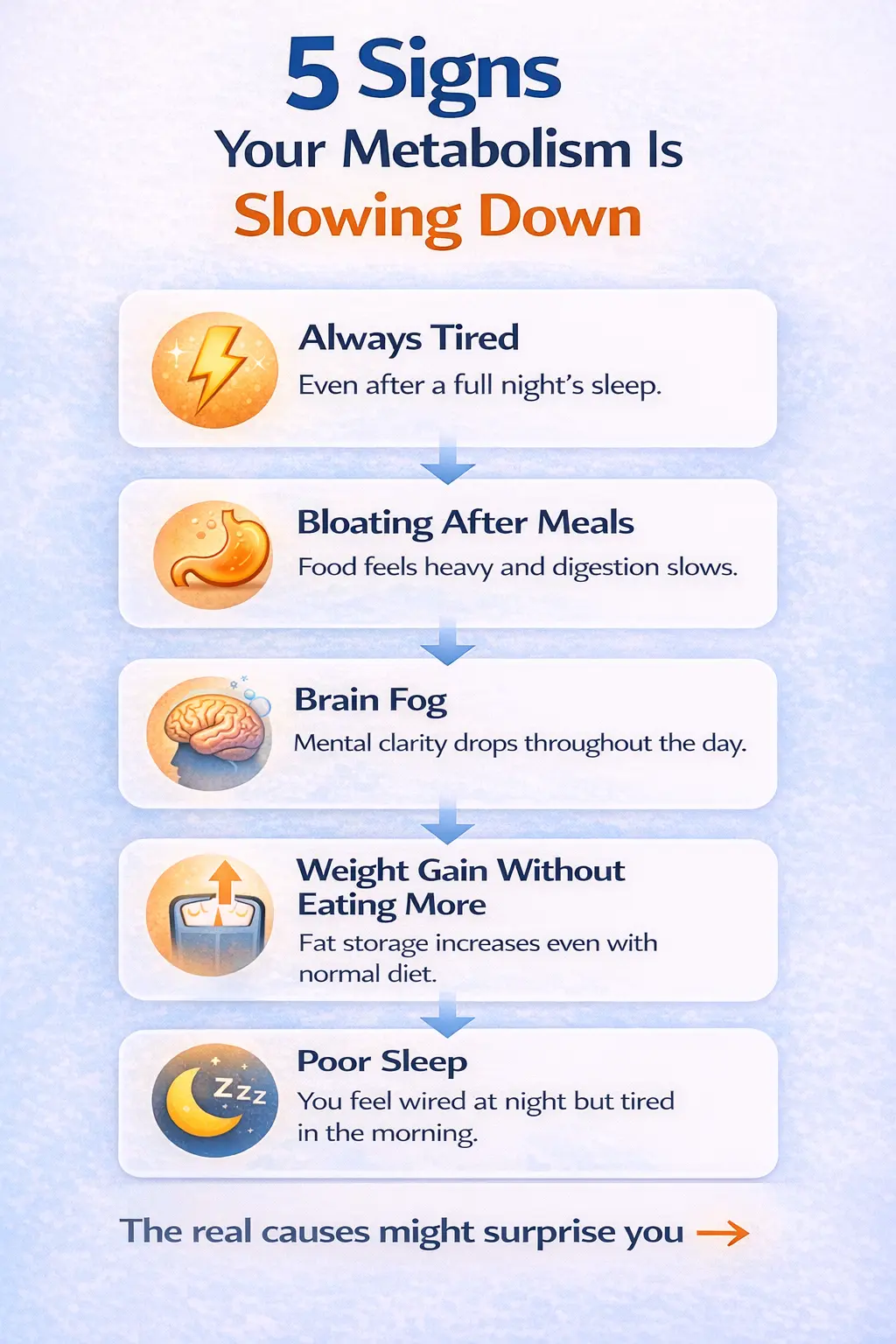
- Waking up tired no matter how many hours they sleep
- Bloating after meals that makes no sense
- Weight slowly creeping up even though they’re not eating more
- Brain fog that makes afternoons a struggle
- That wired-but-tired feeling at night
On paper? Perfectly healthy. In real life? Miserable.
And the frustrating part? When you ask for help, you’re often dismissed because the tests say you’re fine. But deep down, you know something isn’t right.
The Silent Metabolic Crisis Nobody Talks About

The truth is something medicine is only beginning to recognize. For the first time in history, the environment we live in is quietly damaging our metabolism.
It’s not genetics. It’s not bad luck. It’s not simply that you’re getting older.
The way modern life is structured is putting enormous pressure on human biology.
If you look at the data, it’s honestly a little shocking:
These conditions don’t appear overnight.
They develop silently — sometimes over 10, 20, even 30 years.
You don’t get dramatic symptoms. There are no clear warning signs.
Instead, the body begins sending subtle signals:
- Energy becomes less stable
- Digestion becomes unpredictable
- Weight becomes harder to control
- Hormones begin shifting
Many of these early signals are deeply connected to digestive health and stress physiology — something explored in detail in this article on how stress causes stomach issues.
Metabolic problems rarely begin with dramatic disease. They begin with small physiological imbalances that slowly accumulate over time.
Ayurveda described this early phase thousands of years ago using the concept of Sancaya — the stage where imbalance is building, but disease has not fully manifested yet.
Understanding this stage is critical, because it is also the stage where the body is still incredibly capable of recovery.
What “Slow Metabolism” Actually Means
Before we dive into causes, let’s clarify something important.
Your metabolism isn’t a mysterious switch that determines whether you gain weight or lose it.
Metabolism is simply the process by which your body converts the food and drinks you consume into usable energy.
It is the entire system that keeps your cells alive and functioning.
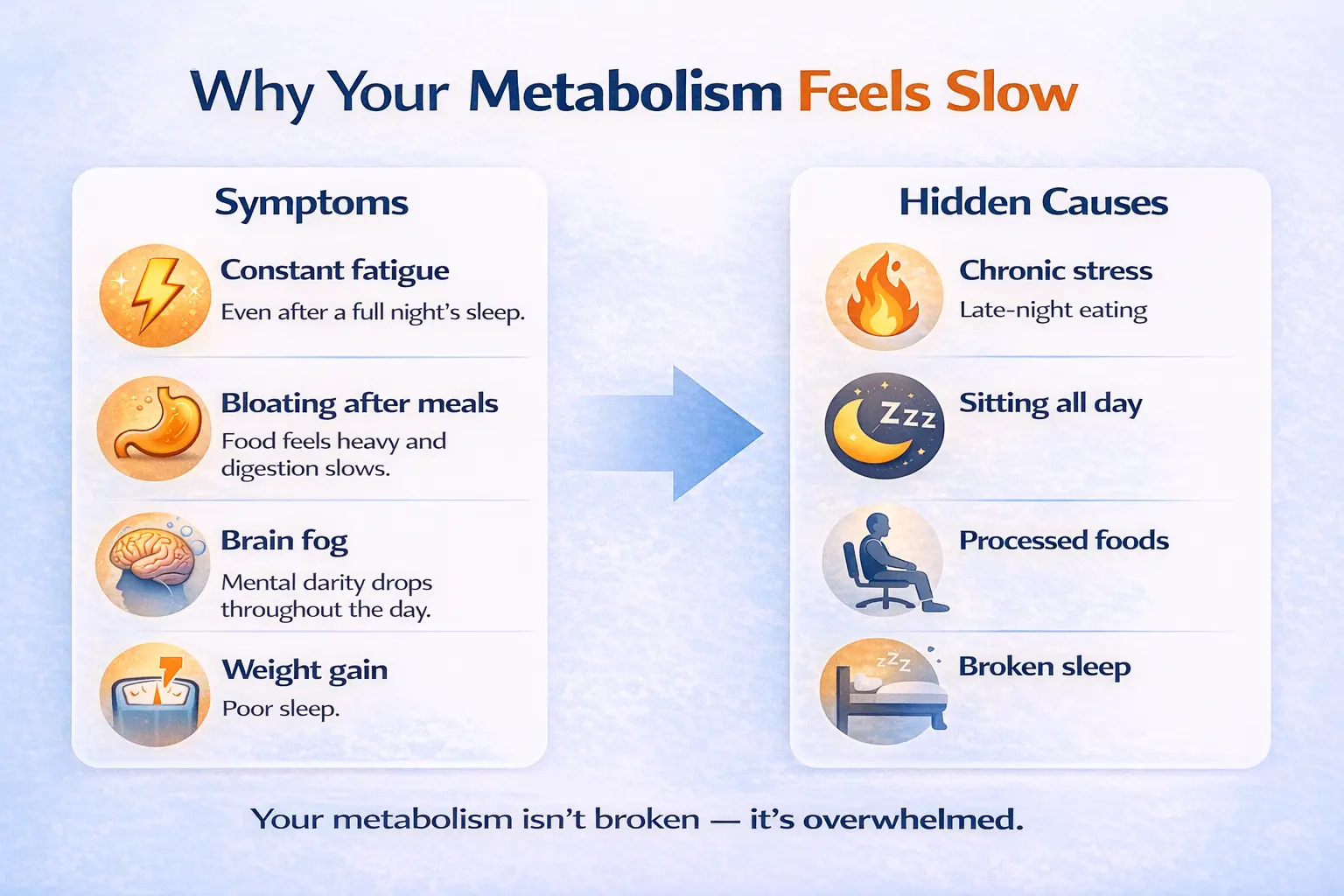
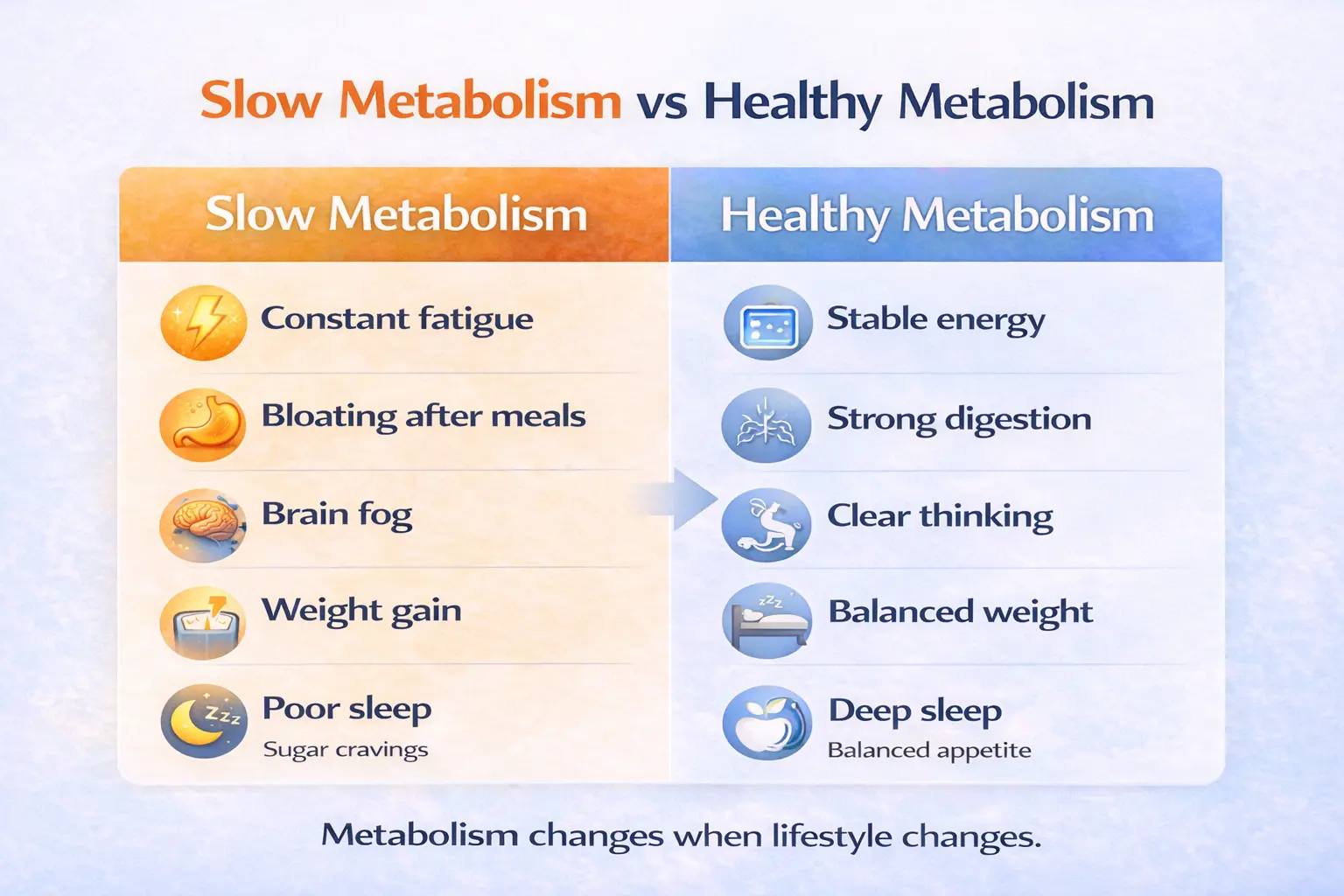
When people say they have a “slow metabolism”, they usually mean their body feels inefficient at managing energy.
And that inefficiency tends to show up through several very recognizable symptoms.
These symptoms are often blamed on aging or genetics, but in reality they usually reflect something deeper happening inside the body’s metabolic systems.
Metabolism is not controlled by a single organ. It is influenced by digestion, hormones, nervous system balance, muscle activity, and sleep quality.
When these systems begin drifting out of alignment, the body becomes less efficient at converting food into energy.
Instead of producing vitality, the body begins accumulating metabolic waste and storing excess energy.
In Ayurveda, this metabolic efficiency is governed by Agni — the digestive and metabolic fire responsible for transforming food into energy.
When Agni weakens, the body begins producing Ama, a toxic metabolic residue that clogs physiological pathways.
Modern research describes very similar mechanisms using terms such as inflammation, insulin resistance, and mitochondrial dysfunction.
Different languages, but describing the same biological reality.
If digestion is consistently weak, metabolic imbalance becomes much more likely. This is why strengthening digestive function is central to Ayurvedic treatment for digestion.
Understanding this connection is the key to solving many metabolic problems that otherwise seem confusing or unexplained.
If you prefer a visual explanation, this short video explains the most common reasons metabolism slows down and what you can do to restore metabolic balance naturally.
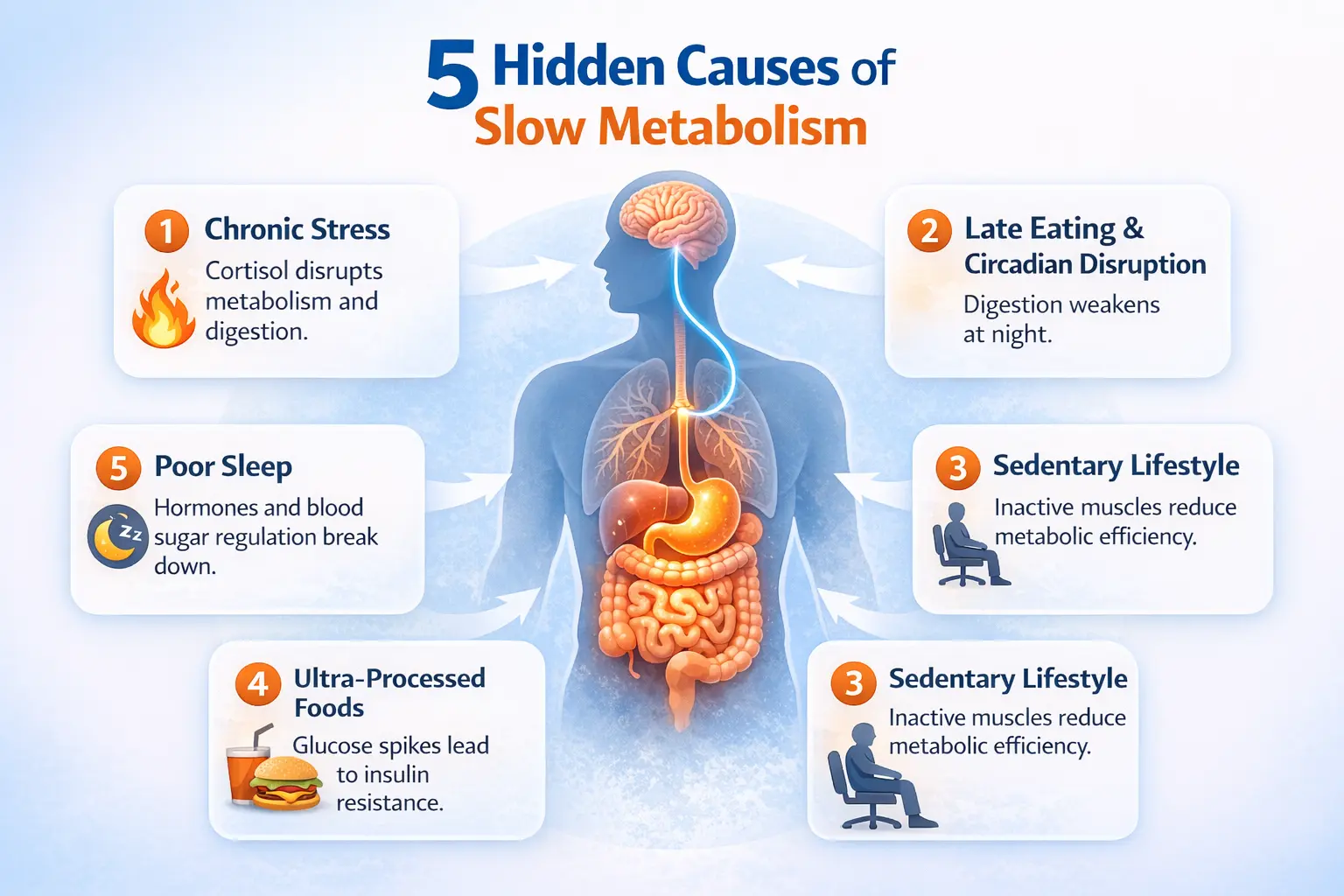
The Five Hidden Reasons for a Slow Metabolism
Let me walk you through the five biggest pressures in modern life that quietly damage your metabolism.
Some of these might surprise you.
Never-Ending Stress (The Cortisol Trap)
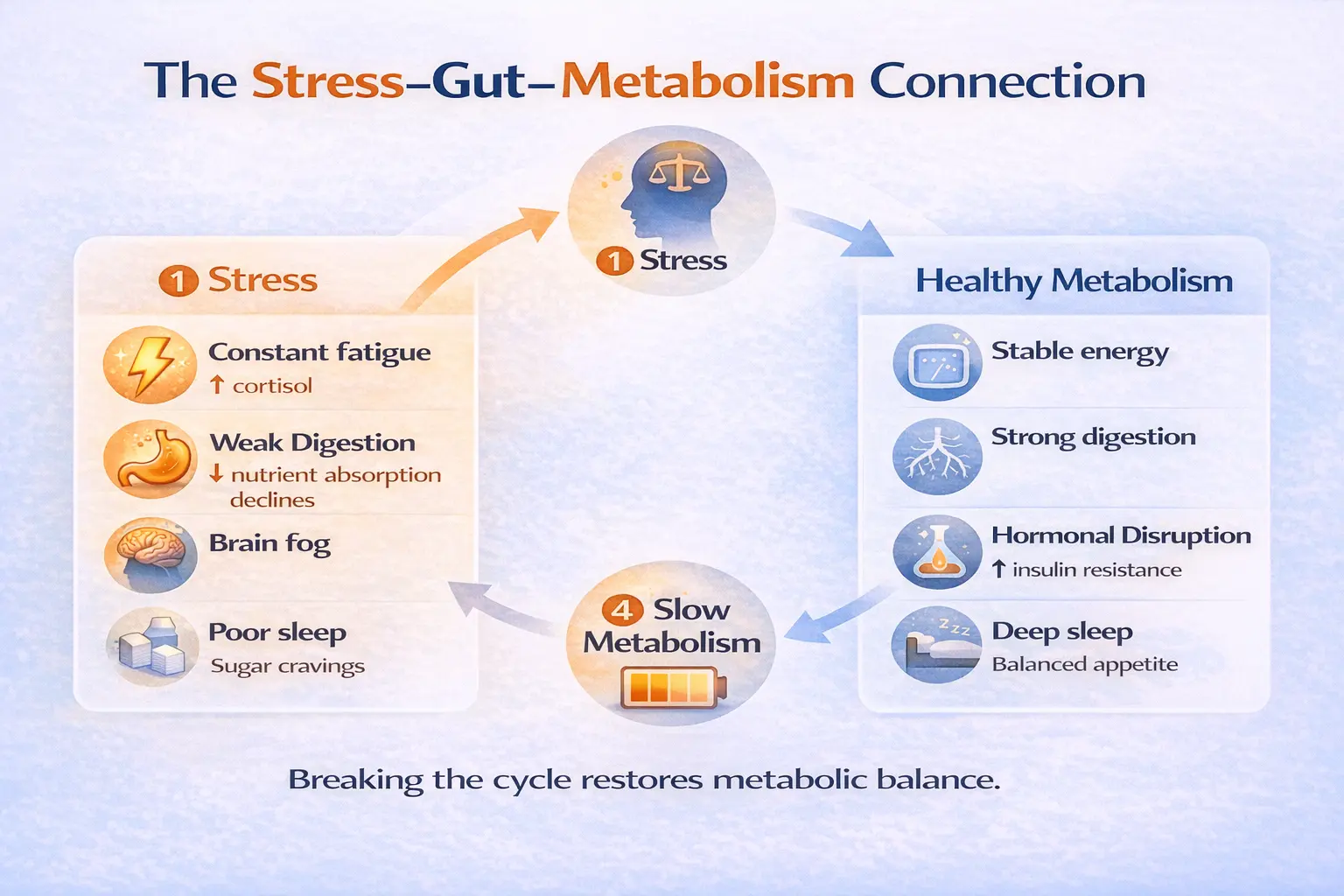
This first one might surprise you. It isn’t food. It isn’t exercise. It isn’t even sleep—though all of those matter.
It’s chronic stress.
Imagine you’re walking through a jungle thousands of years ago. Suddenly, a tiger appears. Your body instantly shifts into survival mode—fight or flight. Your heart rate rises. Your blood sugar increases. Your digestion shuts down temporarily so energy can go to your muscles.
The tiger disappears. Your body relaxes. The cycle is complete.
That cycle is healthy. The problem? Modern stress never ends.
Emails late at night. Financial pressure. Constant notifications. Social media comparison. Traffic. Deadlines.
Your body never receives the signal that the danger is over.
So cortisol stays elevated far longer than it should.
And when cortisol remains high for long periods:
- Blood sugar stays elevated
- The body becomes more likely to store fat
- Digestion becomes weaker
- Inflammation slowly increases
This is why stress physiology is so closely connected to digestive health, something explored further in this guide on stress and stomach issues.
Eating Against Your Body’s Clock
Here’s something most people don’t realize:
When you eat matters almost as much as what you eat.
Your metabolism follows a circadian rhythm—an internal clock that synchronizes with daylight.
Digestion is strongest around midday and naturally weaker late at night.
But modern eating patterns have flipped this completely.
- Breakfast skipped or replaced with coffee
- Lunch rushed at a desk
- Dinner eaten very late
When heavy meals arrive late at night, digestion becomes sluggish.
Food sits longer in the digestive system and begins fermenting.
Ayurveda calls this metabolic residue Ama.
Ama slowly clogs the body’s metabolic pathways and interferes with energy production.
The Sitting Disease
This one is so common that we barely notice it anymore.
We sit in cars. Sit at desks. Sit during meals. Sit on couches watching television.
But muscles are not just for movement — they are metabolic organs.
Active muscles help regulate blood sugar and improve insulin sensitivity.
When muscles remain inactive for long periods, metabolic efficiency gradually declines.
Humans evolved moving throughout the day. Some estimates suggest traditional humans walked 10–15 kilometers daily.
Today, many people walk less than two.
Ultra-Processed Foods and the Glucose Rollercoaster
Ultra-processed foods dominate modern diets.
- Highly refined carbohydrates
- Industrial seed oils
- Artificial additives
- Hyper-palatable flavor combinations
These foods create rapid spikes in blood sugar.
Your body releases insulin to manage the surge of glucose.
Then blood sugar crashes.
This rollercoaster gradually pushes the body toward insulin resistance.
Insulin resistance is the foundation of metabolic syndrome, pre-diabetes, and type 2 diabetes.
Broken Sleep
Sleep is not simply rest.
It is the period when the body performs deep repair and metabolic maintenance.
During deep sleep:
- Hormones recalibrate
- Cells repair damage
- Blood sugar regulation resets
- The brain clears metabolic waste
Modern sleep patterns often involve:
- Too little sleep
- Irregular bedtimes
- Artificial light exposure at night
Even one week of poor sleep can significantly reduce insulin sensitivity.
Which means metabolism becomes less efficient even if your diet is healthy.
What Your Blood Tests Don’t Show
Here’s where things become confusing for many people.
Metabolic disease rarely appears suddenly. It develops gradually in stages. And standard medical tests only catch it at the very end.
Let me show you the stages nobody talks about:
Energy Instability
You feel tired in the morning but wired at night. You rely on coffee to wake up and wine or carbs to wind down. Your energy crashes after meals.
Digestive Unpredictability
Bloating becomes normal. Gas after meals. Irregular appetite. Sometimes constipated, sometimes loose stools. You just assume this is how digestion works.
Hormonal Shifts
Mood changes. Anxiety. Low libido. Sleep disturbances. For women, periods become irregular or more painful. For men, testosterone drifts downward.
Inflammation Builds
Joint aches appear. Skin issues—acne, eczema, rashes. Brain fog makes it hard to focus. You feel puffy, especially in the morning.
Diagnosable Disease
Finally—finally—something shows up on tests. Blood sugar crosses the threshold. Blood pressure ticks up. Cholesterol panels look concerning. You’re handed a diagnosis: pre-diabetes, metabolic syndrome, fatty liver, hypothyroidism.
Here’s the tragedy: all of this was reversible in Stages 1 through 4.
But because nothing showed up on tests, you were told you were fine.
Ayurveda described this early stage long ago using the concept of Sancaya—the phase where imbalance is accumulating but disease hasn’t fully materialized yet.
This stage is incredibly important because this is where the body is still very capable of recovery.
The Good News: Metabolism Is Resilient

Here’s what I want you to take away from all of this:
Metabolism is actually remarkably resilient.
When we restore the basic foundations the body evolved for, things often begin to improve surprisingly quickly.
After years of studying and working with people, one thing has become very clear to me: most metabolic problems are not random. They’re not bad luck. They’re not a genetic curse.
They are the predictable result of how we live.
And when the underlying patterns change, the body responds.
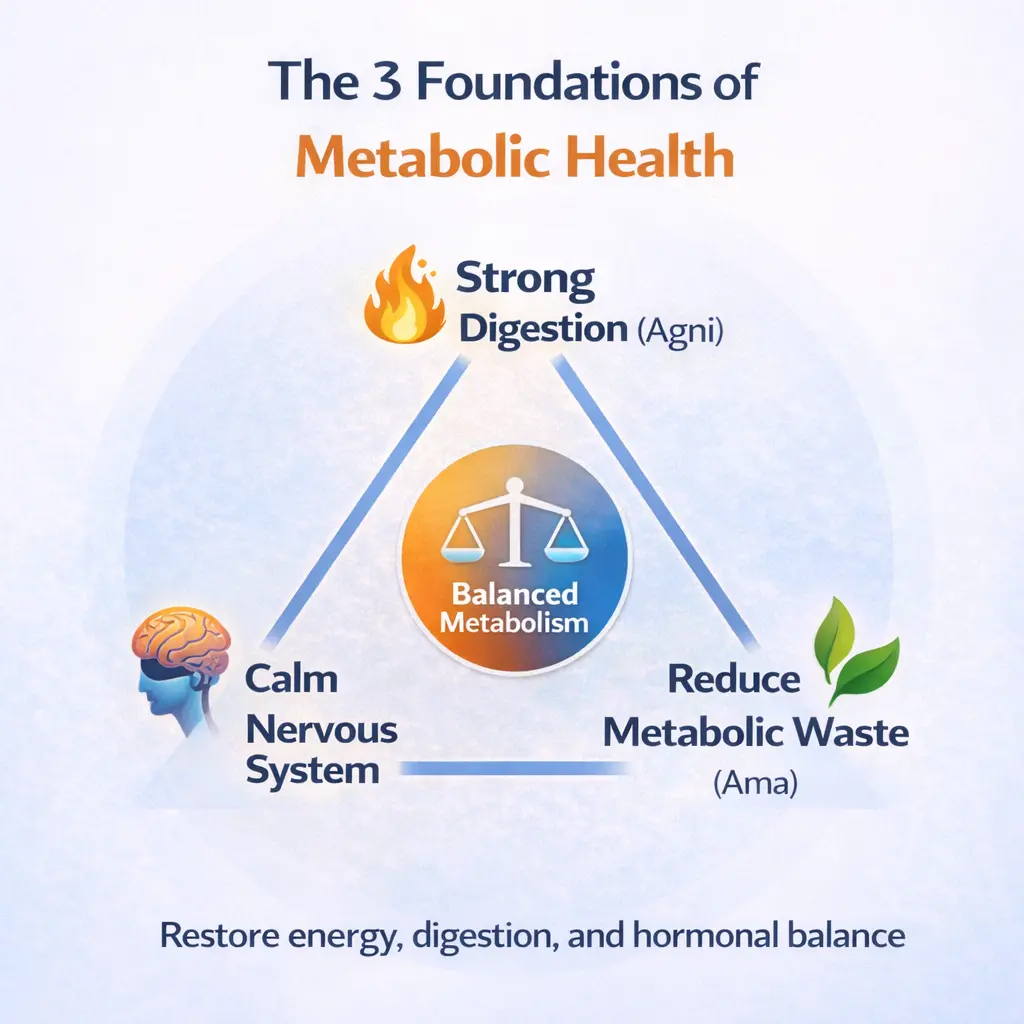
How to Fix Slow Metabolism: Three Foundations

Based on both modern science and thousands of years of Ayurvedic wisdom, here are the three foundations for restoring metabolic health.

Strengthen Digestion (Agni)
In Ayurveda, digestive strength is called Agni—your digestive fire. When Agni is strong, you convert food into energy efficiently. When it’s weak, you create Ama (metabolic waste).
Practical steps:
- Eat warm, freshly prepared foods. They’re easier for the body to process than cold or heavily processed meals.
- Make lunch your largest meal. This aligns digestion with your body’s natural circadian rhythm when digestive fire is strongest.
- Leave 3–4 hours between dinner and sleep. This gives your body time to complete digestion before rest.
- Use digestive spices. Ginger, cumin, turmeric, coriander—these aren’t just flavor. They actively support digestion.
If digestive weakness is a consistent problem, you may benefit from understanding the deeper principles behind Ayurvedic treatment for digestion.
Calm the Nervous System
Remember the cortisol trap? Fixing your metabolism means teaching your body that the tiger is gone.
Practical steps:
- Slow breathing. Even 5 minutes of slow, deep breathing shifts the nervous system out of fight-or-flight.
- Walk after meals. Not intense exercise—just a gentle 10–15 minute walk. This aids digestion and calms stress.
- Eat without distractions. No phone. No TV. Just food. This signals safety to your nervous system.
- Create transition rituals. A few minutes of quiet between work and home, or between day and evening, tells your body it’s safe to relax.
Reduce Metabolic Buildup (Ama)
When digestion is weak and stress is high, metabolic waste accumulates. This is Ama—and it clogs every system.
Practical steps:
- Simplify meals. Fewer ingredients, less processing. Whole foods naturally reduce metabolic load.
- Reduce ultra-processed foods. If it comes in a package with ingredients you can’t pronounce, it’s probably creating Ama.
- Intermittent fasting (mindfully). Giving your digestive system a break allows it to clear out accumulated waste. Start with 12 hours between dinner and breakfast.
- Stay hydrated with warm water. Sip warm water throughout the day—it helps flush metabolic waste without shocking the system.
These principles form the foundation of the structured healing protocols used in our 90-day holistic healing program.
Frequently Asked Questions About Slow Metabolism
Many people struggling with metabolic issues have similar questions. Below are some of the most common ones.
Exercise is only one piece. If stress is high, sleep is poor, and meal timing is off, your body can still function as if it has a slow metabolism. Muscles need to be active, but they also need the right hormonal environment to work properly.
Absolutely. Chronic stress elevates cortisol, which signals your body to hold onto fat (especially belly fat), raises blood sugar, and weakens digestion. This is one of the most overlooked reasons for slow metabolism.
Yes. Metabolism is adaptable. When you address the underlying causes—stress, meal timing, food quality, movement, and sleep—the body responds. It may take time, but it’s absolutely possible.
For most people, yes. Digestion follows a circadian rhythm and is weaker at night. Large late meals are more likely to be stored as fat and create digestive residue (Ama).
Common signs: coated tongue, foul breath, feeling heavy or sluggish after meals, brain fog, joint stiffness, and a sense that food isn’t digesting completely.
Hypothyroidism is a specific medical condition where the thyroid gland doesn’t produce enough hormone. Slow metabolism is a broader term that can include thyroid issues but also includes insulin resistance, digestive weakness, and hormonal imbalances. Many people with “slow metabolism” have normal thyroid labs.
When These Foundations Stabilize, Something Interesting Happens
When patients begin applying these principles, they notice shifts:
The body begins functioning the way it was designed to.
Your Next Step (If This Resonated)
If you’re watching or reading this and thinking, “This sounds exactly like what I’ve been experiencing”—that’s actually a good sign.
Awareness is the first step toward change.
Most lifestyle diseases aren’t random. They’re not a coincidence. They’ve been developing slowly and gradually over time. And when the underlying patterns change, the body responds—for better or worse.
You are not broken. You’re not lazy. You’re not imagining things.
You’re just living in a modern world that puts enormous pressure on ancient biology. And now that you understand what’s happening, you can do something about it.
If you’d like to explore this deeper, I work with patients one-on-one to apply these principles to their specific situations.
Details are here:
Start Your Metabolic Reset
Move beyond generic advice and receive personalized guidance designed around your digestion, stress physiology, and lifestyle.
Book Your Holistic Health ConsultationAnd if this article resonated with you, consider sharing it with someone who needs to hear that their symptoms are real—even if their tests say otherwise.
In the next article, we’ll explore something fascinating: how your gut may actually be controlling far more of your health than your brain does. Once you understand that connection, many health mysteries suddenly start making sense.
Until then, take very good care of yourself.

You may also like