Ayurveda Classes Online: How Technology Is Transforming the Ancient Learning Experience

Ayurveda Classes Online: How Technology Is Transforming the Ancient Learning Experience
An authoritative analysis of how digital platforms, live online classrooms, and global learning communities are reshaping Ayurveda education for the next generation.
For centuries, Ayurveda was passed down through intimate, personal relationships—teacher to student, physician to apprentice, lineage to lineage. Learning happened in courtyards, clinics, forests, and homes. Knowledge flowed through lived experience, not textbooks.
But in the last decade—and especially since 2022—the learning landscape has transformed dramatically. Today, Ayurveda classes online have evolved from niche experiments into the mainstream format for beginners, wellness seekers, and global students.
This shift is not merely technological. It represents a cultural reorientation toward accessibility, flexibility, and integrated learning pathways.
People want Ayurveda education that fits real life:
- Between work meetings
- After putting kids to bed
- During morning routines
- Across time zones
Online Ayurveda classes meet this need with remarkable precision.
The Digital Shift in Ayurveda Learning
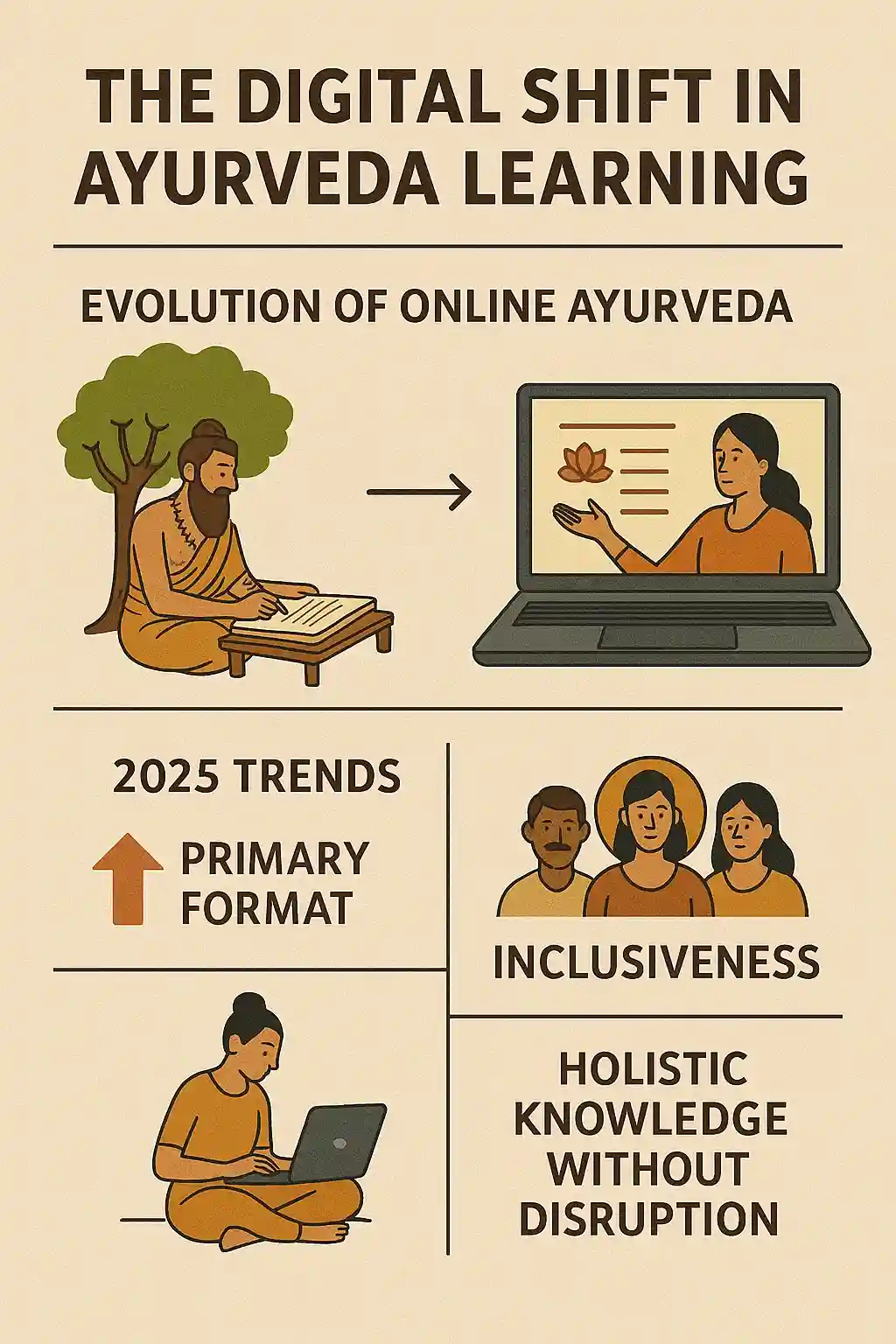
The momentum toward Ayurveda classes online accelerated rapidly between 2020 and 2025. What began as a temporary adaptation soon revealed itself as a powerful pedagogical model—one uniquely suited to the layered, experiential nature of Ayurveda.
Historically, Ayurveda has shown remarkable fluidity. Ancient vaidyas traveled from village to village with little more than herbs and knowledge in hand. Today, Ayurveda teachers travel through fiber-optic lines instead of dusty roads.
Why Ayurveda Thrives in a Digital Classroom
While some classical traditions may seem incompatible with technology, Ayurveda fits surprisingly well into a blended digital model.
- Concepts are visual: Doshas, Agni, Dhatus, Srotas—diagram-friendly systems
- Demonstrations are simple: Herbal mixes, self-care routines, kitchen-based techniques
- Discussion is essential: Students’ real-life experiences enrich the learning
- Global applicability: Ayurveda principles work across cultures and food systems
Why Live Ayurveda Classes Work Better Than Pre-Recorded Courses
Pre-recorded content provides convenience, but Ayurveda as a discipline depends deeply on observation, correction, tone, and energy transmission.
1. Real-Time Corrections
Ayurveda practices—breathwork, marma touch, tongue assessment, spice roasting—require nuance. A live teacher can guide:
“Slow your exhale by two counts… yes, now the prana settles.”
Micro-adjustments like these shape the entire practice.
2. Human Energetics Matter
Ayurveda is built on energy—prana, ojas, tejas, sattva. A teacher’s presence, voice resonance, and grounded intention profoundly influence the student’s learning field.
Many students describe live classes as:
“Exactly like sitting in the same room with the teacher.”
3. Accountability & Learning Rhythm
Self-paced videos often become digital clutter—watched partially, forgotten quickly. Live classes create structure and rhythm: weekly continuity, shared community, real-time engagement.
How Live Online Ayurveda Teaching Actually Works
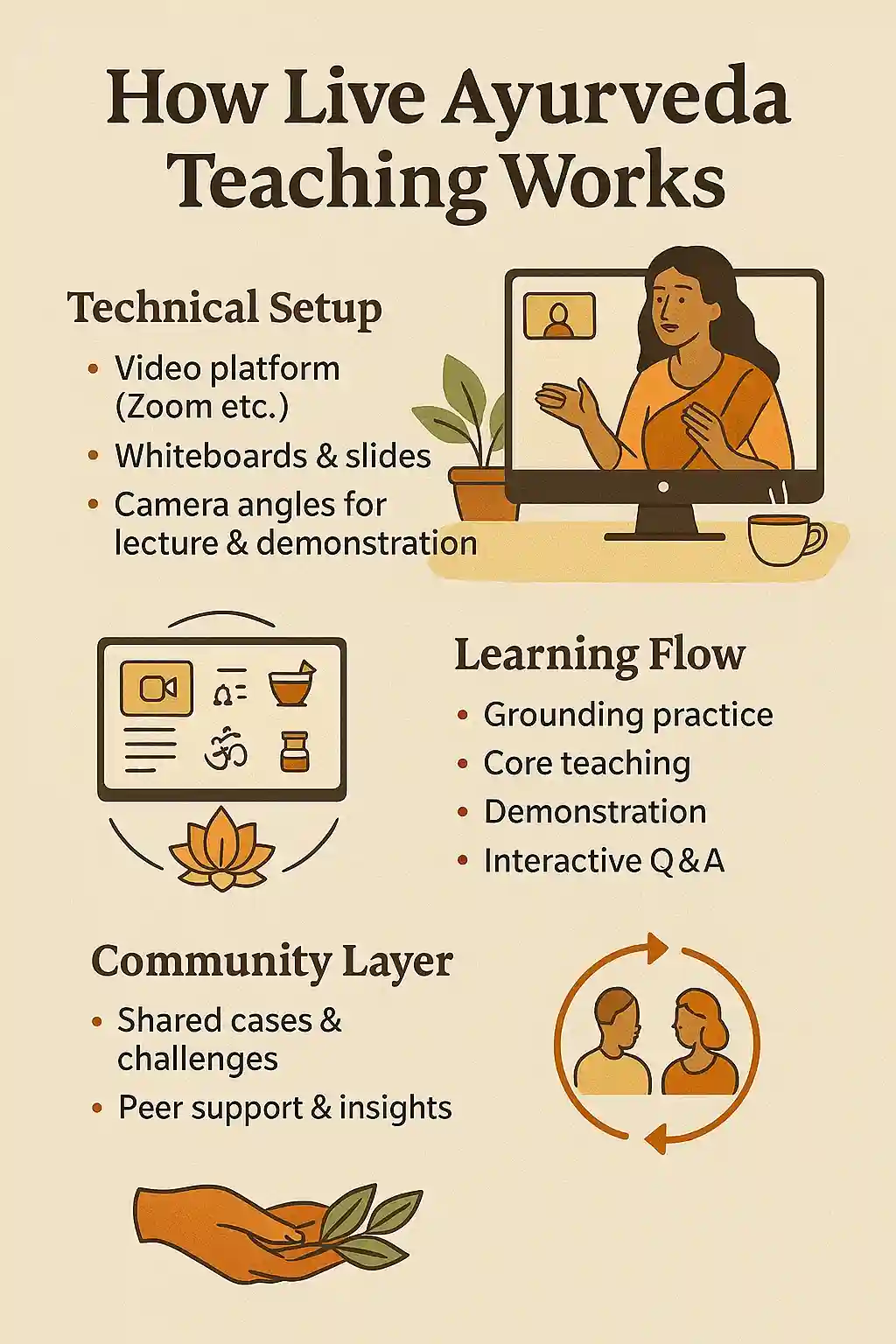
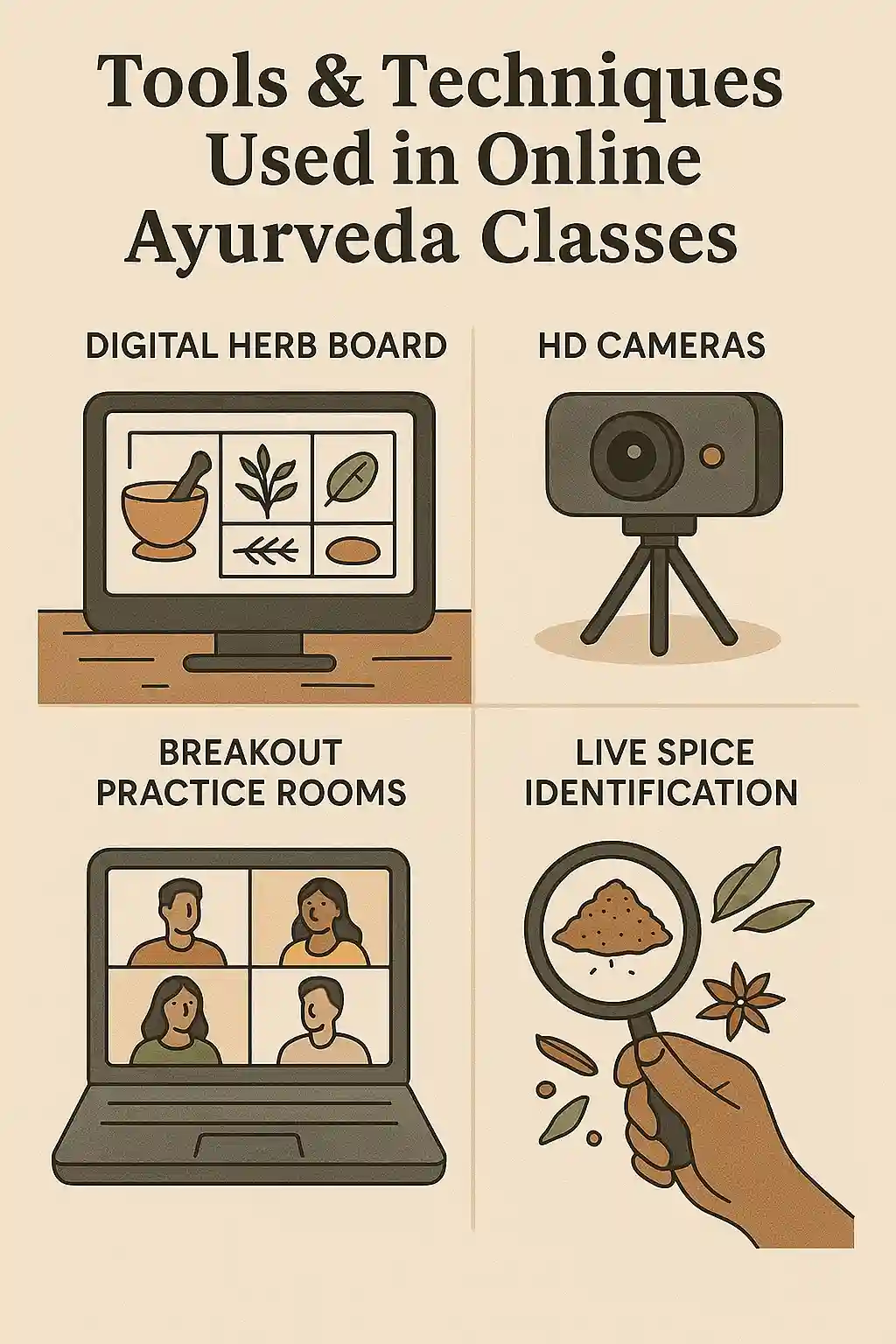
Modern Ayurveda classes online rely on simple, effective digital setups—optimized not for slick production, but for clarity, presence, and accurate demonstration. Teachers focus on conveying essence, not theatrics.
Technical Setup That Supports Authentic Learning
- Front-facing camera — for lectures, expressions, hand gestures
- Top camera — for herbs, powders, massage tools, kitchen demos
- Digital whiteboard — for Tridosha diagrams & flowcharts
- Meditation microphone — for breathwork, grounding practices
This minimalist setup makes learning immersive, while keeping tech stress low.
Learning Flow Inside a Live Class
Most high-quality Ayurveda classes follow a structured yet fluid learning arc:
- Grounding or breathwork — stabilizes the mind before learning
- Short storytelling — activates emotional learning pathways
- Core concept teaching — theory, context, modern parallels
- Demonstration — herbs, kitchen routines, diagnostics
- Interactive Q&A — clarifies doubts instantly
- Reflection or journaling — integrates the knowledge
This blend of cognitive + sensory + experiential teaching mirrors the classical gurukul model.
Inside a 60-Minute Real Online Ayurveda Class
To understand why this model works so well, it helps to visualize a typical session.
0–5 Minutes — Grounding
Students settle into breath using a nature metaphor such as the “peepal tree breath.” This regulates vata, improves focus, and resets the nervous system.
5–20 Minutes — Core Teaching: Agni in Daily Life
Teachers link classical theory with modern life:
- How Agni reacts in air-conditioned offices
- How emotional overload weakens digestion
- How mismatched dinner timing disturbs gut rhythms
This makes Ayurveda applicable rather than abstract.
20–35 Minutes — Demonstration
Example: an Agni-balancing breakfast
- Warm rice kanji
- Ghee swirl technique
- Herbal toppings for dosha balance
35–55 Minutes — Discussion & Personalization
Students share patterns like irregular meals, acidity episodes, or bloating after office lunches. Teachers then give gentle, personalized recommendations.
55–60 Minutes — Closing Intention
A short mantra, breath cycle, or silence period seals the practice.
The Role of the Modern Ayurvedic Educator
Today’s online Ayurveda teacher is not a distant “guru” but a grounded, compassionate guide. Their aim is to make ancient wisdom accessible, safe, and practical for modern lifestyles.
How Modern Ayurveda Teachers Communicate
- Warm, calm, steady voice
- Clear explanations without jargon
- Emphasis on practical integration over memorization
- Encouragement-based teaching rather than fear-based messaging
What They Avoid
- Exaggerated health claims
- Diagnosing illnesses online
- Rigid doctrinal teaching
- Outdated clichés or fear narratives
How They Maintain Authenticity
- Referencing classical Ayurvedic texts
- Providing safety disclaimers
- Using evidence-informed perspectives
- Connecting theory with real-world applicability
This balanced approach helps global students learn Ayurveda in a way that is culturally sensitive, emotionally supportive, and deeply aligned with tradition.
The Three-Layer Framework Modern Ayurveda Teachers Use Online
High-quality Ayurveda classes online follow a structured learning methodology that blends classical transmission with modern digital pedagogy. This three-layered approach helps students not only understand concepts, but embody them.
1. Shakti Layer — Energy Transmission
This is the non-verbal essence of Ayurveda learning. A teacher’s grounding presence, voice rhythm, tone, and intention help regulate the student’s prana. Even through screens, this energetic layer builds trust, focus, and receptivity.
2. Buddhi Layer — Cognitive Understanding
This layer delivers logical clarity. Teachers use digital whiteboards, diagrams, case references, and metaphors to make complex ideas like dosha flow, Agni behavior, and srotas functions easy to grasp.
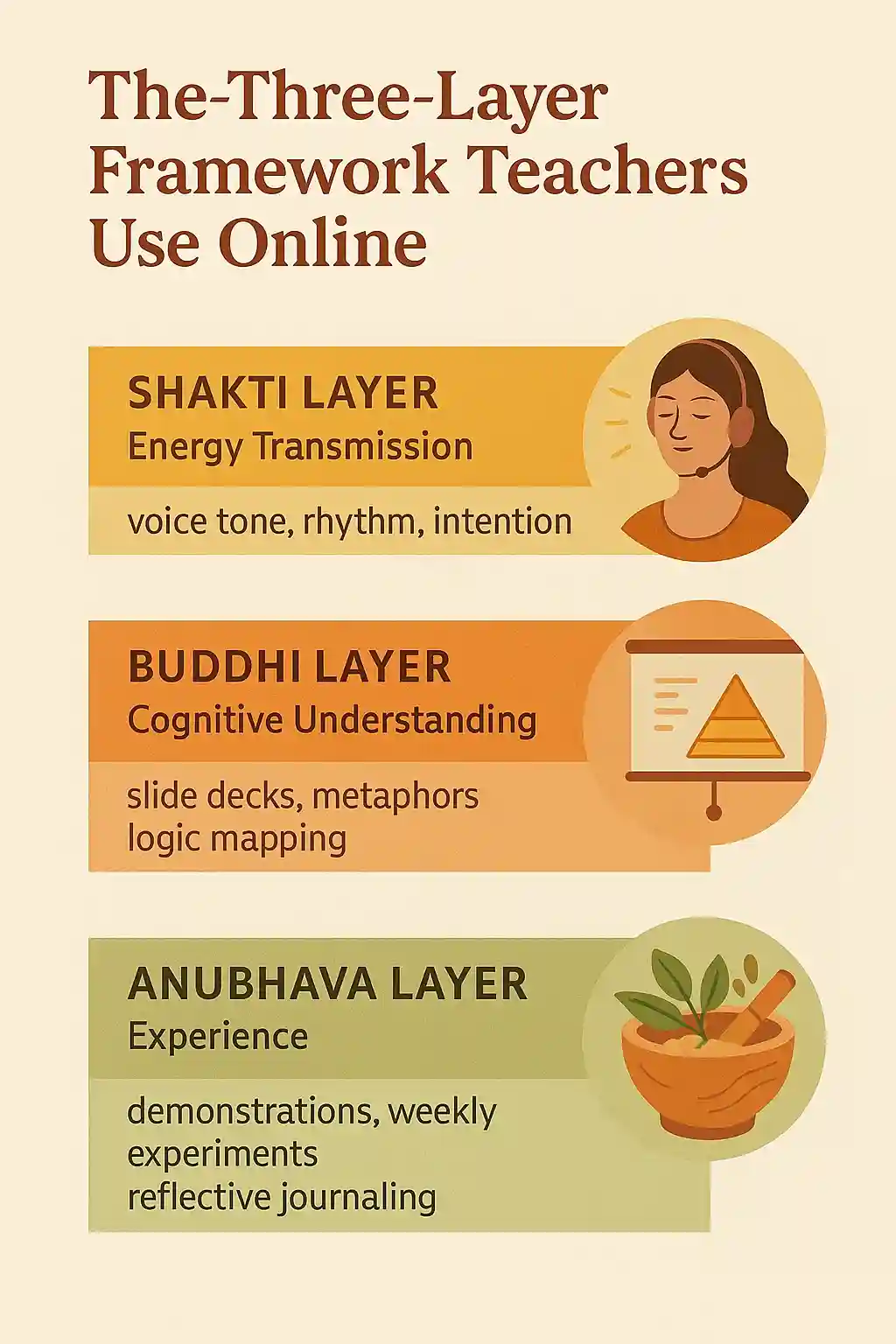
3. Anubhava Layer — Experiential Practice
Experience anchors theory. Demonstrations, breath exercises, self-observation, herbal prep, cooking techniques, and journaling prompts help students turn learning into embodied awareness—something Ayurveda considers essential.
Real Student Experiences — How Online Ayurveda Classes Create Transformation
Authentic learning becomes visible not in theory, but in lived outcomes. Here are real examples reflecting the impact of structured online Ayurveda learning.
Case Study 1 — The Corporate Professional
Name: Rohit, Bengaluru — Product Manager
Challenge: Vata-driven anxiety, irregular meals.
Transformation: Stabilized digestion & anxiety within weeks using breath routines + meal rhythm.
Case Study 2 — The Homemaker
Name: Meera, Chennai
Challenge: Chronic bloating & stress-eating.
Transformation: Evening digestion rituals reduced bloating in 10 days.
Case Study 3 — The Global Learner
Name: Hana, Singapore
Challenge: Emotional stress during exams.
Transformation: Learned pitta-balancing tools to stabilize focus & mood.
What You Learn in Ayurveda Classes Online
- Prakriti & Vikriti self-understanding
- Mind-body nutrition fundamentals
- Daily routine optimization (Dinacharya)
- Seasonal wellness (Ritucharya)
- Foundational herbs & home remedies
- Breath & stress-balancing methods
- Digital habit logs & meal journals
How to Choose the Right Ayurveda School (2025 Criteria)
- Qualified faculty with lineage + modern expertise
- Minimum 2–4 hours live weekly teaching
- Demonstration-based classes
- Strong community support
- Ethics & safety transparency
- Balanced approach: Classical + modern
For students seeking clarity on recognized training pathways, it may also help to review the official guidelines from the Ministry of AYUSH, which outline standards for safe and authentic Ayurvedic education.
Online Ayurveda Courses
-
Online Ayurveda Courses — Main Program Overview
Read More → -
Complete Guide to Online Ayurveda Course — Learn at Your Own Pace
Read More → -
Advanced Ayurveda Training — Deepen Your Knowledge & Skills
Read More → -
Best Online Ayurveda Schools (2025)
Read More → -
Why an Advanced Ayurveda Certification Leads to a Wellness Career
Read More →
FAQs — Ayurveda Classes Online
Yes — live, interactive, demonstration-based classes are highly effective and comparable to in-person learning.
No. Most online programs begin with core fundamentals like doshas, Agni & daily routine basics.
Absolutely. Multi-camera setups allow teachers to demonstrate herbs, remedies, cooking & diagnostics.
Beginner certificates are for personal wellness; advanced programs are needed for professional practice.
Most learners experience noticeable improvements within 2–6 weeks when applying guidance consistently.
Suggested Readings
-
Online Ayurveda Herbalism Courses for Enthusiasts
Read More → -
Ayurveda Training Online: Learn Authentic Ayurveda from Certified Experts
Read More → -
Understanding Online Ayurveda Certification & Accreditation
Read More → -
Ayurveda Courses Online vs Traditional Learning: Cost Compared
Read More → -
How to Learn Ayurveda Online — A Beginner’s Step-by-Step Guide
Read More → -
Online Ayurveda Classes – Weekly Learning Schedule for Working Professionals
Read More →
Conclusion — Ayurveda’s Digital Evolution
Online Ayurveda classes are not a compromise — they are the next chapter in the tradition’s evolution. By combining ancient knowledge with modern accessibility, they bring personalized wellness education to learners across the world.
The future of Ayurveda will be:
- Hybrid (online + experiential)
- Global
- Interactive
- Deeply human — supported by technology, not replaced by it
Ayurveda now travels through screens, bandwidth, and global communities — changing lives with the same timeless wisdom.