Best Online Ayurveda Nutrition Course/Courses in 2025 (Ranked & Compared)
How to Become an Ayurvedic Nutrition Coach: Step-by-Step Guide (2025)
If you’re searching for the best online Ayurveda nutrition course in 2025, you’re not alone. Thousands of students today prefer online Ayurvedic nutrition courses because they offer flexibility, expert-led learning, and globally recognized certificates. But with so many Ayurvedic nutrition programs available, it can be difficult to compare them and choose the right path. This guide ranks and reviews the top options so you can find the ideal ayurvedic nutrition course online based on quality, depth, and outcomes.
Ayurveda nutrition coaching blends classical Ayurvedic wisdom with modern wellness practice. This step-by-step guide explains the skills, certifications, practical methods, career paths, and real-world applications needed to become a successful Ayurvedic nutrition coach.
Becoming an Ayurvedic nutrition coach is far more than learning food lists or dosha charts. It’s a journey into understanding digestion, emotional patterns, seasonal rhythms, constitution-based nutrition, and lifestyle changes that actually help people heal. If you are new to this field, start with this — it offers a foundation that makes everything in this guide easier to absorb.
What an Ayurvedic Nutrition Coach Really Does
An Ayurvedic nutrition coach helps people understand their digestion, emotions, energy, metabolism, cravings, and food reactions using time-tested Ayurvedic principles. Unlike modern dieticians who focus primarily on calories and macros, Ayurvedic coaches work with agni (digestive fire), constitution (prakriti), imbalances (vikriti), and food energetics.
Think of it like this: where modern nutrition tells you “what to eat,” Ayurveda explains “why your body reacts the way it does.” This is why coaches trained through a strong foundation — such as the — can guide clients with far more accuracy and compassion.
Expert Perspective: Most clients struggle not because they don’t know what to eat — but because their digestion, lifestyle, emotional patterns, and rhythms are misaligned. Ayurvedic coaches address the root causes that modern diets often ignore.
- Assess digestion (agni) and meal patterns
- Identify dosha-based imbalances
- Guide clients through food energetics (rasa, virya, vipaka)
- Create personalized Ayurvedic meal plans
- Support emotional and stress-related eating
- Help clients follow seasonal (ritucharya) and daily (dinacharya) routines
- Provide long-term lifestyle guidance
Who Can Become an Ayurvedic Nutrition Coach?
The beauty of Ayurveda is that it welcomes people from diverse backgrounds — homemakers, yoga teachers, corporate professionals, fitness trainers, wellness consultants, and beginners with no prior medical knowledge.
What matters is a genuine interest in helping people heal. A structured online Ayurveda program — such as the ones listed in — can give you the complete foundation you need.
Helpful Skills (Not Mandatory)
- Good communication & listening
- Interest in healing or wellness
- A calm, non-judgmental approach
- Understanding of food, digestion, or yoga
- Interest in holistic living
Formal Requirements
No formal degree is required, but choosing a good online course matters. A career-aligned program — such as an — is ideal for those who want professional coaching opportunities.
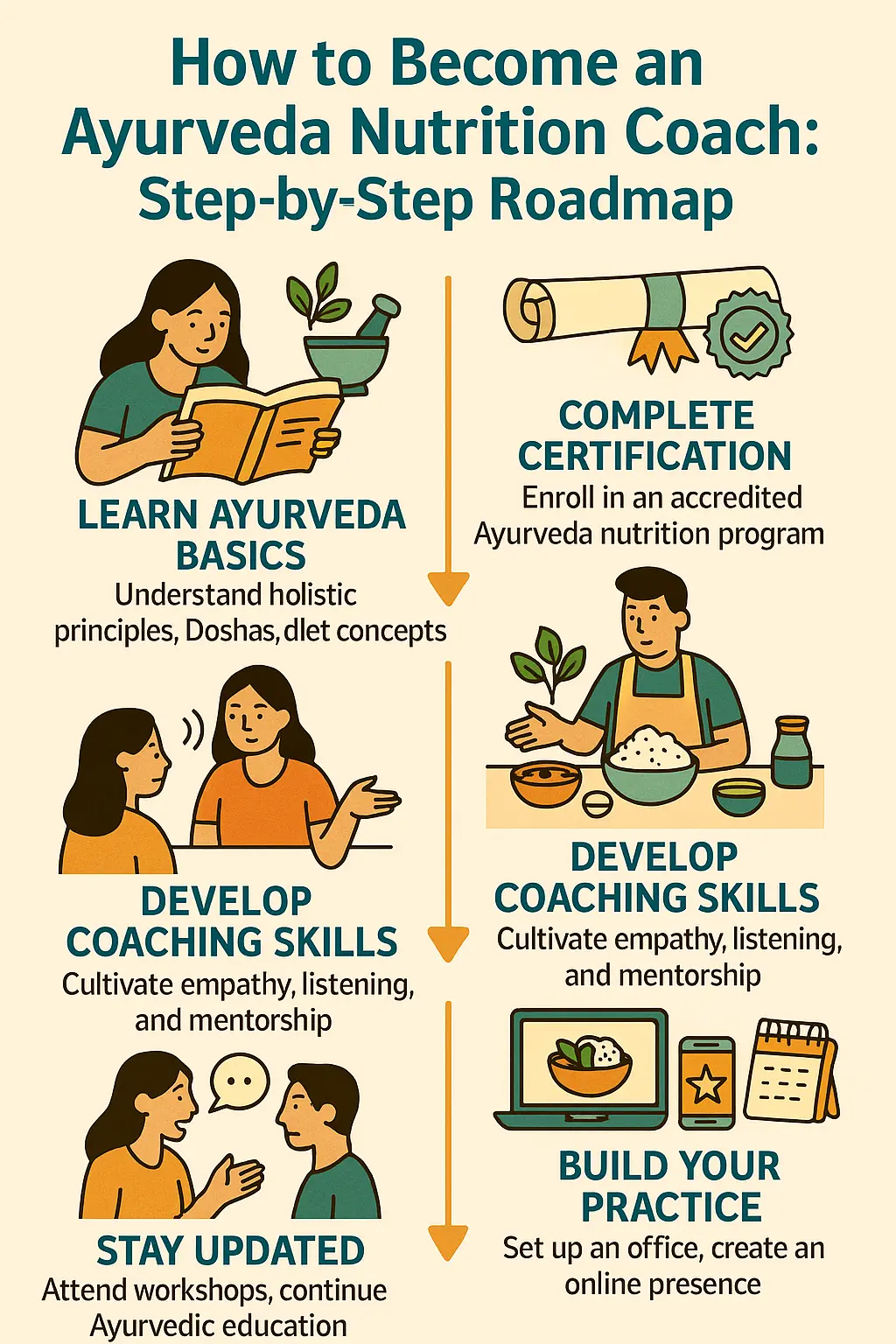
Step-by-Step Path to Becoming an Ayurvedic Nutrition Coach
This roadmap is practical, beginner-friendly, and career-focused. Each step builds the skillset you need to coach real clients confidently.
Step 1 — Learn the Foundations (2–6 weeks)
One-sentence: Build a clear understanding of doshas, agni, and basic food energetics before moving to applied practice.
- Take a structured beginner module (look for practical homework).
- Practice simple daily observations: food diary + digestion log for 2 weeks.
- Read one classical primer or a modern synthesis (your is a great start).
Step 2 — Practical Skills & Assessment (4–8 weeks)
One-sentence: Learn client assessment methods—digestion checks, pulse/tongue observation basics, and food journaling analysis.
- Practice intake forms and simple assessment templates with friends or volunteers.
- Learn how to design a 7-day dosha-balancing menu for common issues (bloating, low energy).
- Join a short practicum or mentorship (many courses include live case reviews).
Step 3 — Counseling & Behavior Change (3–6 weeks)
One-sentence: Learn motivational counseling, habit design, and how to support emotional eating with gentle Ayurvedic tools.
- Practice short coaching calls — focus on listening and small habit shifts.
- Build templates for morning/evening routines (dinacharya) and seasonal adjustments (ritucharya).
- Record and reflect on one client case every week.
Step 4 — Advanced Therapeutic Diet Planning (4–8 weeks)
One-sentence: Master meal plans for specific imbalances (Pitta inflammation, Vata digestion, Kapha weight), and learn safe food substitutions.
- Create 3 therapeutic meal plans for common client types.
- Study spice intelligence and basic herbal food pairings.
- Document outcomes and refine recommendations after client follow-ups.
Step 5 — Certification & Professional Setup (4–12 weeks)
One-sentence: Choose a career-focused certification (your first client-ready program) and set up the basics of your practice.
- Choose a recognized program — consider the as a practical option.
- Create service packages (intro call, 1-month plan, 3-month program).
- Learn simple marketing: a landing page, 3 client case stories, and a clear offer.
Step 6 — Launch, Iterate, and Grow (Ongoing)
One-sentence: Start small, collect client feedback, refine your process, and expand services as you build confidence and results.
- Run a 21-day digestive reset program and document client outcomes.
- Collect testimonials, refine templates, and build a signature offer.
- Consider group programs, workshops, and partnerships with yoga studios or wellness centers.
Expert Tip: Keep your first 10 clients as learning cases — not profit-centred. Document everything: symptoms, food patterns, interventions, and outcomes. These cases become your strongest evidence and help you refine your coaching style.
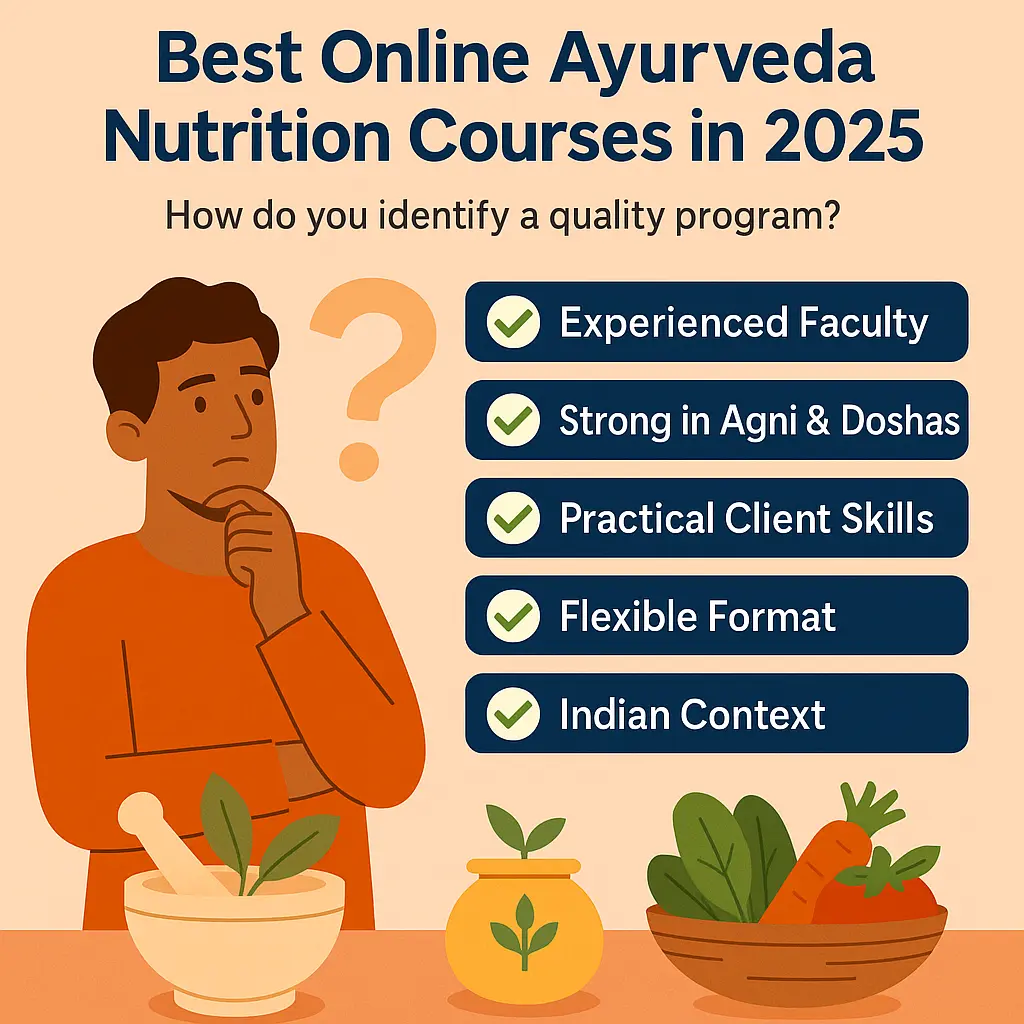
How to Choose the Right Ayurvedic Nutrition Course (2025 Guide)
A good Ayurvedic nutrition certification should make you confident in assessing digestion, reading dosha patterns, designing therapeutic meal plans, and supporting clients with emotional eating and lifestyle balancing. Use the criteria below to evaluate any program before enrolling.
Key Criteria for Selecting a Reliable Ayurveda Course
- Depth of curriculum: Doshas, agni, rasa–virya–vipaka, lifestyle, disorders, emotional eating support.
- Case-study training: Real client simulations, assignments, evaluation.
- Faculty experience: Teachers with clinical or teaching experience in Ayurveda.
- Practical tools: Templates, worksheets, counseling techniques.
- Flexibility: Self-paced + live doubt sessions.
- Career support: Guidance for online coaching, menus, pricing, packages.
Expert Insight: Theory alone is not enough. You must choose a course that teaches how to apply Ayurveda to real people — with real digestion, modern lifestyle stress, and inconsistent habits.
Comparison Table: What Sets High-Quality Programs Apart?
| Criteria | Average Course | Top-Level Course |
|---|---|---|
| Curriculum Depth | Basic doshas + diet rules | Doshas, agni, food energetics, counseling, emotional eating, lifestyle |
| Case Studies | Minimal | Structured reviews + assignments |
| Coaching Tools | Almost none | Intake forms, templates, habit frameworks |
| Career Support | Not included | Business guidance + pricing + marketing basics |
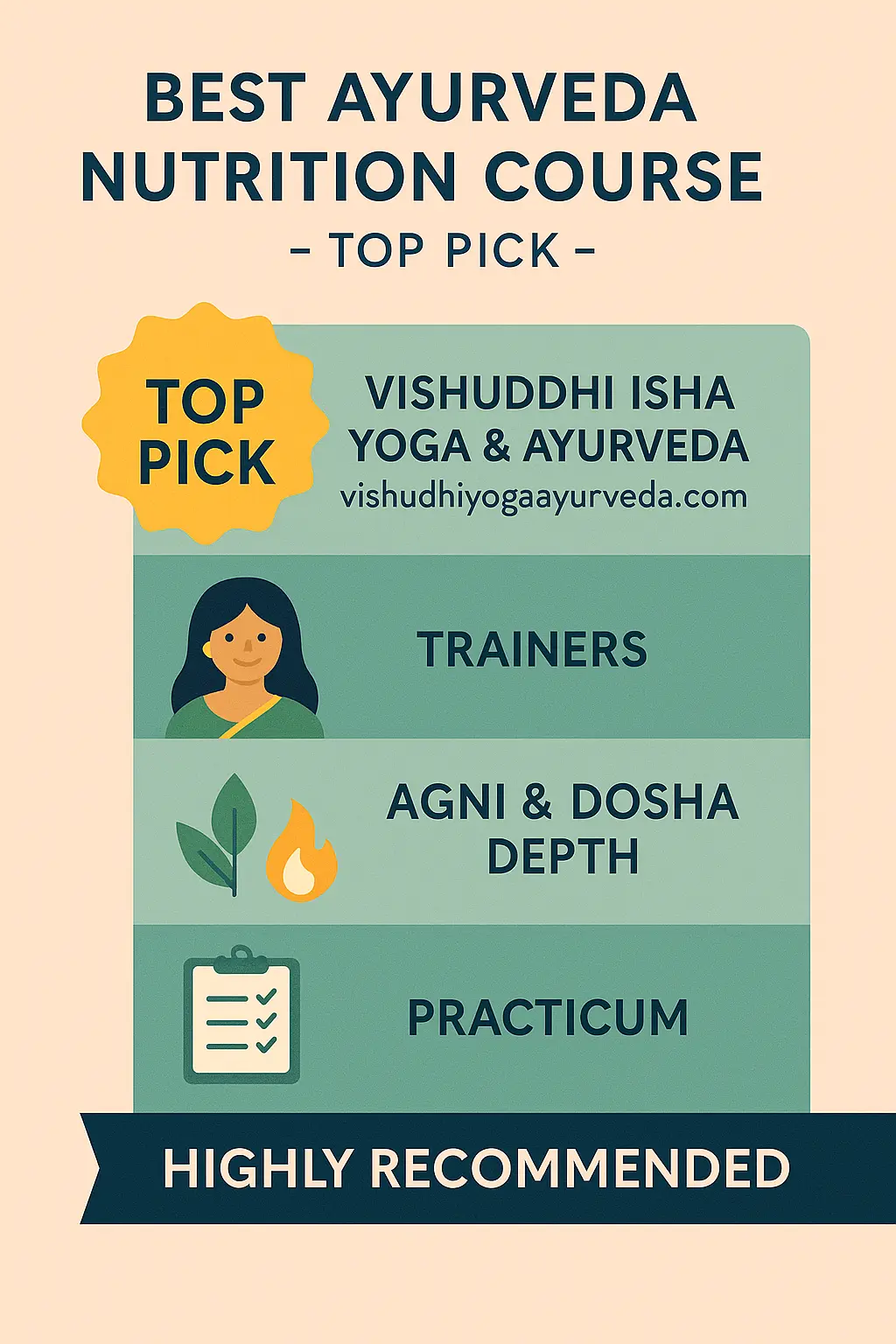
⭐ Best Overall Course for 2025
Vishuddhi Isha Yoga & Ayurveda – Ayurveda Nutrition Course Certification
This course stands out for its balance of classical Ayurvedic depth, modern coaching skills, real case studies, and structured teaching design. It is the most beginner-friendly and career-ready program among all reviewed.
- Full coverage: doshas, agni, energetics, cooking, lifestyle, counseling
- Includes real client simulations + assignments
- Strong faculty with classical + modern expertise
- Affordable + flexible + high support
- Ideal for beginners and career-seekers
Other Good Ayurveda Nutrition Courses (Reviewed)
1. Kerala Ayurveda Academy (USA / India)
Deep classical training with strong academic rigor. Best for students wanting traditional, systematic learning.
Pros: Credibility, well-developed curriculumCons: Expensive, limited coaching practice
2. The Ayurveda Institute (UK)
A respected UK-based institute offering foundational Ayurveda and nutrition concepts.
Pros: Good theory, reputableCons: Not practical enough for coaching careers
3. National Institute of Ayurveda (India)
Government-recognized Ayurvedic institution offering various certifications.
Pros: Govt. credibility, classical groundingCons: Weak nutrition-specific and coaching focus
4. Everyday Ayurveda Academy (USA)
Accessible online Ayurveda school for beginners.
Pros: Beginner-friendly, self-pacedCons: Not deep or therapeutic enough
5. California College of Ayurveda (CCA)
Offers advanced and long-term Ayurveda programs with strong theory.
Pros: In-depth theory, professional facultyCons: Time-intensive, high cost, slow progression
6. Ayurvedic Wellness Coach Programs (Various)
Many platforms offer lightweight Ayurveda coaching certificates.
Pros: Affordable, fast-trackCons: Very superficial, little real Ayurveda
How we evaluated these courses: Curriculum depth × Teacher experience × Practical training × Case studies × Coaching tools × Reviews × Industry relevance × Affordability × Support.
You May Also Like
Frequently Asked Questions
Short, practical answers to the common questions people ask before they start training as an Ayurvedic nutrition coach.
Final Notes & Next Steps
To become a confident Ayurvedic nutrition coach, follow a practical learning path: start with foundations, practice assessment methods, complete a career-focused certification, and then offer small paid programs to refine your skills.
If you want a sensible, student-friendly certification that balances tradition and modern coaching skills, consider exploring the .
Explore the Certification & Enrol
Research highlighted by the National Center for Complementary and Integrative Health (NCCIH) shows a rising global interest in natural, nutrition-based healing systems such as Ayurveda, making high-quality online Ayurvedic nutrition courses more relevant than ever.

You may also like