
Why Your Healthy Breakfast Is Making You Bloated (According to Ayurveda)

Why Eating Healthy Is Making You Feel Worse — An Ayurveda Coach Explains
Healthy food can still cause bloating when digestive strength—not food quality—is the limiting factor. Ayurveda calls this digestive strength Agni, or digestive fire, and classifies it into four states: balanced (Sama), irregular (Vishama), weak (Manda), and overly sharp (Tikshna). Cold smoothies, eating immediately on waking, distracted eating, excess raw food, and replacing breakfast with coffee are the five most common ways a morning routine pushes Agni toward Vishama or Manda — even when every ingredient on the plate is nutritionally excellent. The fix isn’t a stricter diet; it’s matching food, timing, and eating conditions to your body’s current digestive state.

Key Takeaways
- Healthy food isn’t automatically easy-to-digest food — these are two separate variables.
- Ayurveda’s core diagnostic question isn’t “is this food healthy?” but “can my body digest this food today?”
- Digestive fire (Agni) has four classical states — Sama, Vishama, Manda, Tikshna — and knowing which one fits you is more useful than generic bloating advice.
- The five habits that most consistently weaken Agni at breakfast: cold food/drinks, eating immediately on waking, distracted eating, excess raw food, and coffee-as-breakfast.
- Small, sequential changes (one habit per week) sustain better than a full morning-routine overhaul.
- Persistent or severe digestive symptoms warrant a conversation with a healthcare professional — Ayurvedic concepts like Agni and Ama complement, but don’t replace, medical evaluation.

About the Author
Pradip Krishna is a Certified Yoga Teacher Trainer, Ayurveda Health Coach, and Holistic Health Consultant with 15 years of experience helping clients with chronic digestive concerns, hormonal imbalances, and lifestyle-driven conditions through Ayurveda, yoga therapy, and daily-routine coaching. Pradip has worked with thousands of clients through 1:1 consultations and group programs.
Table of Contents
- Why Healthy Food Can Make You Feel Worse
- The Missing Piece Modern Nutrition Often Overlooks
- What Is Agni (Digestive Fire)?
- The Four States of Agni — Which One Is You?
- Why Strong Digestion Matters More Than Perfect Food
- Common Signs Your Agni May Be Weak
- Why Breakfast Sets the Tone for the Entire Day
- The 5 Ayurvedic Breakfast Mistakes
- How to Build an Ayurvedic Breakfast That Supports Digestion
- What Modern Science and Ayurveda Agree On
- Myth vs. Fact
- A Simple Morning Routine for Better Digestion
- Frequently Asked Questions
1. Why Healthy Food Can Make You Feel Worse
Bloating after a nutritious meal usually signals a digestion problem, not a food-quality problem. A spinach-berry-chia smoothie is nutritionally excellent by any standard measure — yet an hour later, some people feel heavy, gassy, and uncomfortable, while others feel fine on the identical drink.
Many people search some version of: why am I bloated after eating healthy, why does healthy food upset my stomach, or why do I feel bloated even though I eat healthy. Most available answers focus on food intolerances, fiber, or gut bacteria — all real factors, but none of them explain why two people can eat the same meal and have opposite reactions.
Ayurveda, one of the world’s oldest continuously practiced health systems, locates the missing variable inside the digestive system itself rather than on the plate. The quality of digestion matters as much as the quality of food.
2. The Missing Piece Modern Nutrition Often Overlooks
Most nutrition frameworks assume a constant: that your body can fully digest whatever you eat. Calorie counts, macro ratios, and ingredient labels all rest on that assumption — and it’s the assumption Ayurveda questions directly.
Instead of asking only “is this food healthy?”, Ayurveda asks a second question: “Can my body digest this food today?” Food nourishes you only to the extent your body can digest, absorb, and use it — not simply because you ate it. Premium fuel poured into a damaged engine doesn’t produce premium performance; the fuel isn’t the problem, the engine is. Ayurveda applies the same logic to digestion.
3. What Is Agni (Digestive Fire)?
Agni is the Ayurvedic term for the body’s overall capacity to digest food, absorb nutrients, and eliminate waste — not a literal flame, but a functional concept for total digestive strength.
Ayurveda describes Agni as governing: breaking food down into usable nutrients, absorbing nourishment into the tissues, eliminating waste efficiently, and supporting energy production and metabolism. When Agni is strong, the body converts a wide range of foods into energy with minimal discomfort. When Agni is weak, food sits longer than it should, fermentation and gas increase, and the person feels heavy rather than nourished.
To deepen your understanding of how this works, you can explore our Ayurvedic treatment for digestion guide.
4. The Four States of Agni — Which One Is You?
Ayurveda classifies digestive fire into four functional states, and identifying which one currently fits you is often more actionable than generic bloating advice.
Sama Agni (balanced): The target state. Hunger arrives predictably, digestion is comfortable, and energy stays steady through the day. Ayurveda treats this as the foundation of overall health.
Vishama Agni (irregular): Linked to Vata imbalance. Digestion is unpredictable — comfortable some days, difficult on others — often alongside bloating, gas, anxiety, and inconsistent bowel movements. Learn more about how this connects to your nervous system in our guide on stress and digestive problems.
Tikshna Agni (sharp): Linked to Pitta imbalance. Digestion runs “too hot” — frequent hunger, acidity, heartburn, and a tendency to burn through nutrients faster than the body can fully absorb them.
Manda Agni (weak): Linked to Kapha imbalance. Digestion is slow and heavy, appetite is low, and this is the state most associated with the exact “healthy food, still bloated” pattern this article addresses — food sits rather than processes.
Here’s why this matters practically: the five breakfast mistakes covered later in this article (cold drinks, rushed eating, excess raw food, coffee-as-breakfast) don’t affect everyone equally — they specifically push digestion toward Vishama or Manda Agni. That’s exactly why the fixes emphasize warmth, rhythm, and settled eating: the goal is restoring Sama Agni, not just masking a symptom.
5. Why Strong Digestion Matters More Than Perfect Food
The same meal can produce opposite outcomes in two different people because their digestive capacity — not their food choice — differs. Ayurveda steps back from diet-label debates (low-carb, keto, plant-based, paleo) and asks a simpler question: how well does this body handle this food, right now?
Part of the answer lies in Prakruti — your individual constitution, established at birth according to Ayurvedic theory, which is why two people eating identically can have entirely different digestive experiences without either one being “wrong.” Documented influences on digestive capacity also include sleep quality, stress levels, eating speed, meal timing, physical activity, age, daily routine, seasonal change, and pre-existing digestive conditions.
6. Common Signs Your Agni May Be Weak
Ayurveda associates several recurring patterns with weakened digestive function — none diagnostic alone, and each can have multiple causes, but their recurrence together is often a useful signal:
- Bloating after meals, frequent gas, persistent heaviness.
- Acid reflux, irregular bowel movements (constipation or loose stools).
- Low energy after eating, feeling excessively full after small portions.
- A white coating on the tongue (a traditional Ayurvedic observation associated with Ama buildup).
- Brain fog after breakfast, and reduced morning appetite.
If several of these are familiar, the more useful question often isn’t what you’re eating, but how and when — which is where breakfast becomes disproportionately important.
7. Why Breakfast Sets the Tone for the Entire Day
Ayurveda treats breakfast as the meal that calibrates digestive rhythm for the rest of the day, because it’s the first input after your digestive system transitions from rest to activity following an overnight fast. A breakfast that’s warm, easy to digest, and eaten calmly tends to support smoother digestion through the morning; one that’s cold, rushed, or heavy can leave effects that linger for hours. This daily pattern is part of what Ayurveda calls Dinacharya — daily routine — one of its central tools for maintaining Agni.

8. The 5 Ayurvedic Breakfast Mistakes
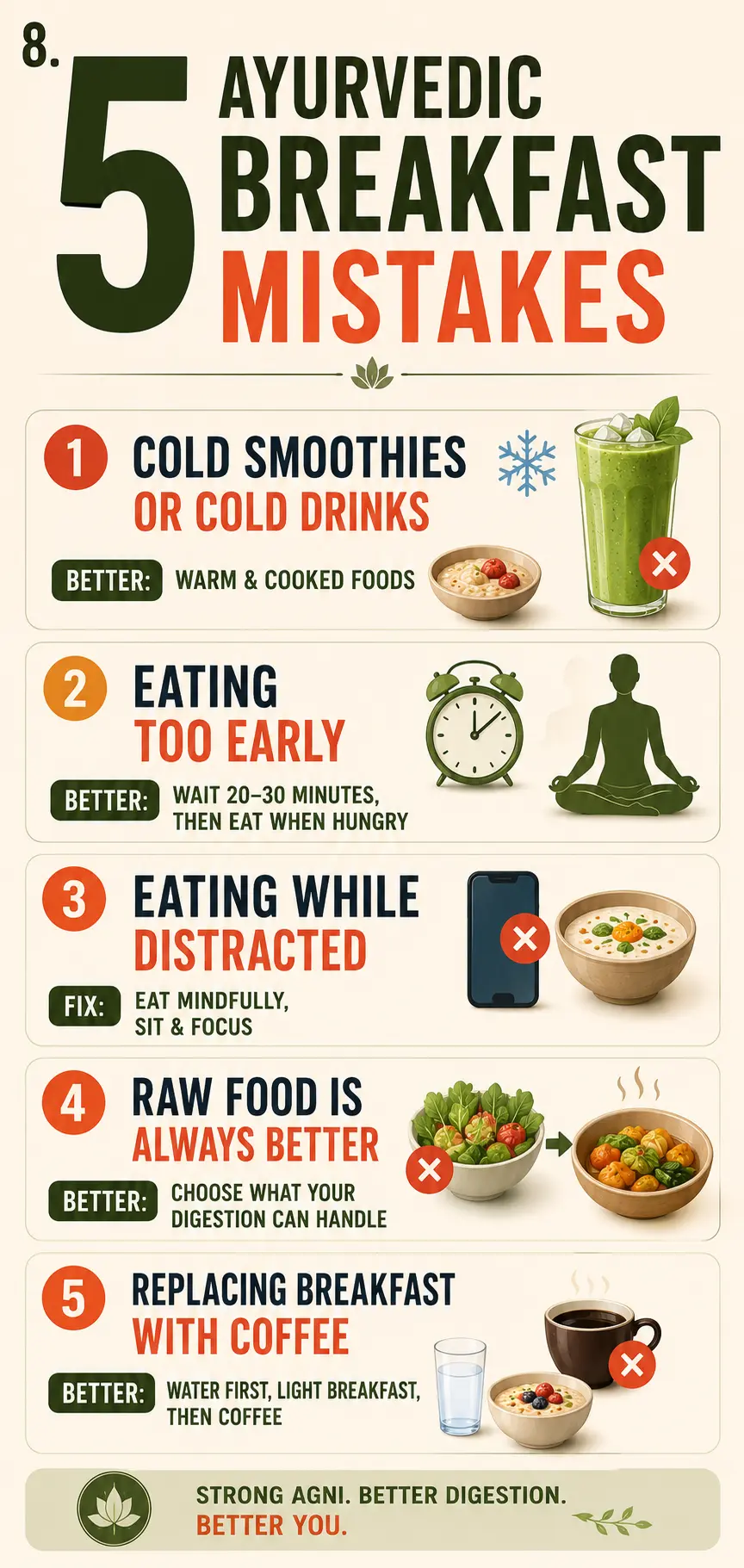
Most digestive problems, in this framework, begin within the first hour after waking — not at lunch or dinner. Here are the five most common patterns Ayurveda associates with weakened morning Agni, and what to do instead.
Mistake 1: Starting the Day With Cold Smoothies or Cold Drinks
Cold liquid consumed first thing forces the body to spend energy warming it to body temperature before digestion can even begin — a real metabolic cost, not folklore. After a night’s sleep, Agni is still activating; introducing very cold food at that moment is compared, in Ayurvedic teaching, to pouring cold water on a fire that hasn’t fully caught. This doesn’t make smoothies “unhealthy” — someone with robust digestion may tolerate them without issue — but if you regularly notice morning bloating, burping, gas, or a cold feeling after eating, it’s worth testing a warm alternative.
Better alternative: warm oatmeal with cinnamon and stewed fruit, vegetable porridge, lightly cooked apples or pears, warm ginger tea, or warm water with lemon.
Mistake 2: Eating Immediately After Waking Up
The body doesn’t switch instantly from sleep into full digestive readiness — circulation, hormones, and the nervous system are all still transitioning in the first waking minutes. The popular “eat within 30 minutes of waking” rule works for some people, but Ayurveda recommends giving the body 20-30 minutes — hydration, gentle movement, a natural bathroom visit — before the first meal, and eating when genuine hunger appears rather than by the clock.
Mistake 3: Eating While Distracted, Rushed, or Scrolling
Digestion depends on the parasympathetic (“rest and digest”) nervous system; a distracted or rushed state keeps the body in sympathetic (“fight or flight”) mode, where digestion is deprioritized. Food eaten while checking email, scrolling, or standing at the counter is processed less completely, regardless of its nutritional quality.
Fix: sit down, put the phone away, take one slow breath before the first bite, and eat at a comfortable pace. Five focused minutes outperforms twenty distracted ones.
Mistake 4: Assuming Raw Food Is Always Better
Raw food requires more digestive effort than cooked food, because cooking has already partially broken down plant fibers. For strong digestion, that extra effort isn’t a problem. For weak or sensitive digestion, it can mean incomplete digestion and bloating from what should have been a healthy meal. Ayurveda doesn’t label raw food “bad” — it asks whether a given food suits this person, in this season, in this digestive state, right now.
Mistake 5: Replacing Breakfast With Coffee
Coffee is a stimulant, not a nutrient — it raises alertness without supplying the nourishment the body needs after an overnight fast. Ayurveda frames coffee-on-empty-stomach as an aggravation of Vata, and links it to the mid-morning energy crash many coffee-as-breakfast drinkers describe.
Better routine: water first, a light breakfast, then coffee afterward if it agrees with you.
9. How to Build an Ayurvedic Breakfast That Supports Digestion
Step 1: Wake Up Your Digestive System Before You Feed It. A glass or two of warm water shortly after waking is one of the simplest, most consistently recommended Ayurvedic morning practices.
Step 2: Choose Warm, Freshly Cooked Foods Whenever Possible. Warm, freshly prepared, lightly seasoned, moist foods are traditionally favored for breakfast because they meet Agni while it’s still becoming active.
Step 3: Eat Without Multitasking. Five minutes of undistracted eating — phone away, seated, chewing slowly — measurably supports the parasympathetic state digestion requires.
Step 4: Eat at a Consistent Time. Digestion is rhythm-dependent: eating at roughly the same time daily allows the body to prepare enzymes and gastric activity in advance.
Progress Beats Perfection: Changing ten habits simultaneously rarely sustains. A sequential approach works better: Week 1, warm water before breakfast. Week 2, phone-free eating. Week 3, one warm breakfast replacing a cold one. Week 4, consistent meal timing.
10. What Modern Science and Ayurveda Agree On
Both traditions now converge on the same core claim: digestion depends on more than just the nutrients on the plate. Modern research recognizes that stress, sleep, meal timing, hydration, and nervous system state materially affect digestive efficiency—the same territory Ayurveda maps through Agni, described in different language centuries earlier.
According to the World Health Organization and the National Center for Complementary and Integrative Health, traditional systems like Ayurveda are increasingly studied as complementary frameworks alongside, not instead of, conventional care. The Harvard T.H. Chan School of Public Health similarly emphasizes that eating context—pace, stress, and routine—measurably affects digestive outcomes, independent of food choice. This is why our Ayurvedic treatment for digestion approach focuses on these broader lifestyle factors alongside diet.
Agni and Ama are traditional concepts, not clinical diagnoses, but as a framework for noticing and adjusting digestive habits, many people find them practically useful alongside standard nutritional guidance.
11. Myth vs. Fact: Ayurvedic Breakfasts
| Myth | Fact |
|---|---|
| Healthy foods never cause bloating. | Nutritious food can feel uncomfortable if it doesn’t match your current digestive capacity (Agni). |
| Cold smoothies are always the healthiest. | They work for some, but can feel heavy for others, especially with weak digestion. |
| Coffee can replace breakfast. | Coffee stimulates but doesn’t nourish; it can aggravate stress-related stomach issues. |
| Raw food is always better than cooked. | Both have benefits; Ayurveda often favors warm, cooked food to support easier processing. |
| Digestion depends only on what you eat. | Meal timing, stress, and eating pace influence digestion as much as food quality. |
12. A Simple Morning Routine for Better Digestion
A consistent morning routine helps calibrate your digestive strength before the demands of the day begin.
- Before breakfast: Wake naturally if possible, drink 1–2 glasses of warm water, stretch or walk briefly, allow time for a natural bowel movement, and wait until genuine hunger appears.
- During breakfast: Choose warm, freshly prepared food, sit down, put the phone away, chew thoroughly, and eat without rushing.
- After breakfast: Avoid lying down immediately, take a relaxed 5–10 minute walk if practical, stay hydrated, and notice how you feel over the next few hours.
13. Frequently Asked Questions
Why do I feel bloated even though I eat healthy?
Healthy food can still cause bloating if your digestion struggles to process it. Meal size, food combinations, eating speed, stress, or underlying conditions like those discussed in our IBS Ayurveda root cause protocol can all contribute. Ayurveda frames this through the strength of Agni, or digestive fire, and specifically through the Manda (weak) or Vishama (irregular) states.
What are the four types of Agni in Ayurveda?
Ayurveda describes four functional states of digestive fire: Sama (balanced), Vishama (irregular, linked to Vata), Tikshna (overly sharp, linked to Pitta), and Manda (weak, linked to Kapha). Most bloating-after-healthy-food complaints trace back to Vishama or Manda Agni.
What is Ama in Ayurveda?
Ama is the Ayurvedic term for undigested metabolic residue that accumulates when Agni is weak. It is a traditional concept rather than a clinical diagnosis, used to describe the buildup associated with heaviness, sluggishness, and a coated tongue.
Is a smoothie a bad breakfast according to Ayurveda?
Not inherently. Ayurveda generally favors warm, freshly prepared breakfasts, particularly for sensitive digestion, but individual tolerance varies and many people digest smoothies well.
What is Agni in Ayurveda?
Agni is the Ayurvedic concept of digestive fire—the body’s capacity to digest food, absorb nutrients, and eliminate waste efficiently. It is a traditional framework rather than a clinical measurement, but it is central to Ayurvedic approaches to nutrition.
Can eating too quickly cause bloating?
Yes. Eating quickly can mean swallowing excess air, chewing less thoroughly, and missing natural fullness cues—all of which can contribute to digestive discomfort.
Should I drink coffee before breakfast?
Some people tolerate coffee on an empty stomach without issue; others experience acidity, jitteriness, or digestive discomfort. If coffee seems to upset your stomach, try water and a light breakfast first.
Is raw food unhealthy?
No—raw fruits and vegetables provide valuable nutrients and fiber. Ayurveda simply notes that some people, particularly with sensitive digestion, may find cooked foods easier to process, especially in the morning.
How can I improve digestion naturally?
Eat at regular times, chew thoroughly, stay hydrated, manage stress, get adequate sleep, and choose meals that leave you comfortable rather than overly full. Persistent symptoms warrant a conversation with a healthcare professional.
When should I seek medical advice?
Occasional bloating is common, but persistent or severe symptoms shouldn’t be ignored. Speak with a healthcare professional if you experience ongoing abdominal pain, unexplained weight loss, blood in the stool, persistent vomiting, difficulty swallowing, or digestive symptoms that interfere with daily life.
Final Thoughts
Ayurveda’s core contribution to digestive health isn’t a superfood list or a detox protocol — it’s a framework for reading digestive capacity and matching food, timing, and eating conditions to what the body can actually process.
Not every traditional concept has been validated by modern clinical research, but the underlying emphasis — mindful eating, consistent routine, attention to the body’s signals — holds up well alongside what modern digestive science independently confirms.
Before removing another food from your diet, the more useful question may be simpler: is my body ready to digest this meal?
References & Further Reading
- World Health Organization — Traditional, Complementary and Integrative Medicine
- National Center for Complementary and Integrative Health — Evidence on Complementary Health Approaches
- Harvard T.H. Chan School of Public Health — The Nutrition Source
- Traditional Ayurvedic principles on Agni, Ama, and daily routine (Dinacharya)
Disclaimer: This article reflects traditional Ayurvedic principles alongside general wellness understanding. It is educational content, not medical advice, and does not replace consultation with a qualified healthcare provider — particularly for persistent or severe symptoms.