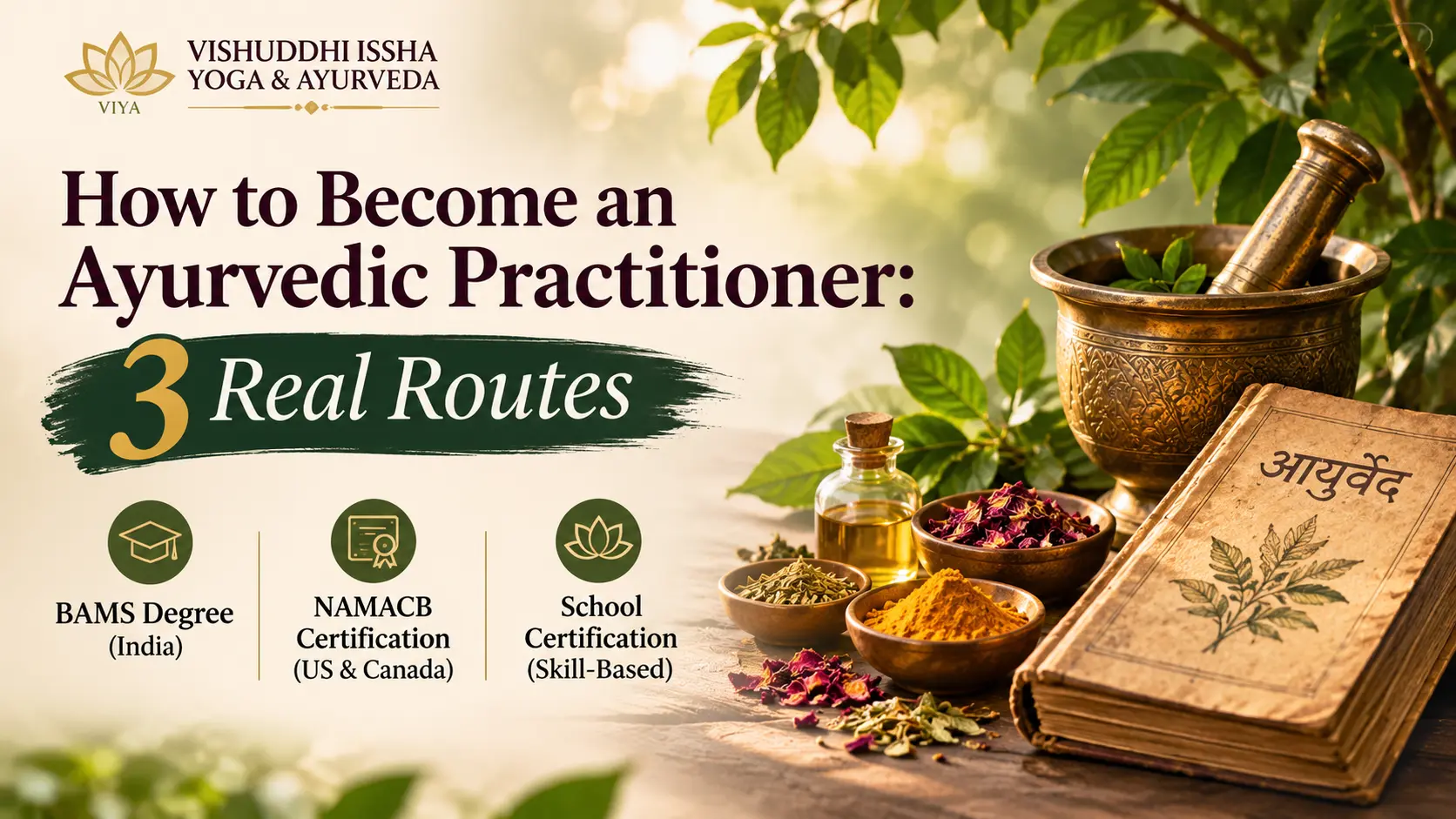
How to Become an Ayurvedic Practitioner: 3 Real Routes
Career guide · Nov 2026
There is no single answer to how to become an Ayurvedic practitioner. The route depends on where you want to work: a five-and-a-half-year BAMS degree in India, a NAMACB certification in the United States and Canada, or a school certificate that builds knowledge but does not license you. This guide compares the three so you can choose before you spend money or years.
Advanced Diploma in Ayurveda (Kerala) · Vishuddhi Issha Yoga & Ayurveda, Goa
Quick answer
BAMS degree (India)
A 5.5-year degree with a one-year internship. Entry through NEET-UG. The regulated route to practise as an Ayurvedic doctor in India.
NAMACB route (US and Canada)
Professional certification as an Ayurvedic Health Counselor or Practitioner, after an approved program. Since 1 July 2026 it needs an accredited program or BAMS.
School certificate
An educational certificate from a school, online or residential. It builds skills and credibility. It is not a medical licence.
New to Ayurveda study? Start with our online Ayurveda course guide, then use this page to plan a career.
What does “Ayurvedic practitioner” actually mean?
Ayurvedic practitioner is not one protected title worldwide. In India it usually points to a registered Ayurvedic doctor. In the United States it is the name of a professional certification level. Elsewhere it is simply a description people use for themselves.
That is why searches for how to become an Ayurvedic practitioner give such different answers. A person who completes the BAMS degree, a person certified by a US professional board and a person with a school certificate may all say “practitioner”, yet the law treats them differently.
Before you plan how to become an Ayurvedic practitioner, decide what you want to do: treat patients as a doctor, advise clients on diet and lifestyle, or teach and write. Our guide on whether you can practise Ayurveda after an online course sets out what each country allows.
How to become an Ayurvedic practitioner: the three routes
Tap a route to see the steps for how to become an Ayurvedic practitioner in that country.
Route 1: the BAMS degree in India
- 5.5 years
- NEET-UG entry
- Regulated
BAMS (Bachelor of Ayurvedic Medicine and Surgery) takes 5.5 years: 4.5 years of study and a compulsory one-year internship. You need Class 12 with physics, chemistry and biology, and a qualifying NEET-UG score. Admission runs through AYUSH counselling.
Ayurvedic education in India is regulated by the National Commission for Indian System of Medicine (NCISM). After the degree and internship, graduates register with their State Board or Council of Indian Systems of Medicine. This is the route for practising as an Ayurvedic doctor in India.
Route 2: NAMACB certification (United States and Canada)
- Three levels
- Accredited program
- Voluntary
The Ayurvedic professional board NAMACB certifies three levels: Ayurvedic Health Counselor (AHC), Ayurvedic Practitioner (AP) and Advanced Ayurvedic Practitioner (AAP). AHC centres on prevention, diet and lifestyle. AP adds clinical training in disease pathology. AAP adds specialised study and an overview of Western medicine.
NAMA publishes the minimum hours. As summarised from its published standards, AHC needs at least 600 hours and 50 client encounters, and AP needs at least 1,500 hours and 150 client encounters. Confirm the current figures on the NAMACB site before you enrol. NAMACB has said that from 1 July 2026 only graduates of accredited or candidate programs, plus BAMS graduates, can apply. This certification is voluntary: no US state requires a licence for Ayurvedic practitioners.
Route 3: a school certificate
- Online or residential
- Educational credential
- No licence
Many schools, including ours, award certificates for completing a course. These are educational credentials. They show what you studied, and a good one gives you structured knowledge, case practice and credibility with clients.
They do not make you a doctor, and they do not by themselves qualify you for NAMACB certification. If you take this route to become an Ayurvedic practitioner in a wellness sense, use honest wording: “Ayurveda consultant” or “Ayurveda educator” rather than any title that implies a medical licence. Our basic online course, 6-month course and 1-year programmes show how study levels differ.
How to become an Ayurvedic practitioner: the three routes compared
| Difference | BAMS degree (India) | NAMACB certification (US and Canada) | School certificate |
|---|---|---|---|
| 1. Title you earn | Ayurvedic doctor, registered with the State Board | Ayurvedic Health Counselor, Practitioner or Advanced Practitioner | The school’s certificate title |
| 2. Time | 5.5 years including a 1-year internship | At least 600 hours (AHC) or 1,500 hours (AP), per NAMA minimums | Weeks to months, depending on level |
| 3. Entry | Class 12 with PCB and NEET-UG | Approved program; some A&P credits | Usually open to all |
| 4. Who regulates | NCISM and State Boards | NAMACB, a voluntary professional board | The issuing school or accreditor |
| 5. What it allows | Practise as an Ayurvedic doctor in India | Use a professional title; no US state licence is required | Education and wellness guidance within local law |
| 6. Best for | Medical careers in India | Western clients and a recognised professional title | Personal depth, teaching, wellness work |
Rules and minimum hours change. Confirm details with NCISM, NAMACB or your local regulator before you enrol.
Which route to become an Ayurvedic practitioner should you choose?
Choose BAMS
If you want to practise medicine as an Ayurvedic doctor in India, and can commit 5.5 years and the NEET-UG exam.
Choose NAMACB
If you plan to work with clients in the United States or Canada and want a recognised professional title.
Choose a school certificate
If you want deep study, to teach, or to add Ayurveda to yoga, nutrition or wellness work without a licence.
Still unsure? Write down the country you want to work in and the title you want on your door. That usually settles how to become an Ayurvedic practitioner in your case. For course-level comparisons, read the online Ayurveda course guide.
What can you earn? We do not quote salary figures. Income depends more on how you work (employed doctor, own clinic, consultations, teaching, products) than on the certificate, and published figures vary widely by country.
Where our Advanced Ayurveda Practitioner Course fits
Our Advanced Ayurveda Practitioner Course (AACCC) runs for 15 weeks in Goa and is also offered online. The residential version adds 3 weeks of supervised clinical training and 3 weeks of practical massage therapy. The certificate is accredited by Bharatiya Sevak Samaj (BSS).
Stated plainly: AACCC is not a BAMS degree, and we do not present it as an AAC-accredited or NAMA-recognised program. It is a strong educational step on the way to become an Ayurvedic practitioner for students who want practical Ayurvedic knowledge and clinical exposure. If your question is how to become an Ayurvedic practitioner with a state registration or NAMACB certification, choose BAMS or an accredited program instead. See the AACCC course page for the curriculum and formats.
Frequently asked questions
How long does it take to become an Ayurvedic practitioner?
How long it takes to become an Ayurvedic practitioner depends on the route. BAMS takes 5.5 years including a one-year internship. NAMACB sets minimum hours of 600 for Ayurvedic Health Counselor and 1,500 for Practitioner, per NAMA standards. School certificates take weeks to months.
Do you need a license to practice Ayurveda?
In India, practising as an Ayurvedic doctor needs a recognised qualification and State registration. In the United States no state requires Ayurvedic practitioners to be licensed, but ordinary medical and consumer laws still apply. See our country-by-country guide for the UK, Canada, Australia and Germany.
Can I become an Ayurvedic practitioner online?
If you are asking how to become an Ayurvedic practitioner online, note that you can study Ayurveda online and earn an educational certificate. An online certificate does not make you a licensed doctor, and NAMACB certification requires an accredited program. Check the rules for your country before you plan client work.
Can I become an Ayurvedic doctor without NEET?
No, not through the BAMS degree. Admission to BAMS in India requires qualifying NEET-UG. Without it you can still study Ayurveda through non-degree courses, which do not make you a registered doctor.
What is the difference between an Ayurvedic practitioner and an Ayurvedic doctor?
An Ayurvedic doctor in India holds a recognised degree such as BAMS and is registered with a State Board. “Practitioner” is also the name of a NAMACB certification level in the United States, and a general description elsewhere.
How to become an Ayurvedic practitioner in the USA?
Complete a program approved by the Ayurvedic Accreditation Council or recognised by NAMACB, meet the hours and client-encounter requirements for the level you want, then apply for NAMACB certification. NAMACB has said that from 1 July 2026 only accredited or candidate programs and BAMS graduates are eligible.
Is an Ayurvedic practitioner the same as an Ayurvedic health counselor?
No. In the NAMACB system the Health Counselor level focuses on prevention, diet and lifestyle. The Practitioner level adds clinical training in disease pathology and needs more hours.
Ready to start your path to become an Ayurvedic practitioner?
Choose the format that fits your goals, and ask us anything on WhatsApp before you enrol.

You may also like
6 Month Ayurveda Course – Learn Ayurveda from the Foundations Up